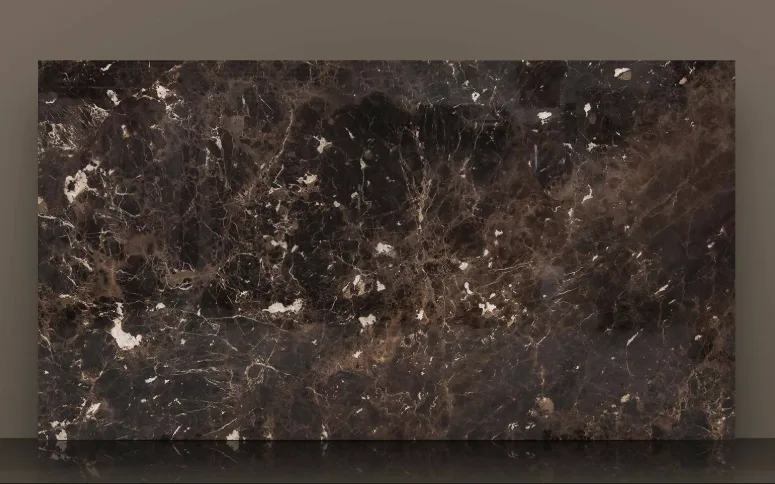
Emperador is the brown marble the hospitality industry is built on. Walk through hotel lobbies from Madrid to Dubai to Shanghai and the chocolate-brown stone with fine cream webbing underfoot or on the bar front is, more often than not, Spanish Emperador. Our index tracks it at $35 to $85 per square foot for polished 2 cm slabs, ex-warehouse, as market estimates (August 2026) — mid-market money for a stone that reads far more expensive than it costs, which is precisely why specifiers keep coming back to it.
This guide covers the stone end to end: where it comes from, the real difference between Dark and Light Emperador, what drives a slab from the bottom of the range to the top, and how the China processing pipeline changes the arithmetic. Emperador blocks are exported and slabbed in Chinese mills at scale, making it one of the easier premium European stones to buy factory-direct at 30 to 60 percent below Western warehouse pricing.
Geology and what makes Emperador distinctive
Emperador is a brown sedimentary limestone-marble from southeastern Spain, colored by iron oxides and organic content and crossed by fine calcite veins that read as cream webbing against the chocolate ground. Technically most Emperador is a compact fossiliferous limestone rather than a true metamorphic marble, but the trade has sold it as marble for a century and it polishes and behaves like one.
Its distinctiveness is tonal: very few stones deliver a genuinely dark, warm brown. Black marbles are colder, travertines lighter and porous, brown granites speckled rather than veined. Emperador owns the warm-luxury register — hence its dominance in hotel interiors and classic bathrooms. The webbing also does practical work: it hides wear, joints and water spots far better than a plain dark stone, which is why designers who would never risk Nero Marquina on a busy floor happily lay Emperador.
Quarries and supply
The classic quarries sit in Spain's Alicante and Murcia provinces — the Dark Emperador heartland around Pinoso and Monte Coto, and Light Emperador (Emperador Claro) zones nearby. Spanish production has tightened over the past two decades: the best Dark Emperador beds are deep, block yields have fallen, and some historic quarries now produce more filler-grade material than premium. That squeeze is visible in pricing at the top of the range.
The supply chain has a second geography: China. Spanish quarriers export Emperador blocks in volume to Chinese mills, which slab, resin and polish them for the Asian, Middle Eastern and increasingly Western markets. A large share of the world's finished Emperador has never seen a Spanish gangsaw. This matters to buyers because the same Spanish block becomes a meaningfully cheaper slab in Xiamen or Yunfu than in Alicante — processing, resin work and labor all cost less — and because Chinese mills also stock Emperador lookalikes from Turkey (Marron Emperador) and domestic brown marbles for tighter budgets.
Dark vs Light: grades and veining
Dark Emperador is the flagship: deep coffee-brown ground with fine, tight cream webbing. Premium grade means dark, even color and delicate veining; commercial grade shows paler patches, open fossil marks and heavier fill. The spread between those grades is most of the $35 to $85 index range. Light Emperador runs cappuccino to greyish-taupe with broader, softer veining; it typically trades 10 to 20 percent below comparable Dark grades and suits large fields where Dark would feel heavy.
Grading Emperador is about consistency. The stone is sedimentary, color shifts bed by bed, and a project drawing slabs from mixed blocks shows banding at the joints — serious suppliers sell by block and keep projects within one or two. A quote suspiciously below market usually means mixed-block lots, heavy resin fill, or Turkish material under the Spanish name: all fine purchases, but only at their own price.
Price breakdown: slab, cut-to-size, installed
Our index puts Emperador at $35 to $85 per square foot for polished 2 cm slabs ex-warehouse, as market estimates (August 2026). Within that: commercial-grade Light Emperador populates the bottom third, standard Dark Emperador the middle, and premium dark, tight-veined Dark Emperador the top. Three-centimeter material typically adds 40 to 50 percent. Cut-to-size — vanity tops, treads, tile modules, bar cladding cut to drawing at the mill — usually adds 20 to 50 percent over slab cost while eliminating most destination fabrication and shipping waste.
Installed figures in the US typically land at $60 to $150 per square foot for countertops and $40 to $100 for flooring, with fabrication and labor making up half or more of the total. The factory-direct route: China-processed Emperador trades typically 30 to 60 percent below Western warehouse levels for the same Spanish material once importer and distributor margins drop out, plus roughly $4 to $8 per square foot for container freight and duties. The economics work at container scale — roughly 3,500 to 4,500 square feet of 2 cm slab — on 6 to 10 week lead times.
What moves an individual quote inside the range: color depth and evenness first, vein fineness second, then block size (big clean blocks yield the long bar-top slabs that command premiums), resin and fill honesty, and finally the number of intermediaries between gangsaw and buyer.
Emperador vs the alternatives
Against other browns: Turkish Marron Emperador is the closest substitute, usually 20 to 40 percent cheaper than Spanish Dark, with a redder cast and coarser webbing — a legitimate value play when specified honestly. Chinese brown marbles undercut both and suit volume flooring. Dark travertines offer the warm tone at lower cost but bring porosity and a more rustic register.
Against other families: Nero Marquina at $40 to $90 delivers drama where Emperador delivers warmth. Brown quartzites cost more but shrug off scratching and acids; engineered quartz in Emperador patterns offers zero maintenance, though the pattern repeat shows to a trained eye. The decision rule: for warm, classic, hotel-grade luxury on a mid-market budget, Emperador remains the reference answer; for acid-proof performance, take quartzite or quartz and accept the different look.
Applications
Hospitality is Emperador's home: lobby floors, elevator surrounds, reception desks, bar tops and restroom vanities, where the wear-hiding webbing carries decades of traffic gracefully. Residentially it anchors classic bathrooms — Dark Emperador vanities against cream walls remain a standard luxury formula — plus fireplaces and powder rooms. Light Emperador works as large-format flooring where Dark would close the space down.
Kitchen countertops are a qualified yes: Emperador etches like any calcite stone, but the dark ground and busy webbing conceal etching and light scratches far better than white marble, making it one of the more forgiving marbles in real kitchens. Mosaics, borders and waterjet medallions consume commercial-grade material efficiently. Exterior use is generally not recommended — iron content can shift color with prolonged UV and water exposure, and freeze-thaw performance is mediocre — so keep Emperador indoors or under cover.
Fabrication and finishes
Emperador fabricates easily — it is softer than granite and kind to tooling — but its vein network demands respect: open calcite veins are fill points, and aggressive handling can open them further. Factory slabs arrive resined and often mesh-backed on commercial grades; good mills fill honestly and note it, and site fabricators should re-seal cut edges. Book-matching Dark Emperador produces striking symmetrical webbing on feature walls and doubles material waste, so price it accordingly.
Polished is the default finish and the one that gives Emperador its depth — honing lightens the stone noticeably and mutes the contrast between ground and veining, which some contemporary schemes want and traditional ones do not; approve a honed sample before committing. Brushed and leathered finishes are gaining ground on bar tops for their fingerprint tolerance. Edge profiles cut cleanly, and the stone takes ogee and bullnose detail well, which is partly why classical interiors favor it.
Care and maintenance
Emperador is calcite-based, so the white-marble rules apply: acids etch it, and no sealer prevents etching. The difference is visibility — on the dark, webbed ground an etch mark that would scream on Carrara has to be hunted for. Seal at installation and annually on horizontal surfaces to slow oil and water absorption; the stone's relatively low porosity for a sedimentary material makes sealing effective.
Daily care is pH-neutral cleaner and water; skip vinegar, citrus and abrasives. Dark stones show dust, lime-scale film and wear-paths sooner than light ones, so lobby floors run scheduled re-polishing — routine service that restores the surface indefinitely. Hard-water deposits build a grey film on dark stone that needs stone-safe descaling, never acid. Treated well, fifty-year-old Emperador installations still look like opening day; that service record is why the hotel trade trusts it.
Sourcing checklist for Emperador
Confirm origin and grade in writing: Spanish Dark Emperador, Spanish Light, Turkish Marron or Chinese brown — all are legitimate purchases at their own prices, and the name on the invoice should match the stone in the crate. Ask which quarry and, for large projects, buy within named blocks to control color banding. Demand current bundle photos with slab IDs, and physical samples approved against a retained control sample for anything above a container.
Commercially: compare quotes on one basis (FOB, CIF or ex-warehouse), confirm thickness tolerance and finish, and ask explicitly about resin, fill and mesh backing. For factory-direct orders from a Chinese mill, require pre-shipment inspection with dry-lay photos, agree breakage terms before the deposit, and have slabs sequenced at the factory so color runs continuously across the finished surface. Done properly, factory-direct Emperador is one of the best value plays in premium stone: Spanish material, Chinese processing economics, and 30 to 60 percent off the Western warehouse number.
Frequently asked questions
How much does Emperador marble cost per square foot in 2026?
As market estimates (August 2026), Emperador runs $35 to $85 per square foot for polished 2 cm slabs, ex-warehouse. Commercial-grade Light Emperador sits at the bottom of the range, premium Dark Emperador with tight cream webbing at the top. Installed countertops in the US typically land at $60 to $150 per square foot including fabrication.
What is the difference between Dark Emperador and Light Emperador?
Dark Emperador has a deep coffee-brown ground with fine cream webbing and is the premium flagship. Light Emperador (Emperador Claro) runs cappuccino to taupe with broader, softer veining and typically trades 10 to 20 percent cheaper. Both come from the same Spanish quarry districts in Alicante and Murcia; the choice is aesthetic and budgetary rather than structural.
Is Emperador marble good for kitchen countertops?
It is one of the more forgiving marbles for kitchens. Like all calcite stones it etches on contact with acids, but the dark ground and busy webbing hide etch marks and light scratches far better than white marble. Seal it annually, use pH-neutral cleaners, and accept some patina. For zero-maintenance requirements, quartzite or engineered quartz are the alternatives.
Where is Emperador marble quarried?
The classic quarries are in southeastern Spain, in Alicante and Murcia provinces around Pinoso and Monte Coto. A large share of Spanish blocks are exported to Chinese mills for slabbing and polishing, so much of the finished Emperador on the world market is Spanish stone processed in China. Turkey produces the similar Marron Emperador at lower prices.
Why do Emperador marble quotes vary so much between suppliers?
Grade and chain length. Color depth, vein fineness, block consistency and honest resin work separate premium from commercial material within the $35 to $85 range of market estimates (August 2026). Beyond grade, each intermediary between the mill and you adds margin — which is why factory-direct quotes from China-processed Spanish stone typically come in 30 to 60 percent below Western warehouse prices.
Can Emperador marble be used outdoors?
It is not recommended. Emperador's iron-oxide coloring can shift with prolonged UV and water exposure, its freeze-thaw performance is mediocre, and polished surfaces weather quickly outside. Keep it to interiors or fully covered areas; for warm brown tones outdoors, granite or porcelain alternatives perform far better.