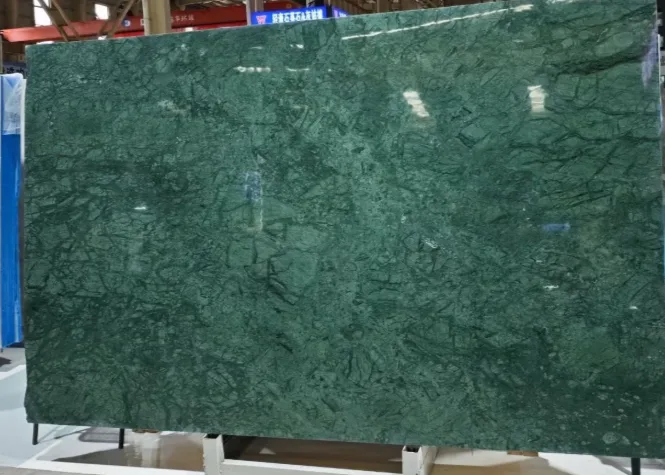
Green marble is the strongest design trend in natural stone this decade, and the pricing behind the trend is opaque. Our index tracks the family at $30 to $100 per square foot for polished 2 cm slabs, ex-warehouse, as market estimates (August 2026) — but that range hides very different stones: dense Alpine serpentinites, Indian forest greens quarried at scale, and delicate Chinese celadons. A buyer who asks for green marble without specifying which one has handed over all pricing power.
This guide sorts the family by stone, look and price: Verde Alpi, the Indian greens, and China's Ming Green, plus the practical differences — hardness, water behavior, resin treatment — that matter more here than in any other marble family. Figures are market estimates from published supplier pricing; factory-direct quotes through our partner mill in China typically land 30 to 60 percent below Western warehouse prices for comparable material.
The green marble price ladder
Within our family range of $30 to $100 per square foot — market estimates (August 2026) for polished 2 cm slabs ex-warehouse — the stones stack like this. Indian greens sit at the bottom: Forest Green and Rainforest typically trade at $30 to $50 in Western markets, thanks to enormous Rajasthan quarry capacity. Verde Guatemala — despite the name, also Indian — sits in the same band with a more uniform emerald ground.
The Italian and Alpine greens occupy the middle and top: Verde Alpi and Verde Issorie typically run $50 to $90, with exceptional dark lots pushing toward $100. Chinese Ming Green — a soft celadon with white webbing, quarried in Jiangsu — trades wide, typically $40 to $80 depending on grade, because clean pale blocks are genuinely scarce. As always the ladder is about supply: India moves green stone by the shipload, the Alps by the block, and Ming Green by the lucky quarry season.
Verde Alpi and the Alpine greens
Verde Alpi is the reference green: a deep forest ground webbed with white veining, quarried in the Aosta Valley. Geologically it is a serpentinite rather than a true marble — denser, less acid-sensitive, harder on tooling — but the trade has always sold it as marble and we index it that way. Mid-century Italian design made it famous; the current revival is essentially a Verde Alpi revival.
Expect $50 to $90 per square foot as a typical Western market band, darkest lots at the top. Supply is the constraint: Alpine quarries are small, seasonal and heavily regulated, and good blocks are allocated rather than marketed. Priced-out buyers should look at Indian Rainforest for a wilder look at lower money, or Verde Guatemala for similar depth with less webbing. Chinese mills also process Verde Alpi blocks bought at the quarry, and factory-direct slabs from China can meaningfully undercut Italian-processed material on identical stone.
Indian greens: Rainforest, Forest Green, Verde Guatemala
India is the volume producer of green marble, and its stones anchor the affordable end of the family at $30 to $50 per square foot in typical Western pricing. Forest Green and Verde Guatemala offer a consistent deep-green field with light webbing — the practical choice for flooring programs and hotel bathrooms. Rainforest Green is the wilder cousin: a green-brown ground crossed by dramatic red-brown dendritic veins, technically closer to a serpentinite breccia, and visually unlike anything else at its price.
Two cautions from the trade. First, Indian green quality varies block to block; vein-heavy Rainforest lots can be weak along the brown veins and arrive with mesh backing and heavy resin fill — fine for floors, risky for cantilevered countertops. Second, naming is chaotic: the same material ships as Rainforest, Bidasar or Fancy Green depending on the exporter. Buy from slab photos of the actual bundle, never from a trade name.
Ming Green and the Chinese greens
Ming Green is China's contribution to the family and its most delicate: a soft celadon-to-jade ground with fine white veining, quarried around Danyang in Jiangsu. It photographs like jade, making it a designer favorite for vanities, mosaics and spas. Typical trade pricing runs $40 to $80 per square foot, clean pale slabs at the top — top-grade Ming Green is scarce and the quarries are past their easiest material.
Because Ming Green is quarried and processed on our partner mill's home turf, factory-direct economics bite hardest here: the slab that carries two intermediary margins by the time it reaches a Western yard can ship straight from the Jiangsu-area cluster. The stone needs respect — a true marble, softer and more absorbent than the serpentinite greens, usually resin-treated, preferring honed finishes and gentle use. Dark-green Chinese alternatives such as Dandong Green serve buyers who want the color without the fragility.
Slab, cut-to-size or installed: what green marble really costs
Index prices are ex-warehouse slab numbers. Cut-to-size — the mill delivering finished countertops, table tops, treads or tile modules to drawing — typically adds 20 to 50 percent over slab cost but removes most destination fabrication, and for green stones it carries a hidden bonus: the factory selects and matches slabs for color consistency before cutting, which matters enormously in a family where two slabs from one block can read differently.
Installed cost in the US typically lands at $70 to $180 per square foot for countertops and $50 to $120 for flooring, as broad typical figures — fabrication on serpentinite greens runs high because the material chews blades. Factory-direct arithmetic: slabs bought at origin plus roughly $4 to $8 per square foot in container freight and duties generally land 30 to 60 percent below Western warehouse pricing. Container volume — roughly 3,500 to 4,500 square feet of 2 cm slab — and 6 to 10 week lead times are the price of that saving.
What drives green marble prices
Color depth and evenness come first: in dark greens buyers pay for saturation, in Ming Green for paleness and clarity. Second is vein behavior — webbing that reads as elegant lace prices above heavy, fractured webbing that signals structural fill. Third is soundness: serpentinites are famously fissure-prone, and the resin, mesh and fill a slab needs is priced in whether or not the seller volunteers it.
Fourth, origin and processing: Italian-quarried, Italian-processed Verde Alpi carries both scarcity and processing premium; the identical block processed in China costs less to turn into slabs, and Indian material is cheapest of all to produce. Fifth, the trend itself: green marble demand has run ahead of supply since the early 2020s, and the fashionable names — Verde Alpi above all — carry a visibility premium that the equally serviceable unfashionable greens do not. Buying the look rather than the name is the easiest saving in this family.
Applications: where green marble works
The current wave is furniture and accents: table tops, consoles, trays and fireplace surrounds, where a single dramatic slab carries the room. Serpentinite greens are well suited here — dense, high-polishing, and far more etch-resistant than calcite marbles because serpentine is not acid-reactive in the same way. Green marble dining tables are one of the few marble applications where red wine is a survivable event.
Bathrooms and spas are the other stronghold: vanities, shower walls and mosaics in Ming Green or Verde Guatemala read instantly as luxury — honed finishes in wet areas, sealed routinely. For commercial flooring, Indian greens at $30 to $50 per square foot are the practical field stone. The caution zone is exteriors and immersion: some serpentinites warp or lose polish with prolonged water and UV, so pool surrounds and facades need stone-specific test data.
Fabrication, finishes and the resin question
Almost all commercial green marble ships resin-treated: fissures filled, backs often mesh-reinforced, faces sometimes vacuum-resined. Standard practice, not fraud — unfilled Rainforest would barely survive transport — but it has consequences: resin lines can yellow under UV, site-cut edges expose unfilled fissures, and aggressive solvents soften cheap resins. Ask every seller what treatment a lot has had; a mill that answers precisely is a mill you can work with.
On finishes: polished maximizes color depth and is the default for furniture and walls; honed suits floors and wet areas but visibly lightens dark greens, so approve a honed sample before committing a whole floor. Leathered finishes on serpentinite greens are increasingly popular for kitchen use. Dense Alpine greens are hard on tooling and slow to fabricate — quotes from experienced shops run higher for good reason — while Ming Green demands the opposite: gentle handling, sharp tooling and no thermal shock.
Sourcing checklist for green marble
Confirm the actual stone and origin in writing — green marble naming is the loosest in the trade, with Verde Guatemala from India, Rainforest under three aliases, and Chinese dark greens occasionally passed off as Alpine. Demand photos of the actual slabs with bundle numbers, and for color-critical projects insist on a dry-lay before crating: greens shift tone across a block more than any white does.
Commercially: compare quotes on the same basis — FOB origin versus ex-warehouse destination changes the number by the entire logistics chain. Ask directly about resin, mesh and fill, and get the answer in the contract. For factory-direct container orders through a Chinese mill, require pre-shipment inspection with photos of every slab face and agree transit-breakage terms in advance. The arithmetic justifies the effort: 30 to 60 percent below Western warehouse pricing on material that you, not a distributor, selected.
Frequently asked questions
How much does green marble cost per square foot in 2026?
As market estimates (August 2026), green marble slabs run $30 to $100 per square foot for polished 2 cm material, ex-warehouse. Indian greens sit at $30 to $50, Chinese Ming Green typically $40 to $80, and Verde Alpi $50 to $90 with top lots near $100. Installed US countertops typically run $70 to $180 all-in.
What is the most popular green marble right now?
Verde Alpi leads the trend — the deep Italian forest green with white webbing that anchored mid-century design is the name designers specify most. Indian Rainforest Green is the volume seller for its dramatic red-brown veining at lower cost, and Ming Green is the favorite for pale, jade-like bathrooms. All three deliver very different looks under the same green marble label.
Is green marble more durable than white marble?
Often yes, with caveats. Most dark greens — Verde Alpi, Forest Green, Guatemala — are serpentinites, which are denser and far less acid-sensitive than calcite whites, so they etch much less from lemon or wine. But they are fissure-prone and rely on factory resin fill, and pale Ming Green is a true marble that is softer than most whites. Durability depends on the specific stone, not the color.
Why is Rainforest Green marble so cheap compared to Verde Alpi?
Scale and geology. Rainforest comes from large Rajasthan quarries in volume; Verde Alpi from small, seasonal Alpine quarries with allocated output. Rainforest also needs heavy resin and mesh along its brown veins, which caps pricing. At $30 to $50 versus $50 to $90 per square foot as market estimates (August 2026), you are paying for scarcity, not just looks.
Can I use green marble for a kitchen countertop?
Serpentinite greens are among the better marble choices for kitchens: they resist acid etching far better than white calcite marbles and take daily use well, especially honed or leathered. Confirm the specific stone is a serpentinite, check how much resin fill it carries, and avoid long unsupported overhangs with vein-heavy material like Rainforest. Ming Green is best kept out of hardworking kitchens.
Is it cheaper to buy green marble directly from the factory in China?
Typically yes — factory-direct quotes through our partner mill run 30 to 60 percent below Western warehouse prices for comparable material, whether the stone is Chinese Ming Green, Indian blocks processed in China, or imported Alpine material slabbed there. The requirements are container-scale volume, 6 to 10 week lead times, and pre-shipment inspection so you approve the actual slabs before they ship.