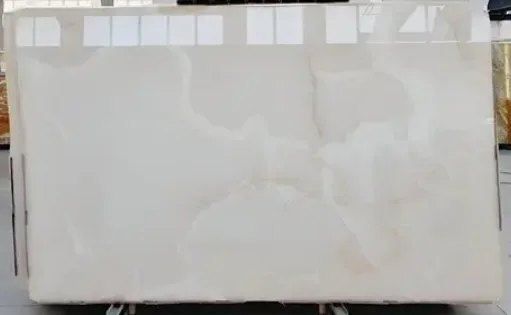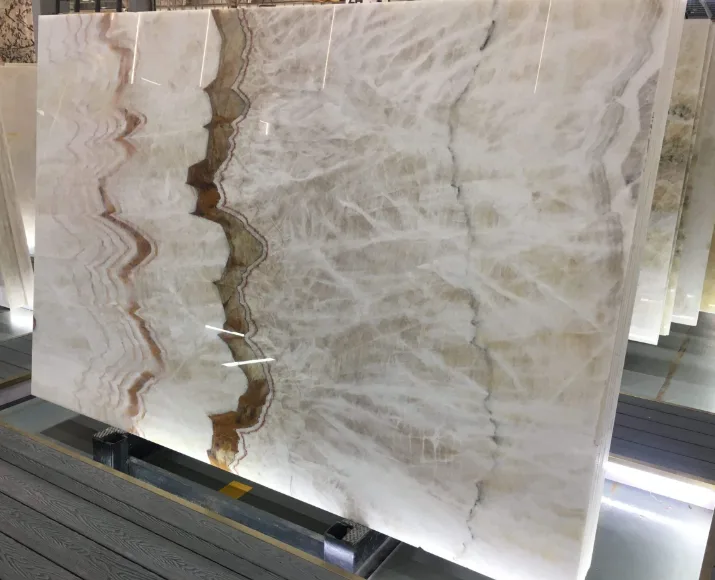
Onyx is the statement stone: the only material in our index that buyers light from behind. We track it at $60 to $200 per square foot for polished 2 cm slabs, ex-warehouse, as market estimates (August 2026) — the widest band of any stone we cover except Calacatta, because onyx is priced like art. Two slabs from one quarry can differ threefold on banding, translucency and color alone.
First, honesty about the name: commercial onyx is not the black chalcedony of the gem trade. It is banded calcite — an onyx-marble deposited layer by layer from mineral springs — sold universally under the onyx name, so we index it that way. This guide covers where it comes from, why it costs what it costs, and the backlighting economics that drive most purchases. China processes large volumes of Iranian, Turkish and Pakistani onyx blocks, and factory-direct slabs typically land 30 to 60 percent below Western warehouse prices.
Geology: why onyx glows
Onyx forms where mineral-rich spring water deposits calcite in thin successive layers, building banded stone the way a candle builds drips. The crystals grow aligned and relatively coarse, without the opaque grain-boundary structure that blocks light in ordinary marble — so light entering an onyx slab scatters through it rather than stopping at the surface. That translucency is the entire commercial proposition.
The banding records the deposition history: amber and honey tones from iron, greens from copper-bearing waters, whites from pure calcite runs. Because deposition follows the spring's flow, patterns range from tight parallel bands to swirled, cloud-like figures, and no two blocks repeat. The same layered structure is also onyx's weakness — the stone is soft (calcite, Mohs 3), and the band interfaces are natural fracture planes. Onyx is fragile, and every stage of its trade, from block to slab to installed panel, is engineered around that fact.
Quarries and supply
Iran is the volume heavyweight — the classic source for white, green and honey onyx, with large blocks and the deepest color range. Turkey follows with well-organized production and easier export logistics. Mexico produces the ambers and multicolor onyx familiar in North America; Pakistan ships green and banded white material at aggressive prices. Those four origins set the market.
The processing map matters as much as the quarry map. Iranian and Pakistani blocks flow in volume to Chinese mills, which have the resin technology and patience onyx demands — nearly every commercial slab is vacuum-resined, mesh-backed or both before polishing. For a buyer, that makes China the practical sourcing hub: the widest live inventory of origins and colors in one place, at processing costs no Western facility matches — the foundation of the 30 to 60 percent factory-direct saving.
Colors, grades and what premium means
Color families, in roughly ascending price order: multicolor and walnut ambers populate the lower band; honey and amber the middle; green onyx — especially deep, evenly banded Iranian or Pakistani material — the upper middle; and clean, highly translucent white or ice onyx the top. Rare vivid lots price case by case above the band; treat any such quote as a negotiation, not a list price.
Grade within a color turns on four things: translucency (the more light a slab passes, the more it earns), banding character (continuous, well-composed figure beats muddy pattern), soundness (fewer fractures, tighter resin work), and size — onyx blocks are small, so large clean slabs and book-match sets command real premiums. A trade note: always inspect onyx both reflected and transmitted — a slab that looks clean face-on can reveal fill lines and dead opaque zones the moment a light goes behind it.
Price breakdown: slab, cut-to-size, installed
Our index band is $60 to $200 per square foot for polished 2 cm slabs ex-warehouse, as market estimates (August 2026). Cut-to-size panels — the mill cutting to your shop drawings, edge-finishing and labeling a layout — typically add 20 to 50 percent over slab cost, and with onyx the surcharge earns its keep twice over: the factory composes the panels across slabs so the banding flows, and factory edges on this fragile material fail far less than site-cut ones.
Installed cost is where onyx separates from every other stone, because the assembly is stone plus light. A backlit feature — wall, bar front, reception desk — typically lands at $150 to $400 per square foot all-in as a broad US market figure once the LED system, diffusion cavity, framing and electrical work are included; the lighting package often costs as much as the stone. Factory-direct arithmetic still applies underneath: slabs through a Chinese mill at 30 to 60 percent below Western warehouse pricing, plus roughly $4 to $8 per square foot in freight and duties — though onyx often ships as partial containers with extra crating, so budget freight at the high end.
What moves a specific quote: translucency and color band, figure quality, slab size, fill honesty, and whether you are buying loose slabs or a composed, sequenced set. The last one is the quiet cost driver — a matched eight-panel sequence can price 50 percent over the same square footage in random slabs.
Onyx vs the alternatives
Against marble: onyx buys translucency and spectacle; marble buys durability and forgiveness. No marble backlights, and no onyx should be specified where marble-grade wear resistance is assumed. Against quartzite: some translucent quartzites (with cristobalite or sheer crystal structure) backlight acceptably and are enormously harder — for a backlit bar top that will take glasses and abuse, translucent quartzite is often the more defensible engineering choice at comparable or higher money.
Against man-made materials: backlit resin panels and engineered translucent surfaces deliver even, repeatable glow at a fraction of the cost — the real competitor in value-engineering rounds. What they cannot deliver is the fact of the stone: depositional banding with geological depth and no repeat. The honest rule: specify onyx for vertical, protected, lit surfaces where it is the centerpiece; specify alternatives wherever the surface must work for a living.
Applications
Backlit verticals are the core use: feature walls, reception desks, bar fronts, elevator lobbies, wine rooms and spa interiors. Onyx also carries unlit roles where light passes near it — window reveals, lamps, carved basins and decorative objects, a segment our partner mill cuts to order. Vanities are popular and survivable with sealed, gentle use; onyx shower walls appear in luxury work but demand meticulous waterproofing.
Where onyx does not belong: kitchen counters that see real cooking, floors above light residential traffic unless the spec accepts visible wear, and exteriors, where UV and freeze-thaw dismantle both the stone and its resin. Every experienced supplier has stories of talked-into-it kitchen islands replaced within two years. Put it on the wall, put light behind it, and it will be the most photographed surface in the building.
Fabrication, backlighting and finishes
Onyx fabrication is a specialist trade. Slabs arrive mesh-backed and vacuum-resined; cutting wants sharp tooling, low feed rates and full support, and edges deserve factory finishing. For backlit work the mesh problem is central: fiberglass mesh shadows through transmitted light, so backlit panels need transparent backing — resin-only or glass/acrylic lamination — specified at ordering time. A slab bought for reflected light generally cannot be converted to a good backlit panel afterward.
The lighting system makes or breaks the result. LED sheets or panel grids need an even diffusion cavity behind the stone, ventilation to keep heat off the resin, and serviceable access, because diodes fail before stone does. Color temperature shifts the stone dramatically — warm white deepens honey material, neutral white keeps green and ice onyx clean — so always mock up a lit corner before committing the wall. Finish is polished almost universally; honing kills the glassy depth buyers are paying for.
Care and maintenance
Onyx is the most delicate stone in our index: calcite softness, acid sensitivity and layered fracture planes in one material. On any horizontal surface expect etching from acids, scratching from grit, and wear paths from traffic — patina is a certainty, not a risk, and buyers should sign off on that in advance. Vertical and backlit installations, by contrast, age extremely well; dust and fingerprints are the whole maintenance story.
Clean with pH-neutral stone soap and soft cloths only; no vinegar, citrus, ammonia or abrasives. Seal horizontal surfaces and renew regularly — oils leave deep shadows in translucent stone, visible from both sides when backlit. Re-polishing wants an onyx-experienced restorer; aggressive grinding stresses the resin. For backlit walls, keep spare LED panels from the original batch, because later-batch diodes rarely match color temperature exactly.
Sourcing checklist for onyx
Inspect every slab transmitted, not just reflected: demand photos of each slab on a light table or against backlighting, with slab IDs visible. Confirm origin and color family in writing, and for backlit work specify transparent backing explicitly — mesh-backed slabs are the default and they will shadow. Buy composed sets, not square footage: have the mill lay out and photograph the actual panel sequence for your elevation before crating, and number every panel to the shop drawing.
Commercially: compare quotes on one basis (FOB, CIF, ex-warehouse) and remember onyx freight runs high — extra crating, partial containers, fragility surcharges. Contract fill standards and a transit-breakage replacement policy, and order 10 to 15 percent overage from the same blocks, because matching onyx later is nearly impossible. Factory-direct through a Chinese mill delivers the widest origin selection at 30 to 60 percent below Western warehouse pricing; pre-shipment inspection on a light table is the control that makes the whole trade safe.
Frequently asked questions
How much does onyx cost per square foot in 2026?
As market estimates (August 2026), onyx slabs run $60 to $200 per square foot for polished 2 cm material, ex-warehouse — amber and multicolor lots toward the bottom, translucent white and premium green toward the top. A complete backlit installation typically lands at $150 to $400 per square foot in the US including lighting and framing.
Is onyx real marble?
Commercial onyx is banded calcite deposited by mineral springs — technically onyx-marble, not the black chalcedony of the gem trade and not a metamorphic marble either. It is sold alongside marble universally and behaves like a softer, translucent cousin. The translucency is what buyers pay for; the calcite chemistry means it etches and scratches like marble, only more easily.
Why is onyx so expensive compared to marble?
Scarcity, fragility and selection. Onyx deposits are small, blocks are small, and the stone fractures easily, so usable slab yield per quarried ton is low and every slab needs resin and mesh work. On top of that, buyers select for translucency and dramatic banding, which only a fraction of production delivers. You are paying for the survivors of a lossy process, plus the fact that no other natural stone backlights.
Can you backlight any onyx slab?
No. Translucency varies widely between lots, and standard slabs carry fiberglass mesh backing that casts visible shadows under transmitted light. For backlit work you must select slabs on a light table and order transparent backing — resin-only or glass/acrylic lamination — at the mill. Plan a diffusion cavity, ventilation and serviceable LED access behind the stone as part of the design.
Is onyx suitable for kitchen countertops?
Generally no. Onyx is soft calcite that etches on contact with any acid, scratches under normal kitchen use, and can fracture along its banding at unsupported spans. It belongs on vertical, protected, ideally backlit surfaces — bars fronts, feature walls, vanities with gentle use. For a translucent surface that works hard, translucent quartzite is the defensible alternative.
Where does onyx stone come from?
The main commercial origins are Iran (widest color range and largest volumes), Turkey, Mexico and Pakistan. A large share of Iranian and Pakistani blocks are slabbed in Chinese mills, which lead in the resin and backing technology onyx requires — which is also why factory-direct sourcing from China typically saves 30 to 60 percent versus Western warehouses.