Travertine is the most widely used natural stone in the world for floors, terraces and pool decks, and probably the most misunderstood. It is a limestone formed by mineral springs, full of natural voids and pits, and it comes in ivory, beige, walnut, silver-grey and gold. It built Rome, it clads the Getty Center, and it also covered ten million suburban kitchen floors in the 2000s — which is why the question of whether it is outdated comes up so often. Travertine tiles and slabs trade at roughly 8 to 40 dollars per square foot ex-warehouse in Western markets, based on our market estimates (August 2026).
That range is the widest of any stone on this index in relative terms, and it maps to a very clear ladder: commercial-grade Turkish tumbled pavers at the bottom, premium vein-cut Italian or select Turkish slabs at the top. This guide is meant to be the complete reference — geology, Turkish, Iranian and Italian supply, filled versus unfilled, honed versus tumbled, vein-cut versus cross-cut, tiles versus pavers, price by product, comparisons with limestone, porcelain and marble, applications, care, and the honest answer to whether travertine is back in fashion. It is.
What Travertine Is: Geology and Appearance
Travertine is a sedimentary limestone deposited by hot or cold mineral springs. Calcium-carbonate-rich water reaches the surface, loses carbon dioxide, and precipitates calcite in layers around gas bubbles, plant matter and bacterial mats. The result is a banded stone shot through with voids — the characteristic pits and channels — that range from pinholes to holes you can put a finger in. Chemically it is calcite, so it is soft, around 3 to 4 on the Mohs scale, porous, and reacts with acids exactly as marble does.
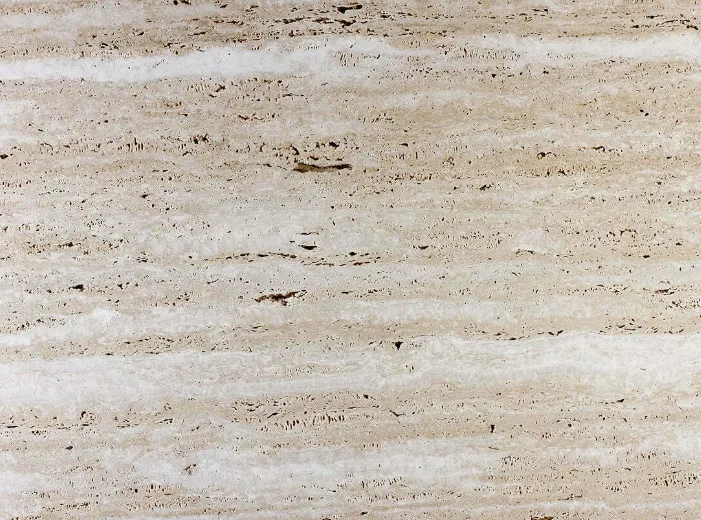
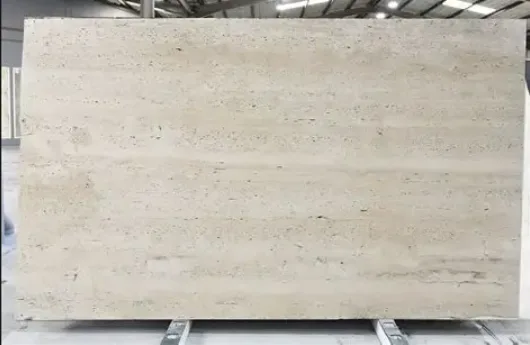
Colour comes from minerals in the spring water and the surrounding rock. Ivory and cream are the classic tones — Turkish Denizli, Italian Tivoli — while iron gives beige, gold, walnut and rust, and organic material or manganese gives silver and grey. Because it forms in layers, the look depends entirely on how the block is cut. Cut across the layers — cross-cut, or fleuri — the surface shows cloudy, swirling figure and open pits. Cut with the layers — vein-cut — it shows linear banding, like the grain of wood, with fewer open holes. The same block can look like two different stones.
Quarries and Supply: Turkey, Iran, Italy, Mexico
Turkey is the world's dominant travertine producer and exporter by a wide margin. The Denizli basin in the southwest — around Pamukkale, whose white terraces are travertine forming today — supplies the classic light ivory and beige stone in enormous volume, along with walnut, noce and silver from neighbouring deposits, and further quarries around Afyon, Sivas and Burdur. Turkish mills export finished tiles, pavers, mosaics and slabs to every market, and Turkey sets the global price for commercial travertine.
Iran is the second great source, with deposits around Azarshahr, Mahallat and Abbas Abad producing ivory, silver, red and chocolate travertine of high quality, including some of the best silver and dramatic vein-cut material anywhere. Iranian stone reaches Western markets mainly as blocks processed in Turkey, China or Italy, and directly in Asian and Gulf markets. Italy is the historic and premium source: Tivoli near Rome, the quarries that supplied the Colosseum, and Rapolano in Tuscany produce Travertino Romano Classico, Navona and Silver at the top of the market, mostly as slabs and large-format cut-to-size for high-end architecture. Mexico supplies Durango and Fiorito travertine to North America in cream and light tones, and Peru is a smaller source.
China does not quarry significant travertine but is a large processor: mills in Fujian and Yunnan import Turkish and Iranian blocks, cut and fill them on modern lines, and export tiles, slabs and cut-to-size at low finished cost, particularly to Asia, the Gulf and Australia. For a buyer, that means factory-direct travertine can be sourced from Turkey directly or from Chinese processors of Turkish and Iranian blocks.
Filled vs Unfilled, Honed vs Tumbled, Vein-Cut vs Cross-Cut
Every travertine order involves three choices, and they matter more than the colour name. Filled or unfilled: filled travertine has its natural pits packed at the mill with cement-based or resin filler in a matching tone, then honed flat, which produces a smooth, cleanable surface — the standard for interior floors, walls and countertops. Unfilled leaves the pits open, giving the rustic look and better slip resistance; it is used for exterior pavers, pool decks and feature walls, and it is cheaper because it skips a process. Unfilled interior floors collect dirt in the holes and are usually filled on site with grout during installation.
Honed or tumbled: honed is a smooth matte finish, the mainstream interior look and the standard for filled tile. Tumbled travertine has been rotated in a drum with abrasives to round the edges and roughen the face, giving an aged, antique appearance; it is normally unfilled and is the standard for pavers and rustic interiors. Polished travertine — filled and brought to gloss — exists but is a niche because the filler polishes differently from the stone; brushed and chiselled-edge finishes sit between. Vein-cut or cross-cut: vein-cut shows linear banding, reads contemporary, has fewer open pits and prices higher because block yield is lower and demand from architects is highest. Cross-cut is the classic cloudy look, cheaper, and the norm for commercial tile and pavers.
The commercial defaults are: interior floors — filled, honed, cross-cut, 12x12, 18x18 or 12x24 tile; contemporary walls and slabs — vein-cut, honed, filled or unfilled depending on the look; exterior — unfilled, tumbled, cross-cut pavers at 3 cm; pool copings and treads — bullnosed pavers, unfilled or partly filled. Specify all three choices in writing on every quote.
Grades and Selection
Travertine grading is looser than granite or marble but consistent in what it looks at: colour uniformity, size and density of pits, and structural soundness. Premium or first-choice tiles have a uniform tone within the lot, small and evenly distributed pits, minimal filler visible, and no cracks or soft zones. Standard or commercial grade allows more colour variation, larger or clustered holes, more visible fill and occasional patched areas. Third or rustic grade — heavy pitting, colour swings, larger repairs — is sold for tumbled pavers and rustic projects where the variation is the point.
Two practical points. First, travertine varies far more within a lot than granite does, so a sample tile tells you almost nothing — ask for photos of at least a full crate laid out, and for pavers, expect and plan for variation. Second, the quality of the fill matters as much as the stone: cheap cement fill cracks and drops out within a few years, leaving holes; resin fill lasts. Ask what filler was used and whether the tiles were double-filled — filled, honed, then filled again where the honing opened new pits.
Travertine Prices in 2026: Tiles, Pavers, Slabs, Installed
Travertine trades at 8 to 40 dollars per square foot ex-warehouse in Western markets — market estimates (August 2026) — and the product type determines where in that band you land. At the bottom, 8 to 15 dollars per square foot, are commercial-grade Turkish tumbled pavers and unfilled tiles in cross-cut ivory and beige — the volume products for pool decks and patios. Filled and honed 12x12 and 18x18 interior tiles in standard grade run roughly 10 to 20 dollars per square foot; premium-grade filled tiles, walnut, silver and noce tones and larger formats sit at 15 to 30. Vein-cut slabs and cut-to-size in premium Turkish, Iranian and Italian material occupy the top of the band, 25 to 40 dollars per square foot, with Italian Travertino Romano and select silver vein-cut at the ceiling and occasionally above it.
Installed pricing differs from granite because travertine is mostly a tile-and-paver product rather than a slab product. In the US, tile installation typically adds 8 to 20 dollars per square foot for interior floors and 10 to 25 for exterior pavers on a prepared base, so installed travertine floors commonly land at 20 to 50 dollars per square foot and installed pool decks at 25 to 55, as typical US market figures — one of the cheapest natural stone surfaces available installed. Slab work — vanities, fireplace surrounds, feature walls — follows the stone-slab pattern with fabrication adding 30 to 60 dollars per square foot.
Factory-direct sourcing typically comes in 30 to 60 percent below Western warehouse prices for equivalent grade and product, whether from Turkish mills in Denizli or Chinese processors of Turkish and Iranian blocks. Because travertine is a volume, container-scale product — a 20-foot container holds roughly 700 to 900 square metres of 1.2 cm tile or 350 to 450 square metres of 3 cm paver — it is one of the most rewarding stones to import direct for a developer, landscape contractor or hotel project. Freight is a larger share of the landed cost than on a premium stone, so always compare at FOB or landed terms, and remember that pavers are heavy: 3 cm travertine weighs roughly 80 kg per square metre.
Travertine vs Limestone, Marble, Porcelain and Concrete Pavers
Limestone is travertine's closest relative — the same calcite chemistry without the pits — and prices similarly to slightly higher for comparable grades. It reads smoother and more uniform; travertine reads warmer and more textured. Marble is the upgrade: White Marble as a family runs 20 to 120 dollars per square foot and Carrara 40 to 90 (market estimates, August 2026), giving a finer, more luminous surface with veining, at two to four times travertine money for comparable formats. Both etch, both stain, both need sealing; travertine hides wear and etching better because it is matte and textured. Emperador at 35 to 85 dollars per square foot (market estimates, August 2026) is the marble comparison for anyone drawn to walnut and noce travertine.
Porcelain travertine-look tile is the main competitor for interior floors: typically 3 to 12 dollars per square foot for the tile, harder, non-porous, zero maintenance and perfectly consistent — and visibly not stone up close, with repeating patterns and cold, uniform surface. Concrete pavers compete for patios and pool decks at 3 to 8 dollars per square foot; they are cheaper, more uniform, hotter underfoot in sun and fade over time. Travertine's case against both is real: it stays cool underfoot, which is why it dominates pool decks in hot climates, it does not fade, and it develops a patina rather than wearing out. Its case for interior floors is warmth and authenticity at a price that is still lower than any marble.
Where Travertine Works Best
Floors are the largest market: filled, honed travertine in 12x12 to 24x24 formats and Versailles patterns for living areas, hallways, bathrooms and entries, and large-format vein-cut tiles and slabs for contemporary interiors. It is warm underfoot, forgiving of wear, and cheaper than marble. Pool decks and patios are the second great use: unfilled tumbled pavers at 3 cm, with bullnosed copings, because travertine stays noticeably cooler in sun than concrete or dark stone, drains through its pits, and gives grip when wet. In freeze-thaw climates, use only dense, well-selected pavers with proper drainage, or the water in the pores will spall the surface.
Cladding — interior feature walls, fireplace surrounds, exterior facades — is where vein-cut travertine has come back strongly: split-face, honed vein-cut and large-format panels in ivory and silver are a signature of current architecture and interiors, from the Getty Center's Roman travertine to the many recent minimalist houses that use it floor to ceiling. Bathrooms use it for floors, walls, shower surrounds and vanity tops; kitchens use it for backsplashes and, less commonly, counters, where etching and staining need to be accepted. Commercial applications include lobbies, retail floors, hotel corridors and building facades — Turkish and Iranian travertine are standard in the Gulf and Asia for exactly this.
Is Travertine Outdated? An Honest Answer
It was, and now it is not. Between roughly 2000 and 2012 travertine — mostly cross-cut, filled, honed beige and noce tile in 18x18 and Versailles patterns, often paired with dark cabinets, ornate edge profiles and Tuscan-style interiors — was installed in such volume across North American suburbs that it became a shorthand for a dated look. Anyone flipping a house from that era knows the floor.
What has come back is a different travertine. Vein-cut, honed or brushed, in ivory and silver, in large formats and slabs, used floor to ceiling in minimalist and Mediterranean-revival interiors, on plinths and coffee tables, on facades and pool surrounds — this is the travertine of current design magazines and of the highest-end architecture, and it references Rome and mid-century modernism rather than 2005 suburbia. Demand for vein-cut premium material has risen accordingly and it prices at the top of the band. The practical guidance: cross-cut noce in Versailles pattern with dark grout is the dated look; vein-cut ivory or silver, honed, in large format with tight grout, is the current one — and both are the same stone at very different price points.
Care, Sealing and Sourcing Checklist
Travertine is calcite and needs to be treated as one. Seal it at installation with a penetrating sealer and re-seal every one to two years indoors, annually on pool decks; the water-drop test tells you when. Clean with pH-neutral stone cleaner only — vinegar, lemon, bleach and mainstream bathroom descalers etch and dull it. Wipe spills promptly on light tones. Expect fill to need occasional patching over the years, and expect a patina; travertine that looks used is not damaged, it is aged. Etching, scratches and worn fill are all repairable in place by a stone restorer, which is a genuine advantage over porcelain.
Sourcing checklist: specify in writing filled or unfilled, honed or tumbled, vein-cut or cross-cut, format, thickness, grade and filler type; ask for photos of a full crate laid out, not a sample tile; confirm calibration and chamfer standards for tiles and thickness tolerance for pavers; ask for FOB or landed pricing per square metre with a realistic freight estimate — travertine is heavy and freight matters; and inspect the loaded container against approved photos. Travertine is a high-volume commodity with three producing countries and a transparent market; a developer, contractor or hotel buyer sourcing a container should be paying factory-direct levels, not warehouse levels.
Frequently asked questions
How much does travertine cost per square foot?
Travertine trades at roughly 8 to 40 dollars per square foot ex-warehouse in Western markets, based on market estimates (August 2026). Tumbled pavers and unfilled commercial tile sit at 8 to 15, filled honed interior tile at 10 to 30 depending on grade and format, and premium vein-cut slabs at 25 to 40. Installed interior floors typically land at 20 to 50 dollars per square foot and pool decks at 25 to 55 in the US.
Is travertine outdated?
The 2000s look — cross-cut noce and beige in Versailles pattern with dark cabinets — is dated. Vein-cut ivory and silver travertine in large formats, honed, floor to ceiling, is one of the strongest current trends in high-end interiors and architecture. It is the same stone; the cut, colour and format make the difference.
What is the difference between filled and unfilled travertine?
Filled travertine has its natural pits packed with cement or resin filler at the mill and honed flat, giving a smooth cleanable surface for interior floors and walls. Unfilled leaves the pits open for a rustic look and better grip, and is the standard for exterior pavers and pool decks. Unfilled is cheaper; interior unfilled floors are usually grout-filled on site.
Is travertine good for pool decks?
It is the most popular natural stone for pool decks in warm climates: it stays cool underfoot, drains through its pits, gives grip when wet and does not fade. Use unfilled tumbled 3 cm pavers with bullnosed copings and seal annually. In freeze-thaw climates use only dense, well-selected material with proper drainage.
Where does the best travertine come from?
Turkey supplies the most and sets the global price, with the Denizli basin producing the classic ivory and beige. Iran produces some of the best silver and vein-cut material. Italy — Tivoli and Rapolano — supplies the premium Travertino Romano at the top of the market. Chinese mills process Turkish and Iranian blocks for factory-direct export.
Does travertine stain and etch?
Yes, like all limestone and marble. It etches with acids — lemon, vinegar, wine — and light tones can stain from oil and coloured liquids if the sealer has worn. Seal it, re-seal every one to two years, clean with pH-neutral products and wipe spills. Its matte, textured surface hides etching and wear far better than polished marble.
Can I buy travertine factory-direct?
Yes. Turkish mills in Denizli and Chinese processors of Turkish and Iranian blocks export tiles, pavers and slabs worldwide, typically 30 to 60 percent below Western warehouse prices. A 20-foot container holds roughly 700 to 900 square metres of 1.2 cm tile or 350 to 450 square metres of 3 cm pavers, which suits developers, landscape contractors and hotel projects.