Backlit Onyx Bar Cost Guide (2026): What a Glowing Bar Front Really Costs
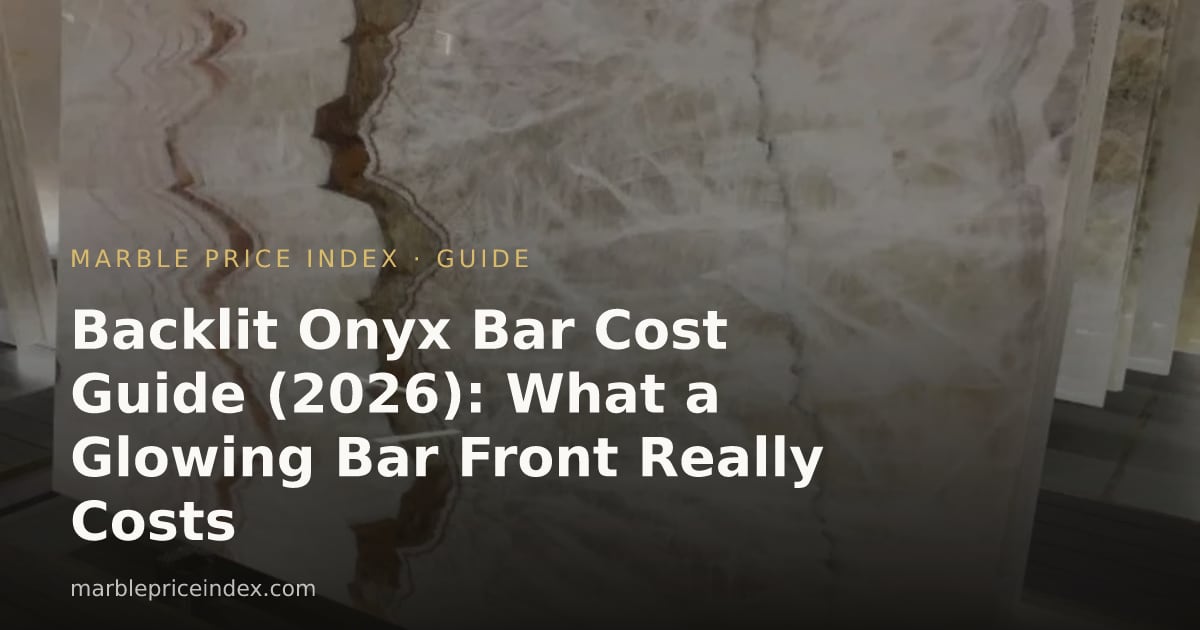
A backlit onyx bar front is a different build than a backlit feature wall, even though both start from the same slab. A wall hangs flat against a stud frame and nothing touches it. A bar front stands freestanding at the edge of a room, gets kicked, bumped by stools, splashed with wine and citrus, and usually has to turn a corner or wrap a curve. The stone, the lamination and the LED spec are the same family of product — but the structural and waterproofing questions are different enough that pricing them off a wall quote gets buyers into trouble. This guide prices the bar front specifically: per linear foot, with a worked case study, and with the trade-offs stated plainly rather than glossed over.
We index onyx at $60–200/sqft and translucent quartzites like Cristallo at $90–200/sqft, both market estimates for August 2026 from our price index. Everything below is built on those bands.
Bar front vs feature wall: why the same stone prices differently
Our backlit green feature wall case study priced a 2.4m × 2.7m wall — a flat, wall-mounted panel with no structural load beyond its own weight, no moisture exposure, and no cutouts. A bar front carries three complications a wall doesn’t:
- It’s freestanding. A bar face has no stud wall behind it to bear load; it needs its own steel or plywood sub-frame, usually clad in the same run as the stone so the frame never shows.
- It’s wet. Bars get wiped down, splashed, and occasionally flooded when a tap runs over. The LED driver and any wiring behind the panel need an IP65-rated enclosure, not the dry-wall-cavity spec that’s fine behind a hallway feature wall.
- It often turns a corner. Most home and commercial bars aren’t a single straight run — there’s a return at one or both ends, which means an extra mitred joint, extra lamination edge to seal, and a slightly higher waste factor cutting from the slab.
None of that changes the stone price. It changes the fabrication and install line items sitting on top of it, which is where a bar quote and a wall quote diverge.
What actually gets backlit on a bar
Onyx is a Mohs 3 banded calcite — soft, scratches with a bottle cap, etches with citrus and wine. Nobody puts it on a working surface. On a real bar, the backlit onyx is almost always the vertical front face (what guests see from their stools) and sometimes the back-bar wall behind the bottles. The bar top itself — where glasses land, ice gets scooped and citrus gets cut — is virtually never onyx. It’s granite, engineered quartz, or a harder quartzite, chosen for the same durability reasons covered in our marble vs granite vs quartz guide. Any bar quote that specs onyx for the working top is a quote from someone who hasn’t run a bar.
That split matters for pricing: a “backlit onyx bar” project is priced as vertical cladding by the linear foot of run (or square foot of face), not as a countertop by the square foot of top surface. Keep that distinction when comparing quotes — a fabricator quoting a low number may simply be pricing less stone than you think you’re buying.
Price comparison: onyx and its alternatives for a bar front
| Material | Raw slab price (sqft) | Hardness (Mohs) | Best use on a bar |
|---|---|---|---|
| Onyx | $60–200 | 3 | Backlit front face, back-bar wall — never the top |
| Cristallo Quartzite | $90–200 | 7 | Backlit front face where knocks are more likely (high-traffic commercial bar) |
| Patagonia Quartzite | $100–250 | 7 | Premium backlit front, harder edges survive stool contact better than onyx |
| Standard white marble (Carrara/Calacatta) | $50–250 | 3–4 | Bar top or dry cladding — not reliably translucent, see below |
| Engineered quartz (bar top) | $18–45 (factory) | 7 | The actual working top surface, paired with an onyx or quartzite front |
Market estimates, August 2026, from our price index and quartzite hub. Onyx remains the cheapest way into a genuine glow; quartzite costs more but takes the physical abuse of a bar-front location — a stool caster or a dropped barstool — far better than calcite.
Building the cost: what’s in a backlit bar quote
A backlit onyx bar front quote, wall-mounted or freestanding, has five components regardless of who fabricates it:
- Slab — the raw onyx, priced per sqft of finished face
- Thin-cut and lamination — onyx for backlighting is cut to roughly 5–8mm and laminated to low-iron glass or a resin backing so it survives handling; this step, not the raw stone, is where a fabricator’s skill actually shows
- LED system — an even-emission panel (never LED strips, which read as bright bars through thin stone) plus an IP65 driver rated for a wet zone
- Frame and sub-structure — the steel or ply frame the panel actually sits in, since a bar front has no wall behind it
- Install labour — templating, mounting, electrical hookup
Two sourcing routes assemble those five components differently, and the gap between them is where most of the money is.
Route A vs Route B: a 14 ft bar front worked case
A home bar project specs a backlit onyx front, 12 linear ft of straight run plus a 2 ft return at one end (14 linear ft total), 3.5 ft tall — a 49 sqft face, rounded to 50 sqft for the math. Market estimates, August 2026.
Route A — source raw onyx from a Western stone yard, hire independent trades (a fabricator for the thin-cut and lamination, a separate electrician, a carpenter for the sub-frame):
| Line item | Basis | Cost |
|---|---|---|
| Onyx slab, mid-grade, Western warehouse | $130/sqft × 50 sqft | $6,500 |
| Thin-cut & lamination to glass | $65/sqft × 50 sqft | $3,250 |
| LED panel + IP65-rated driver | sized for a 50 sqft run | $2,100 |
| Metal kick trim & edge framing | straight run + one return | $950 |
| Electrician (dedicated circuit, dimmer, wet-zone wiring) | — | $700 |
| Fabricator install & templating labour | — | $1,400 |
| Total, Route A | $14,900 |
Route B — factory-direct engineered bar-front kit, same footprint and comparable onyx grade, slab selection + thin-cut + lamination + LED panel + frame bundled into one production run, priced inside the same complete-kit band our feature-wall case study landed in ($122–158/sqft all-in):
| Line item | Basis | Cost |
|---|---|---|
| Factory-direct onyx bar-front kit (slab through LED panel, framed) | $140/sqft × 50 sqft | $7,000 |
| Local carpenter to build & mount the sub-frame | — | $500 |
| Electrician to wire the driver to the dedicated circuit | — | $450 |
| Total, Route B | $7,950 |
Route B runs about 47% cheaper — $6,950 saved on a $14,900 base — not because the raw onyx is priced differently (both routes sit inside the same $60–200/sqft market band) but because Route A stacks three separate trade margins on top of a Western warehouse slab price, while Route B is one production run that does thin-cutting, lamination and LED integration in-house. That’s consistent with the 30–60% factory-direct saving we see across categories, and close to the 52% our full feature-wall case study measured on a larger, simpler (no-return, no-wet-zone) panel.
The trade-off is lead time. Route A can start as soon as a local fabricator has a slot open. Route B is a made-to-order engineered product — plan on 8–12 weeks from confirmed order to a crated kit landing on site, plus ocean freight. For a bar opening on a fixed date, build that lead time into the schedule from day one; it’s the one place a factory-direct project genuinely loses to a local one.
Structural and moisture details that change the quote
The sub-frame carries the load, not the wall. A freestanding bar front needs its own steel angle or heavy ply frame, engineered to the actual run length — a 14 ft run with a return needs a corner post, not just two end brackets. Skipping this and screwing lamination panels straight to drywall is the single most common failure point we see in bar-front photos sent to us for a second opinion.
The driver has to be rated for the room, not just the panel. A dry hallway wall can run a standard indoor LED driver in the cavity behind it. A bar has spilled drinks, mopped floors and, in a commercial space, a wash-down routine. Spec an IP65-rated driver and route the low-voltage cable so it can’t pool water at a connector — it’s a small cost line and the one thing worth over-speccing.
Cutouts stay out of the onyx. If the design calls for a footrest rail bracket, a POS mount or a tap-handle backing plate, put the cutout in the frame or backing panel, not the stone. Every hole cut into a 6mm laminated onyx panel is a crack risk, and a cracked backlit panel is a full-panel replacement, not a patch.
Durability and upkeep on a working bar front
| Concern | Onyx bar front | Translucent quartzite bar front |
|---|---|---|
| Scratches from stool contact, belt buckles | Yes, shows on polish | Rare — Mohs 7 |
| Etching from splashed wine, citrus garnish prep nearby | Yes, if unsealed and unprotected | No |
| Cracking from a dropped bottle or barstool impact | Higher risk, thin laminated panel | Lower risk |
| Cleaning | Soft cloth, pH-neutral only, no acidic bar cleaners | Standard stone cleaner fine |
| Resale/relocation | Panel is bonded to its frame — not portable to a new bar without refabrication | Same constraint, tougher in transit |
None of this means don’t use onyx on a bar — it means keep it on the front face, out of splash-and-scrub range, and brief the bar staff once on what not to spray on it. Most backlit onyx fronts we’ve supplied have run for years without incident because the glow is the point and nobody’s setting drinks on a vertical surface.
Sourcing factory-direct from China
Iran, Turkey, Mexico and Pakistan supply most volume onyx block, and a large share of it — especially Iranian and Pakistani material — is processed at Chinese mills, because vacuum-resining and precision thin-cutting are exactly the capabilities Chinese processors have scaled hardest. Buying the bar-front kit factory-direct rather than through a Western stone yard is where the 30–60% saving in the case study above actually comes from — cutting out the importer’s stocking margin on both the raw slab and the fabrication step, not a lower-grade stone. Our guide to importing marble from China covers container logistics, and a bar-front kit this size ships well combined with a countertop or flooring order in the same container to spread the freight cost.
The one thing to insist on before committing to a slab: ask for a backlit photo, not just a dry one. A slab that looks clean face-on can hide dead opaque zones or dark inclusions that only show up with a light behind it — exactly the check our feature-wall case study flagged, and it applies just as much to a 14 ft bar run as a 9 ft wall.
Run your own dimensions through our cost tools, or send the bar layout and a reference photo through the quote form — the mill returns candidate slabs, a backlit test video and a factory price, usually within 48 hours.
FAQ
How much does a backlit onyx bar cost per linear foot?
At the $140/sqft factory-kit rate used above and a typical 3.5 ft bar height, that’s roughly $490 per linear foot for a complete factory kit (stone, lamination, LED panel, frame), before local install trades. Sourced through a Western yard with independent trades, the same run runs closer to $1,065 per linear foot. Both are market estimates for August 2026 and move with the specific onyx grade chosen.
Can I put a sink or ice well in a backlit onyx bar front?
Not in the onyx itself. Ice wells, sinks and drainage go in the bar top and the frame behind the stone, never cut into a 5–8mm laminated onyx panel — a cutout that close to the panel edge is a near-guaranteed crack point. Keep plumbing penetrations in the sub-frame and let the onyx stay a flat, uninterrupted glow.
Is onyx durable enough for a home bar front?
Yes, as a vertical front face out of splash-and-impact range — it’s the same Mohs 3 hardness that rules it out for a bar top. Keep drinks, garnish prep and stool traffic away from the stone face itself and it holds up for years; treat it like a countertop and it won’t.
Onyx vs translucent quartzite for a bar front — which is better?
Onyx is cheaper at the low end ($60/sqft vs quartzite’s $90/sqft floor) and gives a more saturated, even glow. Quartzite is Mohs 7 — far more resistant to the stool scuffs and bottle knocks a bar front actually takes. For a low-traffic home bar, onyx is the better value; for a commercial bar with real foot traffic, the quartzite premium usually pays for itself in avoided panel replacements.
How long does a factory-direct backlit bar kit take to arrive?
Plan on 8–12 weeks from confirmed order to a crated kit, plus ocean freight transit, since it’s a made-to-order engineered product rather than a stocked item. Build that into the schedule before setting an opening date.
Does a backlit bar front need special electrical work?
Yes — a dedicated circuit and an IP65-rated driver, because bars get wet in ways hallway walls don’t. Route the low-voltage cable so it can’t pool water at a connector, and use a dimmer rated for the driver you install rather than a generic wall dimmer.