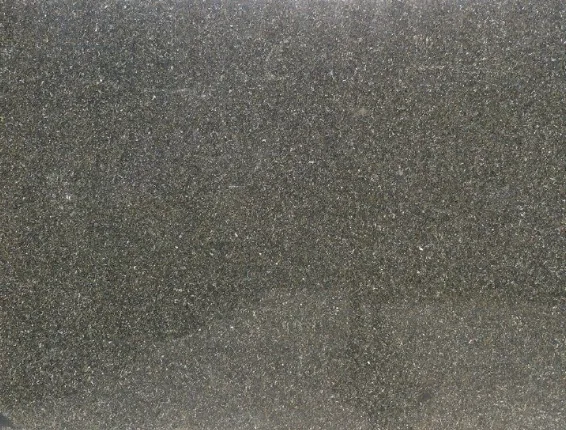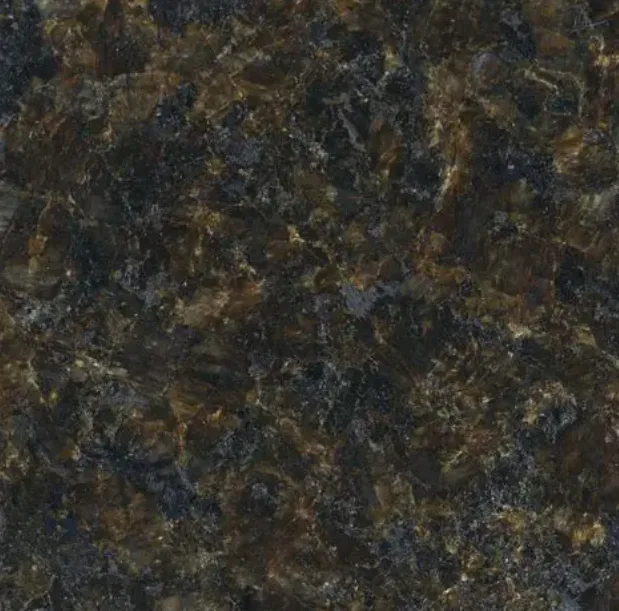
Ubatuba is Brazil's best-known export granite and one of the highest-volume dark granites in the world. From a distance it reads as near-black; up close it is a dense mosaic of dark green, black, grey and gold flecks with a subtle sparkle from mica and feldspar. Polished 2 cm Ubatuba slabs trade at roughly 30 to 60 dollars per square foot ex-warehouse in Western markets, based on our market estimates (August 2026).
It is one of the most affordable premium-looking granites you can buy, and the price band is fairly tight because supply is large and steady. What moves the number inside the band is colour: how green versus how black the slab reads, how dense the gold fleck is, and how uniform the block was. This guide covers the geology, the Brazilian supply chain, the informal grading, slab versus cut-to-size versus installed pricing, comparisons with other dark stones, and how factory-direct sourcing changes the economics.
What Ubatuba Granite Is: Geology and Appearance
Ubatuba is a charnockite — a granite-family rock rich in orthopyroxene, quartz and feldspar — that formed deep in the crust under high temperature and pressure. That origin gives it its dark, slightly greasy-looking green-black colour and its very fine, dense grain. Hardness is around 6 to 7 on the Mohs scale, porosity is low, and it does not react with household acids. It is a true granite in the commercial and, unusually, close to one in the geological sense.
The colour is what makes it distinctive. The ground is a deep green-black, and scattered through it are flecks of gold, brownish-gold, grey and brighter green, plus small mica flakes that glint under light. Some blocks lean noticeably green; others lean almost black with only a green cast in daylight. Under warm indoor light Ubatuba reads as a rich near-black; under cool daylight the green comes forward. Buyers who have only seen a sample under showroom halogens are sometimes surprised by how green the installed slab is by a window — always view samples in daylight.
Quarries and Supply: Espírito Santo, Brazil
Ubatuba comes from the state of Espírito Santo in southeastern Brazil, the centre of the Brazilian granite industry, with the quarries clustered around Cachoeiro de Itapemirim and the processing concentrated in the same region. Brazil has been shipping Ubatuba to North America and Europe for over thirty years and the deposits are extensive, so supply is stable and lead times are predictable. Alternative trade names include Verde Ubatuba, Uba Tuba, Green Labrador and Bahia Green; they refer to the same stone or very close variants from neighbouring pits.
Processing follows the usual dark-granite pattern. Brazilian mills in Espírito Santo cut and polish slabs for direct export in large volumes, and North America takes most of it. Chinese mills in Fujian import Ubatuba blocks and process them alongside Indian and Chinese blacks, then re-export slabs and cut-to-size worldwide at lower finished cost. Western warehouses buy from both. Because Ubatuba is a commodity, mill-to-mill differences show up mainly in resin quality, calibration and crating, not in the stone itself.
There is no exact substitute for the green-black-gold mix, but budget alternatives for buyers who simply want a dark speckled surface include Chinese Shanxi Black or various Chinese and Indian dark greys and blacks, which price lower. Indian Black Galaxy is the closest speckled-dark comparison at a slightly higher band.
Grades and Colour Variation
Ubatuba grading is informal and colour-led. Premium slabs have a deep, uniform green-black ground with an even distribution of gold and green flecks and no light patches, streaks or veins. Commercial grade tolerates some variation in fleck density across the slab, faint lighter or greyer zones, or a slightly duller ground. Third grade — patchy colour, visible veins, repairs — goes to tile and paving.
The bigger issue for most projects is not grade but block consistency. Because Ubatuba can lean green or lean black depending on the block, and because the fleck density varies, slabs from two different blocks can look like two different stones side by side. For any job with more than one slab visible together — an L-shaped kitchen, an island plus perimeter, a lobby floor — insist on sequential slabs from one block, and approve the specific bundle from photos or video in daylight, not from a generic sample.
Ubatuba Granite Prices in 2026
Polished 2 cm Ubatuba slabs run 30 to 60 dollars per square foot ex-warehouse in Western markets — market estimates (August 2026). The bottom of the band buys commercial-grade slabs with some colour variation; the top buys deep, uniform premium blocks with dense gold fleck. 3 cm slabs price roughly 30 to 45 percent above 2 cm. Honed and leathered finishes add 10 to 20 percent over polished. Ubatuba is one of the most affordable premium granites in the market and has been for decades — that is the main reason it became a default in North American kitchens.
Installed pricing in the US follows the standard granite pattern: fabrication and installation typically adds 30 to 60 dollars per square foot on a standard kitchen, so installed Ubatuba counters commonly land in the 60 to 120 dollars per square foot band as a typical US market figure. It is often the cheapest granite on a fabricator's price list once fabrication is included, because it is abundant and easy to work. Cut-to-size — 12x12 and 24x24 tiles, vanity tops, treads, kerbs — is priced per finished piece and per square metre and generally lands well below slab-plus-fabrication for repetitive formats.
Factory-direct sourcing typically comes in 30 to 60 percent below Western warehouse prices for equivalent grade, whether the mill is in Espírito Santo or Fujian. Ubatuba's low base price means the absolute saving per square foot is smaller than on a premium stone, but on a container of slabs or a hotel floor package in tile it is still the largest line-item saving in the project. The buyer takes on freight, duty and quality control, or uses a sourcing partner who handles them.
Ubatuba vs Absolute Black, Black Galaxy, Green Marble and Quartz
Absolute Black at 30 to 75 dollars per square foot and Black Galaxy at 35 to 70 (market estimates, August 2026) are the two dark granites Ubatuba is most often quoted against. Absolute Black is a flat, patternless black; Black Galaxy is black with gold flecks; Ubatuba is greener, busier and slightly warmer, and generally the cheapest of the three at the top end. Ubatuba's dense fleck hides fingerprints, crumbs and water spots better than either — a genuine daily-life advantage on a kitchen counter.
Green Marble — Indian and Italian greens with white webbing at 30 to 100 dollars per square foot (market estimates, August 2026) — is the marble alternative for anyone drawn to Ubatuba's green cast. It is a serpentine or calcite stone: softer, prone to etching, and better on walls than on working counters. Green Quartzite at 60 to 140 dollars per square foot (market estimates, August 2026) is the premium natural alternative — harder, more dramatic and roughly double the money. Engineered quartz in dark green or black speckle patterns typically prices at 50 to 100 dollars per square foot installed in the US, gives a uniform repeatable look, and is less heat-tolerant and unsuitable outdoors.
Where Ubatuba Works Best
Kitchens are the core market and where Ubatuba earned its reputation: hard, dense, heat-tolerant, effectively stain-proof once sealed, and forgiving of daily use because the busy fleck hides everything. It pairs well with wood, cream and white cabinets and with brass or bronze hardware, which pick up the gold in the stone. Vanities, bar tops and laundry counters follow the same logic. It reads as heavy with dark cabinets and dark floors, which is the combination that dated it in the 2000s.
Outdoors it performs well: no fading, no freeze-thaw spalling, and a finish that lasts. Flamed or bush-hammered Ubatuba is used for exterior paving, steps and pool copings, and honed or polished for building cladding and monuments. In commercial work it appears on lobby floors, reception desks, elevator surrounds and retail counters, where its combination of durability, low price and camouflage of wear is hard to beat.
Fabrication and Finishes
Ubatuba is easy to fabricate: uniform hardness, no soft veins, predictable behaviour on the saw and CNC, and it polishes to a deep gloss. Standard thicknesses are 2 cm and 3 cm; 2 cm with a laminated mitred edge gives a thick look at lower cost and weight. All standard edge profiles are routine, and undermount sink cut-outs are trouble-free.
Polished is the classic finish and shows the most green and the most sparkle. Honed turns it into a soft, matte grey-green that reads much lighter and loses most of the gold — view a honed sample first. Leathered keeps the depth and fleck with a low sheen and has become the preferred residential finish for anyone who wants Ubatuba without the high-gloss look. Flamed is for exterior paving and steps, and it lifts the green considerably.
Care and Sealing
Ubatuba is slightly more porous than the densest Indian and Zimbabwean blacks, so it benefits from a penetrating sealer at installation and a re-application every one to three years depending on use. Test with a few drops of water; if it darkens the stone rather than beading, re-seal. Clean with pH-neutral cleaner or dish soap. Avoid abrasive powders, which dull the polish over time. Acids are not a concern.
Edge chips from heavy pans are repairable with colour-matched epoxy, and the busy pattern hides repairs well. Scratches are rare because the stone is harder than steel. Old Ubatuba counters that still look new after twenty years are common; the finish is genuinely durable, and the pattern forgives neglect.
Sourcing Checklist for Buyers and Importers
Verify five things. First, colour lean and block identity: ask whether the lot leans green or black, request daylight photos or video of the actual bundle with slab numbers, and confirm all material for one visual area comes from one block in sequence. Second, fleck consistency across the slab: reject lots with visible light patches or streaks. Third, thickness and calibration: 2 cm should measure 2 cm within tight tolerance, and cut-to-size tiles should be calibrated and chamfered to a stated standard.
Fourth, terms: an ex-works price in Brazil or China is not a price until freight, insurance, duty and inland delivery are added, so ask the mill for FOB or landed pricing per square metre with a realistic freight estimate. Fifth, crating: slabs on A-frames with foam separators, and inspection of the loaded container against the approved photos. Ubatuba is a commodity with a transparent market and abundant supply; there is no reason for a volume buyer to pay warehouse prices.
Frequently asked questions
How much does Ubatuba granite cost per square foot?
Polished 2 cm Ubatuba slabs run roughly 30 to 60 dollars per square foot ex-warehouse in Western markets, based on market estimates (August 2026). Installed US kitchen counters typically land between 60 and 120 dollars per square foot once fabrication and fitting are added. Factory-direct is typically 30 to 60 percent below the warehouse slab price.
Is Ubatuba granite green or black?
Both, depending on the block and the light. The ground is a deep green-black that reads near-black under warm indoor lighting and distinctly green in daylight. Some blocks lean greener than others, so approve the specific slabs in daylight rather than relying on a showroom sample.
Is Ubatuba granite outdated?
It became so common in the 2000s that it carries some of that association, particularly in high-gloss finish with dark cabinets. Leathered or honed Ubatuba with light cabinets and brass hardware looks current, and it remains one of the best-value durable granites available.
Where does Ubatuba granite come from?
The state of Espírito Santo in southeastern Brazil, around Cachoeiro de Itapemirim, which is the centre of the Brazilian granite industry. Blocks are processed both in Brazil and in Chinese mills in Fujian, and both export slabs and cut-to-size worldwide.
Does Ubatuba granite need to be sealed?
Yes, lightly. It is slightly more porous than the densest blacks, so apply a penetrating sealer at installation and re-apply every one to three years when a water-drop test shows absorption. It does not etch with acids.
Ubatuba or Black Galaxy for a kitchen?
They overlap on price (30 to 60 versus 35 to 70 dollars per square foot, market estimates August 2026) and perform the same. Ubatuba is greener, warmer and busier, and hides marks best; Black Galaxy is a truer black with gold sparkle. Choose on colour, not durability.