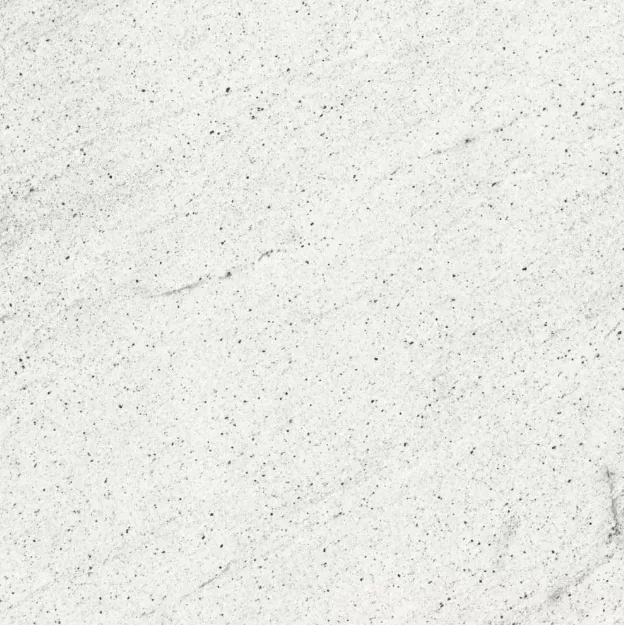
White granite is not one stone but a family: light-ground granites and granite-like rocks from Brazil, India and China with grey, black, burgundy or gold speckling and, in some varieties, soft veining. It became the default hard countertop for anyone who wanted a light kitchen without the maintenance of marble, and it remains one of the highest-volume categories in the trade. Polished 2 cm white granite slabs trade at roughly 35 to 90 dollars per square foot ex-warehouse in Western markets, based on our market estimates (August 2026).
The band is wide because the family spans everything from a busy, speckled Indian white at commodity prices to a rare, veined Brazilian white that competes with quartzite. This hub page lays out the named varieties — River White, Colonial White, Kashmir White, Alaska White and their relatives — in a price ladder, explains the geology and supply behind each, and covers grades, installed and cut-to-size pricing, comparisons with white marble and quartzite, and how factory-direct sourcing changes the number.
What White Granite Is: Geology and Appearance
Most white granites are true granites or closely related gneisses and granodiorites: light feldspar and quartz grounds with darker biotite mica, hornblende or garnet as the speckle. Some, particularly the Brazilian veined whites, are migmatites or gneisses that have been folded, which gives them flowing movement rather than a uniform speckle. Hardness sits around 6 to 7 on the Mohs scale, porosity ranges from low to moderate depending on the variety, and none of them react with household acids.
Visually the family divides into three types. Speckled whites — Kashmir White, Colonial White, Bianco Romano — have a fairly uniform salt-and-pepper look with grey, black and sometimes burgundy garnet dots. Veined whites — River White, Alaska White, Bianco Antico — have a lighter ground with soft grey or taupe veining and looser movement. Cream whites — Giallo Ornamental, New Venetian Gold — lean warm and gold rather than pure white and are usually classed separately. Within any variety, ground colour ranges from cool grey-white to warm cream, and that shift is often the difference between a slab a designer accepts and one they reject.
Quarries and Supply: India, Brazil, China
India supplies the classic speckled whites. Kashmir White comes from Tamil Nadu and Andhra Pradesh in southern India — a white-grey ground with black and burgundy garnet flecks. Colonial White, also southern Indian, is a whiter, cleaner ground with grey and burgundy speckle. Indian mills near the quarries cut slabs and large volumes of tile and cut-to-size for export, and Indian whites are the highest-volume, lowest-priced end of the family.
Brazil supplies the veined and more dramatic whites from Espírito Santo, Minas Gerais and neighbouring states: River White, Alaska White, Bianco Antico, Bianco Romano, Andino White and dozens of trade names that come and go with individual quarries. Brazilian whites are generally lighter, more varied and more expensive, and specific varieties can disappear from the market when a quarry closes. China supplies budget whites — Bethel White, G603 and G655 grey-whites, Sesame White — plus large volumes of processed Indian and Brazilian blocks from mills in Fujian, which re-export finished slabs and cut-to-size worldwide at lower finished cost.
For a buyer the important point is that a Chinese factory-direct quote for white granite can cover all three origins. Chinese domestic whites are the budget alternative for large tile and paving programmes; imported Indian and Brazilian blocks processed in Fujian give the named varieties at factory-direct pricing.
White Granite Price Ladder: Named Varieties Compared
Within the family band of 35 to 90 dollars per square foot for polished 2 cm slabs (market estimates, August 2026), the named varieties sort into a fairly consistent ladder. At the bottom, from roughly 35 to 50 dollars per square foot, sit Kashmir White and Colonial White — Indian speckled whites with abundant supply — alongside Chinese Bethel White and Sesame White for tile and paving programmes. These are commodity stones and price accordingly.
In the middle, from roughly 45 to 65 dollars per square foot, sit Bianco Romano and Andino White from Brazil and the cleaner Indian lots — whiter grounds, more even speckle, fewer burgundy dots. Above that, from roughly 55 to 80 dollars per square foot, are River White and Alaska White: Brazilian veined whites with a light ground and soft grey-taupe movement that read closer to marble or quartzite. At the top of the band, 70 to 90 dollars per square foot and occasionally beyond, sit the rarest and lightest Brazilian whites — Bianco Antico, select Alaska White, Delicatus White with its striking pattern — where supply is limited and demand from designers is strongest.
Treat these positions as indicative. Every variety varies block by block, and a top-grade Colonial White lot can price above a poor River White lot. The ladder tells you where to start negotiating, not what a specific slab is worth.
Grades and Slab Selection
Grading in white granite is about ground colour, pattern consistency and defects. Premium slabs have a clean, even ground — white or consistently cream, not blotchy — with speckle or veining distributed uniformly and no dark blotches, iron stains, pits or fissures. Commercial grade tolerates some patchiness, occasional dark clusters or a slightly greyer ground. Third grade goes to tile and paving.
White granites are the least forgiving family for block mixing. Because the ground is light, any shift in tone or speckle density between two slabs is immediately visible, and burgundy garnet clusters or dark blotches that hide in a dark stone jump out on a white one. For any project with more than one slab visible together, insist on sequential slabs from one block and approve the specific bundle from photos or video in daylight. Pits and fissures — natural to many white granites, especially Brazilian veined ones — are filled with resin at the mill; ask about the resin process and check that filled areas are not visible at grazing light.
White Granite Prices in 2026: Slab, Cut-to-Size and Installed
Polished 2 cm white granite slabs run 35 to 90 dollars per square foot ex-warehouse in Western markets — market estimates (August 2026) — with the ladder above showing where each variety sits inside that band. 3 cm slabs price roughly 30 to 45 percent above 2 cm. Honed and leathered finishes add 10 to 20 percent over polished; leathered white granite has become popular because it softens the speckle and hides fingerprints.
Installed pricing in the US follows the granite pattern: fabrication and installation typically adds 30 to 60 dollars per square foot on a standard kitchen, so installed white granite counters commonly land in the 65 to 150 dollars per square foot band as a typical US market figure — Kashmir White at the bottom, Alaska White or Bianco Antico at the top. Cut-to-size — 12x12, 12x24 and 24x24 tiles, vanity tops, treads, window sills — is priced per finished piece and per square metre and generally lands well below slab-plus-fabrication for repetitive formats.
Factory-direct sourcing typically comes in 30 to 60 percent below Western warehouse prices for equivalent variety and grade, from Indian, Brazilian or Chinese mills. On white granite the saving is largest on the mid and upper varieties, where warehouse margins are widest. As always, compare like with like: a factory-direct River White quote against a warehouse River White quote, in square metres, at FOB or landed terms.
White Granite vs White Marble, Quartzite and Quartz
White Marble as a family — Italian, Greek, Chinese and Vietnamese whites — trades at 20 to 120 dollars per square foot, and Carrara specifically at 40 to 90 (market estimates, August 2026). White marble gives a purer, more luminous white with organic veining that no granite matches, but it is soft, etches with acid and needs sealing and care. White granite is harder, effectively stain-proof and acid-proof, and never etches; it pays for that with a speckled or busier look. Chinese Guangxi White at 15 to 35 dollars per square foot (market estimates, August 2026) is the budget marble comparison for anyone chasing a white look at the lowest price.
White quartzite is the premium alternative and the stone that has taken most of the high-end market from white granite: Super White at 55 to 110, Mont Blanc at 70 to 150, Bianco Superiore at 80 to 170 dollars per square foot (market estimates, August 2026). Quartzite gives a marble-like white with veining at granite-like hardness — the reason it dominates designer kitchens — at roughly double the money of a mid-range white granite. Engineered quartz in white typically prices at 50 to 100 dollars per square foot installed in the US, is perfectly uniform and repeatable, but is less heat-tolerant and cannot go outdoors without yellowing. White granite sits between: harder than marble, cheaper than quartzite, more natural than quartz.
Where White Granite Works Best
Kitchens are the core market: a light, hard, low-care counter that survives real cooking. Speckled whites suit traditional and transitional kitchens and hide crumbs and marks well; veined whites suit contemporary schemes and read closer to marble. Vanities, bar tops and laundry rooms follow. Outdoor kitchens are a strength: white granite does not fade or spall, and it stays cooler in sun than a dark stone.
In commercial work white granite is used for lobby floors, cladding, treads and countertops where a light, durable, low-maintenance surface is needed. Honed or flamed white granite is a standard for exterior paving and steps in bright climates. Chinese whites in particular dominate large paving and tile programmes on price. Memorials in white granite are less common than in black but are standard in some markets.
Fabrication, Finishes, Care and Sealing
White granites fabricate well but need more attention than dark stones. Some Brazilian veined whites are softer along veins and more prone to pitting; a good fabricator checks the slab and reinforces or resins as needed. Standard thicknesses are 2 cm and 3 cm. Polished maximises the white; honed and leathered soften the speckle and hide marks, and leathered has become the popular residential choice. Flamed is exterior-only.
Care depends on porosity, which varies more within white granites than within blacks. Indian speckled whites are moderately porous and should be sealed at installation and re-sealed every one to two years; Brazilian veined whites vary — test with water. Oil and coloured liquids are the main risk on a light ground if the sealer has worn, so wipe spills promptly. Clean with pH-neutral cleaner; avoid abrasive powders. Acids are not a concern. Chips are repairable with colour-matched epoxy, though matching a light ground takes more skill than a black.
Sourcing Checklist for Buyers and Importers
Verify five things. First, exact variety and origin in writing — River White from Brazil, Kashmir White from India — because trade names drift and lookalikes are common. Second, ground colour and pattern consistency: request daylight photos or video of the actual bundle with slab numbers, confirm all material for one visual area comes from one block in sequence, and reject lots with blotches, iron staining or visible resin fill. Third, thickness and calibration to a stated tolerance.
Fourth, terms: FOB or landed per square metre with a realistic freight estimate — an ex-works number in India, Brazil or China is not a price. Fifth, crating and inspection of the loaded container against approved photos. White granite is a large, competitive category with three producing countries; a volume buyer with these checks in place should be sourcing at factory-direct levels.
Frequently asked questions
How much does white granite cost per square foot?
Polished 2 cm white granite slabs run roughly 35 to 90 dollars per square foot ex-warehouse in Western markets, based on market estimates (August 2026). Kashmir White and Colonial White sit at the bottom, River White and Alaska White in the upper half, and rare Brazilian whites like Bianco Antico at the top. Installed US kitchen counters typically land between 65 and 150 dollars per square foot.
What is the cheapest white granite?
Indian speckled whites — Kashmir White and Colonial White — and Chinese whites like Bethel White and Sesame White are the lowest-priced, typically 35 to 50 dollars per square foot for slabs (market estimates, August 2026). Chinese whites are the budget choice for large tile and paving programmes.
What is the most expensive white granite?
The rare, light Brazilian veined whites — Bianco Antico, select Alaska White, Delicatus White — sit at the top of the family band at 70 to 90 dollars per square foot and can exceed it for exceptional lots (market estimates, August 2026). At that level buyers often compare them with white quartzite.
River White vs Alaska White vs Kashmir White — what is the difference?
River White is a Brazilian veined white with a light grey-white ground and soft grey-taupe movement, roughly 55 to 80 dollars per square foot. Alaska White is a Brazilian white with a whiter ground and more varied speckle and veining, similar or slightly higher. Kashmir White is an Indian speckled white with grey and burgundy garnet dots on a white-grey ground, roughly 35 to 50 dollars per square foot. All figures are market estimates (August 2026).
Is white granite better than white marble?
For durability, yes: it is harder, does not etch, and is effectively stain-proof once sealed. For looks, white marble gives a purer white and organic veining that granite cannot match. White marble runs 20 to 120 dollars per square foot and Carrara 40 to 90 (market estimates, August 2026), so the price ranges overlap; the choice is about maintenance tolerance.
Does white granite stain?
It can if unsealed, because light grounds show oil and coloured-liquid marks and some varieties are moderately porous. Seal at installation, re-seal every one to two years when a water-drop test shows absorption, and wipe spills promptly. Properly sealed white granite is very low-maintenance.
Can I buy white granite factory-direct?
Yes. Indian, Brazilian and Chinese mills export slabs and cut-to-size worldwide, typically 30 to 60 percent below Western warehouse prices for equivalent variety and grade. Chinese mills in Fujian process imported Indian and Brazilian blocks alongside domestic whites, so one factory-direct quote can cover the whole family.