Travertine Pool Deck Cost: Pavers, Coping and Installed Prices per Sq Ft (2026)
Travertine is the pool-deck stone of the American Sun Belt for three practical reasons: it stays cooler underfoot than concrete pavers or porcelain, its tumbled surface is slip-resistant wet, and it is cheap for what it is — a natural stone that the Romans built with. The Colosseum is travertine. So is half of the pool decks in Florida, Texas and Arizona.
This guide is about what a travertine pool deck actually costs in 2026. It covers the difference between pavers and tiles (they are not the same product and they are not installed the same way), filled versus unfilled stone, a price table per square foot for material, installation and coping, a 600 sqft deck costed two ways — US warehouse versus factory-direct from our partner mill — and a straight section on care and freeze-thaw, because travertine is not the right stone for every climate. Prices are US market estimates for August 2026.
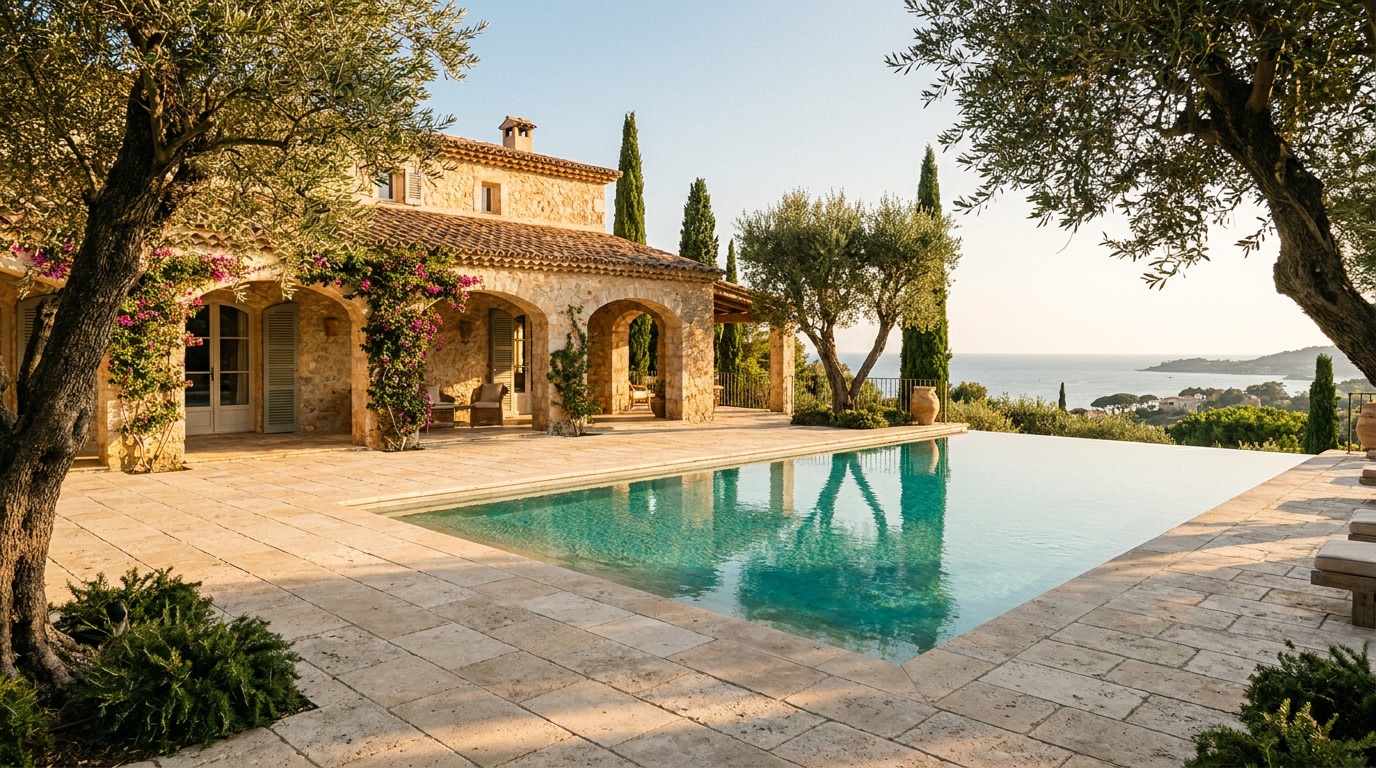
Pavers vs tiles: two products, two installs
The word “travertine” covers everything from a 3/8“ polished interior tile to a 2“ tumbled paver, and the pool-deck price depends first on which one you are buying.
| Travertine pavers | Travertine tiles | |
|---|---|---|
| Thickness | 1¼“ (3 cm) standard; 2“ for driveways | 3/8“–1/2“ (1–1.2 cm) |
| Finish | Tumbled (rounded edges, matte, textured) | Honed or polished, sawn edges |
| Typical formats | 6×12, 12×12, 12×24, 16×24, 24×24; French/Versailles pattern sets | 12×12, 12×24, 18×18, 24×24 |
| Base | Compacted gravel + sand bed (dry-set) or mortar over concrete | Thinset mortar over a concrete slab, always |
| Joints | Sand-swept, tight (1/8“–1/4“); or grouted if mortared | Grouted |
| Slip resistance wet | Excellent (tumbled texture) | Honed: good; polished: poor — not for pool decks |
| Cost per sqft, material (US retail) | $5–12 | $4–10 |
| Cost per sqft, installed (US) | $14–30 | $16–32 (slab required) |
| Where it wins | New pool decks, patios, walkways; drainage; repairs (lift and reset) | Covered lanais, interior-to-exterior transitions, over an existing sound slab |
For an open pool deck the answer is almost always tumbled pavers: they can be dry-set on a compacted base without a concrete slab, they drain through the joints, they can be lifted and reset if the ground moves, and the tumbled texture is the safest wet surface in the natural stone catalogue. Tiles belong on a covered lanai or wherever there is already a slab and the look wants to be crisper. The stone itself is described on our travertine page — slab price $8–40/sqft (market estimate, August 2026), the widest low-end band of any stone we index because so much of the price is format and finish rather than the stone.
Filled vs unfilled
Travertine is a limestone deposited by hot springs, and it is full of small voids — the characteristic pitting. Those voids are either left open (unfilled) or filled at the factory with a colour-matched cement or resin (filled).
- Unfilled tumbled pavers are the pool-deck standard. The open pits give more grip and drain water; the look is rustic and Mediterranean; and because nothing has been filled, nothing can pop out. Over years the pits gather fine debris and can be pressure-washed clean. Price is the lowest.
- Filled and honed is the interior standard and the choice for a smoother, more formal deck or for coping where bare feet want a flat surface. Filled stone costs $1–3/sqft more, and in freeze-thaw climates the fill is the first thing to fail — see the climate section.
- Filled and polished is not for pool decks. Wet polished stone is a slip hazard, full stop.
Rule of thumb: unfilled tumbled for the deck field, filled-and-honed or bullnose tumbled for the coping if a smoother edge is wanted, nothing polished outdoors.
Grades and colours
Travertine is sold in commercial, standard/select and premium grades, and the grade sets the price more than the colour does.
| Grade | What you get | Material $/sqft (pavers, US retail) |
|---|---|---|
| Commercial | More and larger holes, colour variation, some chipped edges; fine for a rustic deck | $4–6 |
| Standard / select | Consistent colour, medium pitting, sound edges — the volume grade for pool decks | $6–9 |
| Premium | Tight, even colour, minimal pitting, chosen blocks | $9–12+ |
Colours: Ivory / light (the coolest underfoot and the most-sold), Noce / walnut (warm brown, hides dirt), Silver (grey-beige, contemporary), Gold / Scabos (varied warm tones with more movement). Ivory and Silver run at the top of each grade band; Noce and Scabos slightly under. Turkey and Iran dominate supply; Chinese mills process it into pavers, coping and vein-cut cladding at volume — which is the factory-direct route below. The wider family — origins, finishes, formats — is on the travertine hub.
Cost per square foot: material, installation, coping
US market estimates, August 2026, tumbled unfilled pavers, standard/select grade unless stated.
| Component | Unit | Low | Typical | High | Notes |
|---|---|---|---|---|---|
| Pavers, 1¼“, material | /sqft | $5 | $8 | $12 | Grade and colour; French pattern sets +$0.50–1 |
| Pavers, 2“, material | /sqft | $7 | $10 | $15 | Driveway-rated; rarely needed on a deck |
| Base prep — excavation, gravel, sand, compaction | /sqft | $3 | $5 | $8 | Higher on clay or slopes |
| Paver installation, dry-set | /sqft | $6 | $10 | $15 | Regional labour spread is wide |
| Paver installation, mortar over slab | /sqft | $8 | $12 | $18 | Adds slab cost if none exists |
| Polymeric sand, edge restraint | /sqft | $0.50 | $1 | $1.50 | |
| Sealing (optional) | /sqft | $0.75 | $1.50 | $2.50 | Enhancing or natural-look sealer |
| Deck installed, dry-set | /sqft | $14 | $24 | $36 | Material + base + install + sand |
| Coping — bullnose 12×24, material | /lin ft | $8 | $14 | $22 | 2“ thick; remodel (drop-face) coping higher |
| Coping — installation | /lin ft | $12 | $20 | $30 | Mortared to beam, includes cutting radii |
| Coping installed | /lin ft | $20 | $34 | $52 | |
| Factory-direct pavers, standard grade | /sqft | $2.50 | $4 | $6 | Ex-factory, market estimate; before freight and duty |
| Factory-direct bullnose coping | /lin ft | $5 | $8 | $12 | Ex-factory |
The two things that move the number most are installation labour (a Phoenix crew and a New Jersey crew are not the same price) and coping, which is priced per linear foot, needs cutting for radii and steps, and is the item people forget to budget. A typical 15×30 pool has 90 linear feet of coping; at the typical installed rate that is about $3,000 before a single square foot of deck is laid.
Case study: a 600 sqft pool deck, two ways
A representative Sun Belt project: a 15×30 ft pool with 90 linear feet of bullnose coping and 600 sqft of surrounding deck in ivory tumbled unfilled travertine, 1¼“ pavers in a French (Versailles) pattern, dry-set on a compacted base. Standard/select grade. Market estimates, August 2026, mid-range regional labour.
Route A — US stone yard / paver warehouse, local hardscape contractor:
| Line item | Math | Cost |
|---|---|---|
| Pavers, French pattern, standard grade (600 sqft + 10% cuts and waste) | 660 sqft × $8.50 | $5,610 |
| Bullnose coping 12×24, 2“ (90 lin ft + 10%) | 99 lin ft × $14 | $1,386 |
| Base prep — excavate, gravel, sand, compact | 600 sqft × $5 | $3,000 |
| Paver installation, dry-set, French pattern | 600 sqft × $10 | $6,000 |
| Coping installation, mortared, incl. radius cuts | 90 lin ft × $20 | $1,800 |
| Polymeric sand + edge restraint | 600 sqft × $1 | $600 |
| Sealing (natural-look, one coat) | 600 sqft × $1.50 | $900 |
| Total | $19,296 (~$32/sqft of deck all-in) |
Route B — pavers and coping factory-direct from the partner mill, same local contractor:
| Line item | Math | Cost |
|---|---|---|
| Pavers, French pattern, standard grade, ex-factory | 660 sqft × $4 | $2,640 |
| Bullnose coping 12×24, 2“, ex-factory | 99 lin ft × $8 | $792 |
| Ocean freight, LCL (a full 20’ container carries roughly 2,500 sqft of 1¼“ pavers plus coping by weight; this order is about a quarter of one, so it ships as a part-load) | flat | $1,900 |
| Duty, port, broker, delivery to site | flat | $1,100 |
| Base prep | 600 sqft × $5 | $3,000 |
| Paver installation | 600 sqft × $10 | $6,000 |
| Coping installation | 90 lin ft × $20 | $1,800 |
| Polymeric sand + edge restraint | 600 sqft × $1 | $600 |
| Sealing | 600 sqft × $1.50 | $900 |
| Total | $18,732 (~$31/sqft of deck all-in) |
Reading the numbers. On a single 600 sqft deck, factory-direct saves only about $560 — because part-load freight and duty eat most of the $3,560 material saving, and labour is identical. This is the honest answer that pool-deck buyers rarely get: for one residential deck, buy locally. The factory route starts to pay at container scale — a full 20’ container carries roughly 2,500 sqft of 1¼“ pavers plus coping by weight, freight per square foot falls to a third of the part-load rate, and the material saving against warehouse pricing is $10,000–12,000 per container. That is a pool builder doing five decks a season, a landscape contractor, a resort, a developer with a community pool and a run of patios. At that scale, request a factory quote with the format list and the mill will price it against your local yard; use the tools — the container calculator in particular — to check how much travertine your project actually fills. How importing works end to end, including duty and the crate-versus-container decision, is in importing marble from China; the same rules apply to travertine.
Care and sealing
A tumbled travertine deck is one of the lowest-maintenance natural stone surfaces there is, provided three things are understood.
- Sealing is optional but useful. Unsealed travertine is fine structurally; sealing makes it stain-resistant against sunscreen, wine, leaf tannin and pool chemicals, and slows algae in shaded areas. Use a penetrating, natural-look sealer (not a topical “wet-look” coating, which becomes slippery and peels). Re-apply every 2–3 years. Enhancing sealers darken the stone — test on a spare paver.
- Acid is the enemy. Travertine is calcium carbonate, like marble. Muriatic acid used to balance pool water, vinegar, and acidic “efflorescence removers” etch it instantly. Keep the pool’s acid additions away from the coping, and clean with pH-neutral stone cleaner. Everything in how to seal marble applies to travertine.
- Cleaning. Sweep; hose; pressure-wash on a low setting once a season to clear the pits. Algae and mildew in shade: oxygen bleach or a stone-safe outdoor cleaner, not chlorine bleach on unsealed stone.
- Salt pools. Salt water is fine on travertine day to day, but salt crystallising in the pores in a dry climate can spall the surface over years — seal the coping and the first two courses in a salt-water pool.
- Repairs. A dry-set paver that cracks or settles is lifted and replaced. Keep 5% of the original order as spares from the same lot; colour varies batch to batch.
Freeze-thaw: is travertine right for your climate?
Travertine is porous. Water goes into the pores, freezes, expands and — over enough cycles — pops the surface or the fill. That is why the stone is ubiquitous in Florida and Arizona and rare on pool decks in Minnesota. Honest guidance by climate:
| Climate | Travertine on a pool deck? | Notes |
|---|---|---|
| No frost (FL, south TX, AZ, southern CA, the Gulf) | Yes, without qualification | Ivory stays coolest underfoot |
| Light frost, few cycles (Carolinas, GA, north TX, inland CA) | Yes | Unfilled tumbled pavers, dry-set on a free-draining base; seal |
| Regular freeze-thaw (mid-Atlantic, lower Midwest, PNW inland) | With care | Dense premium-grade unfilled pavers only, dry-set with excellent drainage, sealed; avoid filled stone (fill pops); expect some spalling over decades |
| Hard winters (upper Midwest, New England, mountain states, Canada) | Not recommended | Use granite pavers, dense porcelain pavers, or concrete; travertine will fail |
The engineering points: dry-set on gravel and sand drains, so pavers do not sit in water; mortared installations trap water and fail faster in frost. Unfilled stone has nowhere for fill to pop from. Sealing reduces absorption. Density varies by quarry — ask for water-absorption data on the specific lot; a dense Turkish ivory at under 2% absorption is a different material from a soft commercial-grade Scabos at 5%. For a hard-winter deck, honed granite pavers — Absolute Black or a light grey — at $30–75/sqft slab and $10–20/sqft as pavers cost more but will not fail. Compare the two on the granite hub.
Alternatives, priced
| Deck material | Installed $/sqft (US) | Cool underfoot | Slip wet | Freeze-thaw | Look |
|---|---|---|---|---|---|
| Travertine pavers, tumbled | $14–36 | Best | Excellent | Poor to fair | Warm, Mediterranean |
| Concrete pavers | $10–22 | Poor (hot) | Good | Excellent | Uniform |
| Porcelain pavers, 2 cm | $18–35 | Fair | Good (textured) | Excellent | Any — incl. travertine-look |
| Granite pavers, flamed | $25–45 | Poor to fair | Excellent | Excellent | Grey, black, hard-edged |
| Poured concrete, broom finish | $8–15 | Poor | Fair | Good | Plain |
| Marble pavers, tumbled | $25–50 | Good | Good | Poor | Bright white, glare |
Travertine wins on comfort and price among natural stones; concrete pavers win on price alone; porcelain wins on climate. Travertine-look porcelain is the honest recommendation for a frost climate that wants the look.
FAQ
How much does a travertine pool deck cost per square foot?
$14–36/sqft installed in the US for tumbled 1¼“ pavers dry-set, with $24 typical — material $5–12, base $3–8, labour $6–15, sand and sealing $1–4. Coping is extra at $20–52 per linear foot installed. Market estimates, August 2026.
How much is a 600 sqft travertine pool deck?
Around $19,000 all-in with 90 linear feet of coping at typical US pricing (case study above), or roughly $12,000–15,000 in a low-labour market with commercial-grade stone. Factory-direct saves meaningfully only at container scale.
Are travertine pavers cheaper than tiles?
Material is similar ($5–12/sqft pavers, $4–10 tiles), but pavers can be dry-set on gravel and sand while tiles need a concrete slab, so a paver deck is usually cheaper installed unless a sound slab already exists.
Is travertine slippery around a pool?
Tumbled unfilled travertine is one of the least slippery wet surfaces in natural stone. Honed is acceptable; polished is a slip hazard and should not be used outdoors.
Does travertine get hot in the sun?
Less than concrete, brick or dark porcelain — light ivory travertine stays noticeably cooler underfoot, which is the main reason it dominates Sun Belt pool decks. Darker Noce runs warmer.
Does travertine crack in the winter?
In hard freeze-thaw climates, yes, over time — water in the pores freezes and spalls the surface. Dry-set, unfilled, sealed premium pavers survive light frost well; for hard winters use granite or porcelain pavers instead. See our travertine page for absorption and density notes.