What Colour Cabinets Go with Taj Mahal Quartzite? 10 Combinations That Work (2026)
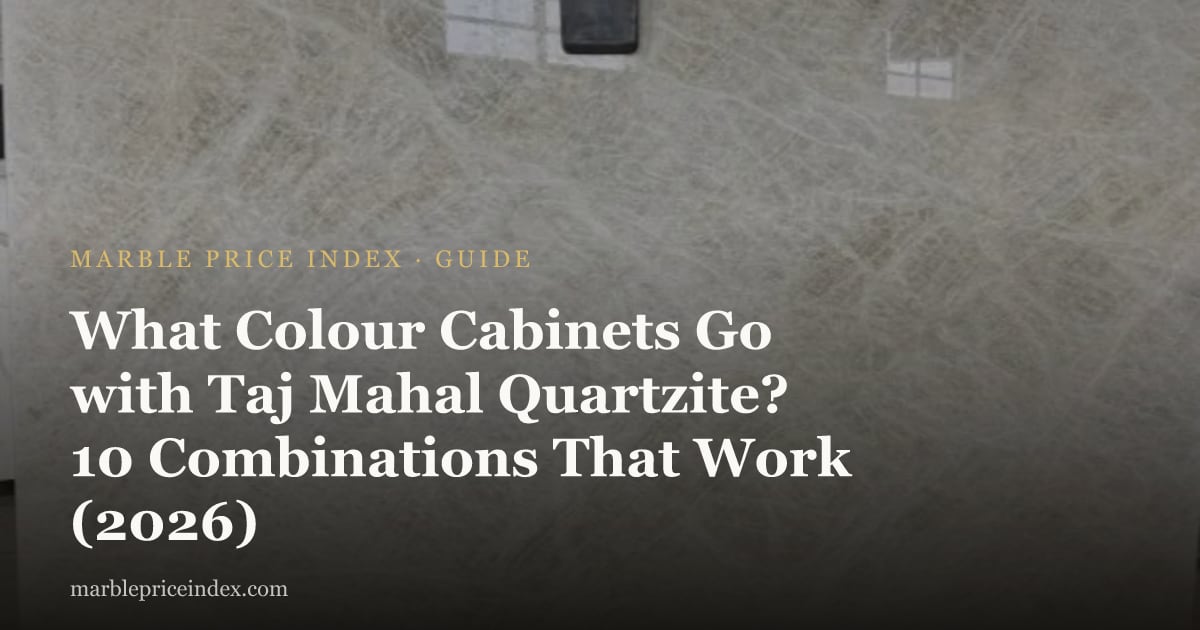
Taj Mahal quartzite is the most-requested quartzite in the US for a reason that has nothing to do with drama: it is warm, quiet and difficult to get wrong. The ground is ivory to cream, the veining is soft gold and beige, and the whole slab reads as “expensive but calm” from across a room. That warmth is also the trap. Pair it with the wrong white and the cabinets look dirty; pair it with the wrong grey and the stone looks yellow.
We sell the stone rather than design kitchens, but we see enough finished projects — and enough returns of the wrong sample — to know which cabinet colours actually work. This guide gives ten combinations with the reasoning, hardware and backsplash pairings, a section on lighting (the variable most people ignore), an honest note on how much Taj Mahal varies from slab to slab, and a costed example so the palette comes with a budget. Prices are US market estimates for August 2026.
Start with the stone’s undertone
Taj Mahal is a warm neutral. Its ground sits between ivory and pale greige, and the veining runs from soft gold through beige to occasional taupe-brown. Under warm light it leans cream; under cool light it leans grey-beige. There is almost never any pink, blue or green in it, which is exactly why it plays well with so many cabinet colours — but the warmth is always there, and any cabinet colour has to either agree with it or deliberately contrast with it. The failure mode is a colour that half-agrees: a stark cool white, a blue-grey, a green with too much yellow.
Read the full stone profile — origin, hardness, price band, care — on the Taj Mahal quartzite page; the short version is that it is a true, dense quartzite at $70–140/sqft slab, market estimate August 2026, and one of the most forgiving stones we handle.
The palette table
| Cabinet colour | Why it works with Taj Mahal | Hardware | Backsplash | Best for |
|---|---|---|---|---|
| Warm white (Swiss Coffee, White Dove, Alabaster) | Shares the ivory undertone; the stone reads as a slightly deeper version of the cabinets | Unlacquered or brushed brass; aged bronze | Same-stone slab, or warm white zellige | Bright kitchens, resale-safe |
| Cream / off-white (Navajo White, Bone) | Sits between cabinet and stone; whole room reads tonal | Antique brass, oil-rubbed bronze | Handmade cream tile, plaster | Traditional, English-country |
| Greige (Revere Pewter, Agreeable Grey, Pale Oak) | Picks up the taupe in the veining; cools the room without fighting the warmth | Brushed nickel, champagne bronze, black | Same-stone slab or grey-veined ceramic | Transitional kitchens |
| Warm mid-grey (Chelsea Grey, Coventry Grey) | Contrast without coldness; makes the gold veins glow | Black, aged brass | Full-height stone or white subway | Contemporary |
| Charcoal / near-black (Iron Ore, Wrought Iron, Kendall Charcoal) | Maximum contrast; the ivory ground looks brighter against it | Brass, gold-tone | Same-stone slab to the ceiling | Islands, statement kitchens |
| Navy (Hale Navy, Naval) | Warm ivory + deep blue is a classic complementary pairing; gold veins echo brass | Brass, unlacquered brass | Same-stone slab or warm white tile | Islands, lower cabinets |
| Sage / grey-green (Evergreen Fog, Saybrook Sage, Pewter Green) | Muted green with grey in it; the stone’s gold reads as warmth, not yellow | Brass, antique bronze | Same stone, or plaster | Nature-led schemes |
| Deep forest / olive green (Rookwood Dark Green, Cascades) | Rich colour that flatters the cream ground; very current | Brass, black | Same-stone slab | Islands, pantries |
| Natural white oak (rift-cut, cerused, or clear-finished) | Wood grain and stone veining share the same warm-brown family | Black, brass, or integrated pulls | Same-stone slab, plaster | Modern, Scandinavian, Japandi |
| Walnut / medium warm wood | Deep brown picks up the darkest taupe in the veins; the stone lightens the wood | Black, bronze | Same-stone or plaster | Mid-century, warm-modern |
Two colour families are absent on purpose. Stark cool white (Chantilly Lace, Extra White, Pure White) turns Taj Mahal yellow by comparison and makes the cabinets look blue-tinged; if you must have a cool white, use it on walls, not cabinets. Blue-grey (anything with a lavender or steel cast) fights the warmth and looks muddy at the seam. Both are common in showrooms because they photograph well under studio light; they rarely survive contact with a real kitchen at 5 pm.
Ten combinations in detail
1. Warm white cabinets, brass hardware, same-stone slab splash
The safest and most-built Taj Mahal kitchen. Warm white perimeter cabinets in a colour with a yellow-beige undertone (Benjamin Moore White Dove and Swiss Coffee are the two most-specified), unlacquered brass pulls that will age toward the veining, and a full-height slab backsplash behind the range cut from the same slab as the countertop. The room reads as one warm envelope. If it feels too soft, add contrast with a black faucet or dark oak floor rather than changing the cabinets.
2. Cream cabinets, aged bronze, handmade cream tile
The English-country version. Cabinets a shade deeper than warm white — Farrow & Ball’s Wimborne White or Benjamin Moore Navajo White territory — with oil-rubbed bronze cup pulls, a cream zellige or handmade tile splash and, ideally, a wooden worktop on the island so the stone is not asked to do everything. Works with beams and Agas; struggles in a flat modern box.
3. Greige perimeter, black hardware, stone slab
The transitional workhorse. Greige (Revere Pewter, Agreeable Grey, Pale Oak) reads as grey next to the stone and beige next to a white wall, so it bridges both. Matte black pulls and a same-stone splash keep it crisp. This is the palette we see most in developer and multi-unit projects, because it works in every unit regardless of the slab drawn.
4. Warm white perimeter, navy island
Warm white uppers and perimeter, a navy island (Hale Navy is the reference colour) with brass pulls, and Taj Mahal across everything. The gold veining picks up the brass, the ivory reads brighter against the blue, and the palette photographs well without being trendy. Keep the navy on the island only; a full navy kitchen with Taj Mahal can feel heavy.
5. Warm white perimeter, charcoal island
Same structure as #4 with charcoal or near-black (Sherwin-Williams Iron Ore, Benjamin Moore Wrought Iron) on the island. Higher contrast, more contemporary. Waterfall the island in Taj Mahal so the stone wraps the dark box; the veining across the mitre is the moment.
6. Sage or grey-green cabinets, brass, plaster splash
Muted greens with grey in them — Sherwin-Williams Evergreen Fog, Benjamin Moore Saybrook Sage — are the most current pairing and one of the best. The green must have grey in it; a yellow-green (avocado, chartreuse territory) will make the stone look dirty. Brass hardware, and either a same-stone splash or a limewashed plaster wall. Very good in north-facing rooms, where the green stops the stone going flat.
7. Deep green island, white oak perimeter
Rift-cut white oak perimeter cabinets in a clear or lightly cerused finish, a deep forest-green island (Rookwood Dark Green, Cascades), Taj Mahal throughout, black or brass hardware. Three warm materials that share the same brown family; nothing fights.
8. Full white oak, integrated pulls, slab splash
Modern and Scandinavian kitchens: flat-panel white oak everywhere, integrated finger pulls or a routed channel, Taj Mahal counters and full-height splash, no visible hardware. The stone provides all the movement; the oak provides warmth. Specify rift-cut or straight-grain oak — a heavily figured cathedral grain plus veined stone is too much pattern.
9. Walnut lowers, warm white uppers
Mid-century leaning: walnut base cabinets, warm white uppers or open shelves, Taj Mahal counters, black hardware. The stone lifts the walnut and the walnut deepens the stone. Keep the walnut in a natural oil finish; a red-toned stain fights the gold veining.
10. Two warm greys, tonal
For people who want grey without coldness: warm mid-grey lowers (Chelsea Grey) with warm light-grey uppers (Balboa Mist, Classic Grey), champagne bronze hardware, and Taj Mahal counters. It reads sophisticated and calm, and it hides fingerprints better than white. This is the palette to test hardest under your actual lighting, because greys move more than any other colour with the light source.
Lighting: the variable that decides the palette
More Taj Mahal disappointments come from lighting than from cabinets. The stone is a warm neutral, and its apparent colour swings with the colour temperature of the light:
| Light source | Colour temp | What Taj Mahal does | What to do |
|---|---|---|---|
| Incandescent / warm LED | 2700 K | Leans cream-gold; veining warms up | Pair with greige, grey, green or wood; avoid cream cabinets (too yellow) |
| Warm-neutral LED | 3000 K | Truest rendition; ivory with soft gold | Any palette above; the reference setting |
| Neutral LED | 3500–4000 K | Leans greige; gold veins read taupe | Warm white and cream cabinets work best; greys can go cold |
| Cool LED / daylight bulbs | 5000 K+ | Flat grey-beige, veins muddy | Avoid — the stone loses everything you paid for |
| North daylight | Cool, diffuse | Greige, subdued | Add warm-white cabinets or green; boost with 3000 K under-cabinet lights |
| South / west daylight | Warm, strong | Cream-gold, glowing | Greys and greens balance it; the room can take contrast |
Practical rules: specify 3000 K for general and under-cabinet lighting; use LEDs with a colour rendering index (CRI) of 90 or above so the veining reads correctly; and take your cabinet sample and your stone sample to the actual kitchen at the actual time of day you use it, not to a showroom.
An honest note on slab variation
Taj Mahal is quarried from more than one pit in Brazil, and it varies more than the sample chip suggests. Across the slabs we see, the ground runs from near-white ivory to a distinct warm beige, and the veining from faint and cloud-like to strong, linear and quite brown. Two slabs from different blocks can look like different stones. Three consequences for your palette:
- Never choose a cabinet colour from a 4-inch sample. Choose the slab first — see it in person or on high-resolution photos of the actual bundle — then choose the cabinet colour from an offcut of that slab.
- Lighter, quieter slabs (near-white ground, faint veins) take grey and cool-leaning greens easily. Darker, busier slabs (beige ground, strong brown veins) want warm white, cream, oak or walnut, and can look yellow against grey.
- On multi-unit projects, specify a grade and hold the whole order to one or two blocks so the palette works in every unit. Our partner mill can reserve a block; ask when you request a quote.
The same variation applies to Taj Mahal’s relatives. Perla Venata is a whiter, more veined stone that takes cool colours better; Mont Blanc is whiter still and closer to marble in palette; if a design leans cool, one of those may serve better than forcing Taj Mahal into it. Pricing for all three is in Quartzite Countertops Cost.
Case study: an island-plus-perimeter kitchen, costed
The palette question usually comes with a budget question, so here is combination #5 — warm white perimeter, charcoal waterfall island, Taj Mahal throughout with a slab splash behind the range — priced two ways. Market estimates, August 2026, mid-range US metro. Stone quantities: 32 sqft perimeter counters, 28 sqft island top, two waterfall ends of 9 sqft each, 14 sqft slab splash — 92 sqft finished, roughly 125 sqft of slab bought at 35% waste for bookmatching the waterfall.
Route A — US warehouse slab ($100/sqft, mid-band of the $70–140 range) + local fabricator:
| Line item | Math | Cost |
|---|---|---|
| Slab material | 125 sqft × $100 | $12,500 |
| Fabrication (quartzite rate) | 92 sqft × $40 | $3,680 |
| Mitred waterfall edges | 2 × 3.5 lf × $60 | $420 |
| Installation | 92 sqft × $10 | $920 |
| Sink + cooktop cutouts | $250 + $200 | $450 |
| Sealing | flat | $150 |
| Stone total, installed | $18,120 (~$197/sqft) |
Route B — factory-direct cut-to-size from our partner mill: tops, waterfall panels and splash cut to template, polished, mitres pre-cut, cutouts made, priced on finished square footage at an estimated $55/sqft (roughly 45% below the warehouse slab price, inside the 30–60% factory-direct band on countertops):
| Line item | Math | Cost |
|---|---|---|
| Cut-to-size tops, panels + splash | 92 sqft × $55 | $5,060 |
| Mitre pre-cutting at mill | flat | $200 |
| Crating + ocean freight (share of crate) | flat | $900 |
| Duty + port fees | flat | $450 |
| Local templating + installation | flat | $1,600 |
| Sealing | flat | $150 |
| Stone total, installed |
Both routes get the same palette; the second buys it for less than half. The usual factory-direct constraints apply — a crate is worthwhile from about ten kitchens’ worth of tops, lead time is 8–10 weeks, and templating is done locally first — so this is a builder’s or designer’s route rather than a single homeowner’s, unless a fabricator is consolidating a container. Cabinets are outside our trade, but for the budget picture: warm white painted shaker perimeter plus a charcoal island in a semi-custom line typically runs $12,000–20,000 for this layout, so on Route A the stone costs about as much as the cabinets, and on Route B about half.
Quick rules to take to the showroom
- Taj Mahal is warm; choose colours that agree with it (warm whites, creams, oaks) or contrast with it (charcoal, navy, deep green), not colours that half-agree (cool whites, blue-greys).
- Brass and bronze hardware echo the veining; black adds crispness; chrome usually looks cold.
- Same-stone slab splash is the strongest pairing and, factory-direct, not much more expensive than tile.
- Specify 3000 K, CRI 90+ lighting and test samples in the room.
- Pick the slab before the paint. Hold multi-unit orders to one block.
For the property comparison behind the choice — why quartzite rather than marble or quartz for a kitchen this warm — see Quartz vs Quartzite; for the price of the alternative stones see slabs.
FAQ
What is the best cabinet colour for Taj Mahal quartzite?
Warm white (White Dove, Swiss Coffee, Alabaster) is the safest and most-built pairing. For contrast, charcoal or navy on an island; for a current look, sage or deep green; for warmth, white oak or walnut.
Does Taj Mahal quartzite go with white cabinets?
With warm whites, yes — it is the classic pairing. With stark cool whites (Chantilly Lace, Extra White) the stone looks yellow by comparison; put those on walls, not cabinets.
Does Taj Mahal quartzite go with grey cabinets?
With warm greys and greige (Revere Pewter, Chelsea Grey), yes. Blue-greys and steel greys fight its warmth. Test under your actual lighting; greys shift more than any other colour.
What hardware goes with Taj Mahal quartzite?
Brass and bronze echo the gold veining and are the default; matte black adds contrast for modern schemes; champagne bronze suits greys. Polished chrome tends to look cold against it.
Is Taj Mahal quartzite warm or cool?
Warm. Ivory-cream ground with gold-beige veining and no pink, blue or green. It reads warmer under 2700 K light and greige under 4000 K.
How much does a Taj Mahal quartzite kitchen cost?
Slabs are $70–140/sqft (market estimate, August 2026); a mid-size kitchen with island typically runs $100–185/sqft installed at US warehouse prices, and roughly half that landed and installed factory-direct at project scale. Details in Quartzite Countertops Cost.