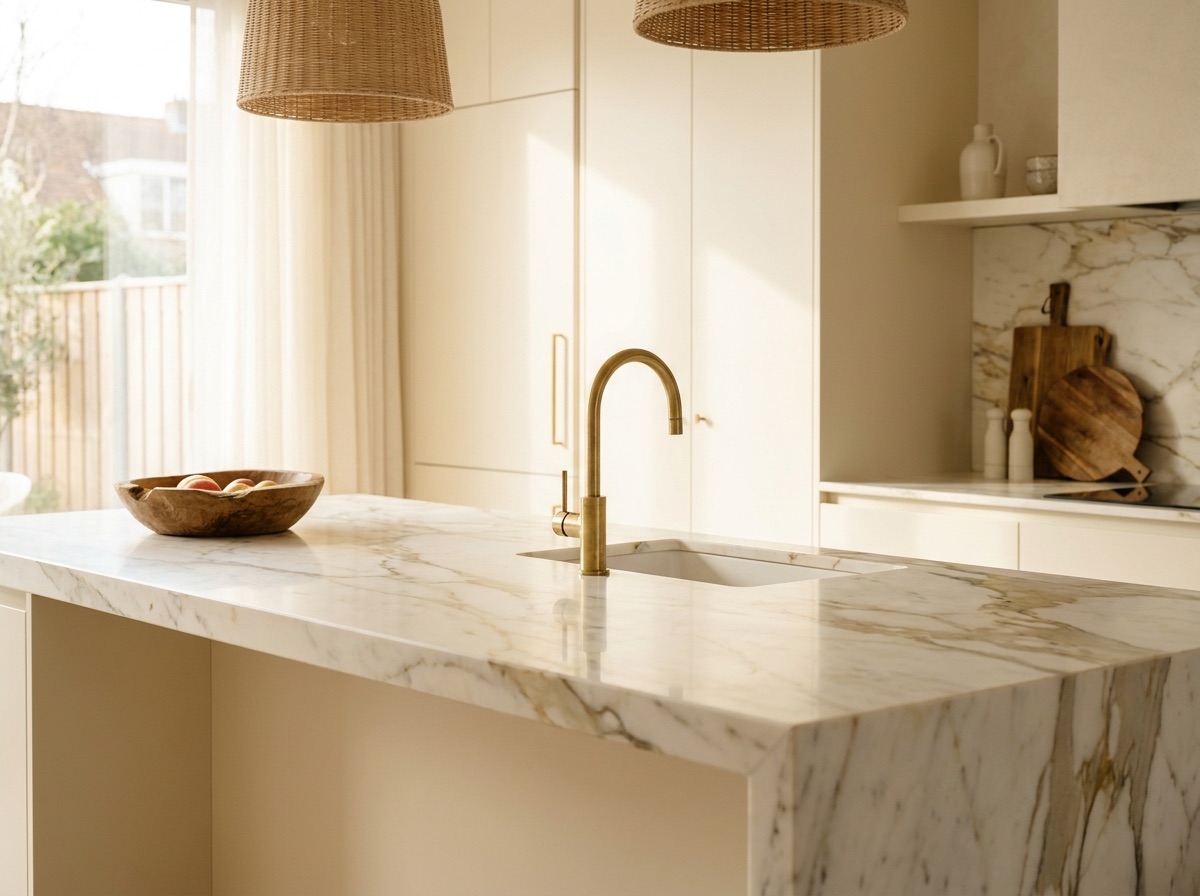
Marble countertops are the category where the gap between what the stone costs and what the homeowner pays is widest. In the US, installed marble countertops run $40 to $250 per square foot as a market estimate for August 2026, depending on the stone, the fabricator and the region. The same countertop, cut to size at a mill in China with polished edges and sink cut-outs already done, starts around $18 per square foot factory-direct. The stone is often literally the same material; the difference is who does the cutting and how many hands touch the slab on the way to your kitchen.
This guide breaks down where the money goes in a countertop quote, when factory-direct cut-to-size makes sense and when it does not, which stones hold up on a working counter, and how the ordering process actually runs from template to crate. The figures here are market estimates as of August 2026; our partner mill in China quotes factory-direct against your drawings, and every number worth acting on should be confirmed with a live quote.
What You Are Actually Buying
A finished marble countertop is a 2 cm or 3 cm slab section, cut to the plan of your cabinets, with edges profiled and polished, cut-outs made for the sink, hob and faucets, and a sealer applied. In the Western supply chain, a fabricator buys a full slab from a stone yard, templates your kitchen, cuts and polishes locally, and installs. In the factory-direct model, the mill does everything except the final installation: you send dimensioned drawings, the factory returns finished pieces in a crate, and a local installer sets them.
Factory cut-to-size suits projects where dimensions are known and repeatable: new construction, hotel and multi-unit developer work, kitchen retailers selling standard runs, and renovators comfortable providing accurate field measurements. It suits one-off retrofits with tricky walls less well, because the factory cuts to your numbers, not to a laser template of your actual room. Out-of-square walls are handled with scribe allowances or a slightly oversized piece trimmed on site.
Price Economics: Where the $40-250/sqft Goes
Take a mid-range installed price of $100 per square foot in the US. The raw slab typically accounts for $15 to $40 of that; Carrara slabs trade around $40 to $90 per square foot at Western warehouses, while Guangxi White, the Chinese stone with a very similar look, trades at $15 to $35. Fabrication - cutting, edge polishing, cut-outs - adds $30 to $60 per square foot at Western shop rates. Templating, delivery and installation add $10 to $30. The remainder is showroom overhead and margin.
Factory-direct cut-to-size collapses the fabrication line item, because the mill's labor and machine time cost a fraction of a Western shop's. From $18 per square foot you get a finished, polished, cut-out-ready countertop in an entry-level white marble; premium stones price higher but the fabrication component barely moves. You still pay freight, duty and local installation, so the honest comparison is landed-plus-install versus local-installed, not factory price versus retail price.
Landed cost basics for a countertop order: ocean freight for a shared container adds roughly $2 to $6 per square foot depending on volume and route; US duty on worked marble articles plus any prevailing tariff measures must be checked against the current HTS schedule at order time; crating is usually included in factory quotes. As a rule of thumb, factory price plus 25 to 45 percent gets you to a landed US warehouse cost on a consolidated shipment. Even after that, a $25 landed square foot against $100 installed leaves generous room for the installer and still beats retail.
Best Stones for Countertops
Carrara ($40-90/sqft slab, market estimate) is the default: cool white, soft grey veining, forgiving of the honed finish most fabricators recommend for kitchens. Calacatta ($80-250/sqft) and Calacatta Gold ($100-300/sqft) are the statement choices for islands and baking counters, with bold veining that book-matches across a waterfall edge. Statuario ($80-220/sqft) sits between them, brighter than Carrara with higher-contrast veins.
For budget-driven volume work, Guangxi White at $15-35 per square foot delivers the Carrara aesthetic at a fraction of the price and is the workhorse of hotel and developer projects. Nero Marquina ($40-90/sqft) makes a dramatic bathroom vanity counter, though black polished marble shows etching more readily than white. Be realistic about marble in kitchens: it etches with lemon juice and wine and scratches more easily than granite or quartz. Buyers who want the marble look with zero maintenance should compare sintered stone; buyers who accept patina get a surface no engineered product matches.
Specs and Formats: Thickness, Edges, Finishes
Standard thicknesses are 2 cm (3/4 inch) and 3 cm (1 1/4 inch). North America mostly specifies 3 cm, which spans dishwashers without extra support; Europe and Asia commonly use 2 cm, sometimes with a laminated mitred edge that reads as 4 cm or 6 cm.
Common edge profiles - eased, bullnose, half bullnose, ogee, bevel and mitred waterfall - are all standard factory work; complex ogee profiles that carry a surcharge locally cost little extra in the factory quote. Finishes are polished, honed or leathered. Honed is the practical kitchen choice because etching shows far less on a matte surface. Every finished piece should arrive sealed.
Templating and Cut-Outs
The factory cuts to the drawing you approve, so the drawing carries all the risk. For new cabinetry, the cabinet plan plus standard overhangs is usually enough. For existing kitchens, field-measure the walls at counter height in several places, record out-of-square conditions, and either add a scribe allowance or accept a small site trim. Digital templating files (DXF from a laser templater) are the gold standard and any competent mill accepts them directly.
Cut-outs need exact models in hand: sink make and model with the manufacturer's cut-out template, hob dimensions, faucet hole diameters and spacing. Undermount sink cut-outs are polished on the inside edge at the factory - another expensive local operation that costs almost nothing done inline. Specify drainboard grooves, if wanted, at drawing stage. The one rule that prevents most disputes: never let the factory guess.
Quality Control Checklist
Before the crate closes, the QC pass should confirm: dimensions within plus or minus 1 mm on length and width; thickness tolerance within 1 mm across the piece; cut-outs matching the templates supplied; edge polish continuous with no chatter marks; surface polish at a consistent gloss reading with no dull windows; no cracks, filled fissures in structural positions, or sticker stains; and vein direction matching the approved layout photos.
Insist on layout approval before cutting: the mill photographs your pieces drawn on the actual slabs so you approve where the veins fall, which matters enormously on book-matched islands. After cutting, ask for photos of every piece, front and back, plus a video of water poured across the surface to reveal any polish waves. Third-party inspection runs $150 to $300 per man-day in Chinese stone hubs and is cheap insurance on a first order.
MOQ and Lead Times
The practical minimum is about 10 countertops - one crate - which is a market-standard threshold rather than a hard law of physics. Below that, crating and documentation costs eat the saving; a single countertop shipped alone from China rarely beats a local fabricator once freight is counted. Ten kitchens, a small hotel floor, or a builder's phase of townhouses is where the economics turn decisively.
Lead times run 3 to 5 weeks in production for standard stones held in block or slab stock, plus 30 to 40 days ocean transit to a US or EU port, plus customs clearance and inland delivery. Call it 10 to 12 weeks door to door on a normal order. Rare stones that must be sourced as blocks add weeks.
The Ordering Process, Step by Step
First, drawings: cabinet plans or field measurements, sink and hob templates, edge profile, finish, stone selection. Second, quotation: a serious factory quote itemizes per-piece pricing, crating, and FOB or CIF terms, and states tolerances. Third, slab approval: photos or video of the actual slabs allocated to your order, with layout marked. Fourth, production and in-process photos. Fifth, QC and crate photos showing pieces foam-separated and braced upright in fumigated wooden crates. Sixth, shipping documents - bill of lading, packing list, commercial invoice - and customs clearance, handled by your broker or the mill's freight partner.
Payment is typically 30 percent deposit, balance against QC photos before shipment. On first orders, structure the balance payment after you have seen the inspection report, not before production ends.
Care and Maintenance
Marble is calcium carbonate, and acids etch it: lemon, vinegar, wine, some cleaners. Sealing slows staining but does not stop etching, which is a physical change in the polish, not a stain. Kitchen owners should use cutting boards, wipe spills promptly, clean with pH-neutral stone soap, and reseal every 6 to 12 months depending on use.
None of this is a defect - it is how the material behaves, and a factory-direct buyer should set end-customer expectations honestly. A marble counter that has been used and maintained for a decade develops a patina many owners actively prefer; the ones who will hate it should be steered to harder stones before the order, not after.
Frequently asked questions
How much do marble countertops cost installed in the US?
As a market estimate for August 2026, installed marble countertops run $40 to $250 per square foot in the US depending on the stone, edge work and region. Carrara at the low-to-mid end and heavily veined Calacatta at the top. Factory-direct cut-to-size from China starts around $18 per square foot before freight, duty and local installation.
Is it cheaper to import marble countertops from China?
At volume, yes. Factory cut-to-size from $18 per square foot plus roughly 25 to 45 percent for freight, duty and crating lands well below Western fabricated prices, which start around $70 to $100 per square foot before installation. For a single countertop the math usually fails because crating and freight minimums dominate; from about 10 countertops - one crate - it works.
What is the minimum order for factory-direct countertops?
About 10 countertops, which fills one export crate. Below that, fixed costs of crating, documents and port handling erode the saving. Builders, kitchen retailers and hotel projects clear this threshold easily; single-kitchen renovators are usually better served locally unless they can pool an order.
Should I choose 2 cm or 3 cm marble for countertops?
North American practice favors 3 cm for stiffness and the ability to span appliances without subtops. 2 cm is standard in Europe and works well with proper support, and a 2 cm top with a laminated mitred edge gives a thick look at lower weight and freight cost. Factories do laminated edges cheaply, so the thick-look option is more affordable factory-direct than locally.
Does marble etch and stain in a kitchen?
Yes. Acids like lemon and wine etch the surface regardless of sealer, and oils can stain unsealed stone. A honed finish hides etching well, sealing every 6 to 12 months controls staining, and re-polishing is a routine restoration job. Buyers who cannot accept any patina should consider harder materials before ordering.
How long does a factory-direct countertop order take?
Plan 10 to 12 weeks door to door: 3 to 5 weeks production, 30 to 40 days on the water to a US or EU port, then clearance and delivery. Rare stones sourced as blocks add time. There is no meaningful way to compress the ocean leg, so the schedule discipline sits in the drawing and approval stage.
What information does the factory need to quote a countertop order?
Dimensioned drawings or a cabinet plan, stone selection, thickness, edge profile, finish, and cut-out templates for sinks, hobs and faucets. With a complete package a mill returns an itemized quote in two or three working days. Incomplete drawings are the single biggest cause of delays and disputes, so send templates, not descriptions.