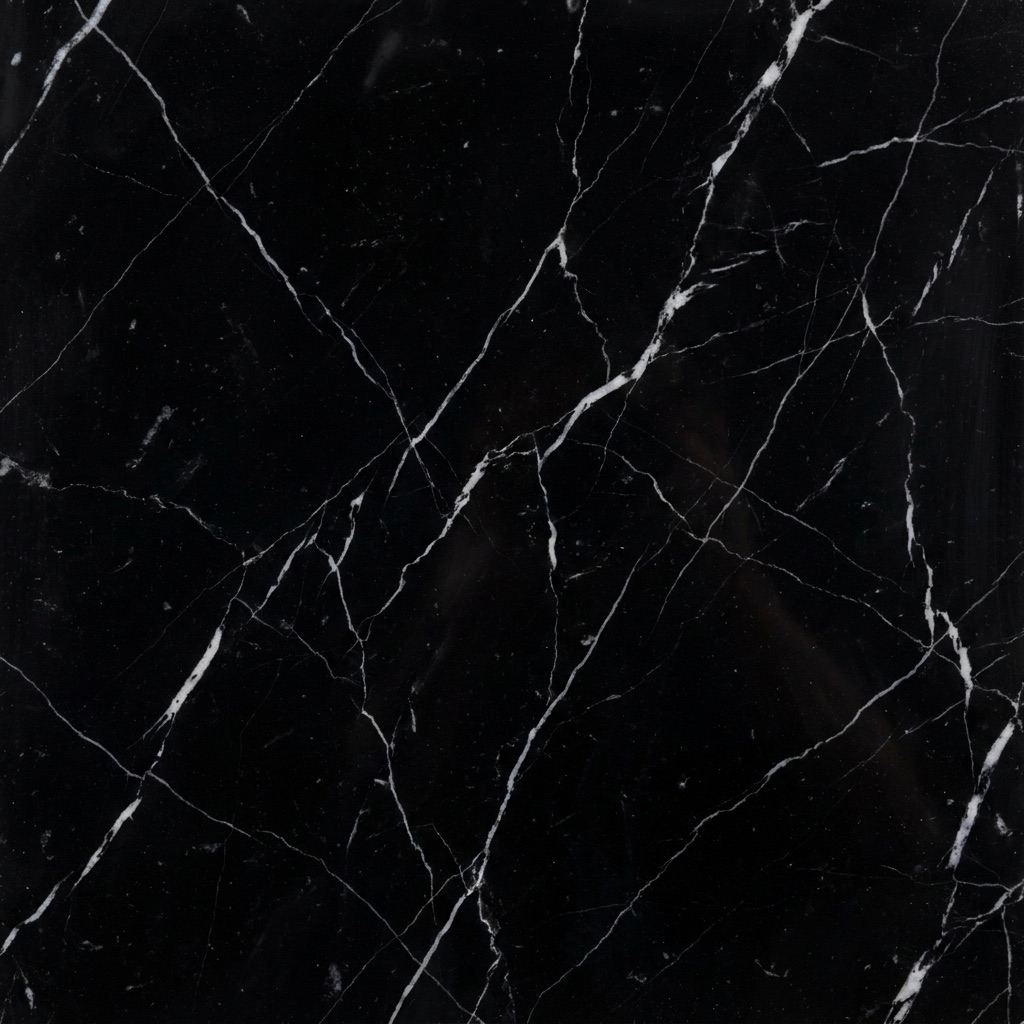
Black marble is not one stone — it is a category in which four very different products compete for the same look: Nero Marquina from Spain, China Black and Mongolia Black from northern China, and the Indian blacks. As a category, slabs run roughly 30 to 80 dollars per square foot ex-warehouse in Western markets, based on our market estimates (August 2026).
Specifying black marble without naming the stone leaves 50 dollars per square foot on the table — or buys the wrong look entirely. This guide compares the major blacks side by side: what each actually looks like, where each comes from, what each costs, and how to decide which one your project needs before anyone quotes you.
What Black Marble Is: Geology and the Colour Problem
Commercial black marbles are mostly fine-grained limestones and dolomitic stones dark enough and dense enough to take a polish — blackened by organic carbon or bituminous content locked in during deposition. The trade calls them all marble, and for buying purposes the label works: they cut, polish, etch and wear like marble, not like granite. The carbon origin explains the category's one shared weakness — prolonged ultraviolet exposure fades the black toward grey, which keeps true black marble indoors.
The colour itself is the first quality axis. A premium black reads deep blue-black or neutral black under daylight; commercial grades drift toward dark grey or show brownish undertones. The second axis is figure: from the white lightning of Marquina through the faint grey threads of China Black to the near-total darkness of premium Mongolia Black. Price follows origin and figure far more than it follows blackness alone.
The Four Stones: Marquina, China Black, Mongolia Black, Indian Black
Nero Marquina, from a single quarry district in Spain's Basque Country, is the category's flagship: deep black with sharp white calcite veining, priced at 40 to 90 dollars per square foot on its own (market estimates, August 2026) — the top of the black market. China Black, quarried mainly in Hebei and neighbouring provinces, delivers a solid black ground with sparse fine veining at sharply lower cost. Mongolia Black, from Inner Mongolia, is prized for the most even, deepest near-solid black in the volume trade and has become the default black for minimalist architecture.
The Indian blacks round out the field with dense, dark material that overlaps the granite trade — some Indian black products sold as marble are closer to fine-grained limestone, and the pricing sits in the lower half of the category. As a rule of thumb across the family: the Spanish stone sells figure, the Chinese stones sell field, and the Indian stones sell volume.
Grades, Veining and Selection Across the Category
Grading black marble is about ground first: depth and evenness of the black, absence of grey wash, brown zones and rust spotting from iron minerals. Second, soundness: black shows filled fissures and repairs more clearly than any white stone, and a cheap fill across a polished black face catches light like a scar. Third, figure control: for veined stones, the white must be crisp; for solid blacks, the buyer is paying precisely for the absence of figure, so stray veining is a defect rather than character.
Selection protocol should match. Demand raking-light photos — low-angle shots under strong light that expose fills, hazing and polish variation invisible in straight-on captures — alongside daylight shots for ground colour. For book-matched veined material, the standard rules apply: sequential slabs, numbered dry-lay, approved cutting plan. For solid blacks bought at volume, one honest production sample from the actual lot tells you more than fifty photos.
Black Marble Prices in 2026
As a category, black marble slabs run 30 to 80 dollars per square foot ex-warehouse in Western markets — market estimates (August 2026). The Chinese and Indian blacks populate the lower half of that range, with volume cut-to-size tile pricing efficiently below slab rates; premium Mongolia Black lots with dead-even ground sit mid-range; and Nero Marquina extends the category's ceiling, trading at 40 to 90 dollars per square foot as its own line (market estimates, August 2026).
Installed numbers follow the standard stack: US fabrication and installation typically adds a broad 30 to 60 dollars per square foot, so finished black marble surfaces commonly land between 60 and 140 dollars per square foot as a typical US market figure. Fabrication quality matters disproportionately, because seam adhesive, edge chips and polish inconsistency all show against black.
Factory-direct is where the category's economics get interesting, because for once the factories are the origin. China Black and Mongolia Black are quarried and processed domestically in China, so factory-direct buying removes every intermediate margin, and even Spanish Marquina blocks are processed in Chinese mills at scale. Factory-direct quotes typically run 30 to 60 percent below Western warehouse prices across the category, and for the domestic Chinese stones the gap can sit at the deeper end of that band.
Choosing Between the Blacks: A Decision Framework
Start from the look, not the name. If the design needs white-on-black drama — chequerboard floors, veined feature walls, statement vanities — you need Nero Marquina. If the design needs an even, uninterrupted black field — minimalist kitchens, monolithic cladding, plinths and furniture — Mongolia Black delivers exactly that at a fraction of Marquina money.
China Black is the volume answer between those poles: darker than commercial-grade Marquina's grey drift, quieter than its veining, at the most efficient price in the category for large areas. And one honest boundary for the whole category: if the surface is a hard-working kitchen counter or an outdoor application, black granite — Absolute Black and its peers — beats every black marble on acid, scratch and ultraviolet resistance.
Where Black Marble Works Best
The category's natural territory is interior drama: bathroom walls and vanities, chequerboard and bordered floors with white marble, fireplace surrounds, bar fronts, reception desks, stair treads and furniture tops. Black marble anchors contrast schemes that white-only palettes cannot achieve.
The boundaries are clear. Outdoors, ultraviolet fades carbon-based blacks toward grey, so exterior cladding and pool surrounds belong to black granite. On polished working counters, etching reads as grey ghosts against the black — honed and leathered finishes are the professional standard for any black surface that will meet lemons and wine. High-traffic polished black floors show wear paths faster than white ones; honed finishes and walk-off matting extend them indefinitely.
Fabrication and Finishes
Black marbles machine cleanly — fine grain, predictable density — but they expose fabrication quality mercilessly. Polish must be even and deep or the surface shows cloudiness at raking angles; edges must be crisp because chipped arrises flash white against black; seams need colour-matched adhesive and tight tolerance. Standard formats are 2 cm and 3 cm slabs plus calibrated tile from 1 cm, and the dense grain takes sharp mitres well.
Finish selection does more work in black than in any other marble family. Polished maximises depth and drama and shows every mark; honed reads charcoal, hides etching and wear, and is the default for working surfaces; leathered adds a tactile texture that masks use almost completely while paradoxically deepening the perceived black. Whatever the finish, apply and renew a penetrating sealer: absorbed oil rings show more on black than anywhere.
Care and Maintenance
The chemistry is calcite-standard: no vinegar, no citrus-based cleaners, no bathroom descalers — pH-neutral stone soap only, with sealer renewed roughly annually on working surfaces. The optics are category-specific: dust, fingerprints, water spotting and etch ghosts all show against black in a way white marble owners never experience.
Management is finish and routine: honed or leathered surfaces cut the visible-mark burden by an order of magnitude, microfibre keeps polished black presentable between cleanings, and hard-water areas benefit from wiping shower walls after use. Restoration economics favour black strongly — the colour runs through the body of the stone, so professional grinding and re-polishing returns a uniform black with no visible patching.
Sourcing Checklist for Buyers and Importers
First, name the stone: the invoice must state Nero Marquina, China Black, Mongolia Black or the specific Indian material — black marble as a line item is an invitation to substitution. Second, ground verification: daylight photos for colour depth, raking-light photos for fills and polish quality, on every slab for veined material and per lot for solid blacks. Third, a physical production sample from the actual lot before volume orders; between-lot variation is the category's main quality risk.
Fourth, match the channel to the stone: the Chinese blacks are domestic products of the factory-direct channel — quoting them through a Western warehouse adds margin without adding assurance — while Spanish Marquina should carry origin documentation whichever mill processed it. Fifth, benchmark: the category trades at 30 to 80 dollars per square foot in Western warehouses, Marquina at 40 to 90 (market estimates, August 2026), and factory-direct should land 30 to 60 percent below comparable grade. Specify edge and seam quality in writing, insure transit at replacement value.
Frequently asked questions
How much does black marble cost per square foot?
As a category, black marble slabs run roughly 30 to 80 dollars per square foot ex-warehouse in Western markets (market estimates, August 2026), with Chinese and Indian blacks in the lower half and Nero Marquina extending to 90 dollars as the premium line. Installed surfaces typically land between 60 and 140 dollars per square foot in the US. Factory-direct quotes run 30 to 60 percent below Western warehouse prices.
What is the difference between Nero Marquina and China Black?
Figure and origin. Nero Marquina, from Spain, carries sharp white calcite veining on a deep black ground and trades at 40 to 90 dollars per square foot (market estimates, August 2026). China Black offers a quieter, near-solid black with sparse fine veining at substantially lower cost. If the design needs the white lightning, only Marquina delivers it; if it needs an even black field, the Chinese stone is often the better and cheaper answer.
Is Mongolia Black real marble?
It is a very fine-grained black stone from Inner Mongolia that the trade classifies and sells as marble — it cuts, polishes and behaves like marble rather than granite. Its commercial claim is the most even, deepest near-solid black in the volume market, which has made it the default specification for minimalist black interiors at a fraction of Spanish Marquina pricing.
Is black marble good for kitchen countertops?
Only with a honed or leathered finish and realistic expectations: polished black shows etch marks from acids as grey ghosts more visibly than any white marble. For hard-working kitchens, black granite such as Absolute Black outperforms every black marble on acid, heat and scratch resistance. Black marble earns its place on vanities, bars, walls and floors, where its drama outweighs its maintenance temperament.
Does black marble fade in sunlight?
Yes — the black in these stones comes largely from organic carbon, and prolonged ultraviolet exposure fades it toward grey. That is why black marble is an interior material, and exterior cladding, terraces and pool surrounds are specified in black granite instead. Indoors, away from direct constant sun, the colour is stable for the life of the building.
Why is black marble cheaper factory-direct from China?
Because for most of the category, China is the origin, not just the processor: China Black and Mongolia Black are quarried and finished domestically, and Chinese mills also process a large share of Spanish Marquina blocks. Buying factory-direct removes the entire Western distribution margin, which is why quotes typically run 30 to 60 percent below warehouse prices — at the deeper end for the domestic Chinese stones.
Which black marble is best for a bathroom?
For veined drama on walls and vanities, Nero Marquina is the category benchmark. For a calm, even black — floors, monolithic cladding, minimalist schemes — Mongolia Black gives the cleanest field at lower cost. Either way, specify honed finish for wet areas and floors: it hides water spotting and etching, and improves slip resistance over polished.