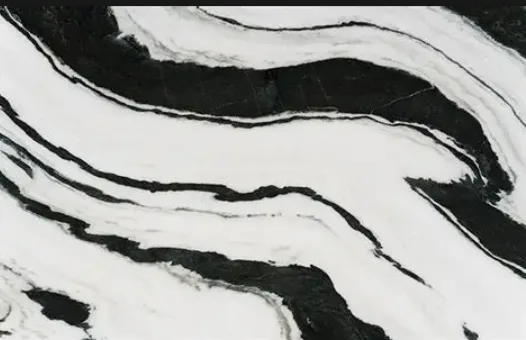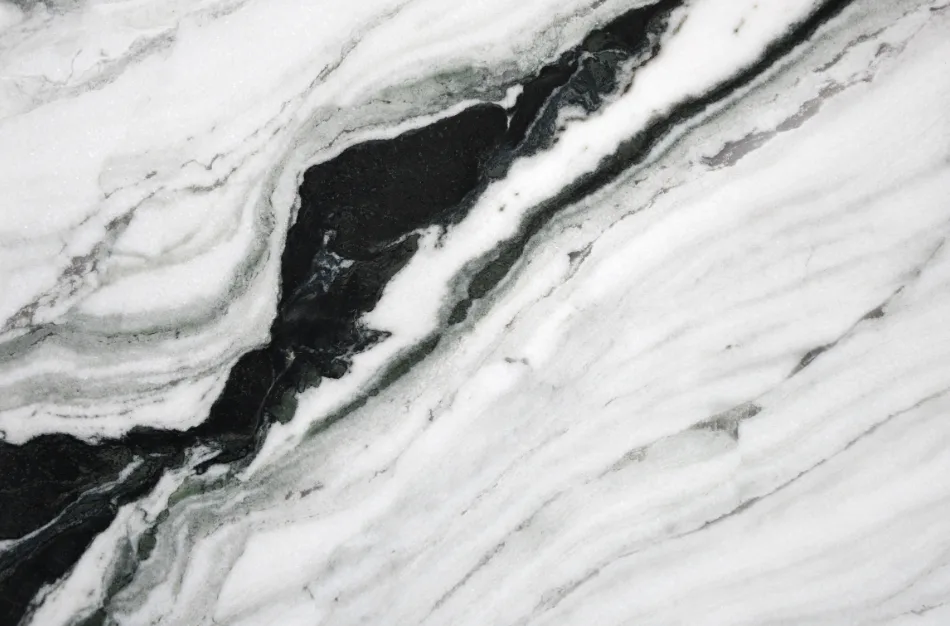
Panda White is the stone China stopped imitating others with. Where Guangxi White chases the Carrara look, Panda White looks like nothing else: a white ground crossed by bold black veins that sweep across the slab like ink brush strokes. Our index tracks it at $50 to $130 per square foot for polished 2 cm slabs, ex-warehouse, as market estimates (August 2026) — premium money by Chinese-stone standards, and the market pays it because there is no substitute.
This is home-turf material for our partner mill: quarried in Sichuan, slabbed and matched in Chinese processing clusters, and sold West through a chain that typically doubles the mill price by the time a slab reaches a US showroom. The factory-direct spread of 30 to 60 percent applies with full force, and on a stone where slab selection decides everything, buying at the source also means choosing your slabs instead of taking what the local yard has left.
Geology and what makes Panda White distinctive
Panda White is a calcite marble in which pale recrystallized ground alternates with dark carbon-bearing bands, folded by metamorphism into the sweeping high-contrast veining the trade named after the panda's coat. The black is geological ink: carbonaceous material concentrated along original sediment layers, deformed into curves and brush-stroke figures that no two blocks repeat.
Two properties define it commercially. First, the contrast itself — a genuine black-on-white at this boldness is rare worldwide, which is why Panda White gets compared to art more than to other stones. Second, directionality: the same block yields calm linear figure or wild abstract figure depending on cutting plane, making the mill's judgment a bigger share of the final result than in almost any other marble. It is a stone you buy by the slab photo, never by the name.
Quarries and supply
Commercial Panda White comes from Sichuan province — the Baoxing county area of Ya'an is the recognized source, a district with a long white-marble history now best known internationally for this one dramatic stone. Output is modest by Chinese standards: mountain quarrying in a seismically active, environmentally regulated region, with block recovery constrained by the same fracturing that gives the stone its figure. This is no Hezhou-style industrial cluster; supply is finite and lumpy, and premium blocks are allocated to mills with standing relationships.
Blocks travel to processing hubs in Sichuan and the coastal clusters for slabbing, resin work and matching. Because figure quality varies so widely, sorting is where value concentrates: a mill that buys whole blocks and sequences them properly captures book-match sets worth multiples of random-slab pricing. Western warehouses typically receive pre-sorted mixed lots — why showroom Panda White is often mid-grade at top-grade prices. Factory-direct buying through a mill with Sichuan block access, our partner's position, moves the selection decision to you before the ocean freight rather than after.
Grades and veining
Grading Panda White is grading the drawing. Top grade: clean white ground with bold, continuous, well-composed black veining that flows across the slab and pairs into coherent book-matches. Middle grade: good contrast but broken or busy figure, greyer ground, or veining crowded to one end. Commercial grade: washed-out grey-on-grey contrast, smudged veining, heavy fill — still handsome, but not the poster material, and priced well down the band.
The black veins deserve their own inspection line: carbon-rich zones can be weaker than the calcite ground, so factory resin reinforcement along major veins is standard and honest. What you check is execution — fill flush and color-matched, mesh backing on vein-heavy slabs, no live cracks running with the figure. What matters most is the mill's block-by-block choice of cutting plane to maximize figure — one more reason the processor's skill is embedded in the price.
Price breakdown: slab, cut-to-size, installed
Our index band is $50 to $130 per square foot for polished 2 cm slabs ex-warehouse, as market estimates (August 2026). Figure quality is the axis: commercial lots populate the bottom third, coherent bold-figure slabs the middle, composed book-match sets the top. Three-centimeter material adds the usual 40 to 50 percent; cut-to-size panels add 20 to 50 percent over slab cost and, for book-matched walls, are effectively mandatory — the mill lays out, matches, cuts and labels the sequence so the figure survives contact with the installer.
Installed, a Panda White feature wall in the US typically lands at $120 to $300 per square foot all-in as a broad market figure, driven by stone grade, panel work and setting complexity. Factory-direct arithmetic: mill pricing runs 30 to 60 percent below Western warehouse levels, plus roughly $4 to $8 per square foot in container freight and duties. On a $100-per-foot stone the absolute saving per container comfortably funds the inspection and the overage — the correct way to spend part of it. What moves an individual quote: figure coherence first, ground cleanliness second, set composition third, then slab size and resin honesty.
Panda White vs the alternatives
Nothing substitutes exactly, which is the point, but three comparisons frame the decision. Against Nero Marquina ($40 to $90): the inverse — white lightning on black ground — cheaper, more available, calmer; Panda White is the louder, rarer statement. Against premium Italian whites: Statuario at $80 to $220 and Calacatta at $80 to $250 offer prestige, but their veining whispers where Panda White shouts; designers cross-shop them for feature walls at similar money.
Against man-made lookalikes: sintered stone and porcelain print convincing panda-style graphics at a fraction of the price, with repeats a trained eye catches at the second panel. For a hard-use floor the print may be rational; for the lobby wall the client will photograph, the repeat is what you paid to avoid. If the budget cannot reach real, well-figured Panda White, a calmer genuine stone usually beats a fake dramatic one.
Applications
Feature walls are the stone's reason to exist: book-matched lobbies, fireplace surrounds, headboard walls, restaurant and retail statements — anywhere a single plane of stone carries the room. Bathrooms are the second home: vanities, shower walls and full-height cladding where the figure turns a small space into a set piece. Furniture follows — table tops, reception desks, bar fronts — where one well-chosen slab does the work of an art budget.
Flooring is selective territory: the stone wears like any calcite marble, and busy figure on large floors can overwhelm, so designers deploy it as borders or entry medallions rather than full fields. Kitchens carry the standard marble caveats, pushing most deployments to islands and splashbacks rather than work zones. Exterior use is not recommended: UV and weather dull the polish and stress the resin along the very veins that make the stone worth buying.
Fabrication and finishes
Panda White fabricates like a mid-hardness marble with one governing rule: protect the figure. Every cut is planned against the veining, and on book-match work the fabricator follows the mill's numbered sequence exactly. The carbon veins can be brittle at edges and cutouts, so slabs want full support, sharp tooling and generous radii at internal corners; mesh backing on vein-heavy slabs should stay on until the panel is set.
Polished is the default finish and earns it: gloss maximizes the black-white contrast that defines the stone. Honed mutes the drama — approve a honed sample first, because the veining goes charcoal-soft and the ground greys down. Book-matching doubles waste and the invoice reflects it; quad-matching more still. Panda White is not translucent — light frames it, not through it. Sealed cut edges and color-matched epoxy at joints keep the figure reading continuously across panels.
Care and maintenance
Standard calcite rules: acids etch, grit scratches, and sealer slows absorption without preventing etching. The white ground etches like any white marble, while the black veins show scratches more visibly than the ground — a reversal of the dark-stone-hides-everything intuition. Vertical installations, where most Panda White lives, largely sidestep all of it; dust and fingerprints are the maintenance story on a feature wall.
For horizontal surfaces: penetrating sealer annually, pH-neutral cleaners only, boards and coasters as policy. Re-polishing is routine restoration work, with one caution — aggressive grinding can smear resin fill along the carbon veins, so name the stone when booking the service. Light-colored setting materials prevent moisture shadows in the white ground. Treated as the display material it is, Panda White ages as well as any marble in the index; the figure does not fade, and the stone's whole value sits in that figure.
Sourcing checklist for Panda White
Buy slabs, not names. Demand photos of every slab face with IDs — and for feature walls, the mill's composed layout: panels numbered against your elevation, dry-lay photographed before crating. Approve figure grade against control photos rather than physical samples alone; a small sample cannot represent a stone whose value is the drawing across three meters. Specify resin and mesh standards, flush color-matched fill, and edge condition per panel.
Commercially: quotes FOB Chinese port for clean comparison; CIF to your port to see freight honestly. Contract the tolerances — breakage, off-grade, figure mismatch against approved photos — and replacement terms before the deposit, and order 10 to 15 percent overage from the same blocks, because matching Panda White figure after the fact is close to impossible. Pre-shipment inspection with dry-lay is non-negotiable at this price band. Done through a mill with direct Sichuan block access, the factory-direct route delivers the two things a Western yard cannot: first pick of the figure, and 30 to 60 percent off the warehouse number.
Frequently asked questions
How much does Panda White marble cost per square foot in 2026?
As market estimates (August 2026), Panda White runs $50 to $130 per square foot for polished 2 cm slabs, ex-warehouse. Figure quality drives position in the band: commercial grey-on-grey lots at the bottom, bold coherent black-on-white figure in the middle, and composed book-match sets at the top. An installed feature wall in the US typically lands at $120 to $300 per square foot all-in.
Where does Panda White marble come from?
From Sichuan province in southwestern China — the Baoxing area of Ya'an is the recognized source. Blocks are slabbed and matched in Sichuan and coastal Chinese processing hubs. Supply is modest and premium blocks are allocated to mills with quarry relationships, which is why slab selection at the source matters more with this stone than with volume materials.
Is Panda White a real marble?
Yes — a calcite marble whose black veining comes from carbon and graphite-bearing bands folded through a white recrystallized ground. It behaves like other calcite marbles in service: it etches on acid contact, scratches under grit, and wants sealing on horizontal surfaces. The black veins are resin-reinforced at the factory as standard practice, since carbon-rich zones can be weaker than the ground.
What is Panda White marble used for?
Primarily book-matched feature walls — lobbies, fireplaces, headboards, restaurants — plus statement bathrooms, vanity tops, table tops and reception desks. It is used selectively for flooring as borders or medallions rather than full fields, and kitchens carry standard marble caveats. Exterior use is not recommended because weathering stresses the resin along the veins.
Why do Panda White slab prices vary so much?
Because the figure is the product. Two slabs of identical size can differ threefold when one carries continuous, well-composed veining and the other a broken, smudged pattern. Book-match sets price above random slabs, and Western showroom lots are often pre-sorted mixed grades — which is why buying against photos of the actual slabs is the only sane method.
Is it cheaper to buy Panda White factory-direct from China?
Typically 30 to 60 percent below Western warehouse prices for the same material, since this is Chinese home-turf stone and the import chain's margins drop out. Equally valuable: factory-direct buyers select figure before shipment instead of taking a yard's leftovers. Container freight and duties add roughly $4 to $8 per square foot; pre-shipment inspection with dry-lay photos is essential at this price band.