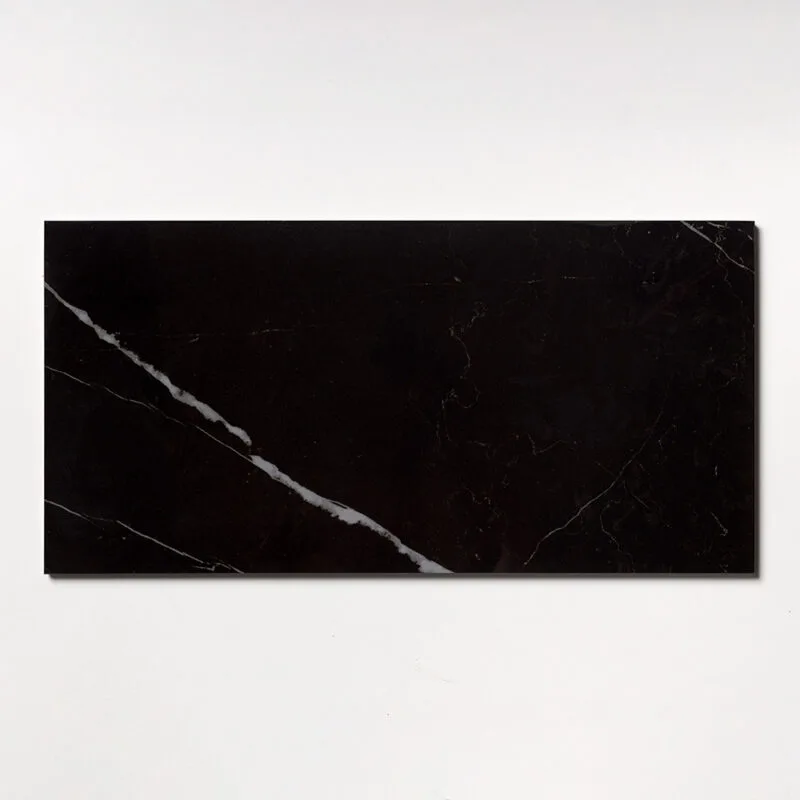
Nero Marquina is the reference black marble of the international trade: a deep, saturated black ground cut by sharp white calcite veins, quarried around the town of Markina in Spain's Basque Country. Polished 2 cm slabs trade at roughly 40 to 90 dollars per square foot ex-warehouse in Western markets, based on our market estimates (August 2026).
The stone's position in the market is unusual: it is a premium-image material at mid-range money — the same price band as Carrara — which makes it one of the highest impact-per-dollar stones you can specify. It also faces the most direct lookalike competition of any famous marble, from Chinese blacks that trade well below it. This guide covers what drives Nero Marquina pricing, when the Spanish original earns its premium, and when a Chinese black is the smarter buy.
What Makes Nero Marquina Distinct
Nero Marquina is a fine-grained black limestone-marble whose colour comes from organic carbon locked into the stone during deposition, cut through by veins and fragments of white calcite. The contrast is the signature: not grey-on-dark but genuinely white-on-black, sharp-edged, often with fossil traces visible inside the white passages — the stone is of sedimentary origin and shell fragments are part of its character, not a defect.
Vein expression varies widely. Some blocks yield an almost solid black with sparse lightning-thin whites; others produce dense, dramatic webs of white covering a third of the surface. What the market consistently pays for is depth of black (no grey wash, no brown undertone) and crisp definition in the whites.
Quarries and Block Supply
Production concentrates in a compact quarry district around Markina-Xemein in Bizkaia, Spain, where the black beds have been worked for over a century. Output is steady and commercially significant but far from Carrara-scale; the district's quarries are the world's single source of the true stone.
A large share of Markina block production ships east: Chinese mills are major buyers and process the blocks into slabs and cut-to-size for global distribution, alongside their own domestic black marbles. This creates the standard two-channel market. Western warehouses stock Spanish- or locally-processed material at full distribution margin; factory-direct buyers get the same Spanish blocks processed in China at typically 30 to 60 percent less. For volume projects — flooring packages, hotel bathrooms across a hundred keys — the second channel is usually decisive.
Grades, Veining and Book-Matching
Grading runs on blackness first, vein quality second, soundness third. Premium lots show a deep, even, blue-black ground with clean white veining and minimal grey clouding. Commercial grades drift toward grey-black or show brownish oxidation zones, dull whites, or heavy fossil clustering that reads as noise. Soundness matters more than in white marble: black stone shows filled fissures and repairs clearly, and a poorly filled line across a black polished surface catches light like a scratch.
Book-matching Nero Marquina produces some of the most dramatic compositions in the stone world — white lightning mirrored across a black field on shower walls, fireplace surrounds and bar fronts. The selection rules are the standard ones: sequential slabs from one block, numbered dry-lay approved before cutting. A black-specific addition: inspect slabs at a low angle under strong light, because surface defects, wheel marks and resin hazing that vanish on white marble are glaring on polished black. The inspection photo set should include raking-light shots, not just straight-on captures.
Nero Marquina Prices in 2026
Polished 2 cm Nero Marquina slabs run 40 to 90 dollars per square foot ex-warehouse in Western markets — market estimates (August 2026). The bottom of the range buys commercial grade with greyer ground or busy fossil content; the top buys deep-black select lots with crisp veining. Cut-to-size tile in standard formats prices efficiently because the Markina district and its Chinese processing partners run high-volume tile lines alongside slab production.
Installed economics track the mid-premium band. US fabrication and installation typically adds a broad 30 to 60 dollars per square foot on kitchen and vanity work, so installed Nero Marquina surfaces commonly land between 70 and 150 dollars per square foot as a typical US market figure. One cost line deserves attention: edge and seam work on black stone demands better finishing, because adhesive lines and chipped arrises that disappear on white marble are conspicuous on black.
Factory-direct pricing from Chinese mills — whether on Spanish Markina blocks or at the buyer's option on Chinese black marbles — typically runs 30 to 60 percent below Western warehouse levels. On a stone whose Western price is already moderate, the absolute saving per square foot is smaller than on Calacatta, but volume changes that: black marble is a high-quantity specification stone for flooring and cladding, and container-scale orders convert the percentage into serious money.
Nero Marquina vs Chinese Blacks and Other Dark Stones
The comparison every buyer should run is against the Chinese black marbles — China Black, Mongolia Black and their trade-name variants — which deliver a deep black ground at a fraction of Markina money; the broader black marble category trades at 30 to 80 dollars per square foot (market estimates, August 2026) with the Chinese stones populating its lower half. The honest differences: Mongolia Black tends toward a near-solid black with little veining, which for minimalist schemes is exactly the point, while none of the Chinese stones reproduce Markina's sharp white-on-black lightning. If the design needs the veining, you need the Spanish stone; if it needs an even black field, you may not.
Beyond the lookalikes, the practical rivals are black granites — Absolute Black and its peers — which resist acid, scratching and heat far better and are the rational choice for hard-working black kitchen counters. The granite trades the marble's white drama and soft lustre for durability. Marble-look black quartz exists but suffers on two fronts: printed veins repeat, and resin-bound black surfaces show fine scratches quickly. For floors, walls and statement pieces, natural black marble holds its ground; for the heaviest-use counters, granite is the professional recommendation.
Where Nero Marquina Works Best
Nero Marquina concentrates impact in bathrooms and contrast schemes: vanity tops, shower walls, chequerboard floors with white marble, fireplace surrounds, bar fronts and furniture. The black-and-white chequerboard with Carrara or Thassos remains one of the most requested marble floor formats in the trade.
As a kitchen counter it is beautiful and demanding: etching shows on black more than on any white stone. Honed Nero Marquina largely neutralises the problem and has become the standard specification for working black surfaces. Outdoors it is a qualified no — ultraviolet exposure fades black marble toward grey over time, so exterior cladding and pool surrounds are better served by black granite. Interior floors, walls and low-splash areas are the stone's natural territory.
Fabrication and Finishes
Nero Marquina works cleanly on modern lines but punishes sloppiness: chips, adhesive shadows and polish variation all read clearly against black. The white calcite veins are marginally softer than the black ground and can polish at slightly different rates — competent mills manage this; cheap processing leaves the whites hazy. Standard thicknesses are 2 cm and 3 cm slabs plus 1 to 2 cm calibrated tile, and the stone takes crisp mitres well.
Finish choice is more consequential than on white marble. Polished delivers the mirror-black drama and shows every fingerprint, etch and scratch; honed gives a soft charcoal-black that hides wear and has become the default for counters and floors; leathered adds texture that masks use almost completely while deepening the visual black. Whichever is chosen, seal it: black marble is not more porous than white, but any absorbed oil ring shows more.
Care and Maintenance
The care rules are calcite-standard — pH-neutral cleaners, no vinegar or descalers, penetrating sealer renewed roughly annually on working surfaces — applied with the knowledge that black shows everything. Etch marks appear as dull grey spots, water spotting and fingerprints are a daily reality on polished surfaces.
The management strategies are finish and habit: honed or leathered surfaces reduce the visible-mark problem by an order of magnitude, microfibre cleaning keeps polished black presentable, and periodic professional re-polishing erases accumulated wear completely. Deep scratches and etches on black marble restore particularly well — the colour is through the body of the stone, so grinding and re-polishing returns a uniform black with no patching visible.
Sourcing Checklist for Buyers and Importers
First, origin honesty: confirm whether you are being quoted Spanish Nero Marquina or a Chinese black sold under a compatible name — both are legitimate products at different prices, and the invoice should say which. Second, black-specific inspection: raking-light photos of every slab to expose fills, hazing and polish variation, plus straight-on daylight shots for ground depth; a grey-washed black is a grade problem visible only with proper photography. Third, fossil and vein content: agree the acceptable range with reference images, because one buyer's character is another's defect.
Fourth, fabrication interface: seam placement and edge details matter more on black — approve the cutting plan and specify edge finishing quality in writing. Fifth, benchmark: Western warehouse Nero Marquina runs 40 to 90 dollars per square foot (market estimates, August 2026); factory-direct should land 30 to 60 percent below the comparable grade, and Chinese blacks below that again in the 30 to 80 dollar category range (market estimates, August 2026). For volume orders, request a production sample from the actual lot — black stones vary less within a block than whites, so one honest sample tells you most of what you need.
Frequently asked questions
How much does Nero Marquina marble cost per square foot?
Polished 2 cm slabs run roughly 40 to 90 dollars per square foot ex-warehouse in Western markets, based on market estimates (August 2026). Installed surfaces typically land between 70 and 150 dollars per square foot in the US once fabrication is added. Factory-direct quotes from Chinese mills — including on Spanish Markina blocks they process — typically run 30 to 60 percent below Western warehouse prices.
Is Nero Marquina more expensive than Chinese black marble?
Yes. Nero Marquina trades at 40 to 90 dollars per square foot while the broader black marble category, dominated at the low end by China Black and Mongolia Black, runs 30 to 80 (market estimates, August 2026). The Spanish stone earns its premium with the sharp white-on-black veining no Chinese black reproduces. If the design calls for an even, near-solid black, the Chinese stones are often the smarter buy.
Where does Nero Marquina come from?
A single quarry district around Markina-Xemein in the Basque Country of northern Spain — the world's only source of the true stone. A large share of the blocks is exported and processed in China into slabs and tiles for global distribution, which is why the same Spanish stone can carry very different price tags depending on where it was sawn and who sold it.
Is Nero Marquina good for kitchen countertops?
With the right finish, yes. Polished black marble shows etching, fingerprints and scratches more than any white stone, so the standard professional specification for working counters is honed or leathered, which hides wear dramatically better. For the hardest-use kitchens, black granite like Absolute Black outperforms any marble on durability, at the cost of the white veining.
Does Nero Marquina fade or change colour?
Indoors, no — the black is stable for the life of the building. Outdoors, ultraviolet exposure gradually fades black marble toward grey, which is why exterior cladding, terraces and pool surrounds are normally specified in black granite instead. Etching from acids appears as dull grey spots on the polished surface but is fully removable by professional re-polishing.
Are the white marks in Nero Marquina fossils?
Often, yes. The stone is of sedimentary origin, and shell and fossil fragments are frequently visible inside the white calcite passages — the trade considers them part of the stone's character rather than defects. Vein and fossil density varies block to block, so agree acceptable reference images with your supplier before production if you want a specific look.