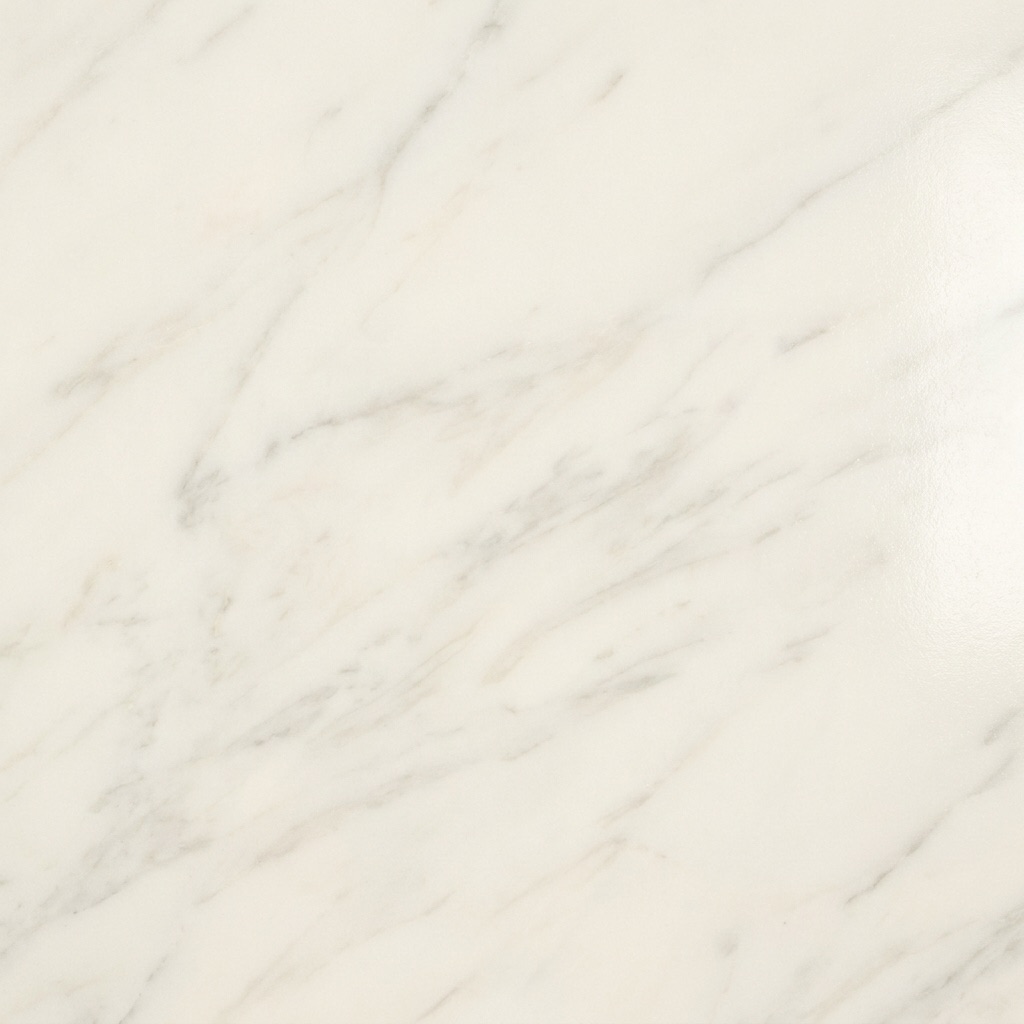
Carrara is the reference white marble of the global stone trade. Quarried in the Apuan Alps above the Tuscan town of the same name, it has been cut continuously since Roman times, and today it moves through the market in higher volume than any other Italian marble. That volume is exactly why it is the most price-transparent stone you can buy: polished 2 cm Carrara slabs trade at roughly 40 to 90 dollars per square foot ex-warehouse in Western markets, based on our market estimates (August 2026).
The wide spread inside that range is not noise. It reflects grade, background tone, vein consistency and where in the supply chain you buy. A C-grade slab with heavy grey clouding sits at the bottom of the range; a clean CD slab with a bright field and even feathering sits near the top. This guide breaks down what drives the number, how Carrara compares with its cheaper Chinese lookalike Guangxi White, and how factory-direct sourcing changes the economics.
What Carrara Marble Is: Geology and Appearance
Carrara is a metamorphosed limestone formed roughly 200 million years ago, recrystallised under heat and pressure into a fine, sugary calcite grain. The background ranges from cool white to pale blue-grey, and the veining is soft, feathery and grey. Mineralogically it is calcite through and through, which means it is softer than granite or quartzite, reads around 3 on the Mohs scale, and reacts with acids.
The commercial family is broader than one stone. Bianco Carrara C is the whiter, cleaner commercial grade; Bianco Carrara CD carries slightly more grey and stronger veining; Venatino shows more defined, linear veins; Bardiglio is the grey-ground cousin from the same basin. When a supplier quotes you simply Carrara, the first question to ask is which of these they actually mean, because the price gap between a dull C-grade lot and a select Venatino lot can be 50 percent or more.
Quarries and Block Supply
The Carrara basin holds well over a hundred active quarry sites across three main valleys: Torano, Miseglia and Colonnata. Annual output of blocks and slabs from the district is measured in the millions of tonnes, which makes Carrara the most reliably supplied premium white marble on earth.
For buyers, the supply picture matters in one practical way: availability of consistent material. Because so many blocks come out of the mountain, a fabricator can usually source ten or twenty slabs from the same block for a large project. Chinese mills buy Carrara blocks in volume, process them on modern gang saws and resin lines, and sell finished slabs and cut-to-size at prices Western warehouses cannot match, because the block cost is the same but labour and margin structures are not.
Grades, Veining and Slab Selection
Carrara grading is informal but consistent across the trade. Grade C means a whiter background with light, dispersed veining; grade CD sits between white and grey with more pronounced movement; grade D is greyer and cloudier and usually flows into commercial flooring lots. Within any grade, individual slabs vary block by block, so serious buyers select from slab photos or live video of the actual bundle, never from a generic sample tile.
Book-matching — polishing consecutive slabs on opposite faces so the vein pattern mirrors — is possible with Carrara but less dramatic than with bold-veined stones, since the veining is diffuse. Where it does matter is consistency: for a kitchen with an island, waterfall ends and full-height splashback, insist that all pieces come from sequential slabs of one block. Mixed-block Carrara installations are the most common and most avoidable disappointment in white marble work, because background tone shifts visibly between blocks.
Carrara Marble Prices in 2026
Polished 2 cm Carrara slabs run 40 to 90 dollars per square foot ex-warehouse in Western markets — market estimates (August 2026). The low end buys commercial C or D grade with grey clouding; the high end buys select, bright, evenly veined material from a premium block. Honed finish typically prices at parity or a few percent above polished because it is an extra pass through the line on the same material.
Slab price is only the start of the installed number. In the US, fabrication and installation — templating, cutting, edge profiles, cut-outs, sealing, fitting — typically adds a broad 30 to 60 dollars per square foot on a standard kitchen, so installed Carrara counters commonly land in the 70 to 150 dollars per square foot band as a typical US market figure. Cut-to-size tiles and vanity tops price differently again: you pay for finished pieces, not slab area, which usually works out cheaper for repetitive formats like 12x24 flooring.
Factory-direct is where the economics shift. Because Chinese mills buy the same Apuan blocks and process them at far lower cost, factory-direct quotes for Carrara slabs and cut-to-size typically come in 30 to 60 percent below Western warehouse prices for equivalent grade. On a container-scale order — a hotel floor package or a multi-unit developer buy — that difference is the largest single saving available anywhere in the project, larger than any discount a local distributor can offer.
Carrara vs Guangxi White, Statuario and Quartz
Guangxi White is the comparison every volume buyer should run. Quarried in Guangxi province, China, it offers a similar cool-white ground with light grey veining at 15 to 35 dollars per square foot — market estimates (August 2026) — roughly a third of Carrara money. Up close the grain is finer and the veining less organic, and it is generally considered slightly softer and more absorbent, but on a hotel corridor floor or a retail wall, most observers cannot tell the difference. For budget-driven projects that need the Carrara look, it is the rational default.
Statuario, from the same Carrara basin, is the upgrade path: a brighter, more luminous white with bold grey veining at 80 to 220 dollars per square foot (market estimates, August 2026). You are paying two to three times Carrara money for rarity and drama. Engineered quartz in Carrara-look patterns prices near mid-range Carrara once installed and wins on stain resistance, but it is a printed pattern — repeats become visible on large runs, it cannot take heat like stone, and it adds nothing at resale. Real Carrara remains the value benchmark of the three.
Where Carrara Works Best
Carrara's sweet spot is broad coverage where a refined white surface matters more than a dramatic centrepiece: bathroom walls and floors, shower surrounds, vanity tops, fireplace surrounds, furniture tops and full-floor installations. Its diffuse veining is forgiving across large areas — it reads as texture rather than pattern, so tile-to-tile variation blends instead of clashing.
In kitchens it performs well with realistic expectations. It etches with lemon juice and wine, and it will develop a patina of use. For commercial lobbies and high-traffic floors, specify a honed finish — polished floors show wear paths within a few years, honed ones hide them almost indefinitely.
Fabrication and Finishes
Carrara is a fabricator-friendly stone: uniform hardness, predictable behaviour on the saw and CNC, and rare surprises inside the block. Standard thicknesses are 2 cm and 3 cm; 2 cm with a mitred, laminated edge gives the chunky look at lower material weight and cost.
The three commercial finishes are polished, honed and brushed. Polished maximises the white and gives the classic gloss but shows etching most clearly. Honed is matte, hides etch marks and fine scratches, and has become the default for kitchen counters. Brushed or leathered finishes add subtle texture and further mask wear, though they slightly darken the stone. Whatever the finish, a penetrating sealer is applied at fabrication and renewed periodically in service.
Care and Maintenance
Carrara care comes down to three rules: seal it, wipe spills promptly, and never clean it with acid. A quality penetrating sealer, reapplied roughly annually on kitchen surfaces, buys you time against oil and wine stains. Vinegar, lemon and mainstream bathroom descalers dissolve the calcite surface on contact and leave dull etch marks — pH-neutral stone soap is the only cleaner that should touch it.
Etching and light scratching are repairable, which is a genuinely underrated property of marble. A stone restorer can re-hone or re-polish a twenty-year-old Carrara counter back to new for a fraction of replacement cost, something impossible with engineered quartz.
Sourcing Checklist for Buyers and Importers
Before committing, verify five things. First, grade and block identity: ask for photos or video of the actual slabs with slab numbers, and confirm all material for one visual area comes from one block in sequence. Second, thickness and calibration: 2 cm nominal should measure 2 cm with tight tolerance, and cut-to-size must arrive calibrated if it is going onto a thin-set floor. Third, resin and mesh disclosure: most commercial Carrara is resin-treated; that is normal, but undisclosed heavy mesh backing on a countertop slab is a red flag for structural quality.
Fourth, the commercial terms: an ex-works China price means nothing until you add freight, insurance, duty and inland delivery, so ask the mill to quote landed or at least FOB with a realistic freight estimate — a competent partner will do this without being pushed. Fifth, crating standard: slabs must ship on A-frames in fumigated wooden crates with corner protection; ask for photos of previous shipments. On volume, get a per-square-foot price broken out by slab, cut-to-size and waste allowance, and benchmark it against the 40 to 90 dollar Western warehouse range — the gap is your negotiating room.
Frequently asked questions
How much does Carrara marble cost per square foot?
Polished 2 cm Carrara slabs run roughly 40 to 90 dollars per square foot ex-warehouse in Western markets, based on market estimates (August 2026). Installed kitchen counters typically land between 70 and 150 dollars per square foot in the US once fabrication and fitting are added. Factory-direct quotes from Chinese mills for the same grade are typically 30 to 60 percent below Western warehouse slab prices.
Is Carrara cheaper than Calacatta?
Yes, significantly. Carrara trades at 40 to 90 dollars per square foot while Calacatta runs 80 to 250 dollars per square foot (market estimates, August 2026). Calacatta is rarer, whiter and more dramatically veined, and its supply is a fraction of Carrara's, which keeps the premium wide. If you want the white marble look at sane money, Carrara is the value pick.
Is Guangxi White as good as Carrara?
It is a credible lookalike at a third of the price — 15 to 35 dollars per square foot against Carrara's 40 to 90 (market estimates, August 2026). The grain is finer, the veining slightly less organic, and it is a touch softer and more absorbent. For volume flooring and wall cladding it is often the smarter buy; for a showpiece counter where provenance matters, genuine Carrara still wins.
Does Carrara marble stain and etch easily?
It etches with any acid — lemon, vinegar, wine — because it is calcite, and no sealer prevents etching. Staining from oil and coloured liquids is largely controllable with a penetrating sealer and prompt wiping. A honed finish hides etch marks far better than polished, which is why honed has become the standard for Carrara kitchen counters.
Can I buy Carrara marble factory-direct from China?
Yes. Chinese mills import Apuan blocks in volume and sell finished slabs and cut-to-size worldwide, typically 30 to 60 percent below Western warehouse prices for equivalent grade. The trade-offs are lead time — usually 4 to 8 weeks plus ocean freight — and the need to verify grade from slab photos or video before shipment. For container-scale orders the saving is usually decisive.
What thickness should I order for countertops and floors?
Countertops are 2 cm or 3 cm; 2 cm with a laminated mitred edge is the cost-efficient route to a thick look. Flooring is typically 1 cm to 2 cm calibrated tile depending on format and substrate. Wall cladding can go as thin as 1 cm.