Guangxi White is the highest-leverage stone in our index: nothing else delivers the white-marble look at anywhere near its price. We track it at $15 to $35 per square foot for polished 2 cm slabs, ex-warehouse, as market estimates (August 2026) — roughly a third of Carrara money for a related cool-white, grey-veined aesthetic. It is the stone behind thousands of hotel bathrooms, retail fit-outs and residential towers across Asia and the Middle East.
It is also our partner mill's home-turf stone, which makes this the page where the factory-direct argument is most concrete: Guangxi White bought from a US warehouse and at the mill in China is the same material separated by an ocean of margin — typically 30 to 60 percent. This guide covers what the stone is, where it genuinely beats Carrara, where it does not, and how to buy it at the source without getting burned on grade.
Geology and what makes Guangxi White distinctive
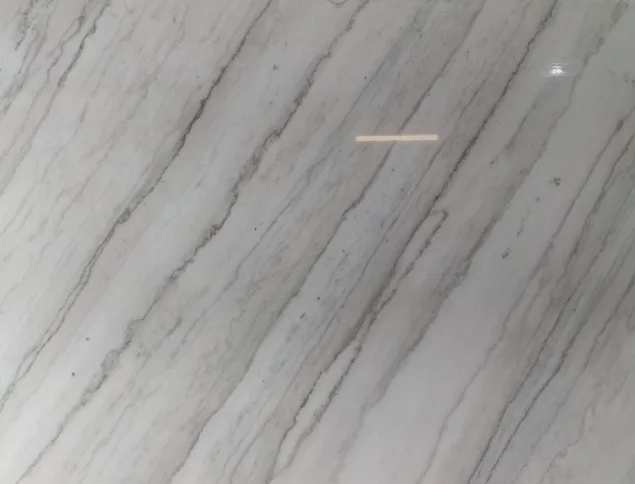
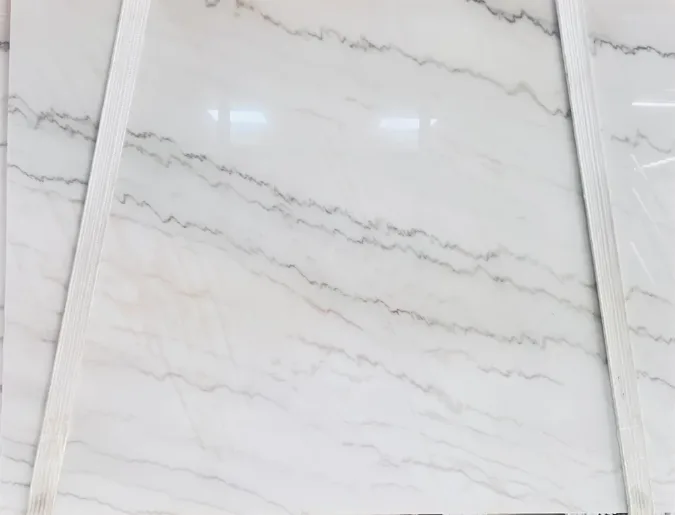
Guangxi White is a fine-grained white marble from the karst country of Guangxi in southern China — most production centers on Hezhou, one of the world's largest white-stone clusters. The stone presents a cool white to pale-grey ground with light grey veining, sometimes diffuse and cloudy, sometimes in soft linear streaks. At arm's length a good slab reads unmistakably as the Carrara family; that resemblance is the entire commercial story.
Mineralogically it is a calcite marble, and much Hezhou material runs softer and more open-grained than the Italian benchmarks. Practically, that means slightly higher absorption and lower polish endurance than Carrara — differences that matter on a hardworking countertop and barely register on a wall, a maintained floor, or a vanity. The stone's real distinctiveness is economic: vast reserves, mechanized quarrying, and a processing cluster sitting next to the quarries — an alignment no European white can match on cost.
Quarries, the Hezhou cluster and supply
The Hezhou district in eastern Guangxi anchors production, with hundreds of quarry faces and processing lines within a short truck run — block to gangsaw to polishing line to container yard, sometimes inside one industrial park. Adjacent Guangdong mills and the Yunfu hub take part of the flow. This density is why Guangxi White behaves more like a manufactured product than a quarried one: supply is continuous, and no single quarry closure moves the market.
For buyers, cluster economics cut both ways. Supply security and price competition are excellent; consistency across suppliers is not, because dozens of quarries sell superficially similar material with real differences in whiteness, soundness and veining. The stone travels under multiple trade names — Guangxi White, China Carrara, Cloud White, Bianco China — and two quotes with different names may be the same stone. The fix is procedural: buy against approved control samples and block-specific photos, through a mill holding standing block contracts rather than trading whatever is cheap that week — exactly the role our partner mill plays.
Grades and veining
The trade sorts Guangxi White into three tiers. Premium: white, even ground with faint well-dispersed veining and minimal rust spotting — the material that genuinely stands in for Carrara, and the top of our band. Standard: greyer or creamier ground, more pronounced veining, occasional filled pinholes — the volume workhorse for flooring and cladding. Commercial: grey-cast ground, muddy veining, visible fill — priced to win projects where the spec says white stone and the budget says very little.
Two grade-specific watch items. First, iron content: some beds carry pyrite that develops rust specks in wet settings, so wet-area and exterior orders should specify low-iron material and a water test on samples. Second, vein direction: cross-cut gives a cloudy field, vein-cut linear striping, and mixed cutting in one order looks like an error at installation. State the cut, grade and control sample in the contract, and the stone is as predictable as any in our index.
Price breakdown: slab, cut-to-size, installed
Our index band is $15 to $35 per square foot for polished 2 cm slabs ex-warehouse, as market estimates (August 2026) — commercial grade at the bottom, premium at the top. FOB mill pricing sits meaningfully below those warehouse numbers; the 30 to 60 percent factory-direct spread is widest on exactly this kind of volume stone, because the Western chain's fixed margins are proportionally huge on a cheap slab. Three-centimeter material adds roughly 40 to 50 percent; calibrated tile formats price below slab at volume.
Cut-to-size is where Guangxi White shines: vanities, treads, sills and full bathroom packages cut to drawing typically add 20 to 50 percent over slab cost and delete nearly all destination fabrication — the formula hotel programs run on. Installed white-marble countertops in the US typically land at $60 to $200 per square foot; a Guangxi White program using factory cut-to-size undercuts the local-fabrication path by a wide margin because both material and labor content shift to the mill.
Container arithmetic: a 20-foot container holds roughly 3,500 to 4,500 square feet of 2 cm slab, or substantially more in tile, with freight, insurance and duties to a US port typically adding $4 to $8 per square foot. Even at the top of that range, landed premium-grade Guangxi White arrives below most Western warehouse pricing for comparable material — the arithmetic that makes this stone the gateway purchase for factory-direct sourcing.
Guangxi White vs Carrara and other whites
Against Carrara ($40 to $90 in our index): Carrara wins on hardness, polish endurance, tighter grain and brand; Guangxi White wins on price by roughly a factor of three at comparable visual grade. On a wall, a floor field or a hotel vanity, the difference disappears at viewing distance. On a heavily used kitchen counter, Carrara's tighter surface earns its premium. Specify by exposure, not by prestige.
Against Vietnamese whites ($20 to $45 typical): Vietnamese material is whiter and more crystalline — closer to a budget Thassos — but block consistency is weaker and good lots get cherry-picked early. Against Han White ($25 to $70): finer-grained and the carving choice, but not a slab-volume stone. Against engineered quartz and porcelain: the manufactured options win on maintenance and lose on authenticity; at Guangxi White's price point the cost argument inverts — real stone becomes the cheaper option, which almost never happens elsewhere in the index.
Applications
Volume interiors are the core: hotel bathrooms from one material package, lobby and corridor flooring, retail fit-outs, staircases, sills and reception cladding. Developers use it to put real marble in mid-market residential where the alternative was ceramic. It book-matches acceptably at premium grade, and its price makes full-height marble bathrooms — walls included — a rational spec rather than a splurge.
Countertops are viable with expectations set: like every calcite marble it etches, and its slightly higher absorption wants disciplined sealing. Honed finishes serve it well in kitchens. Exterior cladding and paving appear across Asia; for exteriors specify low-iron lots, thicker panels and mechanical fixing, and validate freeze-thaw data for cold climates rather than assuming it. The stone's sweet spot is simple: anywhere the design calls for the white-marble look across serious square footage, Guangxi White is the budget answer that still is marble.
Fabrication and finishes
Guangxi White processes easily — softer than Italian whites, fast on the saw — which is part of its cost story. The flip side: edges chip more readily than Carrara, so factory edge profiles matter, and its softness rules out the thinnest unsupported details. Slabs arrive polished and lightly resined; honest mills tell you which bundles carry mesh.
Finish options: polished is standard, though its gloss retires sooner underfoot than harder whites — plan periodic re-polishing on commercial floors. Honed is the workhorse spec for kitchens, treads and wet floors; sandblasted and bush-hammered serve anti-slip roles. The cut decision changes the look more than the finish does and costs nothing — decide it deliberately. For cut-to-size programs, the mill's shop-drawing discipline is the real quality variable: insist on drawing sign-off, labeled crates and installation sequencing.
Care and maintenance
The calcite rules apply, slightly amplified: acids etch, and the more open grain absorbs oils and water a touch faster than Italian benchmarks, so sealing discipline matters more, not less. Penetrating sealer renewed annually on horizontals; pH-neutral cleaners only; white setting materials to prevent shadowing and moisture staining from behind.
In service the stone behaves predictably. Periodic re-honing or re-polishing restores traffic lanes indefinitely, and the material's low cost makes even replacing a worn zone economical — an option Carrara owners do not enjoy. Watch rust spotting in permanently wet settings on lots not specified low-iron. Restoration contractors charge no more to polish Guangxi White than Carrara — one more place where the cheaper stone quietly wins the lifetime-cost comparison.
Sourcing checklist: buying at the source
Grade control is everything with this stone. Approve a physical control sample per grade, and buy against block-specific bundle photos with slab IDs — never against the trade name alone. Specify in the contract: grade, cut direction, thickness and tolerance, finish, low-iron requirement for wet use, and packing standard (fumigated crates, foam interleaving, sea-worthy strapping).
Commercially: quote FOB Chinese port as the comparison basis, with CIF separately to see the freight line. Pre-shipment inspection is non-negotiable — dry-lay photos of every bundle, or third-party inspection for first orders. Agree breakage and off-grade tolerances and replacement terms before the deposit, and order 5 to 10 percent overage. A first container of Guangxi White is the classic proof-of-concept for factory-direct sourcing: modest capital at risk, the widest price spread in the index — typically 30 to 60 percent below Western warehouse levels — and a stone forgiving enough that a competently inspected order simply works.
Frequently asked questions
How much does Guangxi White marble cost per square foot in 2026?
As market estimates (August 2026), Guangxi White runs $15 to $35 per square foot for polished 2 cm slabs, ex-warehouse — commercial grade at the bottom, premium Carrara-lookalike grade at the top. Factory-direct FOB pricing from mills in the Hezhou cluster sits meaningfully lower still, which is where the typical 30 to 60 percent saving versus Western warehouses comes from.
Is Guangxi White a real substitute for Carrara marble?
At viewing distance, yes: a premium-grade slab shows the same cool white ground and soft grey veining. Up close and in service, Carrara is harder, tighter-grained and holds polish longer, which matters on hardworking countertops. For walls, floors, vanities and volume projects, Guangxi White delivers the Carrara aesthetic at roughly a third of the price.
Why is Guangxi White marble so cheap?
Structural economics, not hidden defects: vast reserves, mechanized quarrying, and processing mills next to the quarries in the Hezhou cluster, with intense supplier competition and no scarcity premium. The stone is somewhat softer than Italian whites, but the price gap is mostly supply-side, not quality-side.
What should I check before buying Guangxi White from China?
Grade against a physical control sample, cut direction, low-iron specification for wet or exterior use, and bundle photos with slab IDs of the actual material. Insist on pre-shipment inspection with dry-lay photos, contractual breakage and off-grade tolerances, and 5 to 10 percent overage. The stone is forgiving; the discipline is in the paperwork.
Is Guangxi White marble good for kitchen countertops?
Usable with marble expectations: it etches on acid contact like all calcite stones and absorbs slightly faster than Carrara, so annual sealing and pH-neutral cleaning are required, and a honed finish hides wear best. For heavy-use kitchens, harder stones earn their premium. For bathrooms, walls and floors — the stone's core territory — it performs excellently.
How much Guangxi White fits in a shipping container?
A 20-foot container carries roughly 3,500 to 4,500 square feet of 2 cm slab, or substantially more as calibrated tile. Freight, insurance and duties to a US port typically add $4 to $8 per square foot across a full container, and landed cost still arrives below Western warehouse pricing for comparable material — the arithmetic that makes container-scale factory-direct orders work.