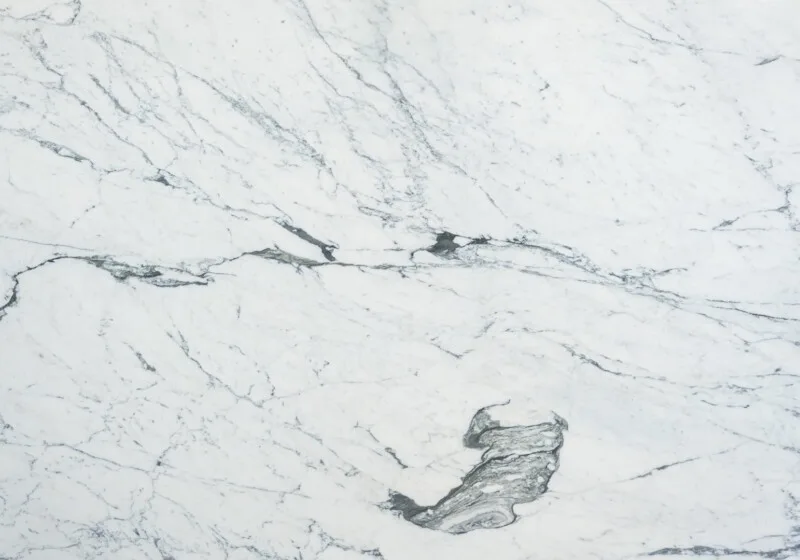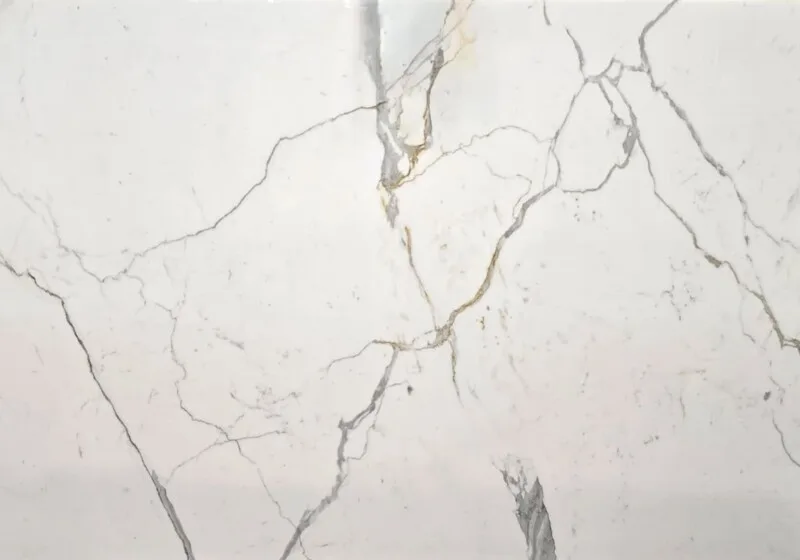
Statuario is the sculptor's marble — the stone Michelangelo chose for the David — and in the modern trade it occupies a precise niche: the most luminous white ground in the Apuan Alps, crossed by bold grey-to-charcoal veining. It is brighter than Carrara, more graphic than most Calacatta, and priced accordingly: polished 2 cm slabs trade at roughly 80 to 220 dollars per square foot ex-warehouse in Western markets, based on our market estimates (August 2026).
Buyers reach for Statuario when they want maximum contrast — a pure white field with confident dark veins — without the warm tones that define Calacatta Gold. Supply is genuinely limited: the historic Statuario benches high in the mountains above Carrara produce a small fraction of the basin's output, and the name attracts as much relabelling as any in the stone trade. This guide covers what the real material costs, how to verify it, and where factory-direct sourcing fits.
What Makes Statuario Distinct
Statuario earned its name from statuary: its fine, dense calcite grain and luminous white ground made it the preferred medium of Renaissance sculptors, and that same optical quality is what the architectural market pays for today. The stone transmits light a few millimetres into its surface before reflecting it, producing a depth — almost a glow — that flatter, chalkier whites lack. Veining runs grey to charcoal, typically bolder and more linear than Carrara's feathering, on a field noticeably whiter than either Carrara or most Calacatta.
The commercial category spans Statuario proper, Statuario Venato with its more pronounced linear veining, and Statuarietto — a more affordable, smaller-figured cousin that shares the bright ground but with busier, finer veins. The distinctions matter commercially: Statuarietto trades far below true Statuario, and slabs of it are routinely offered under the senior name. As with all Apuan whites, the label on the ticket is a claim, not a fact — the ground colour and vein character are the evidence.
Quarries and Block Supply
True Statuario comes from a small group of historic quarry zones high in the Carrara basin, and annual output of genuine premium blocks is modest — a rounding error against the basin's total tonnage. The best material sells into a global network of slab producers, and top blocks are frequently committed before sawing.
The processing picture mirrors the rest of the Apuan trade: Italian mills saw and finish a share of the output, while Chinese mills buy blocks at the same auctions and process them at substantially lower cost. For a stone with Statuario's price tag, that processing arbitrage is material — factory-direct quotes on equivalent grade typically run 30 to 60 percent below Western warehouse pricing. The constraint is authentication rather than logistics: the further you buy from the quarry, the more documentation you should demand.
Grades, Veining and Book-Matching
Statuario grading turns on the whiteness and clarity of the field first, vein quality second. The premium tier is a bright, even, luminous white with charcoal veins that travel the slab in bold, legible strokes. Mid-grade material shows a slightly creamy or grey-shifted field, or veining that fragments into busy networks. Anything with a genuinely grey ground is Carrara-class material regardless of the name on the invoice, and priced honestly it would sit 100 dollars per square foot lower.
High-contrast linear veining makes Statuario one of the most rewarding stones to book-match: mirrored sequences produce strong symmetrical compositions — chevrons, diamonds, cathedral arches — on shower walls, island waterfalls and lobby cladding. The requirements are the standard ones, applied strictly: sequential slab numbers from one block, a numbered dry-lay approved before cutting, and a fabrication plan that respects vein direction across pieces. With veins this graphic, a seam that breaks a vein mid-stroke is visible across a room; plan seams into quiet zones of the slab.
Statuario Marble Prices in 2026
Polished 2 cm Statuario slabs run 80 to 220 dollars per square foot ex-warehouse in Western markets — market estimates (August 2026). The bottom of the range buys Statuarietto-adjacent material or true Statuario with muted figure; the top buys premium blocks with the luminous field and confident charcoal veining the name promises. Between the poles, whiteness of ground is the strongest single price predictor.
Installed numbers follow the premium-white pattern. US fabrication and installation for statement work typically adds a broad 40 to 80 dollars per square foot, putting finished Statuario kitchens commonly in the 150 to 320 dollars per square foot band as a typical US market figure. Book-matched bathroom walls price by composition rather than area: a four-slab matched wall is a fabrication project in its own right, and the labour premium reflects the zero-tolerance seam work.
Factory-direct sourcing from Chinese mills processing Apuan blocks typically lands 30 to 60 percent below Western warehouse pricing for equivalent grade. Statuario rewards this channel for the same reason it punishes carelessness: the price per square foot is high enough that verification effort pays for itself many times over. Numbered daylight photos against a white card are the minimum; for large orders, ask for block documentation and a video walk of the physical bundle.
Statuario vs Calacatta, Carrara and Quartz
Against Calacatta (80 to 250 dollars per square foot, market estimates, August 2026), the choice is character: Calacatta's veins are broader, fewer and often warm; Statuario's are graphic, linear and cool, on an even whiter ground. The ranges overlap almost completely, so at any given budget you are choosing a look, not a price tier. For monochrome, contemporary and gallery-like schemes, Statuario is usually the stronger fit; for warm luxury, Calacatta Gold takes over.
Against Carrara (40 to 90 dollars per square foot, market estimates, August 2026), the question is whether the luminous field and bold contrast justify roughly double the money — for broad coverage it rarely does, for a statement surface it usually does. Statuarietto occupies the middle ground at prices between the two. Engineered quartz produces more Statuario-pattern SKUs than any other marble look, and the better prints are serviceable at viewing distance; they still repeat, still read flat in raking light, and still cannot be re-polished. The natural stone's optical depth — light entering the crystal before returning — is the one property no printer reproduces.
Where Statuario Works Best
Statuario is at its best where light hits it: kitchen islands under pendants, book-matched shower and feature walls, fireplace surrounds, hotel reception desks and bathroom vanities. The luminous ground makes small spaces feel larger and brighter, which is why powder rooms and compact master baths are disproportionately common Statuario applications relative to its price.
As flooring it is spectacular and demanding: polished Statuario floors in low-traffic residential settings are showpieces, but in commercial traffic they need honing and a maintenance contract, and the budget usually argues for Carrara or a bright porcelain instead. The classic discipline applies — spend the Statuario budget where the stone is seen at eye level and touched, and support it with quieter materials elsewhere.
Fabrication and Finishes
Statuario fabricates predictably — fine, dense, uniform calcite that cuts and polishes beautifully. Bold-veined slabs carry the usual caveat about veins as planes of weakness, and long narrow pieces cut across strong veining may be rodded as a precaution. Standard thicknesses are 2 cm and 3 cm, with mitred 2 cm build-ups standard for waterfall edges.
Polished finish maximises the stone's defining asset — the luminous white — and is the default for nearly all applications. Honed Statuario is a deliberate aesthetic choice that trades glow for a soft, sculptural matte; it suits wall cladding better than counters, where the practical etch-hiding benefit competes with a real loss of brightness. Whichever finish, batch consistency matters: polish depth shifts perceived whiteness, and on a stone bought for its white, two pieces finished in different runs can read as different grades.
Care and Maintenance
Statuario follows standard calcite care: penetrating sealer at installation and roughly annually on work surfaces, pH-neutral cleaners only, and prompt wiping of acids and oils. Etching is inherent chemistry. On a polished bright-white ground, etch marks and fine scratches are more visible than on creamy or grey stones, which is the honest trade-off for the luminosity.
The compensations are real. White marble hides dust and hard-water spotting better than dark stone, refinishing restores the polished surface completely at a small fraction of replacement cost, and the material is effectively permanent. Owners who plan a professional re-polish every five to ten years on hard-working surfaces keep Statuario looking new indefinitely.
Sourcing Checklist for Buyers and Importers
First, authentication: the name Statuario is the most borrowed in the white marble trade. Verify the field colour against a white reference card in daylight photos — a grey-ground slab is not Statuario at any price — and ask whether the material is Statuario, Statuario Venato or Statuarietto, with the answer on the invoice. Second, slab-level selection: numbered photos of every slab, block number, and sequence confirmation for matched work.
Third, the fabrication interface: approve the cutting plan against slab images so the graphic veining lands where you want it, with seams routed through quiet zones. Fourth, commercial terms: grade and slab numbers on the invoice, breakage replacement terms, reinforcement disclosure. Fifth, benchmark: Western warehouse Statuario runs 80 to 220 dollars per square foot (market estimates, August 2026); factory-direct should come in 30 to 60 percent below the comparable tier, and quotes far outside that logic mean the grade, not the price, is what changed. Ship on A-frames in fumigated crates, insured at replacement value.
Frequently asked questions
How much does Statuario marble cost per square foot?
Polished 2 cm Statuario slabs run roughly 80 to 220 dollars per square foot ex-warehouse in Western markets, based on market estimates (August 2026). Installed kitchen projects typically land between 150 and 320 dollars per square foot in the US as a broad figure. Factory-direct quotes from Chinese mills processing the same Apuan blocks typically run 30 to 60 percent below Western warehouse prices.
Is Statuario more expensive than Carrara?
Yes — roughly double, tier for tier. Carrara trades at 40 to 90 dollars per square foot against Statuario's 80 to 220 (market estimates, August 2026). The premium buys a distinctly whiter, more luminous ground and bolder charcoal veining from a much smaller quarry output. For broad coverage Carrara is the value play; for statement surfaces the Statuario premium is usually justified.
Is Statuario the same as Calacatta?
No, though both come from the Carrara basin and their price ranges overlap. Statuario has the whiter, more luminous field with grey-to-charcoal linear veining; Calacatta veins are broader, fewer and often warm gold or taupe. Choose Statuario for cool, graphic, high-contrast schemes and Calacatta for warmer luxury looks. At equivalent grade the money is similar.
What is the difference between Statuario and Statuarietto?
Statuarietto is the junior cousin: the same bright ground but with finer, busier, smaller-scale veining, from more abundant material. It trades well below true Statuario and is a legitimate stone in its own right — the problem is only when it is sold under the senior name at senior prices. Ask which one you are being quoted and get it on the invoice.
Does Statuario etch and stain like other marble?
Yes — it is calcite and follows calcite rules: acids etch it regardless of sealing, oils can stain unsealed stone, and pH-neutral cleaning is mandatory. On the polished bright-white ground, etch marks show more than on creamy stones. A penetrating sealer, prompt wiping and a professional re-polish every several years keep working surfaces in showroom condition.
Can I buy Statuario factory-direct from China?
Yes. Chinese mills buy Statuario blocks at the Italian auctions and sell finished slabs typically 30 to 60 percent below Western warehouse pricing. Authentication is the key discipline: demand daylight photos against a white card, block documentation and the exact commercial name in writing, because bright Carrara and Statuarietto are routinely offered under the Statuario label.