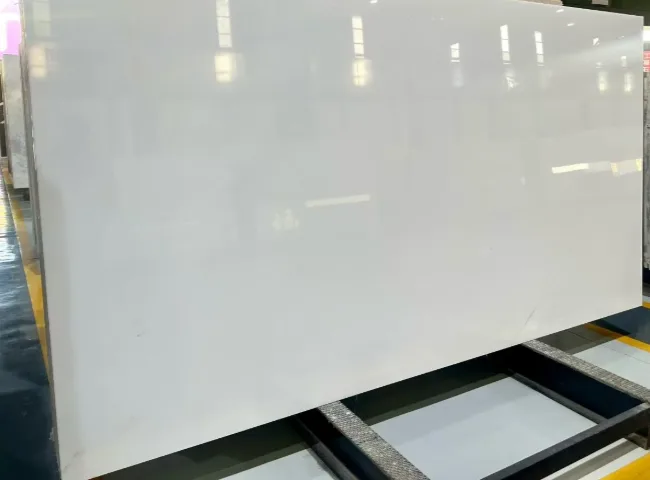
Han White — Hanbaiyu, literally Han white jade — is the marble Chinese civilization built its symbols from. The balustrades of the Forbidden City, the terraces of the Temple of Heaven, the guardian lions outside a thousand institutions: all Hanbaiyu. It is a carving material first, prized for a soft pure-white color and a grain so fine and uniform that a chisel can take detail out of it that coarser marbles shed in chips. Our index tracks it at $25 to $70 per square foot for polished 2 cm slabs, ex-warehouse, as market estimates (August 2026).
For Western buyers, Han White answers a specific question: where do you get statuary, columns, fireplaces and balustrades carved in real marble without Italian statuary-marble money? The stone is Chinese, the carving workshops are Chinese, and the whole value chain sits on our partner mill's home turf — the category where factory-direct is not just 30 to 60 percent cheaper than Western warehouse pricing, but often the only way to buy the carved product at all.
Geology and what makes Han White distinctive
Han White is a fine-grained white marble — dominantly calcite — whose defining property is textural: small, even, tightly interlocked crystals with very little veining. Where Carrara reads as a grey-white field with feathery figure, good Hanbaiyu reads as a soft, near-uniform white with a faint translucent glow at polished edges — the jade in the Chinese name is about that glow, not mineralogy.
Fine uniform grain is a carving property before it is a visual one. Coarse-grained marble fails unpredictably under the chisel; fine even grain cuts cleanly in every direction, holds crisp arrises, and lets a carver take a lion's mane or an acanthus leaf down to millimeter detail. That is why Hanbaiyu became the imperial stone: the Fangshan workshops supplied the Ming and Qing courts for five centuries, and material excellence became cultural symbolism.
Quarries and supply
The historic source is Fangshan, southwest of Beijing — the Dashiwo district that supplied the imperial capital for centuries. Fangshan is the name-bearer, but modern output is limited: heavily worked, environmentally restricted, with much remaining premium stone reserved for monument restoration. Commercial supply today draws mostly on Sichuan's Baoxing district, plus Hunan and Hebei sources sold under the trade name when grain quality qualifies.
The supply chain is really two chains. Slab and tile production runs through standard mills. The carving chain matters more: block goes to workshop clusters — Quyang county in Hebei is the famous one, with tens of thousands of carvers — and becomes statuary, balustrades, columns and fireplaces. For a Western buyer, the product you import is usually finished sculpture, not slabs, and the mill's role is block selection plus workshop management — exactly how our partner mill operates, with photo documentation at each stage.
Grades and what quality means in a carving stone
Slab-stone grading logic applies, but carving adds its own axes. Premium Hanbaiyu: even warm-white color; fine uniform grain with no coarse patches; free of live cracks, dry seams and iron staining; sized to yield the piece from a single block. Standard grade tolerates faint grey wisping and minor color drift, fine for architectural elements viewed at distance. Commercial grade — greyer, wispier — populates balustrade programs and garden ornament where budget rules.
Two carving-specific checks separate professionals from tourists. First, soundness at depth: a statue block must be sound through its whole volume, so serious workshops sound-test blocks before committing carving hours — a defect found at 80 percent completion costs the whole labor bill. Second, grain consistency: a coarse patch becomes visible the moment detail carving reaches it. Buyers of finished pieces inherit these risks through the workshop, which is why the workshop's rejection standards, not the quarry name, are the real quality variable.
Price breakdown: slab, cut-to-size, carved and installed
For slab material, our index band is $25 to $70 per square foot for polished 2 cm, ex-warehouse, as market estimates (August 2026): commercial grade at the bottom, premium even-white stock at the top. Cut-to-size elements add the usual 20 to 50 percent over slab cost. But most Han White trades as carved product, where pricing shifts from area to piece: labor dominates, and two fireplaces in the same stone can differ threefold on carving complexity alone.
Reference points for carved work, as broad typical figures for factory-direct orders: hand-carved fireplace surrounds commonly run from around $2,000 to $15,000-plus per piece depending on size and ornament; balustrades price per linear meter; life-size statuary starts in the low thousands and climbs with detail. Western retail typically runs multiples of these numbers — the 30 to 60 percent factory-direct spread widens further on carved goods, because you are also buying the labor at Chinese workshop rates.
What moves a quote: stone grade first, carving hours second, then block size — monolithic pieces cost disproportionately more than assembled ones — finish level, and packing, because a balustrade program is heavy, low-density cargo in braced crates. Installed cost at destination adds crane time and specialist setting for large elements; simple slab-work installs like any marble.
Han White vs the alternatives
Against Italian statuary marble: Statuario at $80 to $220 is the prestige carving stone of the Western tradition — but for carved work its veining is often a liability, and Italian carving labor prices an order of magnitude above Chinese workshops. For veined slab drama, buy Italian; for carved volume in clean white, Hanbaiyu wins the value equation decisively. Against Carrara ($40 to $90): its grey cast makes it a slab stone first; as a carving stone it is serviceable but not finer than good Hanbaiyu.
Against other Chinese whites: Guangxi White ($15 to $35) is the cheaper slab-volume choice but coarser — fine for simple profiles, not fine statuary. Vietnamese whites are typically too crystalline-coarse for detail work. Against cast stone and resin reproductions: cast pieces cost less and repeat perfectly, which is exactly how they look; carved Hanbaiyu weathers, patinas and reads as the original article. For monument, memorial and heritage work, that authenticity is usually the entire specification.
Applications
Carved architecture leads: balustrades, columns and capitals, door surrounds, copings and pavilion elements — the imperial portfolio, still produced by the same workshop tradition. Fireplace surrounds are the flagship Western import category, from restrained Georgian profiles to fully sculpted French designs. Statuary spans garden figures, fountains, religious sculpture, guardian lions and memorial work; Hanbaiyu is one of the few stones still carved by hand at scale.
As slab material it serves flooring, wall panels, vanities and treads where a calm, vein-free white is wanted — a quieter look than Carrara that some contemporary schemes specifically hunt. Exterior use is proven by five centuries of Beijing winters, with caveats: urban acid exposure slowly sugars polished surfaces, so exterior pieces are typically honed or tooled, and freeze-thaw climates want sound, low-absorption grade and proper drainage details around bases and copings.
Fabrication, carving and finishes
In slab fabrication Han White behaves as a well-mannered fine marble: clean cuts, crisp edges, good polish. Its real fabrication story is the workshop. Traditional Quyang practice runs from rough-out saws to hand chisels and rifflers for finish detail; CNC roughing now handles repetitive elements like balusters, with hand finishing on ornament — a hybrid that cuts cost without the dead uniformity of full machine work. When commissioning, specify which stages are hand-executed; the invoice difference is real, and so is the visual one.
Finish vocabulary is wider than for slab stones: polished for interior work; honed for most carved surfaces, where soft sheen reads better than gloss; tooled or aged finishes for heritage matching. Relief depth, undercut and pierced work all price by the hour. For assembled systems like balustrades, insist on dry-assembly at the workshop with numbered components and stainless pinning hardware included. Staged photo approval is standard professional practice; a workshop that resists it is the wrong workshop.
Care and maintenance
Interior Han White follows white-marble rules: pH-neutral cleaners, sealing on horizontals, coasters-and-boards discipline where acids appear. Its tight grain absorbs less eagerly than coarser whites, but etching chemistry is identical — calcite is calcite. The stone re-hones and re-polishes beautifully.
Exterior carved work is a longer conversation. The stone endures — Beijing's monuments prove it — but polished surfaces dull within seasons outdoors, so exterior pieces ship honed; expect a gentle sugaring patina in rain-exposed detail, historically considered part of the material's dignity. Maintenance is water and soft brushing; never pressure-wash carved detail at close range, never acid-clean. In freeze-thaw climates keep water moving off the work — sound copings, drips and drainage do more for a balustrade's lifespan than any sealer. Iron staining from embedded fixings is the classic preventable failure: specify stainless pins and clamps, always.
Sourcing checklist for Han White
For slab orders the standard Chinese-white discipline applies: control samples per grade, bundle photos with slab IDs, contractual tolerances, pre-shipment dry-lay inspection. Name the actual source — Fangshan, Sichuan, Hunan — because Hanbaiyu is a trade name spanning several quarry districts, and price should track the material, not the mythology.
For carved orders, buy process, not promises. Approve shop drawings before block purchase; require staged photo approvals at rough-out, detailing and finish; specify hand-versus-CNC stages, finish type and stainless hardware in the contract. Confirm crating standard and agree transit-damage replacement terms on one-of-a-kind pieces before the deposit. Lead times run 8 to 16 weeks for significant carved work, and rushing a carving workshop is how detail dies. Done properly through a mill that manages the workshops — the structure our partner operates — you get imperial-grade carved marble at Chinese labor economics: the single widest value gap between factory-direct and Western retail anywhere in our index.
Frequently asked questions
How much does Han White (Hanbaiyu) marble cost in 2026?
As market estimates (August 2026), Han White slab material runs $25 to $70 per square foot for polished 2 cm, ex-warehouse. Carved product prices by the piece: factory-direct fireplace surrounds commonly run from around $2,000 to $15,000-plus depending on size and ornament — typically a fraction of Western retail for comparable work.
What is Hanbaiyu marble famous for?
It is China's imperial stone: the balustrades of the Forbidden City and the Temple of Heaven are Hanbaiyu, carved by workshop traditions that still operate today. Its fine, uniform grain takes chisel detail that coarser marbles cannot hold, which made it the standard material for Chinese statuary, columns and architectural ornament for over five centuries.
Is Han White marble good for carving compared to Italian marble?
Yes — fine, even grain with minimal veining is exactly what carving wants, and good Hanbaiyu compares well to Italian statuary stones as a working material. The decisive difference is economics: Chinese workshop labor prices far below Italian studios, so carved Hanbaiyu delivers hand-worked marble at a fraction of European cost.
Where is Han White marble quarried today?
The historic Fangshan district near Beijing is the name-bearer, but its output is limited and partly reserved for monument restoration. Most commercial Hanbaiyu now comes from Sichuan's Baoxing district, with qualifying material from Hunan and Hebei also sold under the trade name. Serious suppliers state the actual source; price should follow the material, not the legend.
Can Han White marble be used outdoors?
Yes — five centuries of Beijing monuments are the evidence. Use honed or tooled finishes rather than polished, which dulls within seasons outdoors; specify low-absorption grade for freeze-thaw climates; detail copings to shed water; and use stainless fixings to prevent iron staining. Expect a gentle patina on exposed detail over the years.
How do I order carved Hanbaiyu pieces from China?
Through a mill or agent that manages carving workshops: approve shop drawings before the block is bought, require staged photo approvals, and contract the finish type, carving stages, crating and transit-damage terms in advance. Allow 8 to 16 weeks for significant pieces. Factory-direct carved work lands far below Western retail because both stone and labor are bought at Chinese rates.