Carrara vs Calacatta vs Statuario: How to Tell Them Apart (2026 Prices)
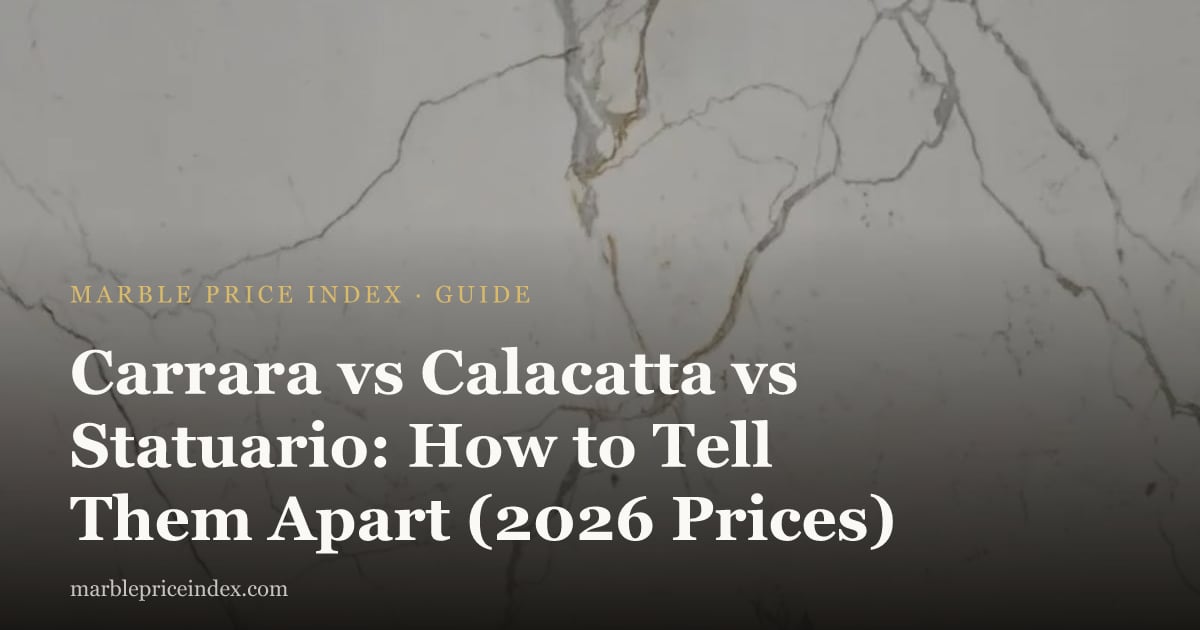
Every white marble with grey veins gets called “Carrara” at some point, usually by someone selling it. Every bright slab with bold veins gets called “Calacatta”, usually at a Calacatta price. The three great Italian whites — Carrara, Calacatta and Statuario — come out of the same few square kilometres of the Apuan Alps, from geologically related deposits, and the naming confusion is worth real money: the price gap between a Carrara slab and a Calacatta slab can be $150 per square foot.
This guide is written from the trading side of the business: what each stone actually is, how to identify it in front of the slab, what each costs as of August 2026 (all prices are market estimates for polished 2 cm slabs, ex-warehouse), and which Chinese stones credibly stand in for each when the budget says no.
The 30-second answer
- Carrara — the volume stone. Cool white-to-grey ground, soft feathery grey veining scattered across the slab. $40–90/sqft. If a white Italian marble is affordable, it is Carrara.
- Calacatta — the luxury stone. Bright white ground, few but bold wide veins in grey and gold. $80–250/sqft, the widest price band in marble because vein pattern drives the number.
- Statuario — the sculptor’s stone. Luminous white ground with bold high-contrast grey veining — brighter than Carrara, greyer-veined than gold-toned Calacatta. $80–220/sqft. Michelangelo’s David is Statuario.
The rule of thumb traders use: Carrara is grey-on-grey, Calacatta is gold-on-white, Statuario is grey-on-white. It oversimplifies — but it sorts 80% of slabs correctly.
Identification table
Market estimates, August 2026, polished 2 cm slabs:
| Trait | Carrara | Calacatta | Statuario |
|---|---|---|---|
| Ground tone | Cool white to light grey | Bright, often warm white | Luminous pure white |
| Veining pattern | Soft, feathery, diffuse, all over the slab | Few, bold, thick, dramatic | Bold linear grey, high contrast |
| Vein colour | Grey | Grey-gold to gold/taupe | Grey, sometimes near-black |
| Vein density | High — busy slab | Low — open white field | Medium — strong statements |
| Slab price /sqft | $40–90 | $80–250 | $80–220 |
| US search demand /mo | 9,400 | 7,000 | 1,000 |
| Availability | Abundant | Limited, quality-graded | Scarce — few active quarry zones |
| Typical use | Countertops, bathrooms, floors, volume projects | Statement kitchens, islands, book-matched walls | Feature walls, luxury baths, sculpture |
| Signature tell | No large white areas — grey is everywhere | Big empty white fields between veins | White ground brighter than Carrara, veins darker than Calacatta |
Related stones worth knowing: Calacatta Gold ($100–300/sqft) pushes the gold veining further on a creamy ground, and Calacatta Viola ($90–250/sqft) swaps the gold for violet-burgundy — the designer favourite of the 2020s.
Each stone in detail
Carrara: the default white marble
Quarried since Roman times and still processed in enormous volume — including by Chinese mills, which buy Carrara blocks and process them into slabs and cut-to-size at scale. The ground is never paper-white; it always carries a grey cast, and the veining is soft and smudged rather than sharp, like pencil shading. That busy, low-contrast character is why Carrara is affordable: no single slab is a dramatic showpiece, so no single slab commands a premium. It is the workhorse for countertops, bathroom cladding and flooring, and the honest choice when you want Italian white marble at the lowest Italian price.
Calacatta: rarity priced by the vein
Calacatta comes from a small number of quarries in the same Carrara basin, but the material is scarcer and visually opposite: instead of diffuse grey everywhere, you get a clean white field crossed by a few thick, confident veins. Because the whole value of a Calacatta slab is the drama of that pattern, pricing is essentially per-slab: a quiet slab might trade near $80/sqft while a perfectly veined book-matching pair from the same quarry pushes $250. No other marble has this spread, which is why buying Calacatta from photos without slab approval is a rookie mistake — and why we publish price ranges rather than single numbers.
Statuario: the scarce one
Statuario sits between the other two and above both in prestige-per-square-foot among stone people. The ground is the whitest of the three — an almost luminous white with fine crystal that light penetrates a millimetre or two before reflecting, giving the surface depth. Veining is bold and grey like Calacatta’s in weight but without the gold warmth. Genuine Statuario output is small; most of what sells globally under the name is better described as “statuario-type”. At 1,000 US searches a month against Carrara’s 9,400, it is a connoisseur’s stone — specified by people who already know they want it.
How fabricators actually tell them apart
Put a slab in front of an experienced fabricator and the identification takes seconds. Here is the checklist they run, roughly in order:
- Look at the empty space. The single most reliable tell. Carrara has no empty space — grey haze covers the slab. Calacatta and Statuario both have clean white fields between veins. If the background is busy, it is Carrara (or being sold too cheap to matter).
- Check the white. Hold a sheet of printer paper against the ground. Carrara reads distinctly grey against it. Calacatta reads white, often slightly warm. Statuario reads white and cold-bright.
- Read the vein edges. Carrara veins are soft-edged and diffuse, like smoke. Calacatta and Statuario veins are defined ribbons with edges you could trace. Gold or taupe in the vein says Calacatta; pure grey to charcoal says Statuario.
- Check translucency at the edge. Statuario’s fine crystalline structure carries light — a polished edge glows faintly under a torch. Carrara stays opaque and flat.
- Ask for the quarry paperwork. Genuine Calacatta and Statuario blocks come with quarry provenance, and serious suppliers will show it. “Calacatta” with no paperwork and a $60/sqft price is a renamed stone — often Carrara’s better grades, often something else entirely.
The commercial reason this matters: relabelling is the oldest trick in the white-marble trade. Upgrading a busy Carrara to “Calacatta Carrara” or a Vietnamese white to “Statuario” adds margin with a word. Buy from ranges published in the open, and check the slab, not the invoice.
Budget alternatives: the Chinese whites
The look of each Italian stone can be approximated at a fraction of the price. This is not a dirty secret — it is most of the volume market, and for hotels, developers and rental projects it is simply the correct engineering decision. The honest comparison:
| Alternative | Mimics | Slab price /sqft | What matches | What doesn’t |
|---|---|---|---|---|
| Guangxi White | Carrara | $15–35 | Cool white ground, light grey veining, same visual family | Veining flatter and less feathery; slightly less depth in the polish |
| Han White | Statuario ground | $25–70 | Soft pure-white ground, fine uniform grain — the carving stone of the Forbidden City | Little to no bold veining — matches the white, not the drama |
| Panda White | High-contrast statement look | $50–130 | Bold black-on-white brush-stroke veins, spectacular book-matched | Veins are black and wilder — reads as its own stone, not an Italian |
At 45 sqft of kitchen, choosing Guangxi White over Carrara saves roughly $1,500–2,500 in material alone; over Calacatta, $4,000–10,000. For the full landscape of whites from $20 entry stones to premium Italians, see the white marble guide.
Which to choose, project by project
- Working family kitchen: Carrara, honed finish. Affordable enough that etching and wear are livable, classic enough never to date. Budget version: Guangxi White cut-to-size.
- Statement kitchen island / book-matched wall: Calacatta if the budget is real ($80–250/sqft slab), Statuario for a colder, more architectural look. Insist on approving the actual slabs and the book-match layout.
- Luxury bathroom: Statuario walls with Carrara floors is the classic Italian pairing — the eye reads the family resemblance while the budget stays sane.
- Hotel / developer volume: Guangxi White for the Carrara look at $15–35/sqft; nobody standing in a lobby can tell at scale. Order as tiles or cut-to-size vanity tops direct from the mill.
- Sculpture and carving: Statuario if provenance matters, Han White for the finest workable grain at a workable price.
Case study: one waterfall island, priced in all three stones
A representative example — a kitchen island with a 32 sqft top and two waterfall sides totalling 28 sqft: 60 sqft of finished stone, book-matched, mitred edges. Book-matching veined stone pushes waste to ~35%, so assume 80 sqft of slab purchased. Market estimates, August 2026; fabrication at $45/sqft reflects mitred waterfall work, not basic tops.
Carrara at $65/sqft (upper-mid of the $40–90 band, chosen for better veining):
| Line item | Math | Cost |
|---|---|---|
| Slab material | 80 sqft × $65 | $5,200 |
| Fabrication (mitres, book-match layout) | 60 sqft × $45 | $2,700 |
| Installation | flat | $600 |
| Total | $8,500 |
Statuario at $150/sqft (mid of the $80–220 band):
| Line item | Math | Cost |
|---|---|---|
| Slab material | 80 sqft × $150 | $12,000 |
| Fabrication | 60 sqft × $45 | $2,700 |
| Installation | flat | $600 |
| Total | $15,300 |
Calacatta at $160/sqft (mid of the $80–250 band; a show-grade pair would be far more):
| Line item | Math | Cost |
|---|---|---|
| Slab material | 80 sqft × $160 | $12,800 |
| Fabrication | 60 sqft × $45 | $2,700 |
| Installation | flat | $600 |
| Total | $16,100 |
And the factory-direct benchmark — Guangxi White, book-matched and cut to size at the mill:
| Line item | Math | Cost |
|---|---|---|
| Cut-to-size mitred pieces, book-matched | 60 sqft × $30 | $1,800 |
| Crating + ocean freight share | flat | $700 |
| Local installation | flat | $900 |
| Total | ~$3,400 |
Same island, a 4.7× spread from $3,400 to $16,100. None of these numbers is wrong — they are four different answers to “how much does the look matter, and who is paying for it?” A boutique hotel fitting out 40 rooms answers it differently from a homeowner building a forever kitchen, which is the entire point of publishing the ranges.
If your project is at container or crate scale — or you want factory pricing on genuine Italian blocks processed in China — request a quote with your drawings and we will price it both ways.
FAQ
What is the main difference between Carrara and Calacatta?
Ground and veining: Carrara is a greyish white covered in soft, diffuse grey veining; Calacatta is a brighter white with fewer, bolder grey-gold veins and open white space between them. Calacatta is scarcer and costs roughly 2–3× more ($80–250 vs $40–90/sqft, market estimates August 2026).
Is Statuario better than Calacatta?
Neither is “better” — Statuario has a whiter, more luminous ground with pure-grey veining; Calacatta brings warmth and gold tones. Statuario is scarcer in genuine form; Calacatta’s top grades reach higher prices ($250+/sqft). Choose by palette: cold architectural whites → Statuario; warm luxury → Calacatta.
Why is Calacatta so much more expensive than Carrara?
Scarcity plus per-slab pricing. Calacatta comes from limited quarry zones, and each slab’s value depends on its individual vein drama — collectors’ pricing, essentially. Carrara is quarried in volume with consistent character, so it trades like a commodity.
How can I tell if a “Calacatta” slab is really Carrara?
Look at the background: genuine Calacatta has clean white fields between a few bold veins; Carrara is uniformly hazed with grey. A “Calacatta” priced under ~$80/sqft with busy grey veining is almost certainly relabelled Carrara. Ask for quarry provenance on any premium white.
What is the best cheap alternative to Carrara marble?
Guangxi White from China: the same cool-white-with-grey-veining family at $15–35/sqft versus Carrara’s $40–90 (market estimates, August 2026). It is the standard substitution for hotels and volume projects, available factory-direct as slabs, tiles and cut-to-size.
Are these marbles OK for kitchen countertops?
All three etch with acids and need annual sealing, like any marble. A honed finish hides wear best. If maintenance is a dealbreaker, compare quartz in our marble vs granite vs quartz guide before committing.