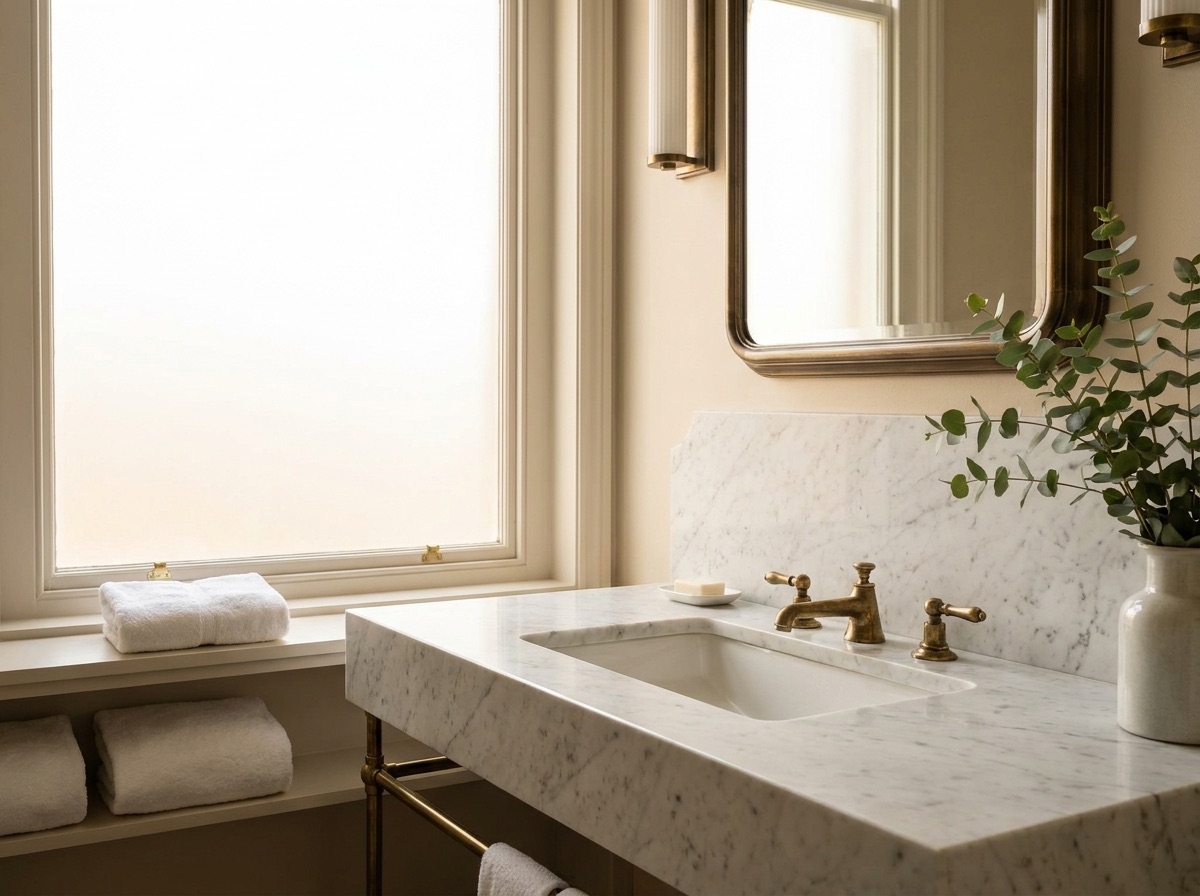
The vanity top is the workhorse of bathroom stone, and it is a category built for factory-direct buying: a finished, cut-to-size piece with basin cut-out, faucet holes and polished edges that needs no local fabrication at all. As a market estimate for August 2026, factory pricing runs $30 to $120 per piece cut-to-size, while comparable marble tops move through Western distribution at several times that before they reach a bathroom. For hotel projects and vanity manufacturers, the arithmetic across two hundred rooms is not subtle.
This guide walks through the price structure of cut-to-size vanity tops, the stones that make sense at each budget, the standard US sizes and specification details — cut-outs, splashes, edge profiles, thickness — the drawing-approval process factories use, and the QC and crating practices that decide whether flat slabs of stone arrive flat and whole. All figures are market estimates tied to our August 2026 index data; exact quotes depend on stone, size and spec, which is what an RFQ is for.
What you get in this category
A vanity top order is a finished component, not raw stone: the top cut to your dimensions, the basin cut-out machined for undermount, drop-in or vessel installation, faucet holes drilled to your fitting spec, visible edges polished to the chosen profile, and matching backsplash and side splashes cut from the same material. Undermount orders can include the ceramic or stone basin bonded at the factory, arriving as one ready-to-set assembly.
The buyers are distinct. Vanity manufacturers and furniture brands buy tops in standard widths to pair with their cabinet lines. Hotels and developers order project runs — one or two specs repeated across hundreds of rooms, delivered to a construction schedule. Kitchen-and-bath retailers stock the common sizes in two or three stones. All three run on the same factory economics: the fabrication that dominates Western vanity-top pricing is already done when the crate ships.
Price economics: what sets the number
Within the $30 to $120 factory range (market estimate, August 2026), a 25 inch top in Guangxi White with a single cut-out and polished front edge sits near the bottom. Moving to 37 and 49 inch widths, Carrara-grade stone, and added splashes brings the middle of the range. Double-basin 61 inch tops, premium stone and thicker material occupy the top. In Western channels the same pieces are priced as fabricated goods — templating, cutting and edging locally — which is why retail runs several multiples of factory even before installation.
Cost drivers rank simply: stone first, then size (material and freight both scale with area), then thickness — 2 cm is standard, 3 cm adds material and weight but reads as luxury in the US market. Cut-outs and holes are cheap machine time; edge profile matters only when you specify laminated or mitered built-up edges, which add labor. A bonded undermount basin adds the basin cost plus a small assembly charge, usually worth it against site labor.
Best stones for vanity tops
Guangxi White, at roughly $15 to $35 per square foot in slab terms (market estimate, August 2026), is the volume answer: a cool Carrara look at a price that works across a 300-room property. Carrara itself ($40 to $90) remains the default specified stone for bathrooms — the name, the soft grey veining, and enough block supply that Chinese mills cut it to size routinely. The broader white spectrum ($20 to $120) adds warm ivories for spa palettes, and at the top, Calacatta-grade stone ($80 to $250) turns a powder room into a statement at a material cost hotels reserve for suites.
Beyond white: Nero Marquina ($40 to $90) and other black marbles ($30 to $80) make dramatic tops for dark-scheme bathrooms, though polished black shows water spots and demands realistic expectations. Green marble ($30 to $100) is the boutique-hotel trend pick. Whatever the stone, order splashes and tops from the same production batch — color drift between batches is the most common complaint in project work, and it is entirely preventable at ordering time.
Specs and formats: US sizes and the details that matter
US vanity widths standardize at 25, 31, 37, 49 and 61 inches, with 22 inch depth typical; 61 inch tops usually take double basins. Factories cut these as stock formats and cut custom dimensions with equal ease — the machine does not care, so odd sizes for European or bespoke cabinetry carry no real premium. Thickness is 2 cm standard or 3 cm for a heavier look; a 2 cm top with a laminated front edge imitates 3 cm at lower weight and cost.
The spec sheet must state: exact length, depth and thickness; basin type and cut-out dimensions with the basin's template if undermount; faucet drilling — single hole or 4 inch or 8 inch spread, stated in the fitting's spec; backsplash height (100 mm is common) and side splash sides; edge profile (eased, bullnose, ogee) on which edges; and finish, polished or honed. Every ambiguity in that list becomes a wrong hole at a construction site eight thousand kilometers from the saw.
The order process, from drawing to crate
Vanity tops are made to shop drawings. You send dimensions or the factory's template filled in; the factory returns CAD drawings for each SKU showing cut-outs, drilling and edges; you approve or correct; production begins on deposit. For project work, the drawing set covers every room type once, and the factory repeats it — which is why a 200-room order is barely harder to manage than a 20-piece one.
Sensible practice on a first order: approve drawings carefully rather than quickly, ask for photos of the actual slabs before cutting if stone consistency matters to the project, and have one physical sample top made and shipped by air for a model room if the schedule allows. Production for a 20 to 100 piece order runs 3 to 5 weeks; project volumes are scheduled in weekly batches so site delivery can be staged.
Quality control checklist
Dimensional checks first: length, depth and thickness against drawing within 1 to 2 mm; cut-out position and size against the basin template; hole spread measured center to center. Flatness matters more than any other single property — a bowed top telegraphs against the cabinet and cracks under fixing pressure, so ask for straightedge photos on the biggest pieces. Edges should be polished evenly with no saw marks visible underneath the profile.
Stone checks: wet photos of each top to expose cracks and fills, veining and color photographed in daylight across the batch laid out together, and splashes matched to their tops. Undermount assemblies get a bond check — the basin seated evenly with clean silicone lines. Insist that every piece is labeled with its SKU and room type on the protective film; a mislabeled crate on a hotel site wastes a day of trades time.
MOQ, lead times and project logistics
The working MOQ is about 20 pieces — one crate — which suits retailers stocking standard sizes and manufacturers testing a stone program. Hotel projects order in the hundreds, and the factory side scales without drama; the constraint becomes site logistics, so agree a delivery schedule that matches construction phasing rather than shipping everything at once.
Timing runs 3 to 5 weeks of production plus 30 to 40 days of sea freight and customs — roughly 9 to 11 weeks door to door, longer if drawings iterate. Payment is customarily 30 percent deposit and balance against pre-shipment QC photos. For projects, build two to three percent overage into the order: a spare top per room type costs little in the container and saves weeks when a site accident happens during installation.
Shipping, crating and installation notes
Tops ship on edge, never flat — vertical in slotted timber crates like miniature slab A-frames, foam-separated, with splashes bundled alongside. Packed this way, cut-to-size marble travels remarkably well; most damage happens in careless forklift handling at destination, so specify crate markings and lifting points. ISPM-15 timber is required for most destinations, and marine insurance at 1 to 2 percent of invoice is standard practice.
Installation is ordinary bathroom trade work: tops bed on the cabinet in silicone, splashes bond to the wall, undermount basins clip or were already bonded at the factory. The one factory-direct nuance is that there is no local fabricator in the loop to fix a wrong hole — which is why the drawing-approval stage and the QC photos carry the weight that a template visit carries in domestic supply. Buyers who respect those two steps get domestic-fabrication results at factory prices.
Care in service
A sealed marble vanity top is a low-maintenance surface: penetrating sealer at installation, resealing every 6 to 12 months in heavy use, pH-neutral cleaner daily and nothing acidic — the same discipline as any marble surface, easier in a bathroom than a kitchen because wine and lemon juice rarely visit. Cosmetics, perfume and hair products are the realistic stains; a sealed honed surface shrugs off nearly all of them.
For hotels, honed finishes hide etching and water marks better than polished and have become the default specification in premium properties. Light etching on polished tops repolishes in place during routine maintenance cycles. A marble top that gets this minimal care outlasts the cabinet under it — and usually the next two renovation cycles.
Frequently asked questions
How much does a marble vanity top cost?
Factory-direct cut-to-size, $30 to $120 per piece as a market estimate for August 2026 — a 25 inch Guangxi White top with one cut-out at the low end, a 61 inch double-basin top in premium stone at the high end. Western retail for comparable fabricated tops runs several times higher before installation.
What are standard US vanity top sizes?
Widths of 25, 31, 37, 49 and 61 inches at a typical 22 inch depth, with 61 inch tops usually taking double basins. Factories stock these formats and cut custom dimensions at no real premium, since every top is machined to a drawing anyway. Thickness is 2 cm standard, with 3 cm or laminated edges for a heavier look.
Do factory vanity tops come with cut-outs and faucet holes?
Yes — the point of cut-to-size is that fabrication is finished at the factory: basin cut-out machined to your template, faucet holes drilled to single-hole or 4 or 8 inch spread, edges polished, splashes cut from the same batch. Undermount basins can be bonded at the factory so the top arrives as one ready-to-set assembly.
Which stone is best for a bathroom vanity top?
Carrara is the default specification; Guangxi White delivers the same look at volume-project budgets; warm whites suit spa palettes; Nero Marquina and green marble serve dark and boutique schemes. Hotels increasingly specify honed finishes, which hide etching and water marks better than polished. Order tops and splashes from one batch to avoid color drift.
What is the minimum order for factory-direct vanity tops?
About 20 pieces, one crate. That suits retailers stocking standard sizes and manufacturers testing a program; hotel projects order hundreds against a staged delivery schedule. Add two to three percent spare tops on project orders — a spare in the container is far cheaper than an air-freighted replacement after a site accident.
How long does a vanity top order take from China?
Production runs 3 to 5 weeks after drawing approval, plus 30 to 40 days of sea freight and customs — roughly 9 to 11 weeks door to door. The drawing-approval stage is the schedule variable worth managing: approve carefully once rather than iterating, and air-freight one sample top for the model room if the program allows.
Is marble durable enough for hotel bathroom vanities?
Yes, with the right spec: sealed, honed-finish marble is the standard in premium properties precisely because it wears predictably and repolishes in place. The realistic exposures are cosmetics and cleaners rather than structural wear. With sealing every 6 to 12 months and pH-neutral cleaning, a marble top outlasts the casework beneath it.