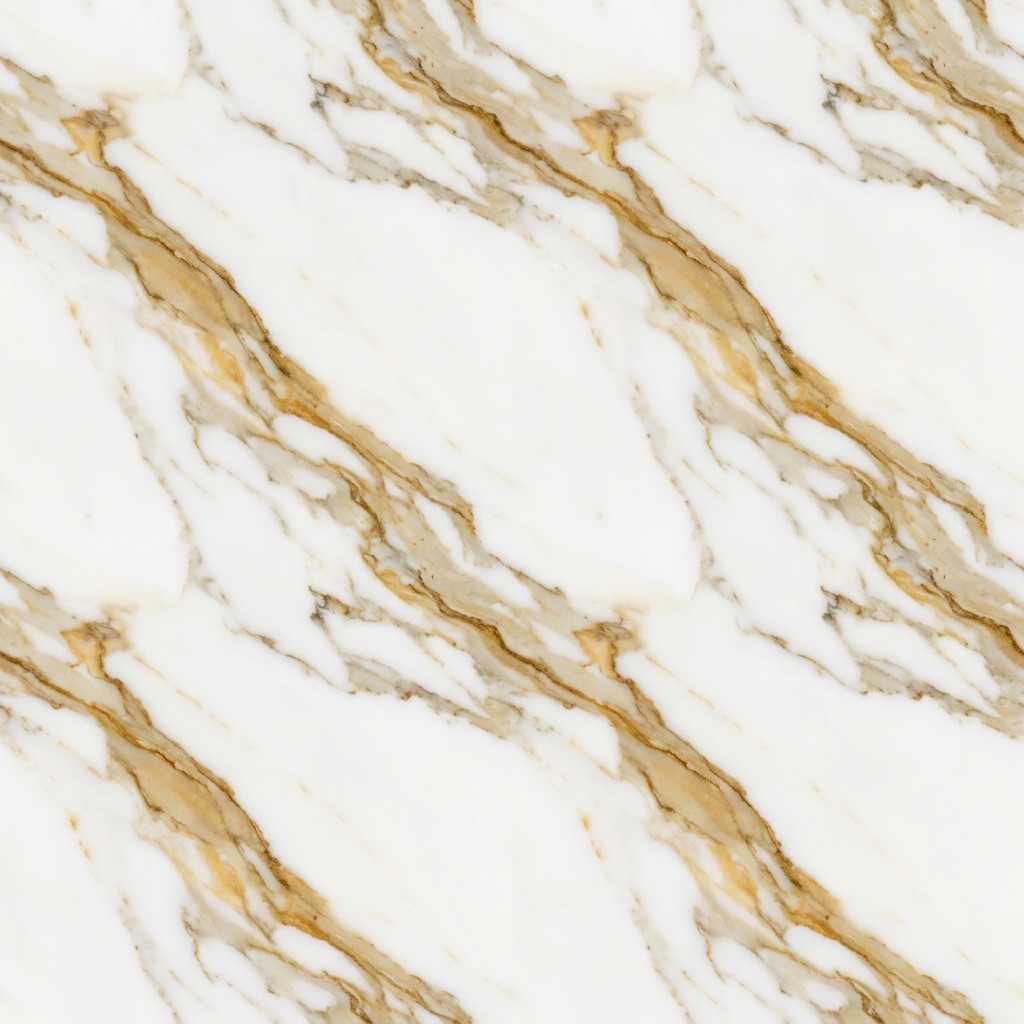
Calacatta Gold is the warmest and, at the top of its range, the most expensive member of the Calacatta family: golden and taupe veins moving across a creamy white field. It sits at the summit of the white marble market — polished 2 cm slabs trade at roughly 100 to 300 dollars per square foot ex-warehouse in Western markets, based on our market estimates (August 2026).
Buyers come to Calacatta Gold for one reason: warmth. Standard Calacatta and Statuario read cool; Calacatta Gold pairs with brass hardware, warm timber and cream cabinetry in a way no grey-veined stone can. Because the gold-veined blocks are the scarcest output of an already scarce quarry group, price discipline and slab-level verification matter here more than anywhere else in the stone trade. This guide covers what you are actually paying for and how to buy it well.
What Makes Calacatta Gold Distinct
Calacatta Gold is not a separate geological deposit — it is the warm-veined fraction of the Calacatta output from the Apuan Alps above Carrara. Iron oxide minerals in the vein structure oxidise into gold, honey and taupe tones instead of the standard grey.
The gold content varies enormously between blocks and even within one block. Some slabs carry thin golden threads over a nearly white field; others show broad taupe-gold rivers with grey undertones. The trade groups all of it under the Calacatta Gold or Calacatta Oro label, which means the label alone tells you little about what a specific slab looks like. This is a photograph-first stone: no serious buyer commits to Calacatta Gold from a name and a price.
Quarries and Block Supply
Supply concentrates in a handful of quarry faces in the Carrara basin. Calacatta Borghini is the benchmark — its warm gold-grey veining on a milk-white ground defines the top of the market — alongside material sold as Calacatta Oro and select warm lots from Macchia Vecchia and Vagli. Output of genuinely gold-veined premium blocks is tiny in absolute terms; a strong block can be pre-sold before sawing, and the best bundles never reach open inventory in Western warehouses.
For buyers this means two things. First, lead times: sourcing a specific look in quantity can take weeks of scouting across mills and warehouses. Second, the factory-direct channel is unusually valuable here — Chinese processing mills that buy Apuan blocks at auction sell finished Calacatta Gold slabs at margins far below Western distributors, and on a stone this expensive the percentage gap converts into the largest absolute savings in the marble market. The same slab that retails at 250 dollars per square foot in a US warehouse can be quoted factory-direct at a fraction of that, typically 30 to 60 percent less.
Grades, Veining and Book-Matching
Grading runs on three axes: warmth and clarity of the gold, whiteness of the field, and composition of the veining. The premium tier shows unmistakably golden veins — not brown, not beige — over a bright cream-white ground, with veins that travel the slab in confident strokes. Mid-tier material has warm but muted taupe veining or a field that drifts toward ivory. The lower tier, still sold under the same name, shows sparse or muddy veining that photographs far better than it looks in person.
Book-matching is close to obligatory at this level: mirrored sequential slabs across an island waterfall or a bathroom wall are the canonical Calacatta Gold applications, and they require buying the full sequence from one block. Insist on a numbered dry-lay — photos or a composite of the slabs in order — before approving. One practical warning specific to warm stones: lighting temperature radically changes how gold veining reads. Ask for photos in neutral daylight, because warehouse halogens flatter taupe into gold, and cool LEDs do the reverse.
Calacatta Gold Prices in 2026
Polished 2 cm Calacatta Gold slabs run 100 to 300 dollars per square foot ex-warehouse in Western markets — market estimates (August 2026). The floor of the range buys genuine but modest material: creamier fields, quieter taupe veining. The ceiling buys named-quarry blocks with vivid gold figure, and individual showpiece slabs can be negotiated above any published range. Within the family, Calacatta Gold prices above standard Calacatta (80 to 250 dollars per square foot, market estimates, August 2026) at every equivalent grade.
Installed numbers escalate accordingly. Fabrication at this level is premium work — full-slab layouts, mitred waterfalls, book-match alignment — and typically adds a broad 40 to 80 dollars per square foot in the US. As a typical US market figure, finished Calacatta Gold kitchens commonly land between 180 and 400 dollars per square foot installed.
The factory-direct calculation deserves attention precisely because the numbers are large. At 30 to 60 percent below Western warehouse pricing, a project needing 600 square feet of premium material can save tens of thousands of dollars buying factory-direct from a Chinese mill. The condition is verification: numbered slabs, daylight photography, block sequence, and grade terms in writing. At 300 dollars per square foot, a lazy purchase is expensive tuition.
Calacatta Gold vs Calacatta, Statuario and Quartz
Against standard Calacatta, the choice is palette. Cool grey-gold Calacatta suits monochrome and contemporary schemes; Calacatta Gold suits warm timber, brass and cream. You pay for the warmth — 100 to 300 versus 80 to 250 dollars per square foot (market estimates, August 2026) — and at the premium end the gap narrows because top blocks of either command collector pricing. Statuario, at 80 to 220 dollars per square foot (market estimates, August 2026), is the cool alternative with charcoal-grey veining and a more luminous white ground; it is the wrong stone for a warm scheme but a better buy for a cool one.
Quartz manufacturers produce Calacatta Gold patterns in volume, and at typical installed prices the engineered option can cost roughly what low-tier genuine material does. The warm veining is the hardest look for printers to fake convincingly — gold tones drift peachy or grey under different lights, pattern repeats are conspicuous on waterfalls, and the material cannot be re-polished. There are also warm-veined natural alternatives at lower cost: some Turkish and Greek stones deliver cream-and-gold movement for less, though without the Calacatta name or its resale cachet.
Where Calacatta Gold Works Best
This is the definitive statement-kitchen stone: island tops with waterfall ends, full-height splashbacks behind ranges, and butler's pantries that photograph like editorials. In bathrooms it makes book-matched shower walls and vanity tops that anchor the entire design. Fireplace surrounds and reception desks are the other canonical uses — concentrated areas where the material's figure is seen up close.
Where it does not belong is broad anonymous coverage. Flooring an entire apartment in Calacatta Gold buries six-figure material under furniture; a cream porcelain or a quieter marble does that job. The discipline that pays is concentration: put the budget into the surfaces people touch and photograph, and let supporting surfaces stay quiet.
Fabrication and Finishes
Calacatta Gold fabricates like the rest of the Apuan family — predictable calcite, kind to CNC tooling — with the same caveat about bold veins acting as planes of weakness. Wide-vein slabs may arrive mesh-backed or rodded, which is standard practice and should simply be disclosed. Mitred 2 cm build-ups are the norm for waterfall edges; 3 cm reads more substantial on flat runs and needs no lamination line.
Polished finish is the overwhelming default because gloss saturates the gold and maximises contrast with the field. Honed Calacatta Gold is a legitimate designer choice — the veining goes soft and watercolour-like — but understand that honing visibly mutes the warmth you paid a premium for; review a honed sample of your actual material before committing the whole lot. Sealing is mandatory in either finish, and edge polishing must be batched consistently, since polish depth shifts perceived tone on warm stones more than on grey ones.
Care and Maintenance
The regime is unchanged from any calcite marble: penetrating sealer at installation, renewal roughly annually on work surfaces, pH-neutral cleaners only, and prompt wiping of wine, citrus and coffee. Etching is inevitable chemistry on a working counter and no premium price exempts the stone from it.
Two practical points specific to the stone. First, warm-veined marble hides light etching slightly better than stark white stones, because the cream field is more forgiving of dull spots than a mirror-white one. Second, refinishing economics are exceptional: a professional re-polish costs a small fraction of the material's value, so a well-bought Calacatta Gold surface is effectively a permanent asset that can be restored to showroom condition repeatedly over decades.
Sourcing Checklist for Buyers and Importers
First, identity: demand the quarry or commercial lot name and block number — Borghini and Oro labels are borrowed constantly by lesser warm-veined stone, including non-Italian material. Second, photography protocol: every slab numbered, shot in neutral daylight against a white reference card, with one close-up of vein detail per slab. Third, sequence: for any book-matched application, confirm consecutive slab numbers and see the dry-lay before cutting begins.
Fourth, paper: grade, slab numbers and replacement-for-breakage terms on the invoice; reinforcement (mesh, rods, resin) disclosed in writing. Fifth, benchmark: Western warehouse range is 100 to 300 dollars per square foot (market estimates, August 2026), factory-direct should land 30 to 60 percent below the comparable tier, and a quote dramatically cheaper than that is a different stone wearing the name. Finally, freight reality: premium slabs demand premium crating — A-frames, fumigated crates, corner protection, transit insurance at full replacement value.
Frequently asked questions
How much does Calacatta Gold marble cost per square foot?
Polished 2 cm slabs run roughly 100 to 300 dollars per square foot ex-warehouse in Western markets, based on market estimates (August 2026). Installed kitchen projects typically land between 180 and 400 dollars per square foot in the US as a broad figure. Factory-direct quotes from Chinese mills processing the same Italian blocks typically come in 30 to 60 percent below Western warehouse prices.
Is Calacatta Gold more expensive than regular Calacatta?
Yes, tier for tier. Calacatta Gold runs 100 to 300 dollars per square foot against 80 to 250 for standard Calacatta (market estimates, August 2026). Genuinely gold-veined blocks are the scarcest fraction of an already limited quarry output, and demand from luxury residential design keeps the premium wide. At the very top, individual blocks of either can command collector pricing.
What is the difference between Calacatta Gold and Calacatta Borghini?
Borghini is a specific quarry whose warm gold-grey veining on a milk-white field represents the benchmark for the whole Calacatta Gold category. Material sold generically as Calacatta Gold or Calacatta Oro may come from several faces and varies more. Borghini-labelled slabs price at the top of the 100 to 300 dollar range (market estimates, August 2026), so verify the quarry claim with block documentation.
Is Calacatta Gold worth it compared to quartz lookalikes?
In the segment where this stone is specified, yes — the printed quartz version repeats its pattern, drifts in tone under different lighting, cannot be refinished, and is recognisable to any designer. Calacatta Gold is bought for warmth, uniqueness and permanence. The natural slab can be re-polished for decades and holds value at resale.
Does Calacatta Gold stain or etch more than other marble?
No — it is the same calcite as Carrara or Statuario and follows the same rules: acids etch it, oils can stain unsealed surfaces, and a penetrating sealer plus pH-neutral cleaning handles routine use. The creamy field actually hides light etching slightly better than stark-white marbles. Refinishing restores the surface fully when the patina accumulates.
Can I buy Calacatta Gold factory-direct from China?
Yes. Chinese mills buy blocks from the Apuan quarries and sell finished slabs and cut-to-size at typically 30 to 60 percent below Western warehouse prices — the largest absolute saving in the marble trade given this stone's price level. Verification is critical at these stakes: numbered slabs, daylight photos against a white card, block sequence for book-matching, and grade terms in writing before payment.