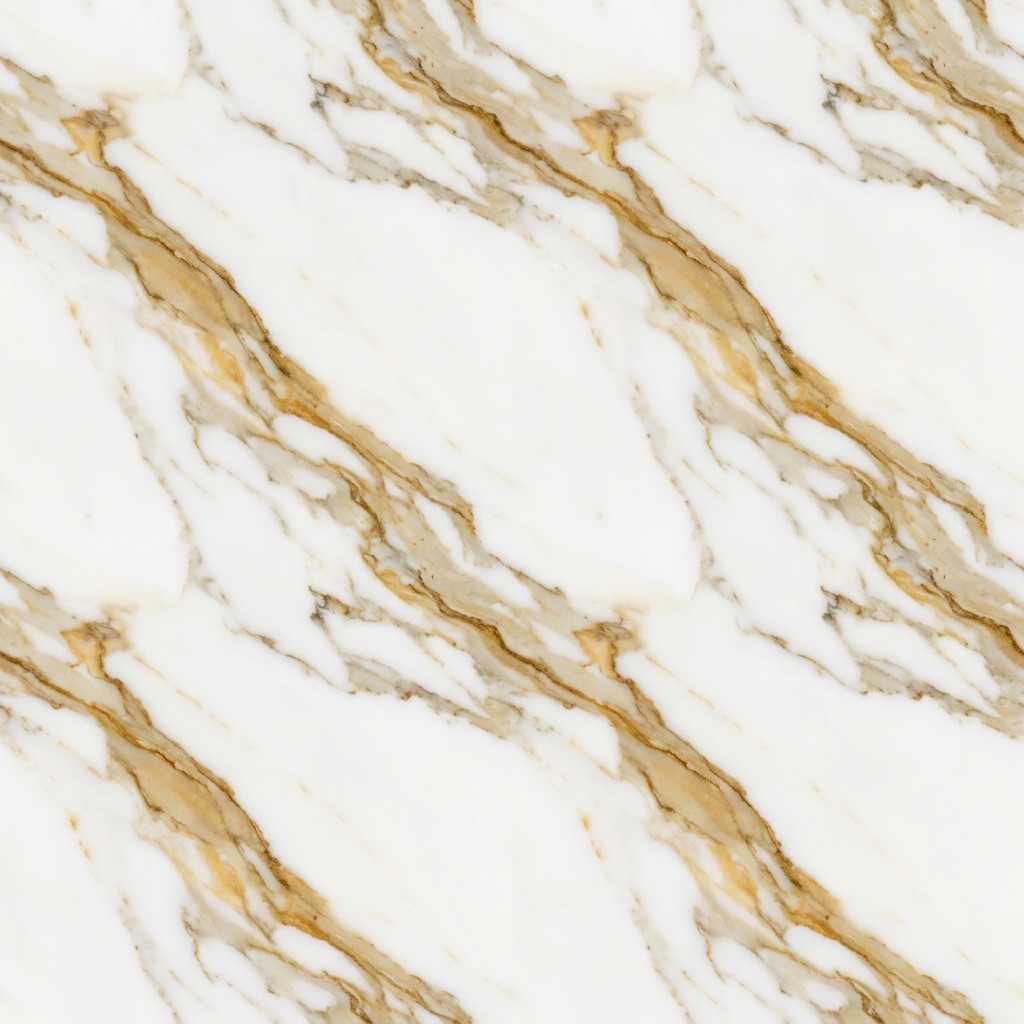
Calacatta is the flagship stone of the luxury kitchen: a bright white ground crossed by bold, wide veins in grey and gold. It comes from the same Apuan Alps that produce Carrara, but from far fewer quarry faces, and the difference shows in the price. Polished 2 cm Calacatta slabs trade at roughly 80 to 250 dollars per square foot ex-warehouse in Western markets, based on our market estimates (August 2026) — the widest price spread of any commercial marble.
That three-fold spread is the defining fact about buying Calacatta. Two slabs with the same name on the ticket can differ in price by 150 dollars per square foot depending on how white the field is, how the veins move, and which quarry the block came out of. No other stone rewards careful slab selection — or punishes lazy buying — as much. This guide explains what drives the number and how to buy at the right point in the range.
What Makes Calacatta Different from Other White Marble
Geologically, Calacatta is a close sibling of Carrara: a metamorphosed limestone recrystallised into calcite. The commercial distinction is visual and consistent across the trade. Carrara has a grey-tinted ground with soft, diffuse veining; Calacatta has a genuinely white ground with fewer, bolder, wider veins that read as deliberate strokes rather than haze.
The whiteness of the field is the scarce property. Blocks with a clean white background and well-spaced dramatic veining are a small fraction of what the mountain yields, and that scarcity — not marketing — is what holds the price at two to three times Carrara. Beware of renamed material: some sellers upgrade bright Carrara or Statuario-adjacent lots to a Calacatta label because the name carries a premium. The tell is the ground colour — if the field reads grey against a white sheet of paper, you are not looking at true Calacatta.
Quarries and Block Supply
True Calacatta comes from a limited set of quarries in the Carrara basin — names like Calacatta Borghini, Calacatta Vagli, Calacatta Macchia Vecchia and Calacatta Caldia each denote a specific quarry face with its own character and its own pricing tier. Borghini, with its warm gold-grey veins on a milk-white field, consistently commands the top of the market. Annual output is a small fraction of Carrara volume, and premium blocks are often sold before they are even sawn.
This supply structure has a practical consequence: large-format consistency is expensive. Getting twelve sequential slabs from one premium Calacatta block for a full kitchen plus cladding is possible but you compete with every high-end fabricator in the world for that block. Chinese processing mills buy Calacatta blocks at the same auctions as Italian producers and sell the finished slabs at substantially lower margins, which is why factory-direct Calacatta can undercut Western warehouse pricing by a wide margin even on genuinely premium material.
Grades, Veining and Book-Matching
Calacatta grading is about three variables: whiteness of ground, vein drama and vein distribution. The top of the market is a bright white field with bold, well-spaced veins that travel the full slab. Mid-grade material has good veins but a creamier or slightly grey field, or attractive colour with cluttered, busy movement. Lower-grade lots have washed-out veins, heavy clouding or dry patches — still genuine Calacatta, still expensive-looking to a casual eye, and 100 dollars per square foot cheaper than the premium tier.
Book-matching is where Calacatta earns its money. Consecutive slabs polished on opposite faces mirror each other, turning a bold vein into a symmetrical pattern across an island waterfall or a feature wall. When buying for a book-matched application, you must see the dry-lay — the actual sequence of slabs laid out or composited digitally — before approving. Vein direction also matters for fabrication: a strong diagonal vein that looks spectacular on the slab can end up chopped into incoherent fragments if the cutting plan ignores it. Approve the cutting layout on the slab photos, not just the slabs.
Calacatta Marble Prices in 2026
Polished 2 cm Calacatta slabs run 80 to 250 dollars per square foot ex-warehouse in Western markets — market estimates (August 2026). The bottom of the range buys honest commercial-grade material with modest veining or an off-white field; the top buys named-quarry premium lots like Borghini with gallery-grade figure. Between those poles, price tracks whiteness and vein quality almost linearly, which is why photos of the actual slab are non-negotiable before any money moves.
Installed cost stacks up quickly. US fabrication and installation typically adds a broad 40 to 80 dollars per square foot for kitchen work at this level, since premium slabs get premium handling — full slab layouts, mitred waterfalls, tight seam work. As a typical US market figure, installed Calacatta kitchens commonly run 150 to 350 dollars per square foot.
Factory-direct changes the arithmetic more for Calacatta than for any cheaper stone, because the absolute saving per square foot is larger. Chinese mills quoting factory-direct typically come in 30 to 60 percent below Western warehouse prices for equivalent material. On a 250-dollar slab, that is up to 150 dollars per square foot of headroom — but the discipline burden rises with the stakes: you are selecting expensive material from photos and video, so demand slab numbers, block sequence documentation and a colour-calibrated reference shot next to a white card.
Calacatta vs Statuario, Calacatta Gold and Quartz
Statuario is the closest natural rival: same basin, similar bright ground, at 80 to 220 dollars per square foot (market estimates, August 2026). The stylistic difference is vein colour and character — Statuario veins are grey to charcoal and often more linear, while Calacatta ranges into gold and taupe with broader, more painterly strokes. Buyers wanting maximum contrast and a cooler look often do better in Statuario at slightly lower money.
Calacatta Gold, at 100 to 300 dollars per square foot (market estimates, August 2026), is the warm sub-family — golden veining over a creamy field. It is priced above standard Calacatta because warm-veined premium blocks are scarcer still. Engineered quartz Calacatta patterns are the volume alternative: consistent, stain-proof and roughly comparable to low-end genuine Calacatta once installed. But quartz repeats its printed pattern, cannot be refinished, degrades in direct heat, and every designer can spot it across a room. In the segment where Calacatta lives, the real stone is the point.
Where Calacatta Works Best
Calacatta is a statement stone, and it performs best where the statement is visible: kitchen islands with waterfall ends, full-height splashbacks, book-matched feature walls, master bathroom vanities and fireplace surrounds.
In working kitchens it carries the same caveats as all calcite marble: it etches with acid and marks with use. High-end owners either accept the patina or specify a honed finish and rigorous sealing. For hotels and restaurants, Calacatta cladding and counters in front-of-house areas deliver enormous perceived value per square foot — one book-matched reception wall photographs better than an entire lobby of beige stone, which is why hospitality designers keep specifying it despite the price.
Fabrication and Finishes
Calacatta fabricates like Carrara — predictable, uniform, kind to tooling — with one caveat: the bold veins can be planes of weakness, and wide slabs with a single dramatic vein sometimes need rodding or mesh backing for transport and handling. A competent mill discloses reinforcement; an evasive one is a reason to walk. Standard thicknesses are 2 cm and 3 cm, with 2 cm mitred build-ups the norm for waterfall islands.
Polished is the default finish because it maximises the contrast between white field and coloured vein — the property you are paying for. Honed Calacatta trades some of that pop for etch-resistance in appearance and has a quieter, more architectural character that some designers now prefer. Whichever finish, insist that all pieces for one visual field are finished in the same batch, because polish depth affects perceived whiteness.
Care and Maintenance
The care regime is standard calcite discipline: penetrating sealer at installation and roughly annually thereafter, pH-neutral cleaners only, and immediate attention to wine, citrus and coffee. Etching is chemistry, not a quality defect — no genuine Calacatta resists acid, and any seller claiming otherwise is describing quartz or a coated product.
The economics of maintenance favour the stone more than buyers expect. A professional re-hone or re-polish restores a tired Calacatta surface for a small fraction of its replacement cost, and the stone itself is effectively permanent — the material outlives kitchens, owners and buildings.
Sourcing Checklist for Buyers and Importers
At Calacatta prices, process is everything. First, verify identity: which quarry name, which block number, and photos of the block face if possible — premium names like Borghini are routinely borrowed by lesser material. Second, see every slab you are buying, numbered and in sequence, shot in daylight next to a white reference card; screens flatter grey fields into white ones. Third, for book-matched work, require a digital dry-lay of the actual slab sequence and approve the cutting plan against it.
Fourth, agree the commercial structure in writing: grade and slab numbers on the invoice, replacement terms for transit breakage, and reinforcement disclosure. Fifth, benchmark the quote: Western warehouse Calacatta runs 80 to 250 dollars per square foot (market estimates, August 2026), and a factory-direct quote should land 30 to 60 percent under the comparable warehouse tier. If a quote is 80 percent under, you are not getting a bargain — you are getting a different stone with a Calacatta label.
Frequently asked questions
How much does Calacatta marble cost per square foot?
Polished 2 cm Calacatta slabs run roughly 80 to 250 dollars per square foot ex-warehouse in Western markets, based on market estimates (August 2026). Installed kitchen projects typically land between 150 and 350 dollars per square foot in the US. Factory-direct quotes from Chinese processing mills are typically 30 to 60 percent below Western warehouse prices for equivalent grade.
Why is Calacatta so much more expensive than Carrara?
Scarcity. Both come from the Apuan Alps, but blocks with Calacatta's white field and bold veining are a small fraction of the basin's output, from a handful of quarry faces. Carrara trades at 40 to 90 dollars per square foot against Calacatta's 80 to 250 (market estimates, August 2026). You are paying for the rarity of the white ground, not a different chemical composition.
Is Calacatta more expensive than Statuario?
They overlap heavily. Statuario runs 80 to 220 dollars per square foot and Calacatta 80 to 250 (market estimates, August 2026), with premium named-quarry Calacatta lots like Borghini commanding the highest prices of all. Statuario gives a cooler grey-on-white look; Calacatta ranges into warm gold veining. At the top tier, the specific block matters more than the name.
How can I tell real Calacatta from relabelled Carrara?
Check the ground colour against a white reference — true Calacatta has a genuinely white field, while Carrara reads grey next to white paper. Ask for the quarry name and block number; legitimate sellers of premium material always have them. Vein character helps too: Calacatta veins are fewer, wider and bolder, not the soft diffuse feathering typical of Carrara.
Is quartz that looks like Calacatta a good substitute?
For rental units and hard-use family kitchens, it can be a rational choice: stain-proof, consistent, and near the price of low-end genuine Calacatta once installed. But the pattern is printed and repeats, it cannot be refinished, and heat damages the resin. In the design segment where Calacatta is specified, the natural stone is the point — quartz reads as a substitute.
Can I buy Calacatta factory-direct from China?
Yes. Chinese mills buy Calacatta blocks from the same Italian quarries and sell finished slabs typically 30 to 60 percent below Western warehouse prices. The stakes of remote selection are higher at this price level, so insist on numbered slab photos in daylight, block sequence documentation and written grade terms before payment. On multi-slab orders the saving routinely reaches five figures.