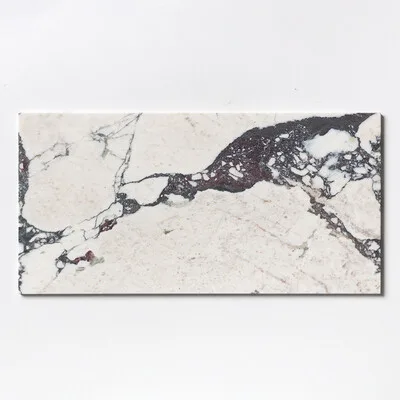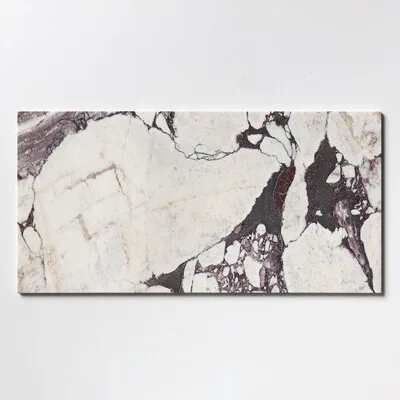
Calacatta Viola is the stone of the 2020s design cycle: violet, burgundy and wine-coloured veins sweeping across a white to cream field. Polished 2 cm slabs trade at roughly 90 to 250 dollars per square foot ex-warehouse in Western markets, based on our market estimates (August 2026).
The economics of Viola are demand-driven in a way the rest of the Calacatta family is not. The quarries were never developed for volume, designer demand spiked faster than block supply could respond, and well-figured bundles now sell as fast as they are sawn. That makes Viola a stone where sourcing skill — knowing what a good slab looks like, moving quickly, and buying close to the mill — translates directly into money.
What Makes Calacatta Viola Distinct
Viola is a brecciated marble from the Apuan region: the violet-burgundy colour comes from iron and manganese mineralisation along fracture zones that were later re-cemented into solid stone. Unlike the linear veins of Statuario or the painterly strokes of Calacatta Gold, Viola's figure is fragmentary and dramatic — angular islands of white and cream bounded by wine-coloured seams.
No two slabs are remotely alike, and the colour range within the commercial category is wide: some lots run pale lilac-grey, others deep oxblood. This variability is the stone's appeal and its commercial hazard. A slab photographed under warm light can look burgundy and arrive lavender-grey. The category also borders on stones sold as Breccia Capraia and Calacatta Monet — material from neighbouring faces with similar character that sometimes crosses labels depending on who is selling. Judge the slab, not the name.
Quarries and Block Supply
Viola comes from a small number of quarry faces in the Apuan Alps, and output was modest even before the demand wave. Brecciated deposits yield less usable block than massive marble beds — the fracture zones that create the colour also create waste — so the ratio of spectacular slabs to quarried tonnage is low. When global demand multiplied in the early 2020s, the quarries could not simply scale, and premium bundles began selling forward before sawing.
The practical consequence is tight supply of the good material specifically. Commodity-grade Viola with washed-out colour is findable; vivid, well-composed slabs are chased by fabricators on three continents. Chinese processing mills participate in the block auctions and hold Viola inventory, and factory-direct buying can capture the usual 30 to 60 percent saving against Western warehouse pricing — but for Viola the deeper advantage is often access itself: a mill cutting blocks this month may have sequences that no Western warehouse will see for a season.
Grades, Veining and Book-Matching
Viola grading runs on colour saturation, composition and field quality. The premium tier shows saturated violet-burgundy seams with strong contrast against a clean white-cream field, composed so the fragments read as deliberate pattern rather than rubble. Mid-tier slabs have good colour but chaotic or sparse figure. The lower tier — still traded under the full name — runs grey-lilac with muddy contrast and is worth a fraction of the premium material despite the identical label.
Book-matching transforms Viola more than almost any stone: mirrored brecciated figure produces kaleidoscopic, Rorschach-like compositions that have become the signature look for bar fronts and shower walls. This requires sequential slabs from one block, confirmed by slab numbers and a dry-lay photo or composite. One Viola-specific warning: because the figure is fragmentary, the cutting plan matters enormously. A vanity top cut from the wrong zone of a spectacular slab can miss every interesting feature. Approve piece placement on the slab image before the saw runs.
Calacatta Viola Prices in 2026
Polished 2 cm Viola slabs run 90 to 250 dollars per square foot ex-warehouse in Western markets — market estimates (August 2026). Colour saturation is the primary price driver: pale grey-violet commodity lots populate the bottom third of the range, while vivid oxblood-on-white showpieces command the top and occasionally trade above it in private sales. Designer demand keeps the premium tier moving quickly, so quoted prices have short shelf lives.
Installed economics follow the premium-stone pattern. US fabrication for statement work — book-matching, mitred returns, tight seam alignment across fragmentary figure — typically adds a broad 40 to 80 dollars per square foot. As a typical US market figure, installed Viola projects commonly land between 160 and 350 dollars per square foot. Waste factors run higher than on uniform stones because pieces must be composed, not just nested; budget 20 to 35 percent overage rather than the standard 15.
Factory-direct buying from a Chinese mill typically prices 30 to 60 percent below Western warehouses for comparable material, and for Viola it adds the access advantage described above. The discipline requirement is also at its peak: colour is the whole value proposition, and colour is exactly what cameras and screens distort. Insist on daylight photography with a white reference card and, for large commitments, a physical sample cut from the actual block — not a generic Viola sample — couriered before payment.
Calacatta Viola vs Calacatta Gold, Breccia Stones and Quartz
Within the family, the choice against Calacatta Gold (100 to 300 dollars per square foot, market estimates, August 2026) is a choice of statement: Gold is warm luxury, Viola is fashion-forward drama. Standard Calacatta (80 to 250, market estimates, August 2026) is the conservative pick that will read as classic in thirty years. Viola is the highest-risk, highest-impact option — its association with the current design cycle is precisely what makes it photograph so well now.
Outside Italy, several breccia and violet-toned stones deliver related looks for less: Turkish and Iranian breccias, and some Chinese purple-veined materials, trade well below Viola money, though the specific white-plus-oxblood combination is hard to duplicate. Engineered quartz Viola patterns exist but are the least convincing of all marble prints — brecciated figure defeats pattern repetition at any viewing distance, and designers dismiss them instantly. If the budget will not reach genuine Viola, a different natural stone is usually a better answer than a printed imitation.
Where Calacatta Viola Works Best
Viola is concentrated-impact material. Its canonical uses are the ones the design press made famous: bar fronts and counters in hospitality, book-matched shower and feature walls, powder-room vanities, fireplace surrounds and furniture tops. In kitchens it appears most successfully as a splashback or island face against quiet cabinetry, letting one surface carry the room.
Restraint is a budget strategy as much as an aesthetic one. Because the stone's value is its figure, small well-chosen areas deliver most of the effect. For commercial clients, one more consideration: Viola photographs so distinctively that it effectively brands a venue, which is an asset for a flagship and a liability for a rollout concept that must be reproduced when supply shifts.
Fabrication and Finishes
Brecciated stone is structurally more demanding than massive marble. The re-cemented seams that create Viola's figure are potential planes of weakness, so slabs are routinely resin-reinforced and mesh-backed at the mill, and complex pieces may need rodding. This is standard, disclosed practice — the question for your supplier is not whether reinforcement exists but what was done and where. Handle and transport with more care than Carrara-class material; edge chips along colour seams are the typical transit damage.
Polished finish saturates the violet and is the overwhelming default. Honed Viola mutes the colour noticeably — sometimes deliberately, for a softer archaeological look — but honing decisions should be made on a sample of the actual lot, since pale material can go flat and lifeless without gloss. Sealing is non-negotiable: the mineralised seams can be marginally more absorbent than the surrounding calcite, and a stain tracking along a burgundy vein is nearly impossible to extract.
Care and Maintenance
Daily care follows standard calcite rules — pH-neutral cleaners, no acids, prompt attention to spills — with sealing renewed roughly annually on working surfaces. Etching shows differently on Viola than on white marble: dull spots interrupt the colour play and are most visible on the saturated seams, so bar tops and kitchen counters in polished Viola will show their service history unless honed or diligently protected.
Refinishing works as on any marble, with one caveat: resin-reinforced surfaces need a restorer who knows brecciated material, because aggressive grinding can expose or haze the resin fills. Structurally, installed Viola is as permanent as any marble — the reinforcement concerns are about fabrication and transit, not about the stone's life on a wall or counter.
Sourcing Checklist for Buyers and Importers
First, judge colour with protocol: daylight photos against a white card, plus a physical sample from the actual block for any large commitment — Viola's value is chromatic and screens lie. Second, sequence and numbering for any book-matched work, with a dry-lay composite approved before cutting. Third, reinforcement disclosure in writing: what resin, what backing, which slabs. Fourth, cutting plan approval against slab images, because fragmentary figure makes piece placement decisive.
Fifth, commercial terms that reflect scarcity: premium Viola sells forward, so a quote is only real once slabs are numbered and reserved against deposit — and a mill that can show you the physical bundle on video call is worth more than a cheaper one that cannot. Benchmark against the 90 to 250 dollar Western warehouse range (market estimates, August 2026); factory-direct should land 30 to 60 percent below the comparable tier. Budget waste at 20 to 35 percent, insure transit at full replacement value.
Frequently asked questions
How much does Calacatta Viola marble cost per square foot?
Polished 2 cm slabs run roughly 90 to 250 dollars per square foot ex-warehouse in Western markets, based on market estimates (August 2026). Colour saturation drives the spread — pale lilac-grey lots sit at the bottom, vivid oxblood-on-white at the top. Installed projects typically land between 160 and 350 dollars per square foot in the US, and factory-direct quotes from Chinese mills run 30 to 60 percent below Western warehouse pricing.
Why is Calacatta Viola so hard to find?
Supply was never built for this demand. The stone comes from a few Apuan quarry faces, brecciated deposits yield less usable block per tonne than massive marble, and the designer-driven demand wave of the 2020s outran output. Premium bundles now sell forward before sawing, so vivid, well-composed slabs rarely sit in open inventory — access to mills cutting current blocks matters as much as price.
Is Calacatta Viola more expensive than Calacatta Gold?
The ranges overlap: Viola runs 90 to 250 dollars per square foot and Calacatta Gold 100 to 300 (market estimates, August 2026). Gold holds the higher ceiling; Viola's pricing is more volatile because it is fashion-driven and supply-constrained. Within either stone, the specific slab's figure matters more than the category — a spectacular Viola outprices a mediocre Gold.
Does Calacatta Viola work in a kitchen?
Yes, with calcite discipline: it etches with acids and shows wear on polished surfaces like any marble. It performs best as a splashback, island face or book-matched statement rather than the full working counter. Sealing matters more than usual because a stain tracking along a burgundy seam is effectively permanent. Many designers pair one Viola statement surface with quieter, harder working surfaces.
Are there cheaper alternatives that look like Calacatta Viola?
Partially. Turkish and Iranian breccias and some Chinese purple-veined marbles deliver related fragmentary figure at well below Viola money, though the precise white-field-with-oxblood-seams combination is hard to duplicate. Quartz Viola prints are the least convincing engineered patterns on the market — brecciated figure exposes repetition immediately — so a different natural stone is usually the better downgrade path.
Can I buy Calacatta Viola factory-direct from China?
Yes — Chinese mills buy Viola blocks at the Italian auctions, and factory-direct pricing typically runs 30 to 60 percent below Western warehouses. With Viola the channel also buys access: mills cutting current blocks offer sequences Western inventory will not show for months. Verify colour with daylight photos, a white reference card and ideally a couriered sample from the actual block before committing.