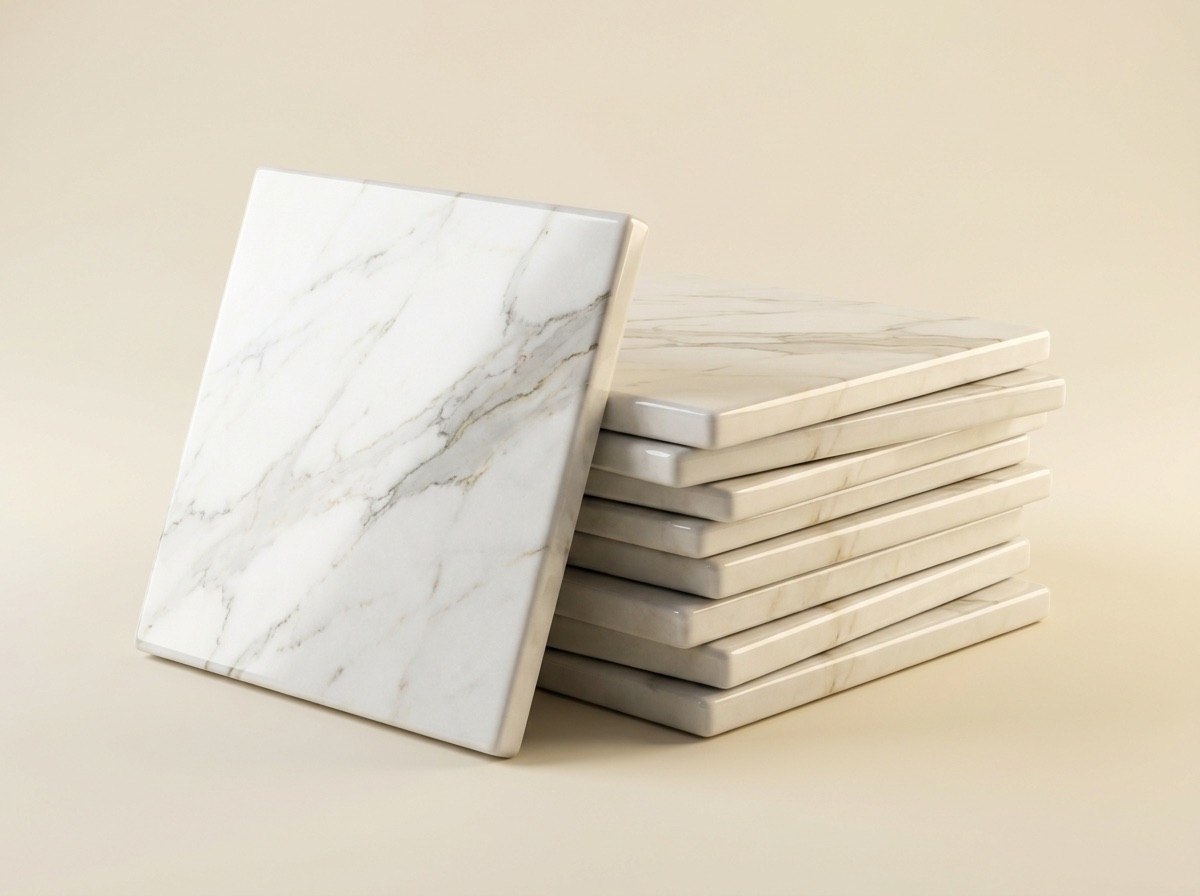
Tiles are the volume end of the marble trade: calibrated, repeatable, shipped by the pallet and priced by the square foot. As a market estimate for August 2026, factory-direct marble tiles run $6 to $40 per square foot depending on stone and format, against Western retail commonly running $10 to $60-plus for comparable material before installation. In 12x12, 12x24, 24x24 and custom formats, polished or honed, the product is a commodity in the good sense: specifications are objective, quality is measurable, and price comparisons actually mean something.
This guide covers what drives tile pricing, how the retail markup stacks against factory-direct landed cost, which stones make sense on floors and walls, the calibration and grading details that decide whether an installer blesses or curses your container, and the QC, MOQ and ordering mechanics. Matching trim - skirting, thresholds, stair treads cut from the same blocks - is covered too, because color-matched trim is where factory-direct buying quietly beats piecing an order together from retail stock. All figures are market estimates; live factory quotes are stone- and format-specific.
What You Are Buying: Calibrated Modular Stone
A marble tile is a slab's disciplined sibling: cut to modular sizes, gauged to uniform thickness, edges finished straight or bevelled, faces polished or honed, packed face-to-face in foam-lined cartons on fumigated pallets. The standard formats - 12x12, 12x24 and 24x24 inches, plus 18x18 and European 30x60 and 60x60 cm equivalents - exist because they lay out efficiently and survive shipping. Custom formats are routine factory work: herringbone planks, large-format 24x48, and project-specific modules cut from the same blocks.
The phrase that matters most in this category is same-block consistency. A factory cutting your entire order from a contiguous set of blocks delivers floors where tile 1 and tile 900 match in tone and veining. Retail stock assembled from different production lots does not, and mixed-lot floors are the most common marble tile complaint in existence. This is the structural advantage of ordering from one mill in one production run.
Price Economics: The $6-40 Factory Band Explained
The stone sets the floor of the price. Guangxi White slabs trade at $15-35 per square foot but its tiles start far lower because tile production uses smaller and more economical block yields - entry Guangxi White and standard Chinese marbles anchor the $6-12 factory band. Carrara tiles run mid-band, consistent with slab stock at $40-90 per square foot translating to tiles well under Western retail for the same stone. Premium material - Statuario, Calacatta grades, Panda White - pushes toward the top of the $6-40 range, driven by block cost rather than processing.
Western retail adds importer margin, distributor margin and retailer margin to a landed cost that already includes freight and duty; 50 to 150 percent over landed is the normal stack, more at design showrooms. Factory-direct, you pay the mill price plus logistics. Landed cost basics: marble tiles ship at roughly 5.5 to 7 kilograms per square foot packed at 3/8 inch thickness, a 20-foot container carries roughly 3,500 to 4,500 square feet limited by weight, ocean freight runs $2,500 to $5,000 US-bound as a market estimate, and duty per the current HTS line for worked marble applies. Net effect: logistics add roughly $1.50 to $3 per square foot on a full container - a small number against mid-band stone, a meaningful one against $6 entry tiles.
The comparison that decides projects: 2,000 square feet of honed Carrara at $28 retail is $56,000 before installation; factory-direct at $14 plus $2.50 logistics is $33,000 landed.
Best Stones for Floors and Walls
Floors need hardness, sensible finish and honest expectations. Carrara ($40-90/sqft slab basis) and Guangxi White ($15-35) are the classic light floor stones, almost always specified honed for slip resistance and etch tolerance. Emperador browns ($35-85) and the black family ($30-80 for standard blacks, $40-90 for Nero Marquina) hide traffic and dirt well but show dust and scratches on polished finishes - honed or leathered is the practical call in busy areas. Green marbles ($30-100) contain serpentine and can react with water-based setting materials; they typically require epoxy setting, a real specification detail your installer must know before the container arrives.
Walls open the palette completely: weight-rated substrates aside, anything goes, including polished finishes that would be reckless on wet floors. Bathroom walls and shower surrounds are the natural home of book-match-effect veining and premium whites. Nero Marquina with white veining remains the signature contrast stone for feature walls. For exterior use, finish loss and freeze-thaw are real; exterior specifications should be stone-specific conversations, not catalog picks.
Specs and Formats: Calibration, Thickness, Edges
Standard thickness is 3/8 inch (10 mm) for 12x12 and 12x24, and 1/2 to 3/4 inch (12-20 mm) for 24x24 and larger formats and for floors on thick-bed installation. Calibration tolerance is the specification that separates professional tile from trouble: demand plus or minus 0.5 mm on thickness and plus or minus 0.5 mm on facial dimensions, with square checked on the diagonal. Well-calibrated tile lays flat with tight joints on thin-set; badly calibrated tile costs more in installer lippage-management time than the tile itself.
Edges are straight (square) or micro-bevelled; the bevel forgives tiny lippage and is the safer call for large formats in raking light. Finishes: polished, honed, and for some stones brushed or tumbled. Specify finish per area, not per order - polished walls with honed floors from the same blocks is a standard package. Matching trim belongs in the same production run: skirting, bullnose, thresholds, niche shelves and stair treads cut from the same material, which is precisely what piecemeal retail buying cannot deliver.
Grading and Variation: Agreeing on What Arrives
Marble tile grading covers two different things buyers often conflate: manufacturing grade - calibration, edge quality, face defects - and aesthetic range - tone and vein variation inherent to natural stone. First-grade manufacturing means no chips, cracks, or calibration misses; that is contractual and testable. Aesthetic range must be agreed with a control set: approve a range board of 4 to 8 tiles showing light-to-dark and calm-to-veined extremes, and write acceptance around that range.
Dry-lay discipline protects both sides: the factory dry-lays a representative area, photographs it in daylight, and you approve before packing. On site, installers should blend tiles from multiple cartons as they lay. Order 7 to 10 percent overage for cuts, breakage and attic stock in the same lot; matching a lot years later is close to impossible.
Quality Control Checklist
Per shipment: random-sample calibration measurements across cartons - thickness, facial dimensions, diagonal square; face inspection for cracks, chips, fills and polish windows under raking light; back-face check for proper mesh or netting where specified and no efflorescence staining; finish gloss consistency across the sampled set; approved range board compliance on tone and veining; and packing spec - face-to-face with foam interleaf, sealed cartons marked with lot, stone, format and finish, pallets fumigated and stamped.
Water and absorption behavior matters for wet areas: request the stone's technical sheet - absorption, flexural strength, abrasion resistance - and for showers and exteriors, confirm suitability in writing. Third-party inspection at $150 to $300 per man-day covers a tile order in a single day of random sampling and is worth it on first orders and any order above a few thousand square feet.
MOQ and Lead Times
Minimum order is from 500 square feet per format - roughly one production run's worth of a single size and finish. Mixed orders combining formats, finishes and trim from the same stone are normal and encouraged, since everything cuts from the same blocks. Below 500 square feet per format, setup and packing costs push unit prices up and retail stock becomes the rational alternative.
Lead times: 3 to 5 weeks production for standard stones and formats, plus 30 to 40 days ocean transit to US or EU ports, plus clearance and inland delivery - plan 10 to 12 weeks door to door. Custom formats and scarce stones add upstream time. For phased projects, reserve blocks or slabs at order time for later phases; a mill can hold material against a small commitment.
The Ordering Process
Step one: quantities per format and finish, area schedule, trim list, and target stone or look with budget band. Step two: quote with stone options at each price point, per-format pricing, packing spec and FOB or CIF terms. Step three: sample approval - physical range board shipped by courier, typically one to two weeks. Step four: 30 percent deposit and production, with dry-lay photos at the mill. Step five: pre-shipment inspection, loading photos, balance against documents. Step six: ocean transit, clearance by your broker or the mill's freight partner, delivery.
Coordinate the installer early: share the technical sheet, setting-material requirements (epoxy for greens, white thin-set under translucent whites), calibration data and the blending instruction.
Care and Maintenance
Marble floors and walls want simple discipline: seal after installation and reseal annually in wet and high-traffic areas, clean with pH-neutral stone soap, never acidic or bleach cleaners, use walk-off mats at entries, and felt under furniture. Etching from acids and wear paths in soft stones are surface phenomena - honed floors can be re-honed in place decades later, which is why marble floors from the nineteenth century still exist and porcelain from the nineties does not.
For wet areas, good waterproofing behind the stone matters more than anything done to the stone itself, and green marbles' epoxy-setting requirement bears repeating. Set maintenance expectations at handover with a one-page care sheet.
Frequently asked questions
How much do marble tiles cost per square foot?
Factory-direct, $6 to $40 per square foot as a market estimate for August 2026: entry Chinese whites and standard stones at $6-12, Carrara mid-band, premium Calacatta-grade material toward the top. Western retail for comparable tile commonly runs $10 to $60-plus before installation. Logistics add roughly $1.50 to $3 per square foot on a full container.
What is the minimum order for factory-direct marble tiles?
From 500 square feet per format - one production run of a single size and finish. Orders can mix formats, finishes and matching trim cut from the same blocks. Below that threshold, setup and freight costs favor buying from local retail stock instead.
Which marble tile is best for flooring?
Honed Carrara and Guangxi White are the classic light floors; Emperador browns and the black family hide traffic well in honed or leathered finishes. Polished floors belong in low-traffic, dry areas. Green marbles need epoxy setting materials, and exterior use requires stone-specific verification rather than a catalog pick.
What is the difference between 12x12, 12x24 and 24x24 marble tiles?
Format changes layout scale, thickness and installation demands: 12x12 and 12x24 run 3/8 inch thick and forgive substrate imperfections better, while 24x24 and larger run 1/2 to 3/4 inch, read more monumental, and demand flatter substrates and tighter calibration. Larger formats also raise freight weight per square foot and breakage stakes slightly.
How much does shipping marble tile from China cost?
A 20-foot container carries roughly 3,500 to 4,500 square feet limited by weight, with US-bound ocean freight around $2,500 to $5,000 as a market estimate. With duty, port fees and drayage, landed logistics typically add $1.50 to $3 per square foot on full containers; small LCL orders cost proportionally more per foot.
How do I avoid tone and veining mismatch in a marble tile order?
Order the full quantity plus 7 to 10 percent overage in one production run cut from contiguous blocks, approve a range board showing acceptable variation, require dry-lay photos before packing, and have installers blend from multiple cartons. Mixed production lots are the root cause of most marble floor complaints.
Are marble tiles hard to maintain?
Not hard, just specific: seal after installation and annually in wet areas, clean with pH-neutral soap, keep acids off the surface, and use entry mats. Honed finishes hide wear and etching well, and marble floors can be re-honed in place decades later - a renewability no printed porcelain offers.