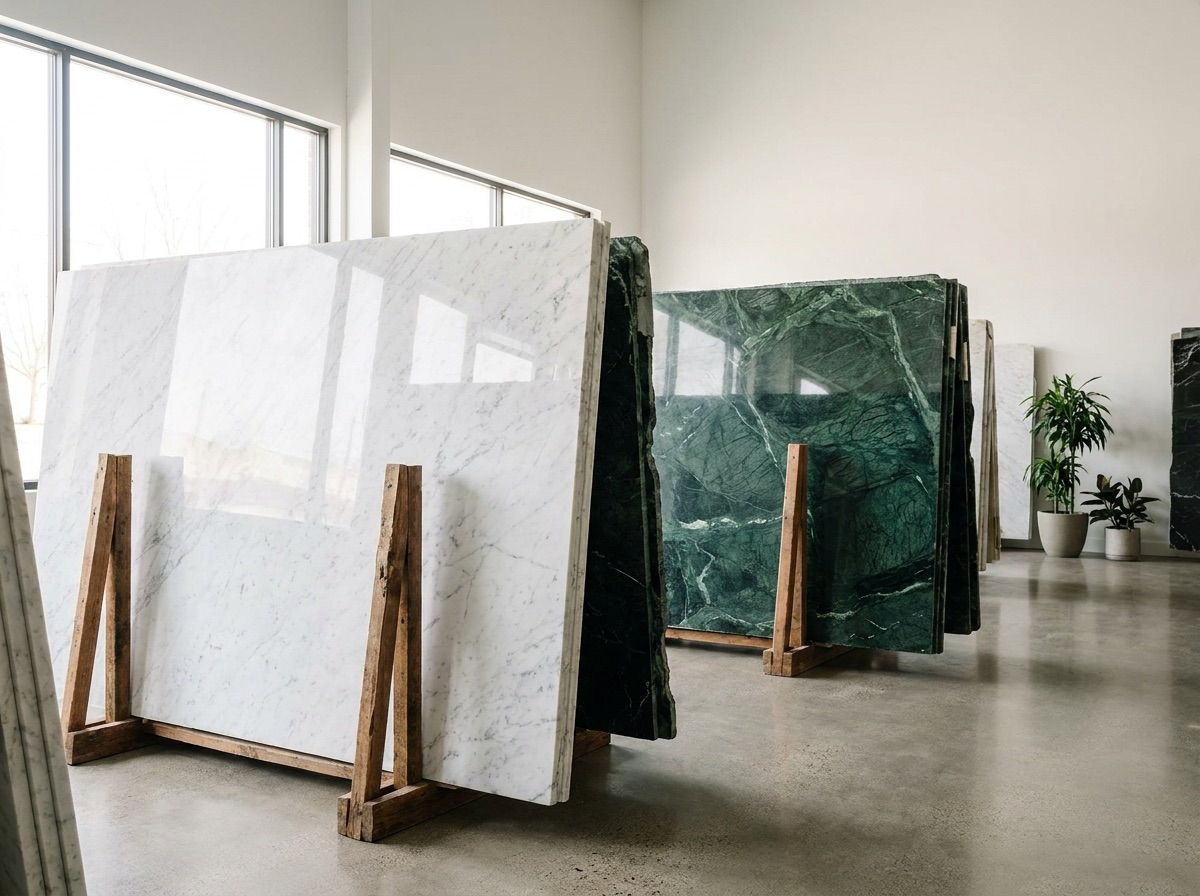
Slabs are the raw currency of the stone trade. Everything else on this index - countertops, table tops, tiles, vanities - starts life as a polished 2 cm or 3 cm slab, and slab pricing is where the market is least transparent. As a market estimate for August 2026, polished marble slabs trade between $15 and $300 per square foot depending on the stone: Guangxi White at $15-35 at the entry, Carrara at $40-90, Statuario at $80-220, Calacatta at $80-250, and Calacatta Gold reaching $300 for premium book-matched material. Those are Western warehouse numbers; factory-direct quotes from mills in China typically run 30 to 60 percent below them for the same or equivalent material.
This guide covers how slabs are actually bought and sold - bundles, A-frames, gauged thickness, book-matching - what drives the enormous price spread within a single stone name, how landed cost works when you import a bundle, and the QC discipline that separates a good container from an expensive pile of crack-filled disappointment. Prices are market estimates; a live factory quote against specific blocks is the only number that binds.
What You Are Buying: Bundles, Not Pieces
Slabs sell by the bundle: 6 to 8 consecutive slabs sawn from the same block, sold together so the pattern runs continuously from slab to slab. That continuity is the value - it is what allows book-matching, where consecutive slabs are polished on opposite faces and opened like a book into a mirrored pattern for walls, islands and showers. Breaking a bundle destroys that value, which is why the minimum order is one bundle.
A typical slab measures roughly 105 by 65 inches, call it 45 to 50 square feet, so a bundle carries 280 to 400 square feet of material. Slabs come gauged - calibrated to uniform 2 cm or 3 cm thickness - and polished, honed or brushed. When comparing quotes, confirm the price basis: per square foot of gross slab area is the convention, and the usable yield after trimming defects and squaring edges is typically 85 to 95 percent of gross.
Why the Same Stone Name Spans a 3x Price Range
Calacatta at $80 and Calacatta at $250 per square foot are both real prices for real Calacatta. The spread is driven by block quality: ground color purity, vein drama and distribution, absence of open fissures, and slab size. Within a single quarry, the best benches command multiples of the commercial grade. Names are also elastic - Carrara sold as first choice, commercial grade sold under fantasy names - so photographs of the actual slabs matter more than any name on an invoice.
Grade language varies by supplier but generally runs premium or first choice, standard or commercial, and second choice with visible defects, filled areas or dull patches. For furniture and cut-to-size work where pieces are small, commercial grade is often the smart buy because defects are cut around. For full-slab applications - islands, book-matched walls - pay for the grade, because every square inch shows.
Price Economics: Warehouse vs Factory-Direct
A Western stone warehouse imports slabs, absorbs breakage and inventory financing, runs a showroom, and marks up accordingly - typically 50 to 120 percent over its own landed cost. That is the $40-90 Carrara you see on a gantry in New Jersey. Factory-direct means buying the same bundle at the mill in China, where enormous volumes of Italian, Spanish, Indian and domestic Chinese blocks are processed, and taking the freight and clearance work on yourself or through the mill's freight partner.
Landed cost math for a bundle: factory price plus inland haulage to port, ocean freight (a 20-foot container carries roughly 7 to 9 bundles of 2 cm slabs, about 2,500 square feet, with freight typically $2,500 to $5,000 US-bound as a market estimate), insurance, duty per the current HTS line for worked marble, port fees and drayage. On a full container of mid-priced stone, freight and clearance commonly add $3 to $6 per square foot. The 30 to 60 percent factory discount comfortably survives that arithmetic on everything except the very cheapest stones, where freight becomes the dominant cost.
One structural note: Chinese mills process Carrara-basin blocks at scale, so an Italian-quarried, Chinese-polished Carrara slab is a normal article of commerce, often indistinguishable from Italian-polished material except in price. For the Carrara look at project budgets, Guangxi White at $15-35 per square foot is the substitution every volume buyer should price before defaulting to the Italian name.
The Stones: A Working Shortlist
Whites carry the market. Carrara ($40-90/sqft) is the liquid, safe choice. Statuario ($80-220) adds brightness and contrast. Calacatta ($80-250) and Calacatta Gold ($100-300) are the luxury tier where vein pattern drives the number slab by slab. Calacatta Viola ($90-250) is the designer favorite with violet-burgundy veining and genuinely tight supply. Guangxi White ($15-35) is the volume workhorse; Han White ($25-70) the fine-grained carving and architectural stone.
Beyond white: Nero Marquina ($40-90) is the reference black with white lightning veins, with China Black and Mongolia Black offering the look for less within the broader $30-80 black marble band. Green marble ($30-100) - Verde Alpi, Rainforest Green, Ming Green - is in a genuine design moment. Emperador ($35-85) covers the warm browns. Panda White ($50-130) delivers the boldest book-match in the business. Onyx ($60-200) is the translucent outlier, sold for backlighting rather than durability.
Specs and Formats
Thickness is 2 cm or 3 cm gauged, with 2 cm dominating furniture and wall work and 3 cm preferred for North American countertops. Confirm gauging tolerance - plus or minus 0.5 mm is good practice - because ungauged slabs cost fabricators real time. Finishes: polished is the default and the best traveler; honed and leathered finishes are better ordered on the slab than applied locally.
For book-matched sets, order and label pairs explicitly: bundle position numbers, match diagrams, and polished faces marked. A mill that book-matches routinely will send a layout photo of the opened pair before packing. Resin treatment and mesh backing on the reverse are standard for fragile stones; ask what treatment each bundle received, because heavy resin on the face affects refinishing later.
Quality Control Checklist
Inspect before the container closes, in person or by hired inspector. Check: every slab photographed front and back against the packing list; thickness gauged within tolerance at multiple points; polish gloss consistent with no wave visible under raking light; cracks and open fissures marked and priced accordingly - filled fissures are normal in many stones, undisclosed structural cracks are not; no rust spots from iron content, especially on whites; and bundle sequence intact for book-matching.
Water test on request: a wet slab reveals polish defects and hairlines that dry photos hide. For whites, ask about iron-line risk and whether blocks were tested; a Carrara slab that develops yellow lines after installation is a chemistry problem no refund fully fixes. Third-party inspection at the mill costs $150 to $300 per man-day and pays for itself on the first crack it catches.
Packing and Shipping: A-Frames and Bundles
Slabs travel upright, leaning on reinforced wooden A-frames or in fumigated slab crates, faces separated by foam or paper, strapped and braced against container walls. Weight is the binding constraint before volume: a 20-foot container maxes out around 26 to 28 tonnes, which is roughly 2,500 square feet of 2 cm marble or proportionally less at 3 cm. Good mills load with cranes and spreader bars and photograph the stuffed container; insist on those photos.
Breakage on a properly packed container should be near zero, but marine cargo insurance on stone is cheap and non-negotiable. Insure at landed value, document condition at loading with photos, and survey visible damage at destination before signing the delivery receipt. A cracked slab discovered at unloading with loading photos in hand is an insurance claim; without them it is an argument.
MOQ, Lead Times and Ordering Process
Minimum order is one bundle, 6 to 8 slabs, which ships as part of a consolidated container; a dedicated container needs 7 to 9 bundles at 2 cm. Lead time for stock material is 2 to 4 weeks to prepare, inspect and load, plus 30 to 40 days ocean transit to US or EU ports. Stones cut from newly sourced blocks add 3 to 6 weeks upstream.
The process: specify stone, thickness, finish and quantity; receive photos of available bundles with dry and wet shots; agree price against specific bundle numbers, never against a generic stone name; place deposit, typically 30 percent; pre-shipment inspection and photos; balance against documents; sail. Every serious dispute in the slab trade traces to buying a name instead of a numbered bundle, so anchor the contract to the photographed material.
Care, Storage and Resale Notes
Store slabs upright on A-frames, never flat, faces protected, in a dry covered space - polished marble left wet against another slab can stain from its own packing. For resale buyers - fabricators and yards - vein-rich bundles photographed well move fastest, and keeping bundles intact preserves book-match premiums.
Sealing happens after fabrication, not in the warehouse. What matters at the slab stage is honest grading of what you hold: mark filled areas, disclose them downstream, and price accordingly.
Frequently asked questions
How much does a marble slab cost in 2026?
As a market estimate for August 2026, polished slabs run $15 to $300 per square foot at Western warehouses: Guangxi White $15-35, Carrara $40-90, Nero Marquina $40-90, Statuario $80-220, Calacatta $80-250, Calacatta Gold up to $300. A typical 45-50 square foot slab therefore ranges from under $1,000 to over $10,000. Factory-direct pricing from China typically runs 30 to 60 percent below warehouse levels.
What is the minimum order when buying slabs factory-direct?
One bundle - 6 to 8 consecutive slabs from the same block, roughly 280 to 400 square feet. Bundles stay together because consecutive slabs carry continuous pattern for book-matching. A dedicated 20-foot container holds about 7 to 9 bundles of 2 cm material, limited by weight rather than space.
Why do Calacatta slab prices vary so much?
Block quality drives the number: whiteness of the ground, drama and distribution of veining, freedom from open fissures, and slab size. Premium benches from the same quarry sell for multiples of commercial grade under the same name. Always price against photographs of the specific numbered bundle, not against the stone name.
Is Chinese-processed Carrara real Carrara?
Usually yes - Chinese mills import Carrara-basin blocks at scale and polish them domestically, so the stone is Italian even when the processing is not. The finished slab is often indistinguishable from Italian-polished material at a meaningfully lower price. For budget projects, Guangxi White offers a similar cool-white look at $15-35 per square foot.
How much does it cost to ship a container of marble slabs?
As a market estimate, ocean freight for a 20-foot container to the US runs $2,500 to $5,000 depending on route and season, and the container carries roughly 2,500 square feet of 2 cm slabs. With duty, port fees and drayage, total logistics commonly add $3 to $6 per square foot on a full container - a small number against mid-range and premium stones.
How do I check slab quality before shipment?
Require photos of every slab front and back, wet shots under raking light, thickness readings at several points, and disclosure of filled fissures and repairs. Hire a third-party inspector at the mill for $150 to $300 per man-day on early orders, and get photos of the stuffed container for the insurance file before it ships.
What is book-matching and does it cost more?
Book-matching polishes consecutive slabs on opposite faces so they open into a mirrored pattern for islands, walls and showers. It requires keeping bundle sequence intact and matching at the mill, and commands a premium over loose slabs - modest at the factory, steep at Western yards. Order matched pairs explicitly, labeled and photographed as opened sets.