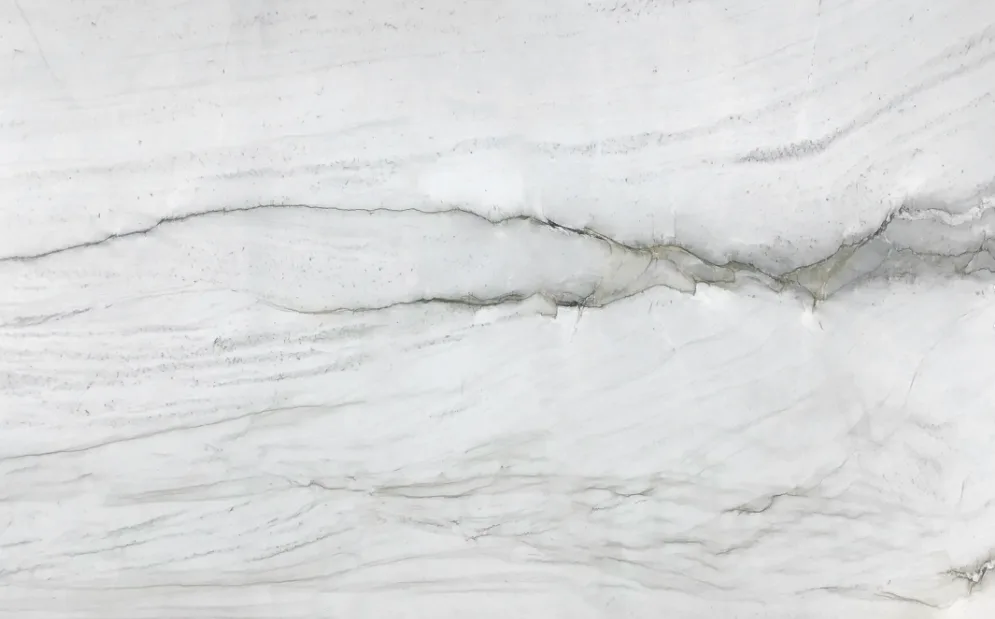
Mont Blanc is the quartzite that most closely stands in for Calacatta marble. It is a bright white Brazilian stone with grey and soft brown veining that runs in linear, legible bands rather than the diffuse clouding of Taj Mahal, and it wears like granite: harder than marble, effectively etch-proof against citrus and wine, and stable under sunlight. Polished 2 cm Mont Blanc slabs trade at roughly 70 to 150 dollars per square foot ex-warehouse in Western markets, based on our market estimates (August 2026).
The spread reflects how white the field is, how clean the veining runs, slab size and where in the supply chain you buy. This guide covers what the stone is, why quartzite is not engineered quartz, how the Brazilian block trade sets the price floor, what installed numbers look like, how it compares with Calacatta and the other white quartzites, and how factory-direct processing of Brazilian blocks in China changes the maths for volume buyers.
What Mont Blanc Quartzite Is: Geology, and Why It Is Not Quartz
Mont Blanc is a metamorphic quartzite: a quartz sandstone buried, heated and compressed until the grains recrystallised into an interlocking mass. It is around 90 percent silica or more, reads about 7 on the Mohs scale, does not react with household acids and takes a genuine polish. The bright white field comes from a very clean parent sand with little iron; the grey and soft brown veins are mineral-stained bands and healed fractures. It comes from the same Brazilian quartzite belts as Taj Mahal, Perla Venata and Cristallo, and sits at the cooler, whiter end of that family.
The confusion between quartzite and quartz drives a large share of search demand and needs stating plainly. Quartzite is a natural stone cut from a quarry block. Quartz, in the countertop trade, is an engineered product: crushed quartz mineral in polymer resin, pressed into slabs in a factory. Mont Blanc comes in unrepeatable slabs, tolerates heat from a hot pan and can be refinished; engineered quartz has a repeating printed pattern, scorches under heat, yellows in UV and cannot be re-polished. Products sold as Mont Blanc quartz are engineered lookalikes borrowing the name. Ask which you are being quoted before you compare prices.
The other check that matters: several white stones sold as quartzite, Super White among them, are actually dolomitic marbles that etch and scratch like marble. Mont Blanc is a genuine hard quartzite, but lots vary. Ten minutes of lemon juice on an offcut and a steel blade dragged across it settle the question. Real Mont Blanc shows neither an etch mark nor a scratch.
Quarries and Block Supply in Brazil
Mont Blanc is quarried in Brazil, principally in the quartzite belts of Bahia and Minas Gerais, alongside Taj Mahal, Perla Venata, Cristallo and Naica. Blocks come out large and the main quarries have run for years, so availability is good, though not at Taj Mahal volume. White lots with clean grey veining are the scarcest and set the top of the range.
The trade route is the same as for every Brazilian quartzite. Blocks are sold at the quarry or from the ports of Vitoria and Salvador. Brazilian and Italian mills slab and resin part of the output; Chinese mills in Fujian and Guangdong buy blocks in volume and process them on modern gang saws and vacuum-resin lines at a fraction of Western labour cost. The block price is broadly the same for everyone; the finished slab price is not, and that gap is where factory-direct buyers gain. For a large project, ask the mill to reserve slabs by block; twenty to thirty sequential slabs from one Mont Blanc block is realistic if you ask early.
Grades, Veining and Book-Matching
Grading is informal. First-selection Mont Blanc has a bright, even white ground with crisp grey veining and only light brown accents, no open fissures and full-size slabs. Commercial selection carries a greyer or creamier field, heavier brown or rust zones, more visible healed cracks and smaller formats. Some blocks lean cool and grey, others warm and brown; both are legitimate, but a kitchen that mixes them looks like a mistake, so every piece for one visual area must come from sequential slabs of one block.
Slab sizes are generous, commonly around 320 by 190 cm, in 2 cm and 3 cm. Because Mont Blanc veining is linear and legible, it book-matches well: consecutive slabs polished on opposite faces give a mirrored pattern across a seam that reads much like a book-matched Calacatta. Waterfall islands, full-height splashbacks and shower walls are where this pays off. Confirm the match from slab photos with slab numbers, never from a hand sample.
Mont Blanc Quartzite Prices in 2026
Polished 2 cm Mont Blanc slabs run 70 to 150 dollars per square foot ex-warehouse in Western markets, based on market estimates (August 2026). The bottom of the range buys commercial selection with heavier brown zones or smaller slabs; the top buys bright white first-selection material with clean grey veining, often 3 cm and often already resined and mesh-free. Honed and leathered finishes typically price at parity or slightly above polished, because they are an additional pass through the line on the same slab.
Installed numbers add fabrication. In the US, quartzite fabrication and installation typically adds a broad 40 to 70 dollars per square foot on a standard kitchen, more than for marble because quartzite is slow to cut and hard on tooling. Installed Mont Blanc counters commonly land in the 120 to 230 dollar per square foot band as a typical US market figure. Cut-to-size pieces such as vanity tops, tiles and stair treads price per finished piece rather than by slab area, which is often more efficient for repetitive formats.
What drives the price: whiteness of the field, cleanness of the veining, block consistency, slab size, thickness, finish, resin treatment and the margin stack between quarry and showroom. Factory-direct is where the economics shift. Chinese mills process Brazilian Mont Blanc blocks at volume, and factory-direct quotes for slabs and cut-to-size typically come in 30 to 60 percent below Western warehouse prices for equivalent selection. Even after ocean freight, insurance, duty and inland delivery, the landed cost on a container-scale order usually sits well under a Western warehouse quote.
Mont Blanc vs Calacatta Marble, Calacatta Quartz and Other White Quartzites
Mont Blanc versus Calacatta marble is the comparison it exists to win. Calacatta at 80 to 250 dollars per square foot and Statuario at 80 to 220 (market estimates, August 2026) are whiter and bolder and carry the prestige of the Carrara basin, but they etch on contact with lemon and scratch under a knife. Mont Blanc delivers a very similar white-with-grey-veins look at 70 to 150 and none of the etching. For a kitchen that will actually be cooked in, it is the rational choice; for a bathroom or a showpiece where provenance matters, Italian marble still wins.
Against Calacatta-look engineered quartz, Mont Blanc is a natural, one-off slab that tolerates heat and UV and can be re-polished. Quartz wins on stain resistance and pattern predictability and usually prices around the lower half of the Mont Blanc range once installed. It loses on outdoor and sun-facing use, on repeat patterns across large runs, and at resale.
Within white quartzites, Bianco Superiore at 80 to 170 dollars is the closest cousin, a bright white with soft grey veining and less brown. Calacatta Macaubas at 60 to 130 offers linear grey veining on white at lower money. Super White at 55 to 110 is cheaper but is often a dolomitic marble and must be acid-tested. Taj Mahal at 70 to 140 and Perla Venata at 80 to 160 are the warmer, creamier options; Cristallo at 90 to 200 is the translucent crystalline white. All figures are market estimates, August 2026.
Where Mont Blanc Works Best
Kitchen countertops and islands in bright, contemporary interiors are the core application, with book-matched waterfall islands and full-height splashbacks the natural showcase. The stone takes hot pans, resists knife scratches, shrugs off citrus and wine and, in a leathered finish, hides fingerprints and water spots.
Beyond kitchens: bathroom vanities and shower walls where a Calacatta look is wanted without the maintenance, fireplace surrounds, bar tops, reception desks and hospitality counters where cleaning chemicals would destroy marble. Because it is UV-stable it also works on outdoor kitchens and covered terraces, which engineered quartz cannot do. As flooring it is durable but heavy and slow to fabricate, so it is usually reserved for feature areas.
Fabrication and Finishes
Quartzite is hard on tooling. Cutting Mont Blanc takes two to three times longer than marble, diamond blades and CNC bits wear faster, and everything must be water-fed. Fabricators price accordingly, and shops that mostly cut marble and quartz sometimes underquote and then struggle. Choose a fabricator with quartzite experience and ask to see a completed quartzite job.
Standard thicknesses are 2 cm and 3 cm; 3 cm is preferred for overhangs and heavy-use kitchens, while 2 cm with a mitred laminated edge gives the thick look at lower weight. Polished maximises the whiteness and vein contrast and is the usual choice for the Calacatta look; honed is a soft matte that reads more contemporary; leathered adds a light texture that hides water spots. Most Mont Blanc slabs are resined at the mill to fill micro-fissures; that is standard practice and not a defect, though it should be disclosed.
Care and Sealing
Mont Blanc does not etch. Lemon, vinegar, wine and common bathroom cleaners leave no dull marks, because there is no calcite for the acid to attack. Scratch resistance is high enough that ordinary kitchen use leaves no trace, and a stone restorer can re-polish it if ever damaged, which is not possible with engineered quartz.
It does need sealing for stains. Quartzite has a network of fine crystalline pores, and oil, coffee and red wine can migrate in if left on an unsealed surface; on a white field a stain shows. Apply a quality penetrating sealer at fabrication and renew roughly once a year on kitchen surfaces; a leathered finish may want it a little more often. Daily care is water and a pH-neutral cleaner. If a stain does get in, a poultice will usually pull it out.
Sourcing Checklist for Buyers and Importers
Verify six things before committing. First, that it is real quartzite: lemon and blade test on a sample cut from the actual bundle, especially important with white stones because of the dolomite lookalikes. Second, block identity: photos or video of the actual slabs with slab numbers, and confirmation that all pieces for one visual area are sequential slabs from one block. Third, dimensions and thickness within tight tolerance, with slab size stated so seams can be planned. Fourth, resin and mesh disclosure: resin is normal, but heavy fibreglass mesh on the back of a countertop slab points to a fractured block and should be priced down or refused.
Fifth, commercial terms: an ex-works China quote is not a landed price. Ask the mill for FOB with a realistic freight estimate, or landed at your port, with the per-square-foot number broken out by slab, cut-to-size and waste allowance. Sixth, crating: A-frames in fumigated wooden crates with corner protection, and photos of previous shipments. Benchmark the quote against the 70 to 150 dollar Western warehouse range for the same selection; the difference is your negotiating room.
Frequently asked questions
How much does Mont Blanc quartzite cost per square foot?
Polished 2 cm Mont Blanc slabs run roughly 70 to 150 dollars per square foot ex-warehouse in Western markets, based on market estimates (August 2026). Installed US kitchen counters typically land between 120 and 230 dollars per square foot. Factory-direct slabs from Chinese mills processing Brazilian blocks are typically 30 to 60 percent below Western warehouse prices.
Is Mont Blanc quartzite a good substitute for Calacatta marble?
For working surfaces, yes. It gives a similar white-with-grey-veins look, book-matches well and does not etch, at 70 to 150 dollars per square foot against Calacatta at 80 to 250 (market estimates, August 2026). Calacatta remains whiter, bolder and more prestigious for showpiece or bathroom use.
Does Mont Blanc quartzite etch or scratch?
Genuine Mont Blanc does neither in normal use, because it is silica rather than calcite and reads about 7 on the Mohs scale. It should still be sealed against stains. Test an offcut with lemon juice and a steel blade before buying, since some white stones sold as quartzite are dolomitic marbles that will etch.
Is Mont Blanc quartzite the same as quartz?
No. Mont Blanc is a natural quartzite quarried in Brazil. Anything sold as Mont Blanc quartz is an engineered product of crushed mineral in resin. Natural quartzite tolerates heat and UV, comes in unrepeated slabs and can be re-polished; engineered quartz cannot.
Mont Blanc or Taj Mahal quartzite?
Mont Blanc is the cooler, whiter option with grey and soft brown veining and a Calacatta character; Taj Mahal is warmer and creamier with softer gold movement and is easier to source in volume. They price close together, 70 to 150 against 70 to 140 dollars per square foot (market estimates, August 2026), so the choice is about tone rather than budget.
Does Mont Blanc quartzite need to be sealed?
Yes, for stain protection rather than etch protection. A penetrating sealer applied at fabrication and renewed roughly once a year on kitchen counters keeps oil and wine out of the fine pores of a white stone where any stain would show.