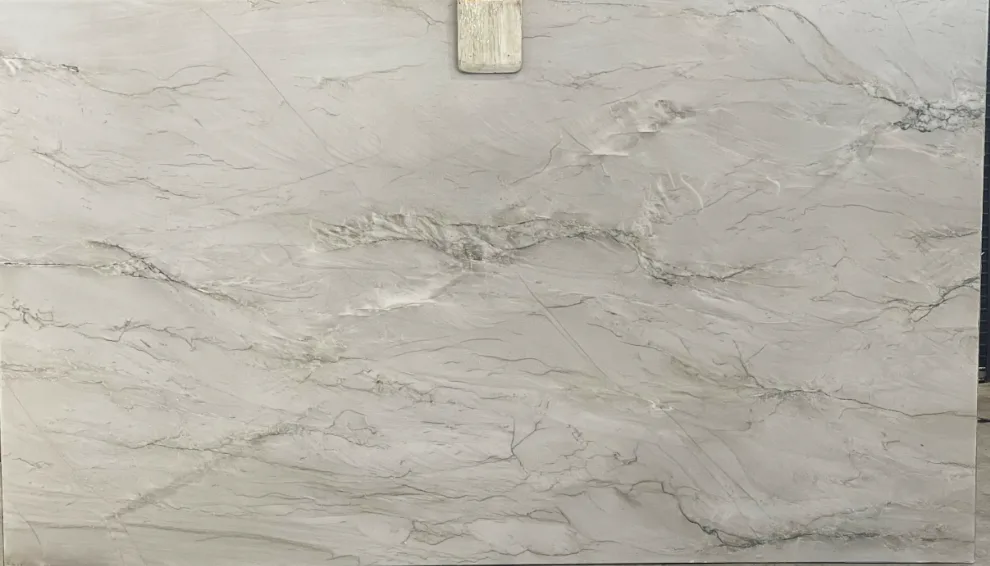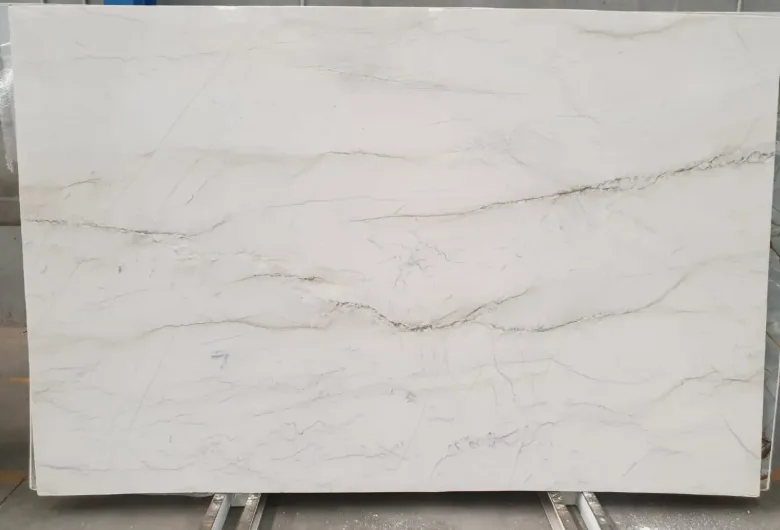
Bianco Superiore is one of the whitest natural quartzites on the market and the closest thing the quartzite family has to Statuario marble: a bright, clean white ground with soft grey veining that drifts rather than shouts. It is the stone people buy when they want an all-white kitchen that survives lemon juice, red wine and children. Polished 2 cm Bianco Superiore slabs trade at roughly 80 to 170 dollars per square foot ex-warehouse in Western markets, based on our market estimates (August 2026).
The spread inside that range comes down to whiteness and clarity. A slab with a slightly creamy or greyish ground and blotchy veining sits at the bottom; a slab with a paper-white field, clean grey veins and no soft spots sits at the top. This guide covers the geology, the supply picture, how the trade grades it, what you actually pay at slab, cut-to-size and installed level, and how factory-direct sourcing changes the arithmetic.
What Bianco Superiore Quartzite Is: Geology and Appearance
Bianco Superiore is a metamorphic quartzite from Brazil: ancient quartz sandstone recrystallised under heat and pressure into a dense, interlocking mass of quartz grains. It reads around 7 on the Mohs scale, is not attacked by household acids, and holds a polish under heavy kitchen use. The white comes from very pure quartz with almost no iron staining; the grey veins are thin bands of finer sediment or trace minerals that were folded into the rock during metamorphism.
Visually it sits between Statuario and a soft Calacatta: bright white with veins that are more defined than Taj Mahal's cloudy movement but less linear than Calacatta Macaubas. Some blocks show a faint pale-gold or beige thread; select blocks are almost pure white and grey. Because 'white quartzite' is a crowded category, the same look sometimes appears under other trade names — Bianco Superiore, White Macaubas Superiore, Super Bianco — and importers do not always agree on where one ends and the next begins. Ask for the block origin, not just the name.
One honest caution: white quartzites in general are the ones most often mixed with dolomitic marble in the trade, because a white ground hides the difference to the eye. Genuine Bianco Superiore does not etch. If a supplier will not put a drop of vinegar on the slab in front of you or on video, that tells you something.
Quarries and Block Supply
The blocks come from the quartzite belt of Minas Gerais and Bahia in Brazil, the same geological province that supplies Taj Mahal, Mont Blanc, Perla Venata and Cristallo. Bianco Superiore is a smaller-volume material than Taj Mahal: a handful of quarry fronts, exported through a small number of Brazilian companies to Italy, the United States, the Gulf and China. Volumes are seasonal and depend on which quarry face is being worked, so the white tone can shift from one shipment to the next.
For buyers this means one thing: reserve your slabs before you template. A large kitchen with island, perimeter and full-height splashback typically needs three to five slabs, and those must come from one block if you want the white tone to match. Bianco Superiore from two blocks can differ visibly in warmth under the same light.
Chinese mills buy Bianco Superiore blocks in the same auctions and negotiations as Western importers, then process them on multi-wire saws, resin lines and polishing lines in Fujian and Guangdong. The block price is the same; the processing cost, energy and margin structure are not. That is why our partner mill quotes factory-direct Bianco Superiore slabs and cut-to-size at typically 30 to 60 percent below Western warehouse levels for the same block grade, before freight and duty.
Grades, Veining and Slab Selection
The trade grades Bianco Superiore on three axes: whiteness of the ground, cleanliness of the veins, and soundness of the slab. Select or premium slabs are paper-white with well-defined grey veins and no cloudy or yellowish patches. Standard slabs have a slightly warmer or greyer ground and veins that blur into the field. Commercial slabs show heavy grey clouding, rust spots from iron inclusions, or resin-filled fissures, and usually go to flooring and cladding.
Bianco Superiore book-matches well because the veins are defined enough to mirror. A book-matched island end or shower wall in this stone is the closest a quartzite gets to a Statuario feature wall, which is why designers specify it for bathrooms where marble would etch under shampoo and cleaning products. For book-matching, confirm the slabs are consecutive from the block and polished on opposite faces.
Slabs typically run 280 to 320 cm long by 170 to 200 cm high, in 2 cm and 3 cm. Because white quartzites are ordered for their ground colour above all, buy from full-slab photos or live video under daylight-balanced light, not from a sample. A sample cannot show whether the block has grey clouding in one corner, and it cannot show whether the white leans cool or cream.
Bianco Superiore Quartzite Prices in 2026
Polished 2 cm Bianco Superiore slabs run 80 to 170 dollars per square foot ex-warehouse in Western markets — market estimates (August 2026). The low end buys standard grade with a warmer or cloudier ground; the high end buys select, paper-white material with clean veins from a premium block. 3 cm slabs add roughly 15 to 25 percent. Honed and leathered finishes typically price at parity or a few percent above polished.
The installed figure is where most buyers are surprised. In the US, fabrication and installation typically add 30 to 60 dollars per square foot on a standard kitchen — templating, cutting, edge profiles, cut-outs, seams, sealing and fitting. Quartzite cuts slowly and wears diamond tooling faster than marble, so fabricators price at the upper half of that band. Installed Bianco Superiore counters commonly land at 110 to 230 dollars per square foot depending on grade, thickness and edge detail.
Cut-to-size changes the equation. When counter tops, vanity tops and wall panels are cut, edged and finished at the mill from your drawings, most local fabrication cost disappears. Factory-direct cut-to-size Bianco Superiore from China typically lands 30 to 60 percent below the equivalent Western slab-plus-fabrication route on the same grade, after ocean freight, duty and inland delivery. The cost is time: allow 6 to 10 weeks from approved shop drawings to arrival, and measure the site accurately before you cut.
What moves the price, in order: whiteness and cleanliness of the block; slab size and freedom from fissures; thickness; finish; and how many margins sit between the quarry and your site. A slab that travels through a Brazilian exporter, an Italian trader, a US importer and a local yard carries four mark-ups. The same slab processed at a Chinese mill and shipped direct carries one.
Bianco Superiore vs Statuario, Mont Blanc and Taj Mahal
Against Statuario marble the comparison is straightforward. Statuario at 80 to 220 dollars per square foot is the reference white for sculpture and showpiece kitchens, but it is calcite: it etches from acids, scratches under a knife and stains from oil. Bianco Superiore costs about the same at slab level and gives up a little of Statuario's luminous depth in exchange for a surface that behaves like granite. For a working kitchen, that trade is usually worth it; for a fireplace surround or a powder-room vanity that no one cooks on, Statuario still wins on beauty.
Against other white quartzites: Mont Blanc at 70 to 150 dollars is slightly cooler and greyer, with brown-grey veining that reads more like Carrara. Taj Mahal at 70 to 140 is warmer, creamier and cloudier, and is the volume seller in North America. Perla Venata at 80 to 160 has more flowing gold-taupe drama. Bianco Superiore is the choice when the brief says white, not cream, not grey.
Against engineered quartz, Bianco Superiore is more expensive per square foot but is natural, heat-resistant and does not yellow in sunlight the way some resin-bound whites do. Against Guangxi White marble at 15 to 35 dollars, it costs four to five times more; that comparison is only relevant if the project can live with marble's etching, and most all-white kitchens cannot.
Where Bianco Superiore Quartzite Works Best
Kitchen counters and islands are the primary use, and the reason the stone exists commercially. An all-white kitchen with a Bianco Superiore island, perimeter and full-height splashback gets the Statuario look with none of the etch anxiety. Bathroom vanities and shower walls are the second use — quartzite tolerates shampoo, toothpaste and acidic cleaners that would dull marble within months.
As flooring it works in polished or honed finish for residential and light commercial spaces, and its hardness means it wears far better than white marble in entrances and corridors. Bright white floors show dirt, so honed rather than polished is the usual specification. It also works outdoors: true quartzite is UV-stable and frost-resistant, so Bianco Superiore is a legitimate choice for outdoor kitchens and terraces where white marble would weather and etch. Use a honed or leathered finish for wet areas.
Feature walls, fireplace surrounds and reception desks round out the list. For very large book-matched panels, ask the mill about thin-slab or lightweight backed panels; they reduce weight and shipping cost but require careful engineering and are not standard stock.
Fabrication and Finishes
Bianco Superiore cuts on standard bridge saws and CNC machinery, but slowly: budget roughly 1.5 to 2 times the cutting time of marble and use diamond tooling rated for granite. Waterjet is preferred for sink and hob cut-outs. The main risk is edge chipping along crystalline planes, so mitred waterfall edges should be test-cut on offcut first. Because the ground is white, any chip repair shows; insist on a fabricator who has worked hard white quartzites before.
Polished is the standard finish and gives the brightest white. Honed produces a soft matte that reads more contemporary and hides fingerprints and light scratches. Leathered adds a light texture that keeps some sheen and improves grip; it is popular for islands and outdoor tops. All three are usually available factory-direct at similar cost.
Seams in a white stone are visible if the veins do not flow across the joint, so ask for a seam layout drawn on the slab photo before cutting. Colour-matched epoxy in a clean white is standard. Eased, pencil-round and small bevel edges are the safest on quartzite; ogee and other decorative profiles are possible but slow to machine and easier to chip. Most contemporary installations use a 3 cm eased edge or a 2 cm mitred build-up.
Care and Sealing
White quartzite needs sealing more than darker quartzites for one simple reason: stains show. Bianco Superiore is dense but not fully non-porous, and oil, coffee or red wine left overnight can leave a shadow in an unsealed slab. Apply a solvent-based impregnating sealer at installation, check with a water drop after a year, and reseal when water no longer beads — typically every one to three years.
Daily care is warm water and a pH-neutral stone cleaner. Vinegar and lemon will not etch genuine Bianco Superiore, but they and bleach will strip sealer over time. Avoid abrasive pads. If a slab turns out to contain a calcite zone that was not caught before installation, that patch will etch and needs a local re-hone by a stone restorer, which is why the pre-purchase acid test matters more than any care routine after the fact.
Hot pans can be set on the surface briefly without scorching or cracking; trivets are still sensible to protect the sealer. Cutting directly on the stone will blunt knives long before it marks the quartzite.
Sourcing Checklist for Buyers and Importers
Ask for full-slab photos or live video under daylight-balanced light, with bundle and block numbers, and confirm the slabs are sequential if you need book-matching or a tone match across a large kitchen. Ask for the acid-test result or an explicit statement that no calcite zones were found. Ask what resin and mesh treatment was applied — full-face resin is standard on Brazilian quartzites and not a defect, but it must be properly cured or it will yellow a white slab.
Specify thickness, finish and slab size, and confirm whether the quote is per square foot or per square metre, gross slab or net usable area. Chinese mills quote per square metre ex-works; convert carefully. For cut-to-size, send dimensioned drawings with edges, cut-outs and finish called out, and ask for shop drawings back before production. Insist on crate photos and numbered pieces matching the drawings.
Budget 6 to 10 weeks for production and ocean freight and plan the site programme around it. Compare total landed cost — ex-works price plus freight, insurance, duty, port charges, inland delivery and any local finishing — against the local installed quote. That is the only fair comparison, and it is where the 30 to 60 percent factory-direct advantage on Bianco Superiore actually shows up.
Frequently asked questions
How much does Bianco Superiore quartzite cost per square foot?
Polished 2 cm Bianco Superiore slabs run roughly 80 to 170 dollars per square foot ex-warehouse in Western markets, based on our market estimates (August 2026). Installed kitchen counters typically land at 110 to 230 dollars per square foot. Factory-direct cut-to-size from China is usually 30 to 60 percent below the Western installed route on the same grade.
Is Bianco Superiore a real quartzite?
Yes. Genuine Bianco Superiore is a quartz-based metamorphic stone that reads about 7 on the Mohs scale and does not etch under vinegar or lemon. Because white quartzites are the ones most often confused with dolomitic marble in the trade, ask the supplier to acid-test the specific slab before you buy.
Is Bianco Superiore quartzite whiter than Taj Mahal?
Yes. Taj Mahal is warm cream-ivory with cloudy gold movement; Bianco Superiore is a cooler, cleaner white with defined grey veins. Taj Mahal is priced at 70 to 140 dollars per square foot and Bianco Superiore at 80 to 170, reflecting its smaller supply and brighter ground.
Does Bianco Superiore quartzite stain?
It can if left unsealed, and stains show more on a white ground. Seal it at installation with an impregnating sealer and reseal every one to three years. Wipe up oil, coffee and wine promptly. It does not etch from acids the way marble does.
Can I use Bianco Superiore quartzite in a shower or outdoors?
Yes. It tolerates shampoo, acidic cleaners and UV exposure that would dull white marble. For shower floors and outdoor terraces choose a honed or leathered finish, because polished quartzite is slippery when wet.
Can I buy Bianco Superiore quartzite factory-direct from China?
Yes. Chinese mills process Brazilian Bianco Superiore blocks into slabs and cut-to-size and sell ex-works, typically 30 to 60 percent below Western warehouse prices for the same block grade. Allow 6 to 10 weeks lead time and compare on total landed cost including freight and duty.