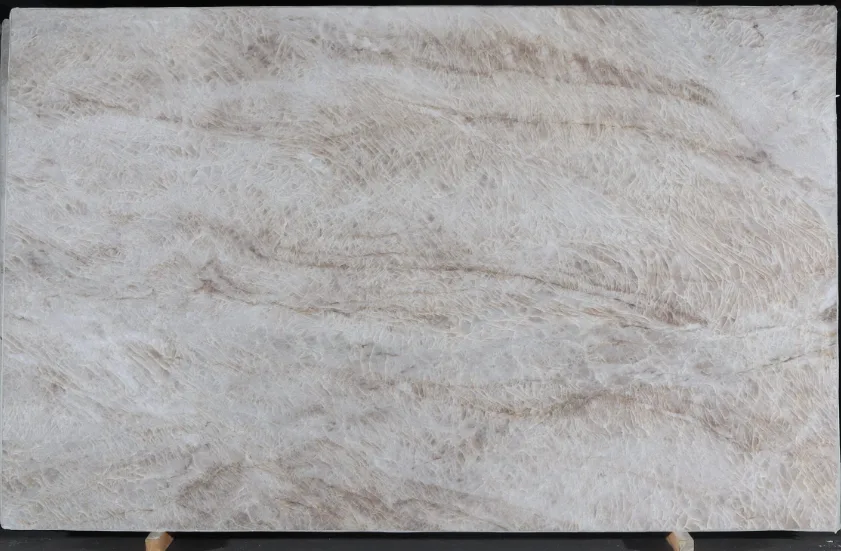
Naica is a cool silver-grey Brazilian quartzite named after the giant-crystal caves of Chihuahua, Mexico, and the name is a fair description of what you see: a grey-white ground shot through with veins that catch light like crushed glass. It sits in the upper-middle tier of the white and grey quartzite market. Polished 2 cm Naica slabs trade at roughly 80 to 170 dollars per square foot ex-warehouse in Western markets, based on our market estimates (August 2026).
That range is wide because Naica is a stone of extremes. A dull, low-contrast slab with muddy grey areas sits at the bottom; a bright, high-sparkle slab with clean silver veining and no soft zones sits at the top. This guide covers what Naica actually is, where the blocks come from, how grading works, what drives the price at slab, cut-to-size and installed level, and how factory-direct processing in China changes the number.
What Naica Quartzite Is: Geology and Appearance
Naica is a true metamorphic quartzite: sandstone that was buried, heated and compressed until the quartz grains fused into an interlocking crystalline mass. That is why it reads 7 on the Mohs scale, why it does not etch under lemon or vinegar, and why it holds a polish for decades on a kitchen counter. The distinctive sparkle comes from coarse recrystallised quartz and, in some blocks, small pockets of mica and clear quartz crystals that reflect light from many angles at once.
The colour palette runs from near-white through pearl grey to a deeper slate grey, with veining in silver, pale gold and occasionally soft brown. Some blocks carry thin dark grey lines that look like pencil strokes; others show cloudy, drifting movement with almost no defined veins. Naica is often confused with Cristallo because both sparkle, but Cristallo is more translucent and whiter, while Naica is greyer, denser and more opaque.
The important honesty point for buyers: not everything labelled Naica is uniform quartzite. Some blocks contain calcite-rich zones — softer, whiter patches that can etch and scratch. A good supplier will identify these and either cut around them or price the slab down. Ask directly whether the slab has been acid-tested and whether any soft zones were mapped.
Quarries and Block Supply
Naica is quarried in Brazil, in the quartzite belt of Minas Gerais and neighbouring Bahia, the same region that produces Taj Mahal, Mont Blanc and Perla Venata. Compared with those stones the quarry footprint is small: output is measured in dozens rather than hundreds of containers a year, and the material is sold through a limited number of Brazilian exporters who allocate blocks to Italy, the United States and China.
Supply matters in one practical way for the buyer: consistency across a project. Because block volume is limited, matching twenty slabs from a single block is not always possible on short notice. For a full kitchen with island, perimeter and splashback, order sequential slabs from one bundle and reserve them before templating. If a fabricator says they will 'find more later', assume the later slabs will come from a different block with a different grey tone.
Chinese mills in Fujian and Guangdong buy Naica blocks alongside other Brazilian quartzites and process them on multi-wire saws and resin lines. Because block cost is the same for everyone and the differences are labour, energy and margin, factory-direct slabs and cut-to-size from China price consistently below Western warehouse stock. Our partner mill quotes Naica factory-direct at typically 30 to 60 percent below Western warehouse levels for the same block grade, before freight and duty.
Grades, Veining and Slab Selection
Naica grading is informal, as with all quartzites, but the trade broadly separates three tiers. Select or premium slabs have a bright pearl-grey ground, evenly distributed sparkle and clean silver veining without soft or muddy areas. Standard slabs have a slightly darker or more uneven ground, patches of low-sparkle grey, or veins that stop and start. Commercial slabs show heavy dark clouding, visible resin-filled fissures or calcite zones, and are usually sold for flooring or cladding rather than showcase counters.
Naica book-matches reasonably well because the veins are defined enough to mirror. It is not as dramatic as Patagonia or Calacatta Macaubas, but a book-matched Naica island with a waterfall end reads as one continuous crystalline field, which is exactly why designers specify it. For book-matching, confirm the slabs are consecutive from the block and polished on opposite faces; a pair of non-consecutive slabs will not mirror.
Buy from photos or live video of the actual slabs, never from a sample tile. Naica's sparkle depends on lighting angle and grain size, and a 10 cm sample tells you almost nothing about a full slab's tone or movement. Slabs run roughly 280 to 320 cm by 170 to 200 cm in 2 cm and 3 cm; 3 cm is the safer choice for large islands and overhangs.
Naica Quartzite Prices in 2026
Polished 2 cm Naica slabs run 80 to 170 dollars per square foot ex-warehouse in Western markets — market estimates (August 2026). The low end buys standard grade with uneven sparkle or darker grey zones; the high end buys select, bright, high-sparkle material from a premium block. 3 cm slabs typically add 15 to 25 percent. Leathered and honed finishes price at parity or slightly above polished because they are additional passes on the same material.
Slab price is only part of the installed number. In the US, fabrication and installation — templating, cutting, edge profiles, sink and hob cut-outs, seams, sealing and fitting — typically add 30 to 60 dollars per square foot on a standard kitchen. Quartzite is harder to cut than marble and wears tooling faster, so fabricators charge at the upper half of that band. Installed Naica counters therefore commonly land at 110 to 230 dollars per square foot depending on grade, thickness and edge detail.
Cut-to-size is where the economics change. Ordering counter tops, vanity tops or wall panels cut, edged and finished at the mill from your drawings removes most local fabrication cost. Factory-direct cut-to-size Naica from China, delivered as finished pieces, typically lands 30 to 60 percent below the equivalent Western slab-plus-fabrication route on the same grade, even after ocean freight, duty and inland transport. The trade-off is lead time — usually 6 to 10 weeks from approved drawings to arrival — and the need for accurate site measurements before cutting.
Price drivers, in order of impact: block grade and sparkle density; slab size and freedom from fissures; thickness; finish; and the number of hands between quarry and site. A slab that has passed through a Brazilian exporter, an Italian trader, a US importer and a local distributor carries four margins. The same slab processed at a Chinese mill and shipped directly carries one.
Naica vs Cristallo, Mont Blanc and Perla Venata
Buyers looking at Naica are usually cross-shopping three other white-grey quartzites. Cristallo is the closest visual relative: whiter, more translucent, more crystalline, and priced at 90 to 200 dollars per square foot for the same reason — rarity. If the project calls for backlighting, Cristallo transmits light better; if it calls for an opaque grey-silver counter, Naica does the job at a lower entry price and with less variability.
Mont Blanc, at 70 to 150 dollars per square foot, is the marble-look option: bright white with grey-brown veining that echoes Carrara. It has less sparkle and reads warmer. Perla Venata, at 80 to 160, is warmer still, with pearl-cream ground and flowing gold-taupe veins. Choose Naica when the palette is cool — stainless, black cabinetry, concrete floors — and Perla Venata or Taj Mahal when the palette leans warm.
Against marble, the comparison is about performance rather than looks. A grey-veined Carrara at 40 to 90 dollars is cheaper but etches, scratches and stains on a working kitchen counter. Naica costs roughly double at slab level but does not etch and needs far less care. Over the life of a kitchen the cost gap narrows once you factor in re-honing and re-sealing marble.
Where Naica Quartzite Works Best
Naica is at its best where light hits it directly: kitchen islands under pendants, bar tops, bathroom vanities beside a window, and full-height splashbacks behind a hob. Its sparkle is the reason to buy it, and a Naica slab in a dim corridor is money not fully spent.
As a floor it works in polished or honed finish for residential and light commercial spaces, and its hardness means it tolerates foot traffic far better than marble. Fireplace surrounds, reception desks and book-matched feature panels are the other natural uses.
Outdoors, true quartzite is UV-stable and frost-resistant, so Naica can be used for outdoor kitchens and pool surrounds in most climates. Choose a honed or leathered finish for wet areas — polished quartzite is slippery when wet — and confirm the specific block has no calcite zones that would weather differently.
Fabrication and Finishes
Naica cuts on standard bridge saws and CNC machinery, but slowly. Fabricators budget roughly 1.5 to 2 times the cutting time of marble and use diamond tooling rated for granite. Waterjet cutting is preferred for intricate cut-outs. Because the stone is hard and can be brittle along crystalline planes, chipping at edges is the main fabrication risk; a mitred waterfall edge needs a skilled shop and a test cut on offcut first.
Polished is the default finish and the one that shows the sparkle best. Honed produces a soft matte grey that mutes the crystalline effect but reads more contemporary and hides fingerprints. Leathered — a brushed, lightly textured surface — is increasingly popular for islands because it keeps some sheen while adding grip and disguising minor scratches. All three are usually available factory-direct at similar cost.
Seams in Naica are visible if the fabricator does not match the vein direction, so plan seam positions early and ask for a seam layout drawing on the slab photo before cutting. Eased, pencil-round and small bevel edges are the safest on quartzite; ogee profiles are possible but costly and easier to chip.
Care and Sealing
True quartzite is dense, but it is not non-porous. Naica in particular can have slightly open crystalline grain that will absorb oil or dark liquids if left standing. Seal it on installation with a solvent-based impregnating sealer, test the seal with a water drop after a year, and reseal when water no longer beads. Most homeowners reseal every one to three years.
Daily cleaning is warm water and a pH-neutral stone cleaner. Vinegar, lemon and bleach will not etch true quartzite the way they etch marble, but they can strip the sealer over time. Avoid abrasive pads; the polish is durable but not indestructible.
If a slab does contain a calcite zone that was not identified before installation, that patch will etch. The remedy is a local re-hone and re-polish by a stone restorer, which is why the pre-purchase acid test matters more than any care routine after the fact.
Sourcing Checklist for Buyers and Importers
Ask for photos or a live video of the actual slabs, dry and under strong light, and ask for the bundle and block number. Confirm the slabs are sequential if you need book-matching. Request the acid-test result or an explicit statement that no calcite zones were found; if the seller cannot answer, treat the slab as mixed and negotiate.
Specify thickness, finish and slab size, and ask whether the price is per square foot or per square metre, gross or net usable area. Chinese mills usually quote per square metre ex-works; convert carefully. Ask what resin and mesh treatment was applied — full-face resin is standard on Brazilian quartzites and not a defect, but it must be properly cured.
For cut-to-size, send dimensioned drawings with edge profiles, cut-out positions and finish called out, and ask for shop drawings back before production. Insist on crate photos before shipping and on numbered pieces matching the drawings. Budget 6 to 10 weeks for production and ocean freight and plan the site programme around it.
Compare the total landed cost — ex-works price plus freight, insurance, duty, port charges, inland delivery and any local finishing — against the local installed quote, not slab price against slab price. That is where the 30 to 60 percent factory-direct advantage on Naica actually shows up, and it is the only fair comparison.
Frequently asked questions
How much does Naica quartzite cost per square foot?
Polished 2 cm Naica quartzite slabs run roughly 80 to 170 dollars per square foot ex-warehouse in Western markets, based on our market estimates (August 2026). Installed kitchen counters typically land at 110 to 230 dollars per square foot once fabrication and fitting are added. Factory-direct cut-to-size from China is usually 30 to 60 percent below the Western installed route on the same grade.
Is Naica quartzite a real quartzite or a marble?
Naica is a genuine metamorphic quartzite: it is quartz-based, reads about 7 on the Mohs scale and does not etch under acids. Some individual blocks contain small calcite zones that behave like marble, so it is worth asking the supplier for an acid test on the specific slab before buying.
What is the difference between Naica and Cristallo quartzite?
Both sparkle, but Cristallo is whiter, more translucent and rarer, priced at 90 to 200 dollars per square foot. Naica is greyer, denser and opaque, at 80 to 170. Choose Cristallo for backlit applications and Naica for cool grey counters where translucency does not matter.
Does Naica quartzite need sealing?
Yes. It is dense but not non-porous, and its crystalline grain can absorb oil and dark liquids. Apply an impregnating sealer at installation and reseal every one to three years, or whenever water stops beading on the surface.
Can Naica quartzite be used outdoors?
Yes. True quartzite is UV-stable and frost-resistant, so Naica suits outdoor kitchens and pool surrounds. Use a honed or leathered finish in wet areas because polished quartzite is slippery, and confirm the block has no calcite zones that would weather unevenly.
Can I buy Naica quartzite factory-direct from China?
Yes. Chinese mills process Brazilian Naica blocks into slabs and cut-to-size and sell them ex-works, typically 30 to 60 percent below Western warehouse prices for the same block grade. Expect 6 to 10 weeks lead time and compare on total landed cost, including freight and duty.