Green quartzite is a family, not a single stone. It runs from restrained grey-sage stones like Sea Pearl through mid-greens with white webbing to saturated, almost jewel-like emeralds, and from opaque counter material to translucent slabs that glow when backlit. Almost all of it comes from Brazil, with a smaller contribution from India. Across the family, polished 2 cm slabs trade at roughly 60 to 140 dollars per square foot ex-warehouse in Western markets, based on our market estimates (August 2026).
This page is the hub for the family. It lays out the main commercial names — Sea Pearl, Emerald Green, Verde Fantastico and their relatives — on a price ladder, explains what moves a green quartzite from the bottom of the range to the top, and covers the two very different ways the material is used: as a hard-wearing counter or floor, and as a translucent backlit feature. The second use is the material of the backlit green feature wall in our case study at /blog/backlit-green-feature-wall-case-study/, and this page explains how that slab was chosen and what it cost.
What Green Quartzite Is: Geology and Why It Is Green
Green quartzites are metamorphosed quartz sandstones, like the white quartzites, but with the colour coming from green minerals folded into the rock during metamorphism — chiefly fuchsite, a chromium-bearing mica, along with chlorite and epidote. The more of these minerals and the finer their distribution, the deeper and more even the green. Where the quartz is very pure and the green minerals are sparse, the stone stays translucent, which is what makes some green quartzites suitable for backlighting.
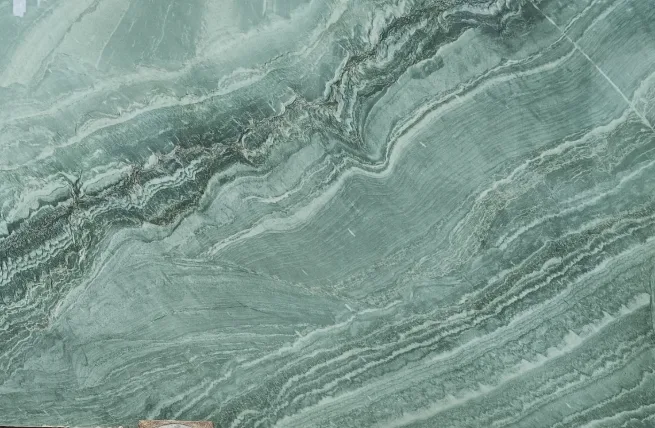
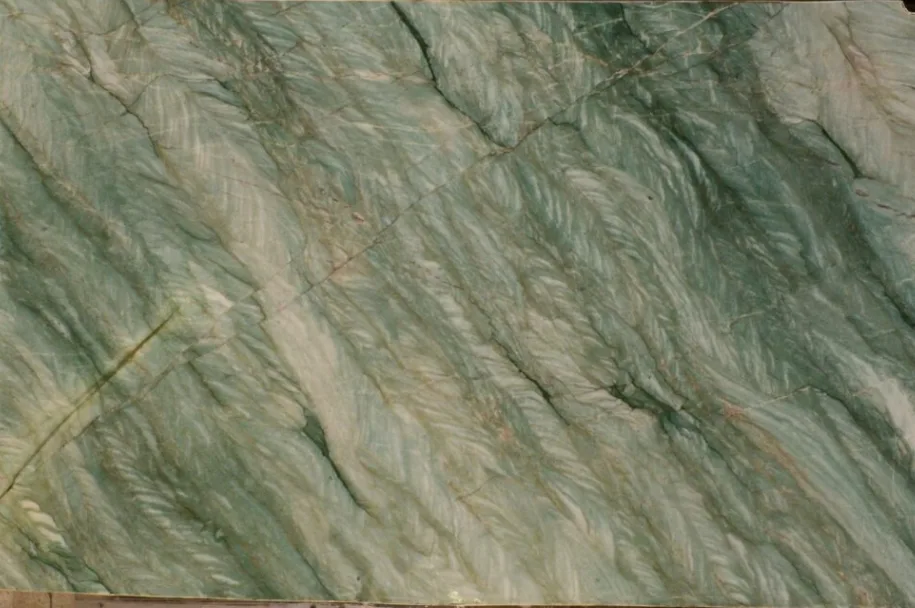
Because they are quartz-based, genuine green quartzites read about 7 on the Mohs scale, resist acids and hold a polish under kitchen use. The green colour is mineral, not surface, and does not fade in sunlight the way some resin-bound greens do. Movement varies: Sea Pearl has wave-like grey-green banding with white and dark green streaks; Emerald Green is more saturated and more uniform; Verde Fantastico carries dramatic white and grey veins across a green ground, often with translucent zones.
As with every quartzite family, some blocks are not pure quartzite. Green stones with calcite content behave partly like marble and can etch in patches; a few 'green quartzites' in the market are in fact green marbles or serpentinites relabelled. Ask for an acid test on the specific block. The trade name tells you the colour; only the test tells you the mineral.
The Family: Sea Pearl, Emerald Green, Verde Fantastico and Relatives
Sea Pearl is the volume seller and the entry point: a grey-green ground with wave-like white and dark green movement, quarried in Brazil and processed in large quantity. It is the most affordable of the family, sits at 60 to 120 dollars per square foot, and is the green quartzite most fabricators have handled. It takes a leathered finish exceptionally well and hides daily use, which is why it dominates coastal and contemporary kitchens.
Emerald Green covers the deeper, more saturated stones — a rich, even green with lighter green and white webbing rather than grey. Supply is smaller and the colour is rarer, so it sits higher on the ladder. Verde Fantastico is the showpiece: a mid-to-deep green ground crossed by bold white and grey veins, often with translucent quartz zones that pass light. It book-matches into striking mirrored panels and is the type most often selected for backlit walls.
Around these three sit a cluster of related names — Verde Aquamarina, Sage Green, Botanic Green, Green Fantasy, Verde Bamboo, Verde Karzai and others — that overlap in colour and sometimes in quarry origin. Indian green quartzites are generally more uniform, more opaque and cheaper, and go mainly into flooring and cladding. Names are inconsistent between importers; buy from block photos, not from the label.
Green Quartzite Price Ladder in 2026
Across the family, polished 2 cm slabs run 60 to 140 dollars per square foot ex-warehouse in Western markets — market estimates (August 2026). Within that band the ladder, from bottom to top, looks like this. Uniform sage and grey-green stones, including Indian material and commercial-grade Sea Pearl, occupy the 60 to 90 range. Select Sea Pearl with strong movement sits at 90 to 120. Emerald Green and mid-grade Verde Fantastico occupy 90 to 130. Select Verde Fantastico and translucent, backlight-grade slabs from any of the deeper greens sit at 110 to 140 and occasionally above for exceptional book-matched pairs.
Three things move a green quartzite up the ladder: saturation and evenness of the green; drama and clarity of the veining; and translucency, which is only relevant if the slab is destined for backlighting but commands a premium when it is. 3 cm slabs add roughly 15 to 25 percent; honed and leathered finishes price at parity or slightly above polished.
Installed, US fabrication and installation add 30 to 60 dollars per square foot on a standard kitchen, with quartzite at the upper half of that band because it cuts slowly. Installed green quartzite counters therefore land at roughly 90 to 200 dollars per square foot depending on which stone and grade. Backlit feature walls are priced as a system — slab, glass lamination, LED panel, frame, engineering — and are covered in the case study rather than by a per-square-foot slab figure.
Factory-direct cut-to-size from China — counters, vanities, panels or a complete backlit wall kit — typically lands 30 to 60 percent below the equivalent Western route on the same grade, after ocean freight, duty and inland transport. Chinese mills process green quartzites at volume and our partner mill's flagship product is exactly this: translucent green slabs sawn thin, laminated to low-iron glass and shipped as a numbered kit. Lead time is 6 to 10 weeks from approved drawings.
Green Quartzite vs Green Marble, Ubatuba Granite and Onyx
Against green marble at 30 to 100 dollars per square foot — Verde Alpi, Indian Rainforest Green, Ming Green — the difference is behaviour. Green marbles and serpentinites are softer, etch and can be sensitive to water-based adhesives; green quartzite is harder, acid-resistant and stable. Green marble is cheaper and has a classic look with white webbing; green quartzite costs more and works on a kitchen counter without care anxiety.
Against Ubatuba granite at 30 to 60: Ubatuba is dark green-black, speckled, extremely durable and cheap, and is the value choice for a dark green kitchen. Green quartzite is lighter, more varied and more expensive, and reads as a design choice rather than a default. Against onyx at 60 to 200: onyx is the traditional backlit stone — translucent, banded, fragile and indoor-only. Translucent green quartzite backlights nearly as well, is far harder, and does not need the same handling care, which is why the case study wall was quartzite rather than onyx.
Against the white and grey quartzites at similar prices — Taj Mahal at 70 to 140, Sea Pearl's cousin Mont Blanc at 70 to 150 — the choice is purely aesthetic. Green quartzite is chosen when the design wants colour and depth rather than a neutral ground.
Where Green Quartzite Works Best
Kitchen counters and islands are the largest use, particularly Sea Pearl in leathered finish, which hides crumbs and fingerprints and gives a soft, tactile surface. Bathroom vanities and shower walls in Emerald Green or Verde Fantastico turn a neutral bathroom into a statement, and the stone tolerates cleaners that would dull marble.
Backlit feature walls, bar fronts and reception desks are the second use and the one that has grown fastest. A translucent green slab, cut thin, laminated to glass and lit from behind, is a light source and an artwork in one. The case study at /blog/backlit-green-feature-wall-case-study/ shows a single book-matched slab roughly 2.4 by 2.7 metres in a private entry hall, chosen from five candidates photographed both dry and against a light table. That second photo is the whole selection method: it reveals which zones pass light and which do not, and it cannot be replaced by a dry slab photo.
Flooring and cladding in the more uniform greens, especially Indian material, work well in commercial spaces and outdoors. True quartzite is UV-stable and frost-resistant, so green quartzite is a legitimate terrace, pool-surround and facade material in a honed or leathered finish.
Fabrication, Finishes and Backlit Selection
Green quartzites cut on standard bridge saws and CNC machinery at roughly 1.5 to 2 times the cutting time of marble, using diamond tooling rated for granite. Waterjet is preferred for cut-outs, and mitred waterfall edges should be test-cut on offcut. Fuchsite-rich zones can be slightly softer than the surrounding quartz, so a fabricator should check the slab for those areas before deciding edge profiles.
Leathered is the signature finish for Sea Pearl and works well across the family: it deepens the green, adds grip and disguises minor marks. Polished shows veining and translucency at their most dramatic and is the standard for backlit and feature work. Honed gives a soft matte that suits floors and wet areas.
For backlighting, the fabrication is different. The slab is sawn to 6 to 10 mm and laminated to low-iron glass or a translucent backer, the edges are encapsulated, and the panel is mounted over an even-emission LED sheet with a dim-to-warm driver. Slab selection is by light-table photo, not dry photo; a slab with dense green zones and clear calcite or quartz windows gives the most interesting result, as the case study shows. The joints between panels must be planned on the backlit photo so that they fall in dark zones and disappear when lit.
Care and Sealing
Green quartzites are dense but not fully non-porous. Seal at installation with a solvent-based impregnating sealer, test with a water drop after a year and reseal every one to three years or when water no longer beads. Leathered surfaces have slightly more open texture and benefit from a second coat.
Daily cleaning is warm water and a pH-neutral stone cleaner. Vinegar and lemon will not etch genuine green quartzite but strip sealer over time; avoid bleach and abrasive pads. If a slab proves to contain a calcite zone that was not caught before installation, that patch will etch and needs a local re-hone by a restorer, which is why the pre-purchase acid test matters.
Backlit panels need almost no care on the stone side — dust and fingerprints on the polished face — but the LED system should be specified with replaceable drivers and accessible panels, because a wall that cannot be serviced is a wall that will eventually go dark.
Sourcing Checklist for Buyers and Importers
Decide first which green you are buying — sage and grey-green, saturated emerald, or dramatic veined — and whether the application is opaque or backlit, because that determines the stone and the selection method. Ask for full-slab photos or live video with bundle and block numbers; for backlit work, insist on light-table photos of the actual slabs. Ask for the acid-test result or an explicit statement that no calcite zones were found.
Confirm consecutive slabs for book-matching, specify thickness and finish, and confirm whether the quote is per square foot or per square metre, gross or net. Chinese mills quote per square metre ex-works. Ask what resin treatment was applied and confirm it was cured; on translucent slabs, ask that the resin is clear and will not yellow under LED light.
For cut-to-size and backlit kits, send dimensioned drawings with edges, cut-outs, panel joints and finish called out, and ask for shop drawings back before production; for backlit walls ask also for the LED specification, colour temperature and driver details. Budget 6 to 10 weeks. Compare total landed cost — ex-works price plus freight, insurance, duty, port charges, inland delivery and any local finishing — against the local installed quote. On green quartzite, and especially on backlit systems, that is where the 30 to 60 percent factory-direct saving shows up.
Frequently asked questions
How much does green quartzite cost per square foot?
Across the family, polished 2 cm green quartzite slabs run roughly 60 to 140 dollars per square foot ex-warehouse in Western markets, based on our market estimates (August 2026). Sea Pearl sits at 60 to 120; Emerald Green and Verde Fantastico occupy the upper half of the range, and translucent backlight-grade slabs sit at the top. Installed counters land at about 90 to 200 dollars per square foot; factory-direct cut-to-size from China is typically 30 to 60 percent below the Western route.
What is the difference between Sea Pearl, Emerald Green and Verde Fantastico?
Sea Pearl is grey-green with wave-like white and dark green movement and is the most affordable. Emerald Green is deeper and more evenly saturated with lighter webbing. Verde Fantastico is a mid-to-deep green with bold white and grey veins and often translucent zones, and is the type most used for backlit walls.
Can green quartzite be backlit?
Some slabs can. Translucent green quartzites — usually Verde Fantastico and select deeper greens with pure quartz zones — pass light well when sawn to 6 to 10 mm and laminated to glass. Selection must be done from light-table photos, not dry photos. Our case study at /blog/backlit-green-feature-wall-case-study/ shows a completed wall and the selection process.
Is green quartzite better than green marble for a kitchen?
For a working kitchen, yes. Green quartzite is harder and does not etch under lemon, vinegar or wine, while green marbles and serpentinites such as Verde Alpi and Rainforest Green etch and need more care. Green marble is cheaper at 30 to 100 dollars per square foot and suits low-use surfaces.
Does green quartzite fade in sunlight?
No. The colour comes from minerals such as fuchsite and chlorite inside the stone, not from a surface treatment, and true quartzite is UV-stable. It can be used outdoors on terraces and facades in a honed or leathered finish.
Which finish is best for Sea Pearl quartzite?
Leathered. It deepens the green, adds grip and hides fingerprints and crumbs, which is why most Sea Pearl kitchens are specified that way. Polished shows the movement most dramatically; honed suits floors and wet areas.
Can I buy green quartzite factory-direct from China?
Yes. Chinese mills process Brazilian and Indian green quartzites into slabs, cut-to-size and complete backlit wall kits and sell ex-works, typically 30 to 60 percent below Western warehouse prices for the same grade. Allow 6 to 10 weeks lead time and compare on total landed cost including freight and duty.