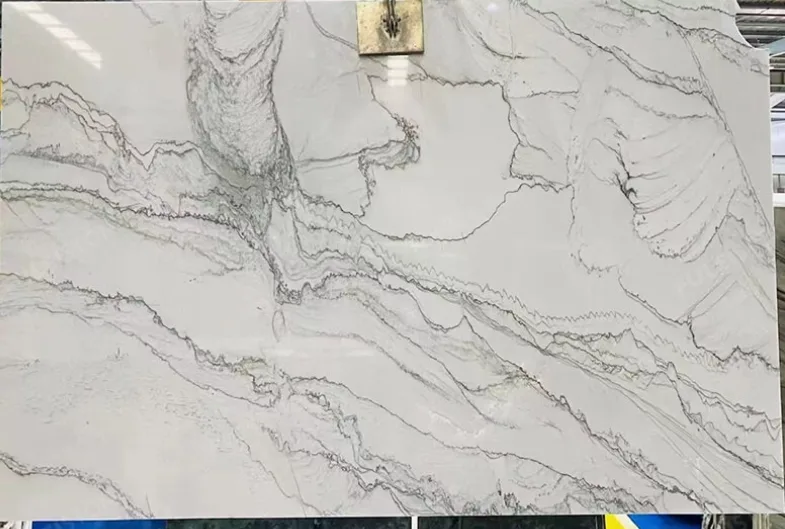
Calacatta Macaubas is the straight-veined member of the Brazilian white quartzite family: a white to off-white ground crossed by long, roughly parallel grey veins that run the length of the slab. The name borrows from Italian Calacatta marble because of the colour, and from the Macaubas region of Bahia because that is where the blocks come from. Polished 2 cm Calacatta Macaubas slabs trade at roughly 60 to 130 dollars per square foot ex-warehouse in Western markets, based on our market estimates (August 2026).
That makes it the most accessible of the white quartzites and one of the few that is regularly specified for large-format flooring and cladding rather than only for counters. The price spread reflects whiteness, vein regularity and slab soundness. This guide covers what the stone is, where it comes from, how it is graded, what it costs at slab, cut-to-size and installed level, and why factory-direct processing in China matters more for this stone than for most.
What Calacatta Macaubas Quartzite Is: Geology and Appearance
Calacatta Macaubas is a metamorphic quartzite formed from layered quartz sandstone. The layering survived metamorphism, which is why the veins are linear: they are the original sedimentary beds, compressed and recrystallised, seen edge-on. Vein-cut slabs show long parallel grey lines; cross-cut slabs, less common, show a cloudier, more random pattern. The stone reads about 7 on the Mohs scale, resists household acids and holds a polish under heavy use.
The ground is white to warm off-white; the veins are grey, sometimes with a faint blue or beige cast, and can be pencil-thin or a few centimetres wide depending on the block. Some blocks carry small rust-coloured iron spots that grade the slab down. Compared with Bianco Superiore it is less bright and more linear; compared with Mont Blanc it is straighter and less marble-like. It is a close relative of White Macaubas and Azul Macaubas, which share the quarry region and the linear structure but differ in colour.
The name is a marketing convenience. Nothing about the stone is Italian and nothing about it is marble. It is a genuine quartzite, and a properly identified slab will not etch. As always with white stones, ask the seller to acid-test the specific slab, because white grounds hide the difference between quartzite and dolomitic marble to the eye.
Quarries and Block Supply
The blocks are quarried around Macaubas in Bahia, Brazil, one of the larger quartzite districts in the country. Supply is steadier than for rarer white quartzites: several quarry fronts work the same formation, block sizes are generous, and exporters ship regularly to Italy, the United States and China. That steadier supply is one reason the price sits below Bianco Superiore and Naica.
For a buyer the practical implication is that large orders are feasible. A hotel lobby floor or a residential project needing thirty slabs from matched blocks is realistic with Calacatta Macaubas in a way it is not with smaller-volume quartzites. Vein direction still needs to be controlled: because the pattern is linear, a project should specify whether veins run lengthwise or crosswise on every piece, and the mill or fabricator must cut accordingly.
Chinese mills process Calacatta Macaubas at meaningful volume, and this is where the stone's economics get interesting. Because it is used for flooring and cladding as well as counters, the cut-to-size and tile side of the business is large. A Chinese mill can take a container of blocks, saw them on multi-wire machines, run them through resin and polishing lines, and deliver calibrated 60 by 60 or 60 by 120 cm tiles or project-specific panels at prices a Western fabricator cannot approach. Our partner mill quotes Calacatta Macaubas factory-direct at typically 30 to 60 percent below Western warehouse levels for the same grade, before freight and duty.
Grades, Veining and Slab Selection
The trade grades Calacatta Macaubas on ground colour, vein regularity and soundness. Select slabs have a clean white ground, evenly spaced grey veins running straight and parallel, and no rust spots or fissures. Standard slabs have a warmer or slightly grey ground, veins that wander or bunch, or occasional small inclusions. Commercial slabs show heavy grey banding, iron staining or resin-filled cracks and are sold for flooring where the pattern is broken up by joints anyway.
Because the veins are linear, this stone book-matches into strong chevron and mirror patterns. A book-matched pair produces a V or an X; a four-slab quarter-match produces a diamond. It is one of the best quartzites for that effect on feature walls and shower enclosures. For book-matching, confirm the slabs are consecutive from the block and polished on opposite faces, and check that vein spacing is regular enough to mirror cleanly.
Slabs typically run 280 to 320 cm by 170 to 200 cm in 2 cm and 3 cm; tiles and cut-to-size panels are common in 1.2 to 2 cm. Buy from full-slab photos or live video with a scale reference so you can judge vein spacing, and specify vein-cut or cross-cut explicitly. A sample tile shows colour but tells you nothing about how the lines will lay out across a floor.
Calacatta Macaubas Quartzite Prices in 2026
Polished 2 cm Calacatta Macaubas slabs run 60 to 130 dollars per square foot ex-warehouse in Western markets — market estimates (August 2026). The low end buys standard grade with a warmer ground or irregular veins; the high end buys select, bright, straight-veined material from a premium block. 3 cm slabs add roughly 15 to 25 percent. Honed and leathered finishes price at parity or slightly above polished.
For counters, US fabrication and installation typically add 30 to 60 dollars per square foot — templating, cutting, edges, cut-outs, seams, sealing and fitting — and quartzite sits at the upper half of that band because it cuts slowly. Installed Calacatta Macaubas counters therefore land at roughly 90 to 190 dollars per square foot. For flooring, installed cost depends on tile size and substrate preparation, but material at 60 to 130 dollars plus 15 to 30 dollars per square foot for professional setting is a reasonable planning figure.
Cut-to-size and calibrated tiles are where Calacatta Macaubas separates from other white quartzites. Because it is bought for floors and walls at project scale, ordering it factory-direct as finished tiles or panels — cut, edged, calibrated and finished at the mill from your drawings — typically lands 30 to 60 percent below the equivalent Western route, after ocean freight, duty and inland transport. Lead time is 6 to 10 weeks from approved drawings; the discipline required is accurate site measurement and a clear vein-direction plan before cutting.
Price drivers, in order: whiteness of the ground and regularity of the veins; slab or tile size and freedom from rust and fissures; thickness; finish; and the number of margins between quarry and site. The steadier supply keeps the whole range lower than Bianco Superiore or Naica, but the factory-direct arithmetic is the same: one processing margin instead of three or four.
Calacatta Macaubas vs Mont Blanc, Bianco Superiore and Calacatta Marble
Against Mont Blanc at 70 to 150 dollars per square foot: Mont Blanc has softer, more marble-like grey-brown veining and reads closer to Carrara; Calacatta Macaubas is straighter, more graphic and cheaper. Choose Mont Blanc for a kitchen that should look like marble, and Calacatta Macaubas for a floor or wall where the linear pattern is the point.
Against Bianco Superiore at 80 to 170: Bianco Superiore is whiter and its veins are freer and more Statuario-like. Calacatta Macaubas gives up some brightness for a lower price and larger available volume. Against Taj Mahal at 70 to 140, the difference is temperature — Taj Mahal is warm cream with cloudy movement; Calacatta Macaubas is cooler and linear.
Against real Calacatta marble at 80 to 250 dollars per square foot the comparison is one of behaviour, not looks. Calacatta marble has bold, branching gold-grey veins and a depth quartzite does not match, but it etches, scratches and stains. Calacatta Macaubas has neither the drama nor the fragility. For a floor in a busy lobby or a shower wall, the quartzite is the sensible choice; for a fireplace or a low-use vanity, the marble still wins on beauty. Against Guangxi White marble at 15 to 35 dollars for volume flooring, the quartzite costs several times more and is only justified where etching and wear would be a real problem.
Where Calacatta Macaubas Quartzite Works Best
Large-format flooring is the first application, and the one that sets this stone apart from other white quartzites. Its linear veining lays out cleanly across a floor when tiles are cut and installed with a consistent vein direction, and its hardness means it takes hotel-lobby traffic without wearing the polish. Honed is the usual specification for floors because polished white shows scuffs and is slippery when wet.
Wall cladding and shower enclosures are the second application: book-matched Calacatta Macaubas panels produce chevron and diamond patterns that look designed rather than accidental, and the stone tolerates shampoo and acidic cleaners that would dull marble. Kitchen counters and islands are the third; the linear veins run well along a long island and mitre neatly at a waterfall end.
Outdoors, true quartzite is UV-stable and frost-resistant, so Calacatta Macaubas works for terraces, pool surrounds and outdoor kitchens in a honed or leathered finish. Facade cladding is possible with appropriate anchoring and thickness, and is one of the few uses where a white quartzite competes on cost with mid-range granites.
Fabrication and Finishes
Calacatta Macaubas cuts on standard bridge saws and CNC machinery, at roughly 1.5 to 2 times the cutting time of marble, using diamond tooling rated for granite. Because the veins are bedding planes, some blocks split more readily along the veins than across them; fabricators should test-cut offcuts before mitring waterfall edges or cutting narrow strips parallel to the veins. Waterjet is preferred for cut-outs.
Polished is the standard finish and gives the crispest contrast between white ground and grey line. Honed softens the contrast into a matte, contemporary surface and is the usual choice for floors and wet areas. Leathered adds texture that keeps some sheen and improves grip; it works well on islands and outdoor tops. Vein-cut is the default cut and produces the linear look; cross-cut is available on request and produces a cloudier, more random pattern from the same block.
Seams and tile joints matter more with a linear stone than with a cloudy one, because a vein that stops at a joint and does not continue on the other side is obvious. Plan seams and tile layout on the slab photo before cutting, and use colour-matched epoxy or grout. Eased and pencil-round edges are the safest; decorative profiles are possible but slow and chip-prone on quartzite.
Care and Sealing
Calacatta Macaubas is dense but not fully non-porous, and the white ground shows stains. Seal at installation with a solvent-based impregnating sealer, test with a water drop after a year, and reseal when water no longer beads — typically every one to three years for counters, less often for walls. Floors in high-traffic areas may need more frequent attention because foot traffic wears the sealer.
Daily cleaning is warm water and a pH-neutral stone cleaner. Vinegar and lemon will not etch genuine Calacatta Macaubas, but acids and bleach strip sealer over time. Avoid abrasive pads and dry-sweep floors before wet-mopping to prevent grit scratching the polish. If a slab proves to contain a calcite zone that was not identified before installation, that patch will etch and needs a local re-hone by a restorer.
Hot pans can be set on the stone briefly without scorching or cracking. Cutting on it will blunt knives before it marks the surface.
Sourcing Checklist for Buyers and Importers
Ask for full-slab photos or live video with a scale reference and the bundle and block numbers. Specify vein-cut or cross-cut, and for book-matching confirm the slabs are consecutive and polished on opposite faces. Ask for the acid-test result or an explicit statement that no calcite zones were found. Ask what resin and mesh treatment was applied and confirm it was properly cured.
For flooring and cladding, send a layout drawing showing vein direction on every piece, tile or panel sizes, thickness, finish and edge treatment, and ask for shop drawings back before production. Confirm whether the quote is per square foot or per square metre and whether it is gross slab or net finished area; Chinese mills quote per square metre ex-works. Insist on crate photos and numbered pieces matching the layout.
Budget 6 to 10 weeks for production and ocean freight. Compare total landed cost — ex-works price plus freight, insurance, duty, port charges, inland delivery and any local finishing — against the local installed quote. On a project-scale floor or wall order, that comparison is where the 30 to 60 percent factory-direct saving on Calacatta Macaubas becomes real money.
Frequently asked questions
How much does Calacatta Macaubas quartzite cost per square foot?
Polished 2 cm Calacatta Macaubas slabs run roughly 60 to 130 dollars per square foot ex-warehouse in Western markets, based on our market estimates (August 2026). Installed counters land at about 90 to 190 dollars per square foot; installed flooring adds roughly 15 to 30 dollars per square foot to the material cost. Factory-direct tiles and cut-to-size from China are typically 30 to 60 percent below the Western route.
Is Calacatta Macaubas a marble or a quartzite?
It is a genuine quartzite from the Macaubas region of Bahia, Brazil. The name borrows 'Calacatta' from Italian marble because of the white-and-grey colour, but the stone is quartz-based, reads about 7 on the Mohs scale and does not etch under acids. Ask the supplier to acid-test the specific slab to be sure.
What is the difference between Calacatta Macaubas and White Macaubas?
They come from the same region and share the linear vein structure. White Macaubas is generally whiter with finer, more uniform grey lines; Calacatta Macaubas has a slightly warmer ground and bolder, more spaced veins. Importers do not always draw the line consistently, so buy from photos of the actual block.
Can Calacatta Macaubas quartzite be used for flooring?
Yes, and it is one of the few white quartzites regularly specified for large-format floors. Its hardness handles heavy traffic and its linear veins lay out cleanly when tiles are installed with a consistent vein direction. Use a honed finish for floors, since polished white shows scuffs and is slippery when wet.
Does Calacatta Macaubas quartzite etch or stain?
Genuine Calacatta Macaubas does not etch from vinegar, lemon or wine. It can stain if left unsealed, because the white ground shows marks, so seal it at installation and reseal every one to three years.
Can I buy Calacatta Macaubas quartzite factory-direct from China?
Yes. Chinese mills process Brazilian Calacatta Macaubas blocks into slabs, calibrated tiles and cut-to-size panels and sell ex-works, typically 30 to 60 percent below Western warehouse prices for the same grade. Allow 6 to 10 weeks lead time and compare on total landed cost including freight and duty.