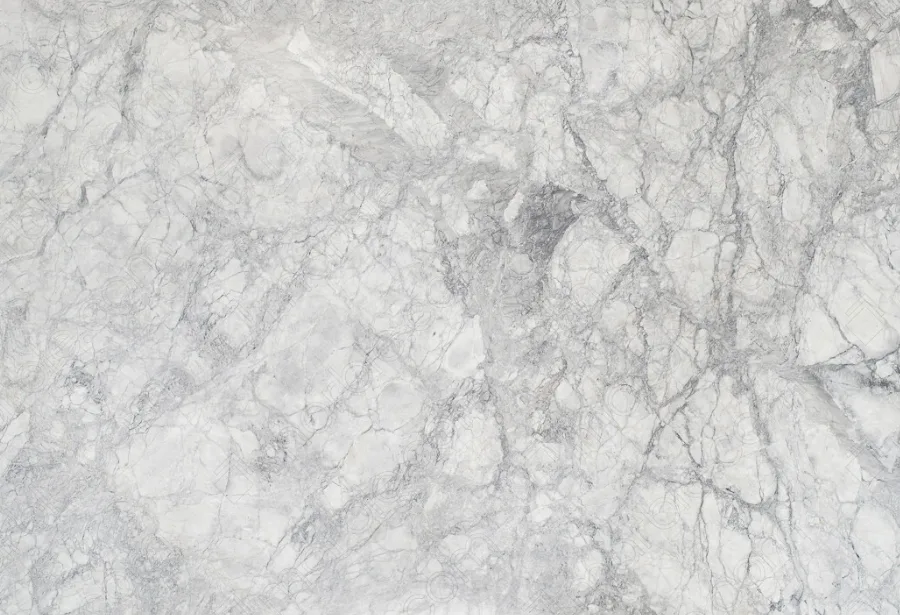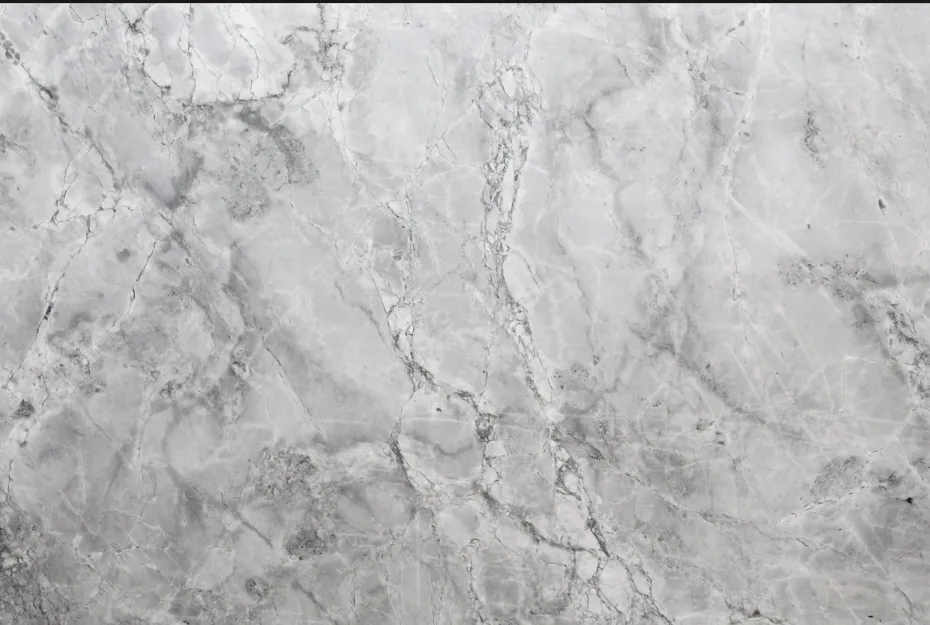
Super White is the most argued-about stone in the trade, and the argument is simple: it is sold as quartzite, and it is not one. Super White is a dolomitic marble — a hard, dense marble, harder than Carrara, but a marble all the same. It etches under lemon juice and vinegar, it can scratch under a knife, and buyers who were told they were getting a granite-hard quartzite discover this in the first month of owning a kitchen. This page exists to say that plainly, because most pages selling Super White do not.
None of that makes it a bad stone. It has a cool white-grey ground with soft to bold grey veining that reads like a Carrara or a muted Calacatta, and it is priced well below true white quartzites. Polished 2 cm Super White slabs trade at roughly 55 to 110 dollars per square foot ex-warehouse in Western markets, based on our market estimates (August 2026). Buy it knowing what it is, put it where a marble belongs, and it is good value. Buy it as a quartzite and you will be disappointed.
What Super White Actually Is: Dolomitic Marble, Not Quartzite
Super White is quarried in Brazil and is a dolomitic marble: a metamorphosed carbonate rock in which much of the calcite has been replaced by dolomite, a calcium-magnesium carbonate. Dolomite is harder than calcite — roughly 3.5 to 4 on the Mohs scale against calcite's 3 — and reacts more slowly with acid, which is why Super White feels tougher than Carrara and why a quick vinegar test can be misleading: it etches, but not instantly. True quartzite is quartz, reads about 7 on the Mohs scale, and does not react with acid at all.
The 'quartzite' label appeared because Super White arrived in the North American market alongside genuine Brazilian quartzites, looked similar, was priced in the same neighbourhood and was described that way by early importers. Some blocks in the same formation genuinely carry quartz-rich bands, which is where the honest half of the confusion comes from: a single slab can have zones that behave like quartzite and zones that behave like marble. The trade has been arguing about it for over a decade, and geologists have settled it — the bulk of the material is dolomitic marble.
The practical test is not hardness but acid. Put a few drops of vinegar or lemon juice on an unsealed offcut, wait fifteen minutes, wipe it off and hold the surface up to raking light. If there is a dull spot, it is carbonate and it will etch on your counter. Every serious fabricator knows this test; every buyer of Super White should ask to see it done.
Three parties have an interest in the label. Importers and yards have stock in the ground marked 'quartzite' and a customer base that searches for the word. Fabricators are caught in the middle: they know it etches, but if they call it marble the customer walks. Homeowners want the marble look with none of the marble care, and Super White at 55 to 110 dollars is the cheapest stone that appears to promise that.
The result is a mess of naming. The same block may be sold as Super White Quartzite, Super White Dolomite, Fantasy White, White Fantasy or Bianco Superiore Dolomite depending on the yard. Some honest yards have relabelled it dolomite or dolomitic marble; some have not. Do not rely on the label. Ask what the stone does under acid.
There is also a real geological wrinkle: some slabs from the same quarry are notably harder and more acid-resistant than others, because the quartz content varies. This is why two people can own Super White kitchens and report opposite experiences. It does not change the buying rule. Assume it is marble unless the specific slab proves otherwise.
Quarries and Block Supply
Super White comes from Brazil, mainly from the carbonate belts of Bahia and Minas Gerais adjacent to the quartzite districts that supply Taj Mahal and Mont Blanc. Supply is steady and volumes are meaningful — this is not a rare stone — which is a large part of why it is priced below true white quartzites. Blocks are exported to the United States, Europe and China through the usual Brazilian exporters.
Because volume is good, matching several slabs from one block for a full kitchen is usually straightforward, and reserving slabs before templating is still the right discipline. Tone shifts between blocks — some lean cool grey, some lean warm — so a mixed-block installation will show.
Chinese mills process Super White alongside the Brazilian quartzites and Italian marbles, on gang saws or multi-wire saws with resin and polishing lines. Because it is a marble, it cuts faster and wears tooling less than a true quartzite, which keeps processing cost down. Our partner mill quotes Super White factory-direct at typically 30 to 60 percent below Western warehouse levels for the same block grade, before freight and duty — and describes it as dolomitic marble on the quote.
Grades, Veining and Slab Selection
Super White is graded on ground colour, vein pattern and soundness. Select slabs have a bright white-grey ground with well-defined dark grey veining that reads like a bold Carrara or a quiet Calacatta. Standard slabs have a greyer, cloudier ground and softer, less distinct veins. Commercial slabs show heavy grey mottling, resin-filled fissures or dark blotches and go to flooring and cladding.
Vein patterns vary more than in most white stones: some blocks are almost linear, some are wildly branched, some are soft clouds. Book-matching works well on the bolder-veined blocks and is a common way to use it on shower walls and fireplace surrounds. For book-matching, confirm the slabs are consecutive from the block and polished on opposite faces.
Slabs typically run 280 to 320 cm by 170 to 200 cm in 2 cm and 3 cm. Buy from full-slab photos or live video, and ask for a photo of the acid test on an offcut from the same block. That second photo is more important than the first.
Super White Prices in 2026
Polished 2 cm Super White slabs run 55 to 110 dollars per square foot ex-warehouse in Western markets — market estimates (August 2026). The low end buys standard grade with a cloudier ground; the high end buys select, bright, boldly veined material. 3 cm adds roughly 15 to 25 percent. Honed finish is priced at parity or slightly above polished, and honed is the finish most Super White should be bought in, for reasons covered below.
Installed, US fabrication and installation typically add 30 to 60 dollars per square foot for a standard kitchen. Because Super White is a marble and cuts more easily than true quartzite, fabricators price it toward the lower-middle of that band. Installed Super White counters commonly land at 85 to 170 dollars per square foot depending on grade, thickness and edge detail.
Cut-to-size factory-direct — counter tops, vanities and wall panels cut, edged and finished at the mill from your drawings — typically lands 30 to 60 percent below the Western slab-plus-fabrication route on the same grade, after freight, duty and inland transport. Lead time is 6 to 10 weeks. Because it processes like marble, mills are comfortable with tighter tolerances and more complex profiles than they would be on quartzite.
The honest price comparison is not against quartzites. It is against other white and grey marbles. Carrara at 40 to 90 dollars per square foot is cheaper and etches about the same or slightly faster; Statuario at 80 to 220 is more expensive and brighter; Guangxi White at 15 to 35 is far cheaper for volume work. Priced as a marble, Super White is mid-range. Priced as a quartzite it looks like a bargain, and that is exactly the illusion the label creates.
Super White vs Mont Blanc, Taj Mahal and Carrara
Against Mont Blanc quartzite at 70 to 150 dollars per square foot: the two look alike — cool white with grey-brown veining — which is why buyers cross-shop them. Mont Blanc is a true quartzite and does not etch. If the counter is a working kitchen and etching matters, Mont Blanc is worth the extra 15 to 40 dollars per square foot at slab level. If the surface is a bathroom vanity, a fireplace or a low-use island, Super White does the same job for less.
Against Taj Mahal at 70 to 140: Taj Mahal is warmer, creamier and a genuine quartzite. Choose it if the palette is warm and the surface takes acid daily. Against Bianco Superiore at 80 to 170: brighter, whiter, genuine quartzite, and roughly 50 percent more expensive.
Against Carrara marble at 40 to 90: this is the fair fight. Both are marbles, both etch, both need sealing. Super White is harder, denser, slightly more stain-resistant and has bolder, darker veining; Carrara is softer, cheaper, more widely available and has the classic feathery look. If you have already decided you can live with a marble counter, Super White is a reasonable upgrade over Carrara for durability. Against engineered quartz, Super White wins on looks and heat resistance and loses on etch resistance and uniformity.
Where Super White Works Best — and Where It Does Not
Put Super White where you would put a good marble. Bathroom vanities, shower walls with a neutral cleaner, fireplace surrounds, feature walls, low-traffic floors and furniture tops are all sensible. It is harder than Carrara, so it takes those uses better than most white marbles. In a bathroom, the usual etch sources — toothpaste, cosmetics, some cleaners — can be managed with the right products.
Kitchen counters are the contested use. Super White will etch from lemon, tomato, wine and vinegar, and the etch shows as dull spots on a polished surface. That is a marble kitchen, and plenty of people live happily with one. If you choose it for a kitchen, choose honed, seal it well and accept that it will develop a patina. If you want a white counter that shrugs off acid, buy a true quartzite and pay for it.
Outdoors, Super White behaves like marble: it will weather and can etch from acid rain, and polished surfaces dull over time. It is not the right choice for outdoor kitchens or pool surrounds where a true quartzite or granite would serve for decades.
Fabrication and Finishes
Super White fabricates like a hard marble: it cuts on standard bridge saws and CNC machinery faster than quartzite, takes decorative edge profiles cleanly, and mitres well. Fabricators like it for that reason. Some blocks contain harder quartz-rich bands that slow the blade unpredictably, so a fabricator who has cut it before will test an offcut first.
Honed is the finish to buy for any surface that will meet acid. On a honed surface an etch mark is far less visible than on polished, because there is no gloss to lose. Polished shows the veining at its most dramatic and is fine for walls, fireplaces and vanities with careful owners. Leathered is available and hides both etching and fingerprints, and suits islands well.
Seams take colour-matched epoxy well. Because the veining is often bold, ask for a seam layout on the slab photo before cutting so that veins flow across the joint. Eased, pencil-round, bevel and ogee edges are all practical on this stone.
Care and Sealing
Treat Super White as marble. Seal at installation with a good impregnating sealer, reseal every one to two years or whenever water stops beading, and remember that a sealer slows staining but does nothing to prevent etching — etching is a chemical reaction with the stone itself, not absorption. No product sold as a sealer will make Super White acid-proof.
Daily cleaning is warm water and a pH-neutral stone cleaner only. Vinegar, lemon, bleach and most bathroom sprays will etch it. Wipe up spills at once. Use trivets, boards and coasters. When an etch mark does appear on a polished surface, a marble polishing compound or a stone restorer's re-polish will remove it; on a honed surface a light re-hone does the same, and most owners simply let a honed counter patinate.
The one advantage over Carrara: the dolomite content makes Super White a little more resistant to staining and slightly slower to etch, so the care routine is the same but the margin for error is a bit wider.
Sourcing Checklist for Buyers and Importers
Ask the seller directly whether the stone is quartzite or dolomitic marble, and ask for a photo or video of an acid test on an offcut from the specific block. A seller who answers 'quartzite' without qualification and will not test it is either uninformed or not being straight with you. A seller who says 'dolomitic marble, and here is the test' is worth buying from.
Ask for full-slab photos or live video with bundle and block numbers, and confirm consecutive slabs for book-matching. Specify thickness and finish — honed for anything near food or acid — and confirm whether the price is per square foot or per square metre, gross or net. Chinese mills quote per square metre ex-works and, if they are honest, describe the stone as dolomite or marble on the proforma. Ask what resin treatment was applied and confirm it was cured.
For cut-to-size, send dimensioned drawings with edges, cut-outs and finish called out and ask for shop drawings back before production. Budget 6 to 10 weeks. Compare total landed cost against the local installed quote — and compare Super White against Carrara and other marbles, not against true quartzites, or the price will look better than it is.
Frequently asked questions
Is Super White a quartzite or a marble?
It is a dolomitic marble sold under the name quartzite. Dolomite is harder than the calcite in Carrara, so Super White feels tougher than typical marble, but it is still a carbonate stone: it etches under acids and can scratch. Some blocks contain quartz-rich bands that behave more like quartzite, which is where the confusion comes from, but the bulk of the material is marble.
How much does Super White quartzite cost per square foot?
Polished 2 cm Super White slabs run roughly 55 to 110 dollars per square foot ex-warehouse in Western markets, based on our market estimates (August 2026). Installed kitchen counters land at about 85 to 170 dollars per square foot. Factory-direct cut-to-size from China is typically 30 to 60 percent below the Western route on the same grade.
Does Super White etch?
Yes. Lemon, vinegar, wine, tomato and many bathroom cleaners will leave dull etch marks, more slowly than on Carrara but reliably. Sealing slows staining but does not stop etching. A honed finish hides etch marks far better than polished.
How can I test whether a slab is real quartzite or Super White dolomite?
Put a few drops of vinegar or lemon juice on an unsealed offcut, wait fifteen minutes, wipe and look at the spot under raking light. A dull mark means carbonate stone that will etch. Ask the seller to do this on video before you buy. Hardness tests are less reliable because dolomite is harder than ordinary marble.
Is Super White good for kitchen countertops?
It is good for a kitchen if you accept marble behaviour: it will etch and patinate. Buy it honed, seal it and use boards and trivets. If you want a white counter that ignores lemon and wine, choose a true quartzite such as Mont Blanc or Taj Mahal and pay the difference.
What is the difference between Super White and Mont Blanc quartzite?
They look similar — cool white with grey veining — but Mont Blanc is a genuine quartzite that does not etch, priced at 70 to 150 dollars per square foot. Super White is a dolomitic marble that does etch, priced at 55 to 110. The price gap is the cost of etch resistance.
Can I buy Super White factory-direct from China?
Yes. Chinese mills process Brazilian Super White blocks into slabs and cut-to-size and sell ex-works, typically 30 to 60 percent below Western warehouse prices. An honest mill will describe it as dolomitic marble on the quote. Allow 6 to 10 weeks lead time and compare on total landed cost.