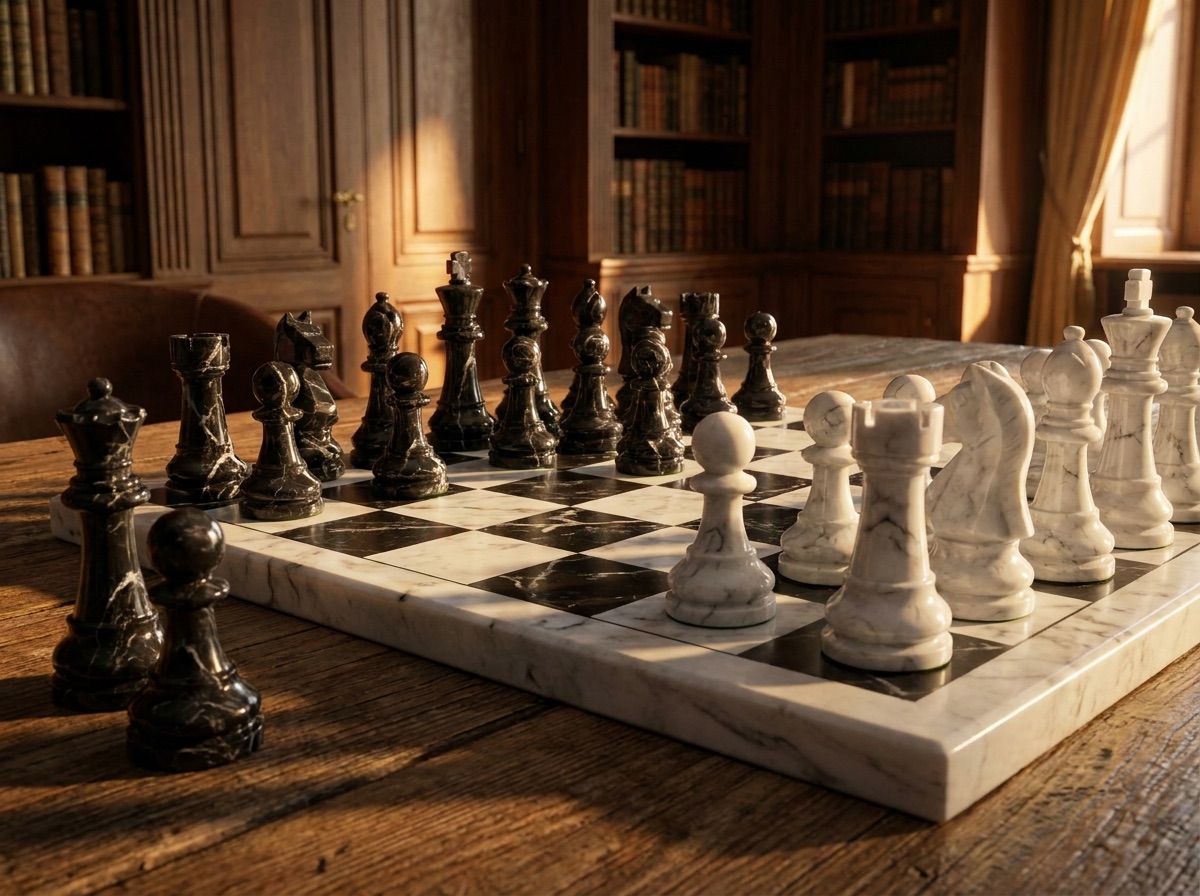
A full marble chess set - stone board and thirty-two turned stone pieces - is one of the oldest gift products in the stone trade and still one of the most reliable. As a market estimate for August 2026, factory prices run $18 to $60 per set for boards with turned pieces in contrasting marble pairs, against retail prices of $80 to $300 in the US and EU. The classic pairs sell forever: white against black, white against green, cream against brown. The set is heavy enough to feel expensive, decorative enough to live on a coffee table, and giftable enough to spike every fourth quarter.
This guide covers what a factory chess set actually consists of and where quality diverges, the economics from an $18 factory set to a $200 product page, the stone pairings and what drives their costs, board and piece specifications that matter to buyers who play as well as those who decorate, the QC points specific to turned stonework, gift packaging, and the ordering process at a 50-set minimum. Figures are market estimates; our partner mill quotes factory-direct by specification.
What a Factory Chess Set Includes
A complete set is a stone board - typically a single plate with inlaid or veneered contrasting squares, or a solid two-stone checkerboard mosaic - plus thirty-two pieces turned and carved from two contrasting marbles, felted on their bases. Entry sets use smaller boards, simpler piece profiles and thinner stone; premium sets add borders, taller carved pieces and fitted gift boxes.
The price band divides on four axes. Board construction: a mosaic checkerboard of solid stone squares costs more than a printed or shallow-inlay board and wears infinitely better. Piece height and weight: a king of 7.5 to 9 cm with proportionate pieces feels serious; 5 to 6 cm kings mark souvenir grade. Carving detail: the knight is the tell - crisp mane and muzzle carving is skilled work, a vague horse-shaped lump is not. Packaging: loose pieces in a bag versus a fitted presentation box are different products at different prices.
Price Economics: From $30 Ex-Factory to $200 Retail
Follow a mid-range set: a 40 cm solid checkerboard in white and black marble with 8 cm-king turned pieces and a foam-fitted gift box, at $32 ex-factory. Sets pack one per box, six to ten boxes per master carton; consolidated sea freight, duty and inland delivery add $4 to $8 per set at 100-set volumes - call it $38 to $40 landed. It wholesales to gift retailers at $70 to $90 and retails at $160 to $220. The multiple is standard gift-trade arithmetic: the retailer funds shelf space and seasonality risk.
Landed cost basics: a boxed set weighs 4 to 10 kilograms depending on board size, so freight is weight-driven; LCL sea shipping is the default at 50 to 500 sets. Duty per the current tariff line for worked stone articles applies and is small against these unit values. Air freight for restocks is more defensible here than in most stone categories because fourth-quarter stockouts are the category's main commercial failure.
Factories also quote matching backgammon, checkers and tic-tac-toe sets from the same stone pairs, and a coordinated games line amortizes photography and advertising across SKUs.
Stone Pairs: What Contrasts Sell
White versus black is the eternal bestseller, and the stones behind it price the set. Entry sets pair Guangxi White ($15-35/sqft slab basis, market estimate) with a standard Chinese black from the $30-80 black marble band. Premium sets step up to Carrara ($40-90/sqft) against Nero Marquina ($40-90/sqft), whose white lightning veins make even the dark squares interesting. The visible difference is veining character and whiteness; the functional difference is nil.
White versus green is the second seller - green marble ($30-100/sqft) in Ming Green or deeper forest tones reads fresh and photographs beautifully against cool whites. Cream versus brown - beige marbles against Emperador ($35-85/sqft) - covers the warm, traditional segment that suits wood-heavy interiors. Han White ($25-70/sqft), China's fine-grained carving marble, takes crisp knight carving better than coarsely crystalline stones and appears in the best premium pieces. Onyx ($60-200/sqft) appears in translucent luxury sets at the top of the market.
Specs and Formats: Boards
Standard board sizes run 30, 40 and 50 cm square. Playability math: a 40 cm board gives 5 cm squares, which pairs correctly with a king of roughly 8 cm at the classic king-to-square ratio - sets that violate this look crowded or sparse. Board thickness runs 12 to 20 mm; mosaic boards should sit dead flat with tight, even joints and a chamfered border.
Details that separate grades: a contrasting border frame or brass inlay, felt or rubber feet, and engraving options - coordinates on the border, a logo on the frame - which factories do cheaply. Visible glue lines and uneven squares are the most common board defect and entirely preventable.
Specs and Formats: Pieces
Pieces are turned on a lathe from stone rods, then hand-finished; knights are carved, which is where workshop skill shows. Specify king height (7.5 to 9 cm for a 40 to 50 cm board), proportionate graduation down to the pawns, base diameters that match square size, and base felting on every piece. Weight is a feature: stone pieces sit securely and give the product its perceived value - list total set weight in the product page.
Ask for one spare pawn per color per set, or at minimum a small percentage of spare pieces per order - turned stone pieces chip if dropped on hard floors, spares transform customer service, and they cost the factory almost nothing at production time. Polished piece finish is standard. Check that both colors come from single stone lots per order, so spares match.
Quality Control Checklist
Boards: flatness checked on a reference surface; mosaic joints tight, even and clean of glue residue; squares consistent in size with sharp contrast between stones; border chamfers even; no cracks or repaired breaks; felt or feet applied straight. Pieces: full census of all thirty-two - shortages are the classic chess-set defect; heights and profiles consistent within each rank; knights carved to the approved sample standard; no chips on collars and finials, the vulnerable spots; bases felted and pieces standing plumb; polish uniform across both colors.
Set-level: pieces match the board scale per the approved sample; gift box fits snugly with every piece immobilized - a loose king destroys itself and its neighbors in transit; box print quality and any engraving verified. Approve a full physical golden sample before production, and have the final inspection open sealed boxes at random. One third-party inspection man-day covers a 200-set order and is worth it on any first run.
Packaging and Gift Boxing
Chess sets are gifts, so the box is part of the product. The standard grades: a plain foam-fitted shipper for value sets; a rigid two-piece gift box with die-cut foam and a lid photo card for the core market; and a wooden or leatherette presentation case with velvet-lined piece trays for the premium tier, adding $3 to $8 at the factory and $40-plus at retail. Every grade must immobilize each piece individually and sandwich the board rigidly - stone-on-stone contact in transit is the category's main damage mode.
Master cartons carry six to ten sets with weight capped for handling; parcels for direct-to-consumer fulfillment need a double-box spec with the gift box floating in cushioning. Private-label service - branded boxes, printed rules leaflets, care cards, UPC and FNSKU labels - is standard at the 50-set MOQ, with print minimums shaping the real order size.
MOQ, Lead Times and the Ordering Process
Minimum order is from 50 sets, mixable across the classic stone pairs within a shared board and piece specification. Fifty sets is genuinely small - a single boutique's season or a cautious e-commerce test - and per-set pricing improves meaningfully at 200 and 500 sets as turning runs lengthen. Lead times: 25 to 40 days production, since thirty-two pieces per set means real lathe hours, plus 30 to 40 days sea transit. Plan roughly 10 to 12 weeks door to door, and count backward from mid-November: fourth-quarter sets should be in production by August.
Process: specification in - board size and construction, stone pair, king height, box grade, branding; per-set quote back, itemized; physical golden sample by courier, one to two weeks, reviewed for census, carving, fit and box; 30 percent deposit; production with photo checkpoints; random final inspection of sealed boxes; balance against the inspection report; shipment. Repeat orders of an established specification can skip the physical sample against lot photos.
Care, Play and Longevity
A marble chess set is close to maintenance-free by stone standards: it holds no food, sees no acids, and lives indoors. Care card content: dust the board, wipe with a damp cloth and mild soap, keep vinegar-based cleaners away, lift pieces rather than sliding them on a polished board, and store pieces in their fitted tray rather than loose in a drawer.
The failure mode is mechanical, not chemical: a piece dropped on tile chips, a board dropped breaks. This is worth saying plainly in listings - solid stone, substantial weight, handle accordingly - and spare pieces turn accidents into service moments. A well-made marble set outlasts its buyer; the trade has been shipping essentially this product for centuries.
Frequently asked questions
How much does a marble chess set cost wholesale?
Factory-direct prices run $18 to $60 per set as a market estimate for August 2026 - small boards with simple pieces at the bottom, 50 cm solid mosaic boards with 9 cm carved kings and presentation boxes at the top. Comparable sets retail for $80 to $300 in the US and EU, and landed cost adds roughly $4 to $8 per set at 100-set volumes.
What is the minimum order for factory-direct chess sets?
From 50 sets, mixable across stone pairs within one board and piece specification. Fifty sets suits a single retailer's season or an e-commerce test; per-set pricing improves at 200 and 500 sets as production runs lengthen. Single sets are a retail purchase - freight and boxing minimums erase the factory saving on one unit.
Which marble combinations are best for chess sets?
White versus black leads permanently - Guangxi White against standard black at entry, Carrara against Nero Marquina at premium. White versus green is the second seller and photographs best, and cream versus Emperador brown covers the traditional segment. Fine-grained Han White takes the crispest knight carving for premium pieces.
What size marble chess board should I buy or order?
A 40 cm board with 5 cm squares and a king around 8 cm is the sweet spot between playability and coffee-table presence; 30 cm suits gift and travel positioning, 50 cm the statement tier. Keep the classic king-to-square proportion - oversized pieces on small squares mark a set as decorative-only.
How do marble chess sets ship without damage?
Each piece must sit immobilized in die-cut foam or a fitted tray, the board sandwiched rigidly, and direct-to-consumer parcels double-boxed with the gift box floating in cushioning. Stone-on-stone contact in transit is the main damage mode. Order spare pawns with the production run - they cost cents and rescue customer-service situations.
Are marble chess pieces durable enough to play with?
Yes - turned stone pieces are solid, stable and effectively immune to wear from normal play, and their weight is part of the appeal. The risk is impact: a piece dropped on a hard floor can chip, and pieces slid roughly across a polished board can scratch it. Felted bases, careful handling and the fitted storage tray cover all of it.
When should retailers order chess sets for the holiday season?
By August. Production takes 25 to 40 days because every set contains thirty-two lathe-turned pieces, sea transit adds 30 to 40 days, and clearance and inbound handling consume the rest - roughly 10 to 12 weeks door to door. Sets that miss December wait most of a year for their next peak.