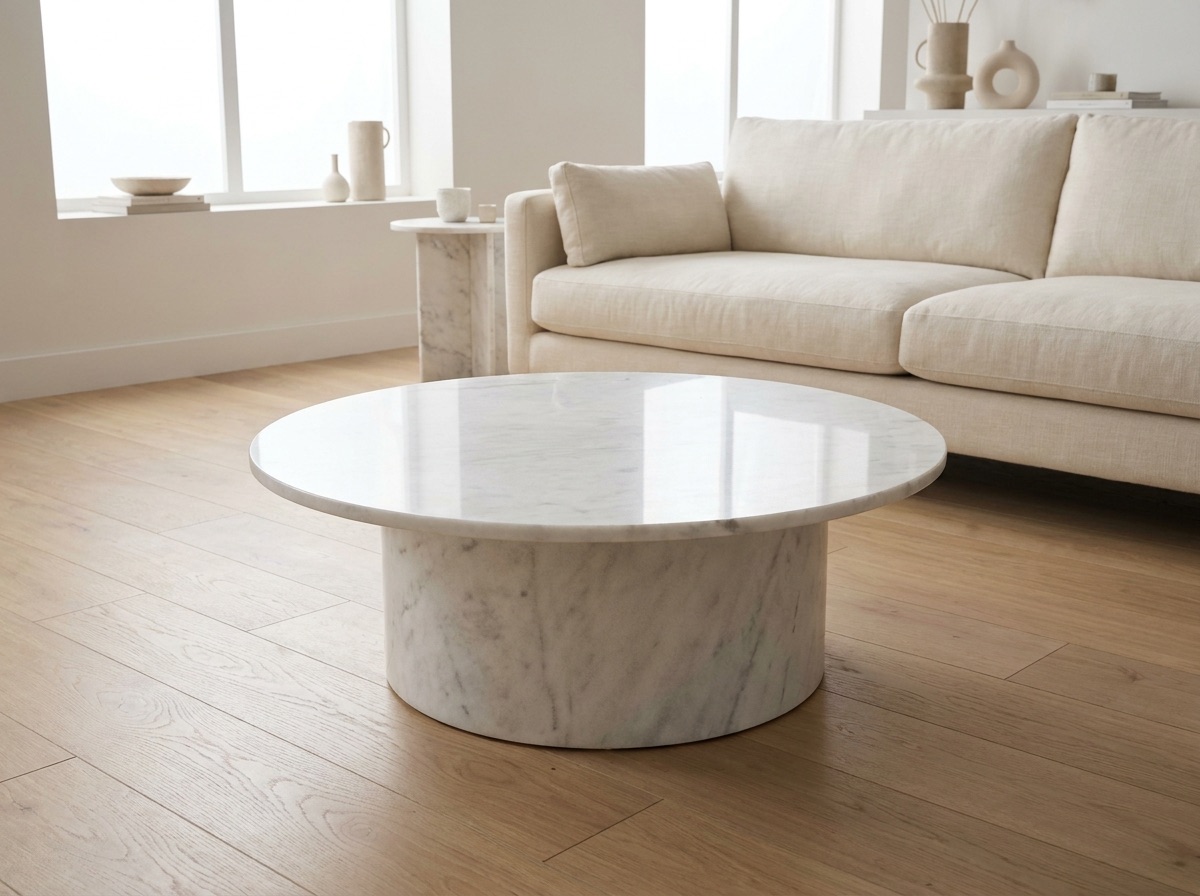
Marble coffee tables are the single biggest marble furniture search in the US, and the margin structure explains why every furniture brand wants one in the line. As a market estimate for August 2026, factory prices run $60 to $400 per piece for round, oval and rectangular tables in Carrara, Calacatta-look, Nero and green marble, while the same tables retail for $300 to $2,000 in the US and EU. A four-to-six-times gap between factory gate and checkout page is normal in this category, and understanding what fills that gap is the difference between buying well and buying a story.
This guide is written for the people who actually place orders: e-commerce brands, furniture retailers, interior designers buying for projects, and importers testing the category. It covers what the factory price includes, how landed cost builds, which stones and bases sell, the flat-pack versus assembled decision that quietly drives your freight bill, and the QC checklist that keeps a container of stone tables from arriving as a container of claims. Figures are market estimates; our partner mill quotes factory-direct against drawings or reference photos.
What the Factory Price Buys
A $60 table and a $400 table from the same mill are different objects. At the bottom of the range: a small round top, 60 to 70 cm, in Guangxi White or a standard black, 18 mm thick, on a simple powder-coated steel base, foam-and-carton packed. At the top: a large oval or plinth-style table in genuine Carrara or a book-matched Calacatta-look stone, 30 mm top with a profiled edge, on a solid stone or brushed stainless base, crated. The factory price includes fabrication, finishing, the base, standard packaging and export documents to FOB terms.
The category splits into three constructions: stone top on a metal base (the volume seller), stone top on a wood base, and solid stone throughout - drum, plinth and sculptural forms cut entirely from marble. Solid stone photographs beautifully and commands the highest retail prices, but weight is the tax: a solid marble drum table can weigh 80 to 120 kilograms, which shapes freight, handling and the customer's delivery experience.
Price Economics: From $150 Ex-Factory to $1,200 Retail
Follow one mid-range table through the chain. Factory price $150 for an 80 cm Carrara round on a black steel base. Ocean freight, duty and inland delivery on a consolidated container add $30 to $60 per table depending on how densely you pack - call it $200 landed at a US warehouse. A wholesale brand sells it to retail at $400 to $500; the retailer tickets it at $900 to $1,200. Nobody in that chain is stealing: the brand carries marketing, returns and inventory risk, the retailer carries showroom and delivery. But the importer who goes factory-direct captures the first and fattest markup.
Landed cost basics for furniture: stone tables ship by volume and weight together, and a 40-foot container carries roughly 200 to 400 tables depending on size and whether they are flat-packed. Duty on stone furniture articles must be checked against the current tariff schedule at order time. As a working rule, factory price plus 20 to 40 percent gets a consolidated order landed in the US; small LCL shipments run higher per unit, which is why testing the category with 20 pieces costs more per table than scaling to 200.
The honest comparison for a brand is landed cost versus wholesale price from a domestic distributor, and there the gap is stark: a table landed at $200 replaces one wholesaling at $450. That spread funds advertising, free shipping and returns - the actual cost structure of selling furniture online.
Best Stones for Coffee Tables
Whites dominate demand. Carrara ($40-90/sqft slab, market estimate) is the safe, liquid choice; Guangxi White ($15-35/sqft) delivers the same cool-white read at entry price points and is the right stone for tables retailing under $500. Calacatta-look tops - genuine Calacatta runs $80-250 per square foot - are the premium tier, and a book-matched Calacatta or Panda White ($50-130/sqft) top turns a table into a statement piece worth photographing.
Black and green are the trend axis. Nero Marquina ($40-90/sqft) with its white lightning veins is the reference black; broader black marbles trade at $30-80. Green marble ($30-100/sqft) - Rainforest, Ming Green, Verde Alpi types - is in a sustained design moment and green tables currently punch above their share in sell-through.
Specs and Formats: Tops, Thickness, Edges
Standard rounds run 60, 70, 80, 90 and 100 cm; ovals 100 to 130 cm long; rectangles 100 by 60 to 130 by 70 cm. Top thickness is 18 or 20 mm for metal-base tables and 30 mm where the design shows edge mass; solid-stone pieces go far thicker. Edges are eased, bullnose, or bevel; a thick-look mitred drop edge on a thin top saves weight and freight while reading as solid stone - a factory technique worth specifying.
Finishes: polished is the default and what most retail photography shows; honed reads more architectural and hides fingerprints and etching better on dark stones. All tops should ship sealed.
Bases: Metal, Wood and Solid Stone
The base is half the design and most of the engineering. Powder-coated carbon steel is the volume standard - cross, ring, tripod and pedestal forms - and costs the factory little. Brushed or PVD-coated stainless steps the table upmarket and resists rust in humid markets. Wood bases, usually ash or oak, warm the design but introduce moisture-content and finish QC of their own. Solid stone bases - cylinders, plinths, sculpted forms - make the heaviest and most premium tables.
Engineering checks to specify: base weight and footprint adequate for the top (a 90 cm stone top on an undersized ring base is a tip-over lawsuit waiting), levelling feet included, fixing method defined - threaded inserts and plates for flat-pack, structural adhesive for assembled - and coating thickness on steel stated in microns. Ask for a load and stability test photo or video on the first order of any new design.
Flat-Pack vs Assembled, Packaging and Freight
Flat-pack - top and base in one carton, customer attaches the base to pre-fitted inserts - is the e-commerce default. It cuts cube by 40 to 60 percent versus assembled tables, survives parcel networks better, and lets you ship a table a customer can actually move into an apartment. Assembled tables suit solid-stone designs that cannot be split, showroom retail, and hospitality projects delivered by two-man teams.
Packaging is where stone furniture orders live or die. Minimum spec: top in a fitted foam tray with corner protectors, carton walls of double or triple-wall board, a stiffener frame or honeycomb panel against the stone face, base hardware bagged and boxed inside, and drop-test evidence on the first production run. Heavy solid-stone pieces go in wooden crates.
Quality Control Checklist
Per piece: top dimensions and thickness within tolerance (plus or minus 1 mm thickness, 2 mm diameter); polish uniform with no dull windows or wheel marks; edges smooth and even all round; no cracks, chips or badly filled fissures on visible faces; vein appearance consistent with approved samples - stone varies, so approve a range, not a single photo; base welds ground, coating even, no orange peel or runs; inserts positioned to drawing and threads clean; table sits level without rocking.
Per order: an approved golden sample before mass production, in-line photos during fabrication, and a final random inspection to an agreed AQL standard before the container closes. Third-party inspection costs $150 to $300 per man-day in Chinese furniture and stone hubs. On natural stone, define acceptable variation in writing - percentage of veining, allowed color shift - because 'it does not look like the website photo' is not a workable rejection standard for either side.
MOQ, Lead Times and the Ordering Process
Minimum order is from 20 pieces, which can usually mix sizes and stones within one design family. Twenty pieces is a test order that ships LCL; real unit economics start at 100-plus pieces where container consolidation kicks in. Lead times: 25 to 40 days production for standard designs, longer for new tooling or scarce stones, plus 30 to 40 days ocean transit to the US or EU. Plan 10 to 12 weeks door to door.
Process: send reference photos or drawings; receive an itemized quote per design and stone; approve a golden sample, physical or by detailed video for repeat stones; place deposit, typically 30 percent; production with photo checkpoints; final inspection; balance against inspection report; ship. For private-label brands, factories routinely handle logo engraving, branded cartons and care cards - specify them in the quote stage, not as an afterthought.
Care and Maintenance
A marble coffee table lives a harder life than a countertop backsplash: glasses, coffee rings, feet. Sealed stone resists staining but etching from wine, citrus and some cleaners is a surface change no sealer prevents. Care guidance to print on the card in the box: use coasters, wipe spills promptly, clean with pH-neutral soap, never with vinegar or bleach, and reseal once or twice a year under heavy use.
For sellers, the care card is margin protection - it converts 'defective table' complaints into normal-material-behavior conversations. Honed and dark stones hide wear best; polished white tops show life honestly. Light scratches and etching on a top can be professionally re-polished, and solid tops can be refinished repeatedly.
Frequently asked questions
How much does a marble coffee table cost wholesale?
Factory-direct prices run $60 to $400 per piece as a market estimate for August 2026 - small Guangxi White rounds on steel bases at the bottom, large book-matched or solid-stone pieces at the top. The same tables retail for $300 to $2,000 in the US and EU. Landed cost on a consolidated order typically adds 20 to 40 percent to the factory price.
What is the minimum order for factory-direct marble coffee tables?
From 20 pieces, usually mixable across sizes and stones within a design family. Twenty pieces works as a market test shipped LCL; container economics improve sharply from around 100 pieces. Single-piece purchases are better made at retail - freight and packing minimums erase the factory saving on one table.
Which marble is best for a coffee table?
Carrara is the liquid default and Guangxi White gives the same cool-white look at entry price points. Nero Marquina and green marbles are the current trend stones, and book-matched Calacatta-look or Panda White tops carry the premium tier. Honed finishes and darker stones hide everyday wear better than polished white.
Should marble coffee tables ship flat-pack or assembled?
Flat-pack for e-commerce: it cuts shipping cube by 40 to 60 percent, survives parcel networks better, and the customer can move the boxes. Assembled suits solid-stone designs that cannot split and hospitality deliveries. Either way, insist on fitted foam trays, corner protection and drop-test evidence on the first run.
How heavy is a marble coffee table?
A stone top on a metal base typically runs 25 to 50 kilograms depending on diameter and thickness; solid marble drum and plinth tables run 80 to 120 kilograms. Weight drives freight cost and last-mile experience, which is why thin tops with mitred drop edges - thick look, less mass - are a smart factory specification.
Do marble coffee tables stain and scratch?
Marble etches with acids like wine and citrus regardless of sealing, and can stain if unsealed. Sealed tops, coasters and pH-neutral cleaning keep tables presentable for years, and light wear can be professionally re-polished. Sellers should ship a care card with every table to set expectations honestly.
How long does a wholesale coffee table order take from China?
Standard designs take 25 to 40 days in production, plus 30 to 40 days ocean transit to the US or EU and customs clearance - about 10 to 12 weeks door to door. New designs add sample time up front, roughly two to three weeks for a golden sample before production starts.