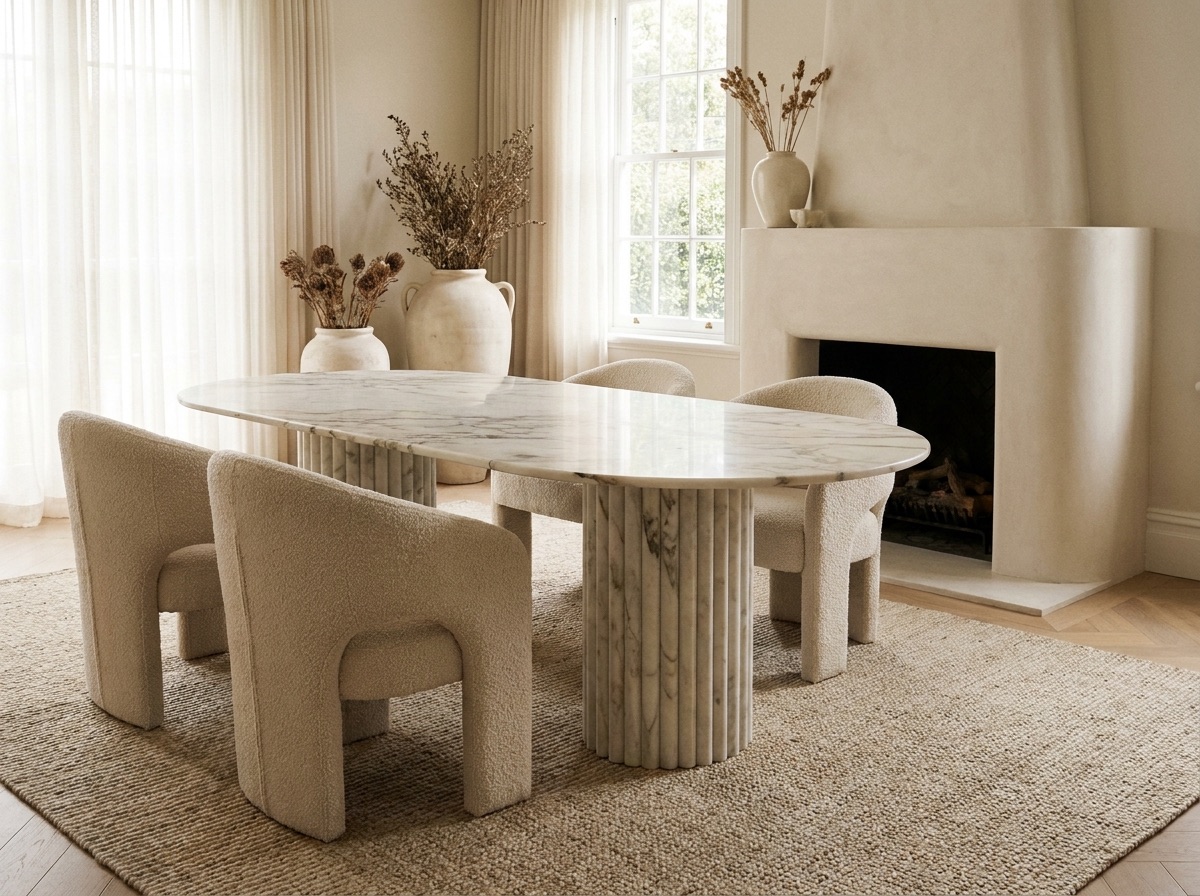
A marble dining table is the most demanding piece of stone furniture to build and ship: a top up to 2.4 meters long that must arrive flat, unbroken and level on its base after ten thousand kilometers of handling. As a market estimate for August 2026, factory prices run $180 to $900 per piece for round and rectangular tables with solid marble or sintered-composite tops, while comparable tables retail from roughly $1,500 to $6,000 in the US and EU. The current bestsellers: book-matched Calacatta-look tops on fluted stone bases.
This guide covers the full buying picture for retailers, e-commerce brands, interior designers and hospitality projects: what separates a $180 table from a $900 one, how the retail markup builds and what landed cost really is, the solid marble versus sintered stone decision, base engineering, the flat-pack versus assembled trade-off at dining-table weights, and the QC and crating discipline this category demands. Figures are market estimates; our partner mill quotes factory-direct from drawings or reference photos.
What You Get at Each Price Point
At $180 to $300 ex-factory: a 120 to 135 cm round or 140 to 160 cm rectangular table with an 18 to 20 mm top in Guangxi White, a standard black or a sintered Calacatta-look composite, on a powder-coated steel pedestal. At $300 to $550: larger formats to 180 cm, genuine Carrara or Nero Marquina tops, better bases - stainless, heavier pedestals, simple stone cylinders. At $550 to $900: 200 to 240 cm tops, book-matched Calacatta-look natural stone, 30 mm thickness or mitred thick edges, and the fluted or sculpted solid stone bases that define the current premium look.
The factory price covers fabrication, base, sealing, standard export packaging and documentation to FOB terms. What it does not cover - and what fills the gap to a $4,000 retail ticket - is ocean freight, duty, warehousing, white-glove delivery, returns risk on a 150-kilogram object, and two layers of trade margin.
Price Economics: Factory Gate to Dining Room
Trace a mid-range table: $450 ex-factory for a 180 cm book-matched Calacatta-look top on a fluted stone base. Crating, ocean freight and duty on a consolidated container add $80 to $150; call it $580 landed at a US warehouse. Add domestic freight to a regional hub and white-glove two-man delivery - $150 to $300 for a table this heavy - and the all-in cost to put it in a customer's dining room is around $800 to $900. Retail for the equivalent table runs $2,500 to $4,000, which is why direct-to-consumer brands and hotel procurement go factory-direct.
Landed cost basics: dining tables ship crated or in heavy cartons, 60 to 120 tables to a 40-foot container depending on size and knock-down design. Freight per table is dominated by cube for flat-packed designs and by weight for solid-stone ones. Duty on stone furniture must be checked against the current tariff schedule at order time. As a working band, factory price plus 20 to 40 percent covers a consolidated order landed at a US or EU warehouse; small trial shipments cost proportionally more.
For hospitality projects the arithmetic is simpler still: a 40-room boutique hotel specifying 45 tables saves roughly $60,000 on this one line item against a 10 to 12 week lead time.
Best Stones - and the Sintered Stone Question
For natural tops, the demand curve is unambiguous: Calacatta-look whites lead. Genuine Calacatta slabs run $80-250 per square foot as a market estimate and premium Calacatta Gold reaches $300, so most factory dining tables achieve the look with book-matched Statuario ($80-220), high-grade Carrara ($40-90), Panda White ($50-130) or well-veined Guangxi White ($15-35) depending on price point. Nero Marquina ($40-90) anchors the black segment; green marble ($30-100) is the fashion-forward choice.
Sintered-composite tops - sintered stone and large-format porcelain with printed Calacatta veining - deserve an honest paragraph because our partner mill supplies both. Sintered tops do not etch, stain or scratch in normal use, weigh less at 12 mm thickness, and survive shipping better. Natural marble is the real thing: cool to the touch, unique per table, refinishable, and it commands higher retail prices. The trade split we see: e-commerce volume sellers lean sintered for damage and complaint rates; premium brands and designers lean natural and sell the patina story. Both are legitimate; misrepresenting sintered as natural marble is not.
Specs and Formats
Rounds: 120, 135, 150 cm seating four to eight. Rectangles and ovals: 160, 180, 200, 220 and 240 cm, seating six to ten. Natural stone tops run 18 to 20 mm on supported designs and 30 mm where the edge shows mass; a mitred drop edge on a 20 mm top gives the 50 mm plinth look without the weight. Sintered tops run 12 mm, sometimes laminated to a substrate. Standard height is 75 cm.
Edges: eased and bullnose for family use, sharp square and mitred for the architectural look. Finishes: polished dominates retail photography; honed is more forgiving of daily use and increasingly specified by designers. Rounds on pedestal bases are the e-commerce favorite: flexible seating and a far more manageable crate.
Bases: The Engineering Half of the Table
A dining top weighs 60 to 150 kilograms in natural stone, and the base carries it through years of leaning elbows and dragged chairs. The current bestseller is the fluted stone cylinder or twin-pillar base - solid or hollow-core marble with vertical fluting - followed by sculpted plinths, steel pedestals with wide footprints, and X-frames. Hollow-core stone bases with internal steel sleeves cut weight substantially while keeping the monolithic look.
Specify: base footprint adequate against tipping with point load at the table edge; levelling feet; a steel connection plate bonded or bolted between top and base rather than adhesive alone on heavy tops; and for rectangles over 200 cm on twin pedestals, a stretcher or substrate stiffener to prevent flex. Require a stability and load test video with the golden sample.
Flat-Pack vs Assembled, Packaging and Crating
Dining tables ship knocked down almost without exception: top in one crate or reinforced carton, base in another or in the same crate, hardware bagged. A fully assembled marble dining table is effectively unshippable at parcel or standard freight rates and is reserved for local white-glove distribution. The design decision is how the knock-down connects: threaded inserts and a bolt plate the customer can manage, versus a two-man professional assembly for stone-base models.
Packing spec for natural tops: fitted foam frame, face board against the polished surface, vertical-preferred orientation in a wooden crate for tops over 160 cm, fumigated timber with ISPM 15 stamps, corner blocks, and strapping that does not bear on stone edges. Long tops shipped flat must be supported across the full face. Budget 1 to 3 percent transit damage even with good packing; the difference between 1 and 10 percent is entirely in the crate design.
Quality Control Checklist
Top: dimensions within 2 mm, thickness within 1 mm, flatness within 1.5 mm over 2 meters checked with a straightedge; polish uniform under raking light; edges continuous and chip-free; book-match seam, where present, tight and pattern-aligned; back face sealed or meshed; no undisclosed filled cracks in structural zones. Base: welds and coatings clean, stone bases free of cracks at the bearing surface, connection hardware matching the drawing, table assembled level with no rock.
Order-level: golden sample approval before production; vein-range approval for natural stone - agree explicitly how much variation from the sample photos is acceptable, since no two natural tops match; in-line photos at fabrication and pre-packing; final random inspection against an agreed defect standard before the container closes. Third-party inspection runs $150 to $300 per man-day and is non-negotiable on a first container of dining tables.
MOQ, Lead Times and the Ordering Process
Minimum order is from 10 pieces, mixable within a design family - realistic for a boutique hotel, a designer's project batch or a brand's market test. Serious unit economics start around 60-plus pieces where a container fills. Lead times: 30 to 45 days production for standard designs and stocked stones, plus 30 to 40 days ocean transit; plan 11 to 13 weeks door to door, longer when a scarce stone must be sourced as blocks.
Process: reference photos or drawings in; itemized quote back with stone options at each price point; golden sample - physical for new designs, detailed video and slab approval for repeats; 30 percent deposit; production with photo checkpoints at slab layout, fabrication and pre-packing; final inspection; balance against the inspection report; shipment with full document set. For projects, ask the mill to hold approved slab stock for follow-on phases so re-orders match the first delivery.
Care and Maintenance
A dining table takes the hardest use of any marble surface in the home: hot dishes, wine, citrus, cutlery. Natural marble will etch with acids no matter the sealer, so the honest setup is placemats and coasters as standard practice, prompt wiping, pH-neutral stone soap, no vinegar or bleach cleaners, and resealing once or twice a year. Honed finishes disguise etching dramatically better than polished; dark and heavily veined stones hide daily life better than pure whites.
Natural tops can be professionally re-honed or re-polished in place, effectively resetting the surface - a genuine advantage over any printed composite, which cannot be refinished once worn.
Frequently asked questions
How much does a marble dining table cost from the factory?
Factory-direct prices run $180 to $900 per piece as a market estimate for August 2026: entry rounds in Guangxi White or sintered tops at the bottom, 200-240 cm book-matched Calacatta-look tops on fluted stone bases at the top. Comparable tables retail for roughly $1,500 to $6,000 in the US and EU before delivery.
What is the minimum order for factory-direct dining tables?
From 10 pieces, which can mix sizes and stones within a design family. That threshold suits hotel projects, designer batches and brand market tests; container-level economics arrive around 60-plus tables. For a single table, retail or local trade suppliers remain the practical route because crating and freight minimums dominate.
Should I choose natural marble or sintered stone for a dining table?
Natural marble is unique per table, refinishable and commands premium retail prices, but etches with acids and needs sealing. Sintered stone does not etch or stain, weighs less and survives shipping better, but is a printed pattern that cannot be refinished. Volume e-commerce leans sintered for lower claim rates; premium brands lean natural. Never sell one as the other.
How heavy is a marble dining table?
Natural stone tops run 60 to 150 kilograms depending on size and thickness, and solid stone bases add 40 to 100 kilograms more; hollow-core stone bases cut that substantially. Total shipped weights of 100 to 250 kilograms are normal, which is why tables ship knocked down and why white-glove delivery is a real line item in retail pricing.
Do marble dining tables ship assembled or flat-pack?
Knocked down, almost always: top in one crate, base separately, connected on site by bolt plate and inserts. Tops over 160 cm should travel vertically in fumigated wooden crates with full-face support. Budget 1 to 3 percent transit damage even with good packing, and demand crate photos and a drop or vibration test on the first production run.
Which marble is best for a dining table top?
Book-matched Calacatta-look whites are the current bestseller - achieved with Statuario, high-grade Carrara, Panda White or well-veined Guangxi White depending on budget, since genuine Calacatta slabs run $80-250 per square foot. Nero Marquina leads the black segment. For heavy daily use, a honed finish hides etching far better than polished.
How long does a factory dining table order take?
Plan 11 to 13 weeks door to door: 30 to 45 days production, 30 to 40 days ocean transit to the US or EU, then clearance and inland delivery. New designs add two to three weeks for golden sample approval up front, and scarce stones sourced as blocks add more. The schedule risk sits in approvals, so turn samples and slab photos around fast.