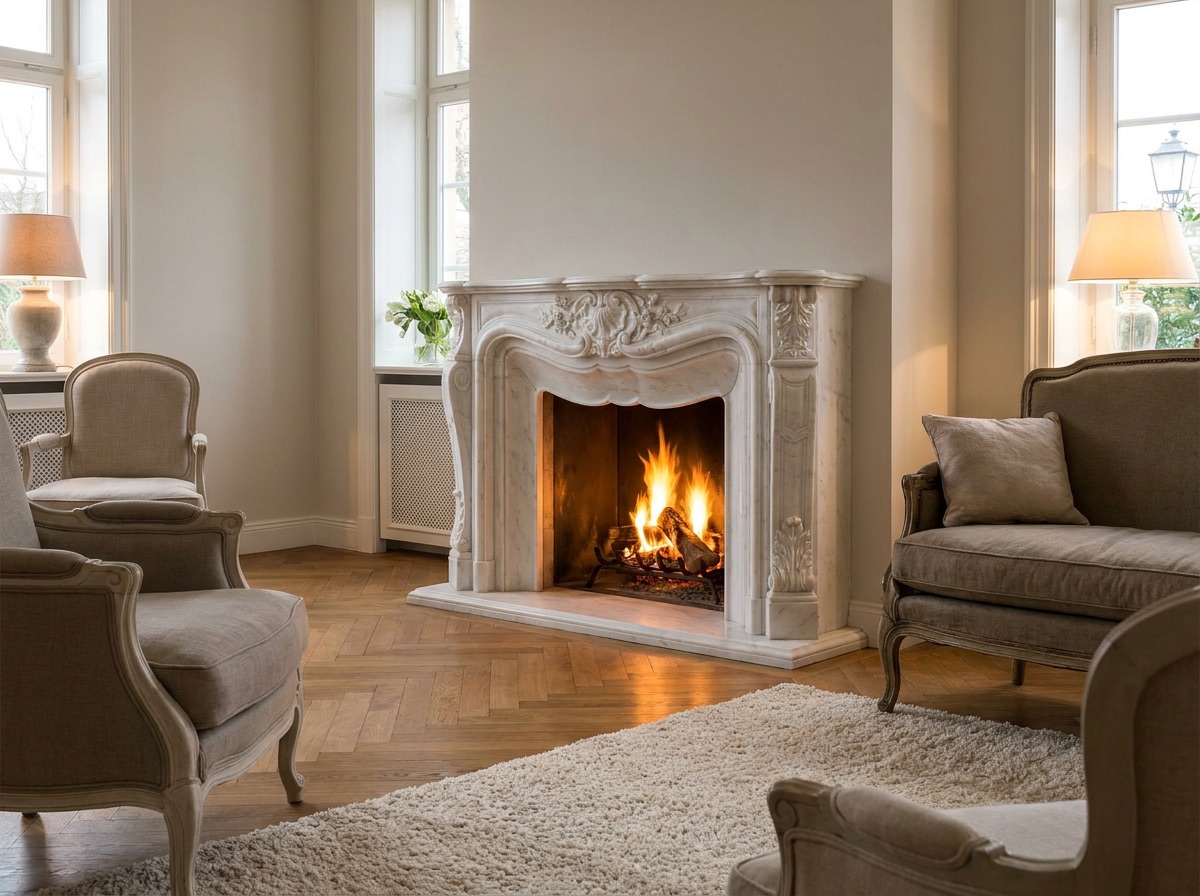
A carved marble fireplace surround is the most visible stone element in a room, and it carries one of the widest retail markups in the stone trade. As a market estimate for August 2026, factory-direct pricing from a Chinese carving mill runs $400 to $3,500 per surround, while comparable pieces retail in the US and Europe from $3,000 to $15,000 and beyond — often for stone carved in the same workshops. Buying direct is unusually practical here: a surround ships as one crate and needs no local fabrication, only installation.
This guide covers what sets the price of a marble fireplace — carving style, stone, dimensions and finish — which white, cream and black marbles make sense at each budget, how the made-to-drawing process works, and what to check before the crate is sealed. All figures are market estimates tied to our August 2026 index data; use the ranges to judge whether a quote is fair rather than as a price list.
What you get in this category
The core product is the surround: two legs, a frieze and a mantel shelf framing the firebox opening, carved as a kit of stone parts that assemble on site. Styles fall into three broad families. French designs — Louis XV and Louis XVI profiles with curved legs, shell and floral carving — are the most carving-intensive. Georgian and Victorian English patterns use straighter lines, fluted columns and corbels. Modern minimal surrounds are essentially precision slab work: clean rectangular frames in honed or polished stone with no ornament at all.
Beyond the surround, the same order usually includes a hearth slab, an inner slip frame in matching or contrasting stone, and sometimes an overmantel. Freestanding decorative mantels for non-working fireplaces are ordered to the same drawings. Everything is carved to order — there is no stock inventory — which is why single surrounds are the normal transaction in this category.
Price economics: factory versus retail
As market estimates for August 2026: a modern minimal surround in Guangxi White or another economical stone starts around $400 to $800 factory-direct. A Georgian-style surround with moderate carving in Carrara-grade stone typically runs $900 to $1,800. A full French Louis XV surround with deep floral carving lands between $1,800 and $3,500 depending on stone and size. Western retail and antique-reproduction dealers price equivalent pieces at three to five times these numbers, plus installation.
The cost drivers rank in a clear order. Carving hours dominate: an ornate French frieze can absorb two weeks of hand work while a minimal frame takes a day of sawing and polishing. Stone is second — the difference between Guangxi White and Statuario can double the quote on a large surround. Size matters less than buyers expect until it forces thicker structural sections or a larger mantel shelf in one piece. Finish is the smallest factor: honed versus polished is a modest difference, though hand-finished patina effects add real hours.
Best stones for fireplaces: white, cream and black
White marbles carry the category. Carrara, at roughly $40 to $90 per square foot in slab form (market estimate, August 2026), is the classic fireplace stone — soft grey veining reads correctly on both period and modern designs. Han White ($25 to $70) is the carver's choice for ornate work: its fine, uniform grain holds crisp detail in shells, acanthus leaves and flutes better than veined stones, and it was the carving marble of imperial China. Guangxi White ($15 to $35) delivers the Carrara look at project budgets and is the default for volume orders. Statuario ($80 to $220) is the statement option where the surround is the centrepiece of a serious room.
Cream and ivory tones come from the warmer end of the white-marble spectrum, which spans roughly $20 to $120 per square foot across origins — cream stones suit Georgian designs and rooms with warm palettes where bright white would look clinical. For black, Nero Marquina ($40 to $90) is the reference: jet ground with white lightning veins, striking in modern frames and Victorian slate-replacement designs. Chinese and Indian black marbles in the broader $30 to $80 black-marble range give a similar look for less where bold veining is not wanted.
Specs, dimensions and formats
A surround is specified around the firebox opening: the drawing must state opening width and height, overall external dimensions, and shelf depth. Typical US and UK surrounds run 1,200 to 1,800 mm overall width with openings around 900 by 900 mm, but the stone is carved to your firebox — supply the appliance or opening spec with the RFQ. Confirm the fuel type too: gas and electric inserts are undemanding, while solid-fuel fireboxes need non-combustible clearances that affect slip and jamb dimensions under local codes.
The surround ships as parts — legs, frieze panels, shelf, plinth blocks, hearth — each a manageable weight, doweled and assembled on site with adhesive and mechanical fixing to the wall. Total weight for a typical surround runs 150 to 400 kg. Hearths are normally 20 or 30 mm slab material; check whether your appliance requires a thicker or ventilated hearth before finalising the drawing.
The made-to-order process
Fireplaces are carved to drawing, and the process is forgiving even for buyers without CAD. Start with reference photos of a design you want, plus your firebox dimensions; the workshop's draftsman returns a dimensioned shop drawing for approval. Buyers with their own architect can send DWG or PDF drawings directly. The quote that comes back specifies stone, dimensions, finish, part count and crating.
After a deposit — typically 30 to 50 percent — carving begins with CNC profiling of the flat sections and roughing of ornament, followed by hand carving of the detailed work and final finishing. Expect progress photos at roughing and finishing stages. Before crating, the workshop should dry-assemble the complete surround, photograph it from several angles and share close-ups of carved detail for sign-off. Production time runs 3 to 6 weeks for minimal designs and 6 to 10 weeks for heavily carved French work, plus roughly 30 to 40 days of sea freight.
Quality control checklist
On the dry-assembled surround, check that joints between legs, frieze and shelf close tight and even — open or stepped joints at the miters are the most common defect and cannot be hidden on site. Verify overall dimensions and the opening size against the drawing within 1 to 2 mm. Color and veining should be consistent across all parts: legs cut from a different slab batch than the frieze will show on the wall forever, so ask for photos of the parts laid out together in daylight.
On carved detail, look for symmetry between the two legs, crisp rather than mushy ornament, and no filled chips at fragile edges. Wet photos reveal cracks and resin repairs. Check the back faces too — fixing holes and dowel positions should match the assembly drawing, and the hearth should be flat enough to sit without rocking. Finally, confirm the parts are labeled to match the assembly diagram before crating; an unlabeled 20-part surround wastes hours at installation.
MOQ, lead times and ordering logistics
Single pieces are the norm — one-off orders are routine here, which suits homeowners, fireplace showrooms and interior designers alike. Trade buyers ordering three to five surrounds per crate get meaningfully better freight economics, since one crate position absorbs the same handling cost regardless of contents.
Realistic end-to-end timing from approved drawing to a crate at a US or EU door: 10 to 16 weeks depending on carving complexity and routing. Payment is normally deposit plus balance against pre-shipment QC photos. For showrooms, a sensible pattern is a first order of two or three display surrounds in different styles, then made-to-order flow against client deposits.
Shipping and crating
Surrounds ship disassembled in a single plywood-and-timber crate, each part foam-separated and blocked so nothing shifts. Carved elements get individual wrapping with corner protection on shelf edges and ornament. ISPM-15 treated timber is required for most destinations, and a proper crate for a full surround costs $80 to $200 — trivial against the value it protects. Marine insurance at 1 to 2 percent of invoice value is standard practice and worth it on every shipment.
A crated surround weighs 200 to 500 kg, so plan a liftgate delivery or forklift at the receiving end. Uncrate on arrival, check parts against the packing list and photograph any damage before signing — carriers and insurers both work off that timestamp. Chipped ornament can often be repaired invisibly by a local stone restorer, and workshops will ship a replacement part far cheaper than a full remake, but only if damage is documented at delivery.
Installation and care
Installation is a competent two-person job: parts are bonded with stone adhesive, mechanically tied to the wall at concealed brackets, and shimmed level. Any experienced stone mason or fireplace fitter can do it from the assembly diagram in half a day; the critical points are a level hearth, tight miters and respecting the appliance's clearance requirements.
In service, marble around a fire has two enemies: acid and soot. Clean with pH-neutral stone soap only — vinegar or bathroom cleaners etch polished marble on contact. Seal the hearth and shelf with a penetrating impregnator yearly in working fireplaces, since soot and log resin stain unsealed stone. Light scratches on a shelf can be repolished in place, and a deeper slip or heat shield prevents the slight yellowing white marble can develop above hard-used solid-fuel openings.
Frequently asked questions
How much does a marble fireplace surround cost?
As a market estimate for August 2026, factory-direct pricing runs $400 to $3,500 per surround: minimal modern designs from around $400 to $800, Georgian-style carved surrounds $900 to $1,800, and ornate French Louis XV work $1,800 to $3,500. Western retail for equivalent pieces typically runs three to five times higher, plus installation.
What is the best marble for a fireplace?
Carrara is the classic all-rounder; Han White holds fine carved detail best and suits ornate French designs; Guangxi White delivers the white-marble look at project budgets; Nero Marquina is the reference black for modern and Victorian styles. Cream marbles from the warmer white spectrum suit Georgian rooms where bright white would look cold.
Can I order a custom marble fireplace from a photo?
Yes. Send reference photos of the design you want plus your firebox dimensions, and the workshop's draftsman produces a dimensioned shop drawing for your approval before carving. Buyers with architects can submit DWG or PDF drawings directly. The surround is then carved to that approved drawing, with progress and dry-assembly photos before shipping.
How long does a custom marble fireplace take to deliver?
Production runs 3 to 6 weeks for minimal designs and 6 to 10 weeks for heavily carved surrounds, plus about 30 to 40 days of sea freight and customs. Realistic end-to-end timing from approved drawing to your door is 10 to 16 weeks.
Is a marble fireplace surround hard to install?
No — it ships as labeled parts that a stone mason or fireplace fitter assembles in about half a day using stone adhesive, concealed wall brackets and shims. The critical points are a level hearth, tight joints and meeting the appliance's clearance requirements. No specialist equipment is needed beyond safe handling of parts weighing 30 to 80 kg.
Does marble crack from fireplace heat?
Not in a properly built fireplace. The surround sits outside the firebox and never sees direct flame; gas and electric inserts are entirely undemanding. With heavy solid-fuel use, white marble above the opening can yellow slightly over decades — a deeper slip or heat shield prevents it. Thermal cracking indicates ignored clearance requirements, not a stone problem.
Can I order just one fireplace surround from China?
Yes — single pieces are the normal order in this category, crated individually for sea freight. Homeowners and designers order one-offs routinely, though showrooms ordering three to five surrounds per crate get better freight economics per piece. Expect deposit plus balance against pre-shipment QC photos.