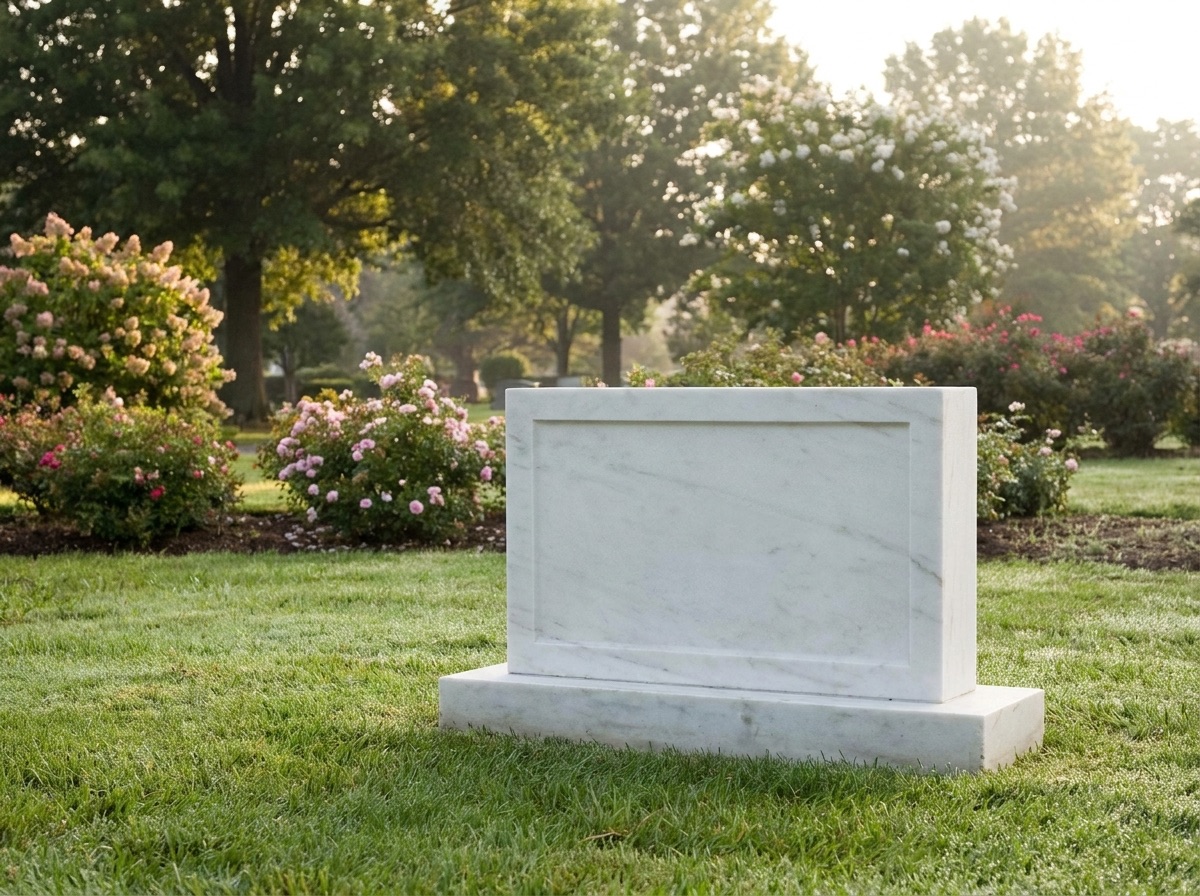
The memorial trade runs on a supply chain most families never see: monument dealers buy blanks and finished memorials from wholesale factories, add engraving or margin, and sell at several times landed cost. As a market estimate for August 2026, factory-direct pricing for marble headstones runs $150 to $1,200 per piece, while finished memorials retail in the US at $1,500 to $6,000 and more for carved work. For a dealer, the spread between those numbers is the business.
This page is written for that B2B buyer — monument dealers, funeral homes with retail programs, and cemetery contractors — rather than for grieving families. It covers the factory price ladder, the honest marble-versus-granite question, US memorial formats and cemetery specifications, engraving options from sandblast to hand-carved lettering, and the QC, MOQ and shipping mechanics of importing memorial stone. All figures are market estimates tied to our August 2026 index data.
What monument dealers get in this category
The range covers four product groups. Flat and bevel markers — the lawn-level and slightly raised rectangles that dominate modern cemeteries — are the volume item. Upright monuments, a die on a base, carry traditional sections and family plots. Slant markers sit between the two. The fourth group is carved memorial sculpture: angels, hearts, books, crosses and custom figures, where the factory's carving workshop does work that few Western monument shops still staff for.
Dealers order in two modes. Blanks — polished, shaped stones with no inscription — stock a showroom and get engraved locally as orders come in, keeping delivery promises short. Finished memorials arrive engraved to artwork the dealer supplies, shifting labor to the factory at lower cost per letter. Most importers run both: blanks for staple shapes, factory-finished work for carved designs.
Price economics: the factory ladder
Within the $150 to $1,200 factory range (market estimate, August 2026): flat and bevel markers in standard sizes run $150 to $300. Slant markers with polished faces sit at $250 to $450. Upright die-and-base sets in standard proportions run $400 to $800 depending on size and stone. Carved work — angels, custom shapes, sculpture-grade memorials — occupies $600 to $1,200 and beyond for large or complex pieces. Engraving at the factory adds modestly per piece; deep hand-carved lettering and gold leaf add more.
Cost drivers are material volume first — memorials are thick stone, and a 6 inch upright die uses real tonnage — then polishing (each polished face is a production step; polish-two-sides costs less than all-sides), then carving and engraving hours. Compare that with US monument retail, where a plain upright commonly sells for $2,500 to $5,000, and the wholesale arithmetic explains why importing dealers hold their margins even after freight and duty.
Marble, granite and the honest answer
The straight answer a dealer should give families: granite outlasts marble outdoors. Marble is calcite — a century of rain softens inscriptions and whitens polish, which is precisely the aged look historic cemeteries are loved for, but modern perpetual-care cemeteries largely specify granite, and many US cemeteries require it outright. The same factories process both, so mixed orders are routine; quote granite for regulation-bound sections and marble where it is wanted and permitted.
Where marble earns its place: carved work, above all. White marble carves detail that granite cannot economically match — Han White (slab reference $25 to $70 per square foot, market estimate August 2026) is the classic memorial carving stone, with fine uniform grain for angels, drapery and portraiture, and centuries of cemetery history behind it. The broader white range ($20 to $120) covers upright dies and traditional tablets; black marble ($30 to $80) makes striking polished memorials where regulations allow, though black granite dominates that look in practice. Mausoleums, columbarium fronts and indoor memorials are marble territory without reservation.
Formats and cemetery specifications
US formats standardize tightly. Flat markers: 24 by 12 inches at 3 or 4 inches thick is the single most ordered stone in the trade, with 28 by 16 and 20 by 10 close behind. Bevel markers run the same footprints at 6 inches back, 4 front. Slants are typically 16 to 18 inches high with a 45-degree face. Uprights pair a die — commonly 20 to 36 inches wide, 6 or 8 inches thick — with a base 6 to 10 inches longer than the die. Companion sizes double widths for double interments.
The dealer's discipline is the cemetery spec sheet: every cemetery publishes rules on permitted materials, maximum and minimum dimensions, base requirements, and finish. Confirm the spec before ordering, not after — a die half an inch over the section maximum is scrap. Factories hold these standard formats as templates, so ordering to spec is a line on the PO, and custom dimensions machine at no premium beyond material.
Engraving: from sandblast to hand carving
Sandblasted engraving through a rubber stencil is the industry standard for lettering and standard emblems: crisp, deep, weatherproof, and cheap at the factory. Supply vector artwork — the factory returns a layout proof for approval before blasting. Laser etching produces photographic detail on polished dark stone and drives the photo-memorial segment; it is shallow, so it belongs on polished black surfaces, realistically granite more often than marble.
Above these sit the hand skills. V-cut hand-carved lettering, the traditional monumental letter with angled walls that catch light, survives at Chinese carving factories at prices Western shops cannot approach. Relief carving — roses, doves, religious scenes raised from the stone — and fully sculpted elements come from the same workshop as the statue trade. Gold leaf and lithochrome paint fills complete the options. Dealers who sell these upper tiers differentiate on work their local competitors quote reluctantly or not at all.
The order process for dealers
A memorial order runs on artwork discipline. For blanks: sizes, stone, finish schedule (which faces polished), and quantities per SKU. For finished work: the same plus inscription artwork as vector files, emblem references, and layout instructions; the factory returns proofs for every stone, and nothing is cut until each proof is approved. Keep a signed proof archive — it is the arbitration document if an inscription arrives wrong.
Production for a mixed 10 to 40 piece order runs 4 to 6 weeks, longer when carved elements are included. Progress and pre-shipment photos of every inscribed face are standard practice — insist on legible, straight-on photos, since an engraving error caught at the factory costs a stone, while one caught at a graveside costs a client relationship. Payment is customarily 30 percent deposit, balance against QC photos.
Quality control checklist
Stone first: memorial stock must be sound — no cracks, no filled fractures, no rust-prone iron veins that will streak a white tablet after a winter outdoors. Wet photos expose all three. Color should be consistent within each stone and across companion sets; a two-tone upright die is a rejection. Check polish gloss is even on every specified face, edges crisp, and corners undamaged — corner chips are the most common transit-blamed defect that actually left the factory that way.
Inscription QC is line-by-line proofreading against the approved proof: spelling, dates, spacing, emblem placement, letter depth consistency. Read every character; a transposed date is the industry's most expensive small error. On dimensioned work, verify against the cemetery spec sheet, including base dimensions and any required foundation holes or lifting slots. Confirm each stone is labeled to the packing list before crating.
MOQ, lead times, shipping and crating
The working MOQ is about 10 pieces — memorial stone is dense, and ten mixed markers and dies make a sensible first crate at 1.5 to 3 tonnes. Established dealers order quarterly containers blending fast-moving flat markers with uprights and a few carved pieces. End-to-end timing runs 4 to 6 weeks of production plus 30 to 40 days of sea freight and customs: roughly 10 to 12 weeks, which is why blanks inventory is the backbone of responsive local service.
Memorials crate in heavy timber with stones vertical or flat depending on format, foam-separated, faces protected, weight blocked against shifting. ISPM-15 timber is mandatory for most destinations. At destination, plan forklift handling — single crates commonly exceed a tonne — and inspect before signing: photograph every face, check corners, and file insurance claims within the window. Marine insurance at 1 to 2 percent of invoice is standard and non-negotiable practice for stone this heavy.
Weathering and care guidance for the end customer
Dealers field care questions for decades after a sale, so ship a care card with every memorial. Marble: clean with water and a soft brush only — never household cleaners, never bleach, never pressure washing, all of which eat calcite and open the surface to biological staining. A marble memorial will soften in surface and inscription over generations; that patina is normal, and deep-cut or hand-carved lettering is the practical defense, staying legible long after shallow blasting fades.
Biological growth — lichen and algae — is the main maintenance event and lifts with quaternary ammonium stone biocides, not bleach. Foundations matter more than families realize: a leaning stone is a foundation failure, not a stone failure. Selling that context honestly is part of what separates a monument professional from a commodity reseller.
Frequently asked questions
How much do marble headstones cost wholesale?
Factory-direct, $150 to $1,200 per piece as a market estimate for August 2026: flat markers at $150 to $300, slants at $250 to $450, upright die-and-base sets at $400 to $800, and carved memorial work from $600 upward. US retail for finished memorials commonly runs $1,500 to $6,000, which is the dealer's working spread.
Is marble or granite better for a headstone?
Granite outlasts marble outdoors and many US cemeteries require it; marble softens in surface and inscription over generations. Marble's case is carved work — angels, relief scenes and hand-cut lettering that granite cannot economically match — plus mausoleum and indoor memorials. The same factories supply both, so dealers routinely order mixed crates to match cemetery rules.
What are standard headstone sizes in the US?
The staple flat marker is 24 by 12 by 4 inches, with 28 by 16 and 20 by 10 common; bevels share those footprints at 6 inches back. Uprights pair a 20 to 36 inch wide die with a base 6 to 10 inches longer, and companion formats double the widths. Always confirm the individual cemetery's spec sheet before ordering — dimension rules vary section by section.
Can the factory engrave headstones, or should dealers engrave locally?
Both models work. Factory sandblast engraving to approved vector artwork is cheaper per stone and handles carving, gold leaf and photo etching that local shops may not offer; local engraving on imported blanks keeps delivery promises short for at-need sales. Most importing dealers stock blanks for staples and order factory-finished stones for carved and complex work.
What is the minimum order for factory-direct memorials?
About 10 pieces — a mixed crate of markers and uprights weighing 1.5 to 3 tonnes. That suits a dealer testing an import program; established buyers move to quarterly containers. Expect 4 to 6 weeks of production plus 30 to 40 days of freight, with 30 percent deposit and balance against pre-shipment QC photos of every inscribed face.
How do you verify inscription accuracy before shipment?
Through proof discipline: the factory issues a layout proof for every stone, nothing is cut until each proof is signed off, and pre-shipment photos of every inscribed face are checked character by character against the approved proofs. A transposed date caught at the factory costs a stone; caught at the graveside, it costs the client relationship — so read every character twice.
How should families care for a marble memorial?
Water and a soft brush only — no household cleaners, bleach or pressure washing, which erode calcite and invite biological staining. Lichen lifts with quaternary ammonium stone biocides. Surface softening over generations is normal patina, and deep or hand-carved lettering stays legible longest. A leaning stone signals a foundation problem, not a stone defect.