Marble mosaic is priced by pattern, not by stone — a rule that surprises buyers coming from tile. The same Carrara chips cost one number as a hexagon sheet and three times that as a waterjet arabesque with brass inlay, because the labor of cutting and hand-assembling small pieces dominates the material. As a market estimate for August 2026, factory-direct pricing runs $8 to $35 per square foot depending on pattern, against Western retail that commonly sits at several multiples of those figures for identical mesh-mounted sheets.
This guide maps the price ladder pattern by pattern, covers the stone combinations that sell — whites, blacks, greens and brass — explains sheet formats and specifications, walks through custom pattern development, and sets out the QC points that separate a clean installation from a wavy one. With an MOQ around 200 square feet, mosaics suit tile retailers, importers and designers buying for specific projects. All figures are market estimates tied to our August 2026 index data.
What you get in this category
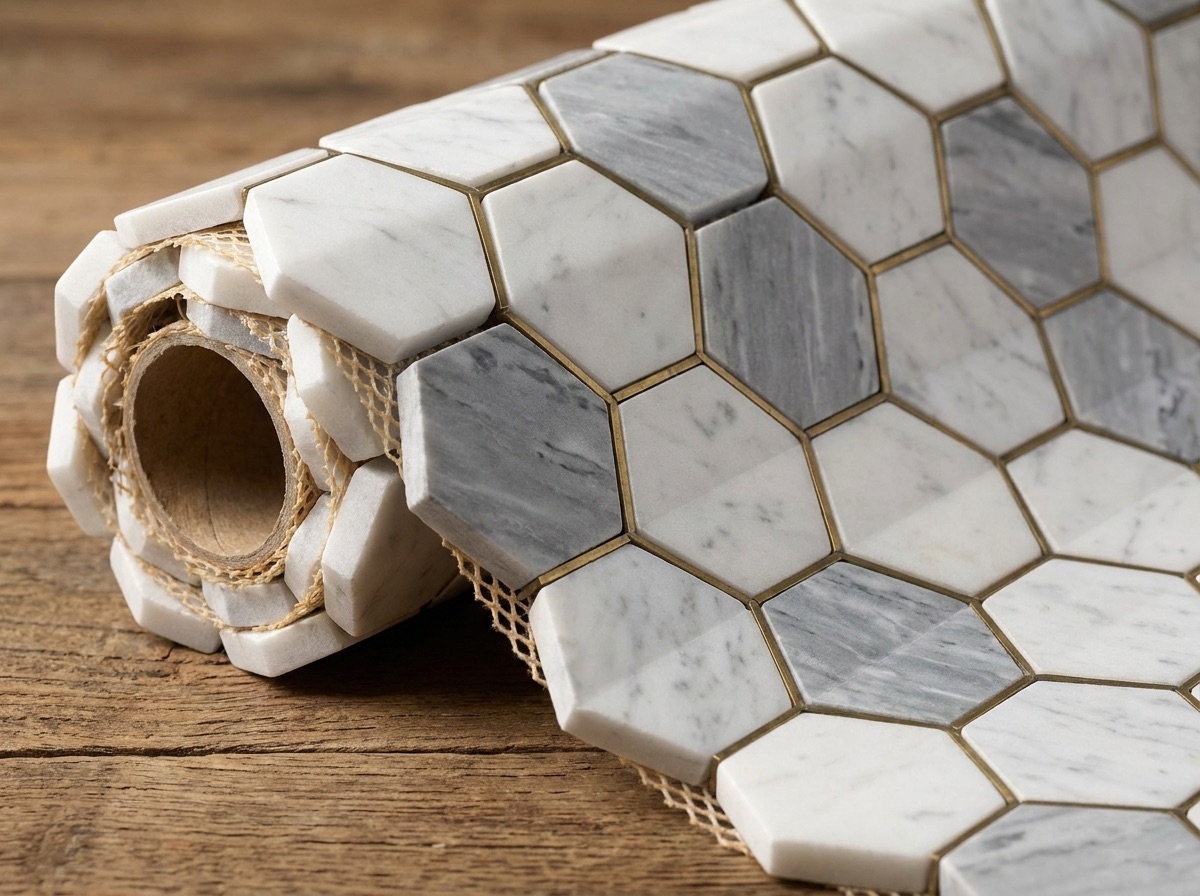
Factory mosaics arrive as mesh-mounted sheets, nominally 12 by 12 inches, with small stone pieces pre-arranged and glued to a fiberglass mesh backing so an installer sets a square foot at a time rather than a chip at a time. The pattern library divides into machine-cut geometrics — hexagon in several chip sizes, herringbone, basketweave, penny round, chevron, brick and stacked formats — and waterjet work, where a computer-guided jet cuts flowing arabesques, florals and interlocking designs impossible with saws.
The premium end mixes materials: marble fields with brass or stainless inlay lines, mother-of-pearl accents, and multi-stone patterns pairing white grounds with green, black or grey figures. Matching trim — pencil liners, borders, and skirting cut from the same stones — completes an order so a bathroom can be specified wall to wall from one production batch.
Price economics: pattern sets the price
Within the $8 to $35 per square foot factory range (market estimate, August 2026), the ladder runs: simple large-chip geometrics — 2 inch hexagon, brick, stacked squares in a single stone — at $8 to $14. Smaller chips and directional patterns — 1 inch hexagon, herringbone, basketweave, penny round — at $12 to $20, because smaller pieces mean more cutting and more hand placement per sheet. Multi-stone geometrics and chevron sit at $15 to $24. Waterjet patterns start around $20 and reach $35 with brass inlay and complex interlocks.
Stone choice moves the number less than pattern but is not free: Carrara-based sheets carry a premium over Guangxi White bases, and Calacatta-grade or onyx accents push toward the top of each band. The practical read for a buyer: decide the pattern tier first, then optimize stone within it. A $12 herringbone in Guangxi White and an $18 herringbone in Carrara install identically; the difference is purely how much the veining matters to the end client.
Stone combinations that sell
White-on-white is the volume base: Carrara chips (slab reference $40 to $90 per square foot, market estimate August 2026) for the recognized soft-grey veining, or Guangxi White ($15 to $35) where budgets rule — most retail buyers cannot tell the sheets apart once grouted. Thassos-type pure whites from the broader white range ($20 to $120) make the crisp gallery-white grounds that waterjet patterns need for contrast.
For figures and accents: Nero Marquina ($40 to $90) is the standard black, delivering the classic black-on-white basketweave dot and modern hexagon contrasts; broader blacks ($30 to $80) serve where the white veining of Marquina is unwanted. Green marble ($30 to $100) — Ming Green especially — is the current designer favorite in penny rounds and chevrons. Emperador browns ($35 to $85) carry traditional and Art Deco schemes, and brass inlay, priced as pattern rather than stone, is the single strongest premium signal in the current market.
Specs and formats
Standard sheets are nominally 305 by 305 mm on fiberglass mesh, with chip thickness of 8 or 10 mm; heavier stones and larger chips run thicker. Finishes are polished, honed or tumbled — honed dominates floors for slip and wear reasons, polished suits walls and showers. Confirm chip edges: straight-cut and slightly beveled edges grout differently, and tumbled patterns read rustic rather than tailored.
Sheets should interlock: pattern edges are cut so adjacent sheets continue the geometry without visible seams. This is the specification that separates competent factories from cheap ones, and it is checkable in photos — ask for four sheets laid together, dry, before shipment. Coverage math matters too: order 10 percent overage for cuts and breakage on geometric patterns, 15 percent on directional patterns like herringbone and chevron where cutting waste runs higher.
Custom patterns and made-to-order work
Custom development is more accessible than buyers expect. Geometric variants — your chip size, your stone mix, your proportions — cost nothing beyond the quote, since the factory is recombining existing cutting programs. Fully custom waterjet designs start from your drawing, logo or reference image; the factory nests the design into cutting files, produces a sample sheet, and iterates until approved. Sampling typically costs the sheet price plus courier and takes two to three weeks.
For branded and hospitality work, the valuable option is the custom rug or medallion: a waterjet field pattern with a border, sized to a lobby or bathroom floor, shipped as numbered sheets with a layout drawing. This is genuine made-to-order stonework at prices that undercut Western waterjet shops by multiples, and it is the category's best answer to commodity competition.
Quality control checklist
Sheet geometry first: sheets square within a millimeter or two, consistent chip spacing, and — the critical test — four sheets dry-laid together showing seamless pattern continuation with no visible sheet boundary. Chip quality next: consistent thickness across the sheet (run fingers across it; steps telegraph through grout lines on walls), clean cut edges without chipping, and polish or hone even across every chip.
Stone consistency across the whole order is the project-level check: batch photos in daylight, all cartons sampled, because a color shift between production runs shows as a stripe across a finished wall. For waterjet with inlay, check that metal pieces sit flush with stone and are firmly bonded. Mesh bond matters more than it looks: chips should not peel off with light finger pressure, and the mesh should be trimmed flush, not overhanging. Finally, confirm cartons are labeled by pattern and batch with sheets packed vertically, foam-interleaved.
MOQ, lead times and shipping
The working MOQ is about 200 square feet per pattern — roughly one pallet — which suits a tile retailer stocking a pattern or a designer buying for one substantial bathroom program. Mixed orders across several patterns are routine above that base. Production runs 3 to 4 weeks for geometric patterns and 4 to 6 for waterjet work, plus 30 to 40 days of sea freight and customs to North America or Europe.
Mosaics ship in cartons of 10 to 11 square feet, cartons palletized or crated with ISPM-15 timber. The product is more forgiving than slabs — a dropped carton loses sheets, not the shipment — but moisture is the quiet risk: mesh adhesives dislike soaked cartons, so confirm shrink-wrapping and desiccant on the pallet. Marine insurance at 1 to 2 percent of invoice value is standard. Freight per square foot at pallet volumes is small change against the factory-versus-retail spread.
Installation and care
Mosaic installs like tile with two extra disciplines: flat substrate — small chips telegraph every hollow — and grout choice, since grout color transforms the pattern. White grout disappears into white sheets; grey outlines every chip; dark grout turns a penny round graphic. Sample the grout on a spare sheet before committing a wall. Polished marble sheets should be sealed before grouting so pigmented grout cannot shadow the stone, then sealed again after.
In service, marble mosaic follows marble rules: pH-neutral cleaners, no vinegar or acid descalers, resealing every year or two in showers. Honed mosaic floors wear gracefully and hide etching; polished shower walls keep their gloss for decades under nothing more than neutral soap and a squeegee habit. Brass inlay develops patina unless polished occasionally — a selling point or a maintenance note, depending on the client, and worth stating on the care card either way.
Frequently asked questions
How much do marble mosaics cost per square foot?
Factory-direct, $8 to $35 per square foot as a market estimate for August 2026: large-chip geometrics at $8 to $14, small-chip and directional patterns like herringbone and penny round at $12 to $20, multi-stone designs at $15 to $24, and waterjet patterns with brass inlay at $20 to $35. Western retail commonly runs several multiples of these figures.
Why do waterjet mosaics cost more than hexagon or herringbone?
Because pattern labor, not stone, dominates mosaic cost. Waterjet designs are cut piece by piece on computer-guided machines and hand-assembled into interlocking sheets, with far more cutting time and waste than saw-cut geometrics. Brass or mother-of-pearl inlay adds material and fitting labor on top, which is why waterjet sheets top the price ladder.
What is the minimum order for factory-direct mosaics?
About 200 square feet per pattern — roughly one pallet — with mixed-pattern orders routine above that. That volume suits tile retailers stocking a line or designers buying for a full bathroom program. Order 10 percent overage on geometric patterns and 15 percent on directional ones to cover cutting waste and breakage.
Are mesh-mounted marble mosaics good quality?
Mesh mounting is the industry standard, not a shortcut — quality shows in whether sheets interlock seamlessly, chips sit at consistent thickness, and the mesh bond holds. Ask for photos of four sheets dry-laid together and check that pattern continues across sheet edges without visible seams; that single test separates competent factories from cheap ones.
Can I get a custom mosaic pattern made?
Yes. Geometric variants in your chip size and stone mix cost nothing beyond the quote, while fully custom waterjet designs are developed from your drawing with a sample sheet in two to three weeks. Custom rugs and medallions for lobbies ship as numbered sheets with a layout drawing, at prices well below Western waterjet fabrication.
Which stones work best in mosaic patterns?
Carrara and Guangxi White carry the white base market; pure whites give waterjet patterns their contrast ground; Nero Marquina is the standard black figure stone; Ming Green leads the current trend patterns; Emperador browns serve traditional schemes. Pattern tier sets most of the price, so choose the design first and optimize stone within it.
Do marble mosaics work in showers and on floors?
Yes — honed sheets are the standard mosaic floor finish, wearing well and hiding etching, while polished sheets suit walls and showers. Seal before and after grouting, clean with pH-neutral products, and reseal every year or two in wet areas. The many grout lines actually add slip resistance compared with large-format polished tile.