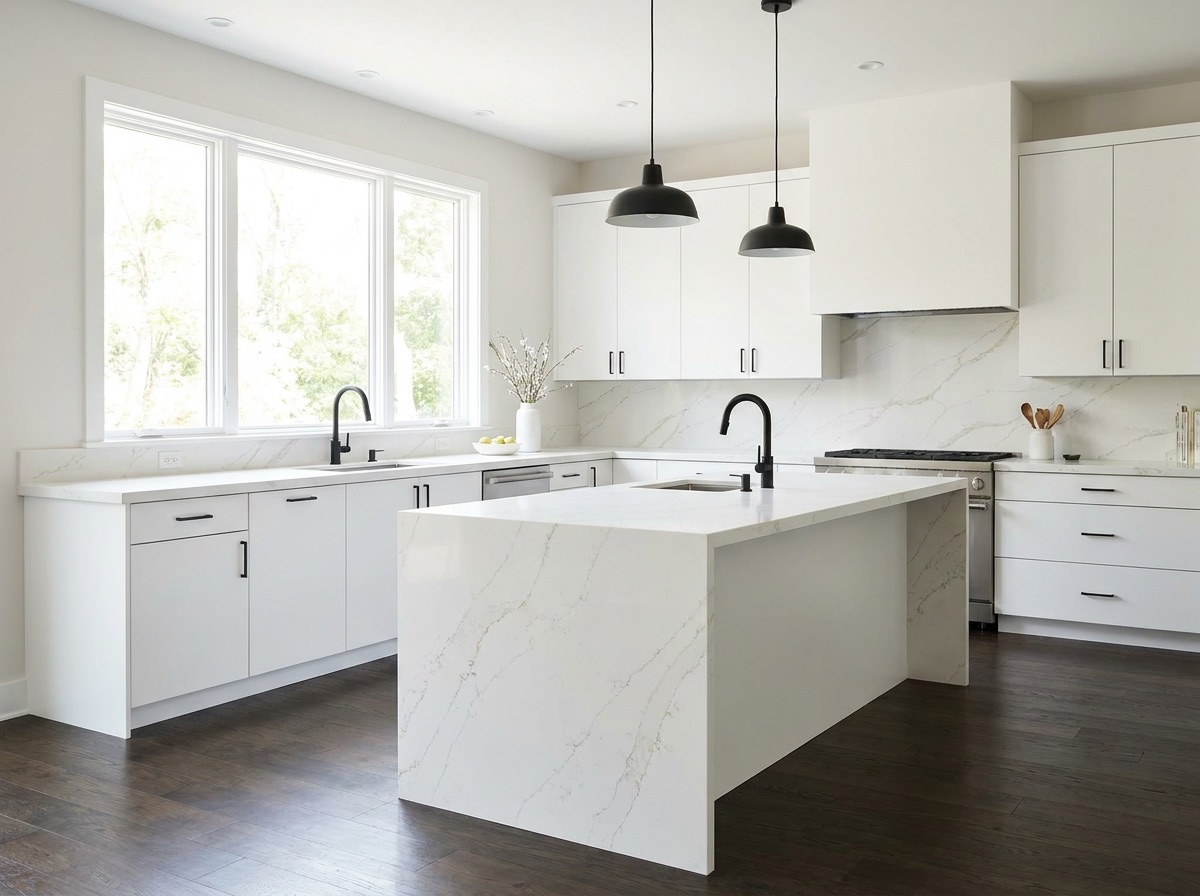
Engineered quartz is the best-selling countertop surface in North America and much of Europe, and it is also the category with the largest brand mark-up in the stone trade. As a market estimate for August 2026, factory-direct quartz slabs from China run $18 to $45 per square foot depending on pattern, thickness and resin grade. Installed in the US, the same material sells for $60 to $120 per square foot, and branded quartz sold through kitchen showrooms can go higher still. Unlike a Calacatta slab, where the block itself is scarce and expensive, quartz is a manufactured product with a stable input cost. Most of the price gap is distribution, brand and fabrication, not material.
This page is written from the trader's side of the counter. It explains what engineered quartz actually is, where it genuinely beats natural stone and where it does not, why a Calacatta-look quartz slab costs what it costs at the factory gate, and how ordering from a mill works from drawings to crate. We price quartz next to real marble, quartzite and granite from our index so the comparison is honest. All figures are market estimates as of August 2026; our partner mill quotes factory-direct against your specification.
What Engineered Quartz Actually Is
Engineered quartz is roughly 88 to 93 percent crushed natural quartz and other mineral fillers by weight, bound with 7 to 12 percent polyester or epoxy resin, plus pigments. The mix is poured into a mould, compacted under vacuum and vibration, then cured with heat and pressure. The result is a dense, non-porous slab that is calibrated to a consistent thickness and polished on one face. Veined patterns are made by injecting pigmented resin or a second mix during compaction; the vein is printed or laid in, not grown, which is why it repeats and why the pattern rarely runs through the full thickness of the slab.
The key point for anyone comparing quartz to marble is that the resin does the binding. Resin is what makes quartz stain-resistant and seamless to fabricate, and resin is also what yellows under UV, softens under heat and cannot be re-polished the way stone can. Every strength and weakness of quartz traces back to that 7 to 12 percent. Quartzite, despite the similar name, is a natural metamorphic rock with no resin at all; the two should never be confused on a quote.
Quartz vs Marble, Quartzite and Granite: The Honest Comparison
Where quartz wins: it does not need sealing, it does not etch from lemon juice or vinegar the way marble does, it is consistent from slab to slab so a 40-unit apartment project looks identical in every kitchen, and it is easier to fabricate with tight seams because the material has no natural fissures. For a busy family kitchen or a hotel bathroom where housekeeping uses whatever cleaner is on the cart, quartz is genuinely the lower-maintenance surface.
Where quartz loses: heat. A pan straight from the hob will scorch or discolour the resin, and the mark is permanent because you cannot hone it out. Granite such as Absolute Black ($30-75/sqft slab, market estimate) or Ubatuba ($30-60/sqft) shrugs off the same pan. UV is the second weak point: quartz installed in a sunlit room or on an outdoor kitchen yellows over time, white and light patterns most visibly. Natural stone does not. Third, repairability. A chipped or scratched marble or quartzite counter can be filled and re-polished on site by any competent fabricator; a damaged quartz counter can be colour-filled but never truly re-polished, and the repair usually shows.
Then there is resale and perception. In mid-market housing quartz is expected and neutral. In the upper market, buyers and designers still pay a premium for real Calacatta ($80-250/sqft slab), Statuario ($80-220/sqft) or a Brazilian quartzite such as Taj Mahal ($70-140/sqft), and a Calacatta-look quartz island is read as an imitation. If the project is a flagship kitchen, real stone holds value better. If it is a rental portfolio, quartz is the rational choice. Neither answer is wrong; the mistake is paying real-stone money for the imitation, which is what branded quartz pricing often amounts to.
Price Economics: Factory Gate vs Branded Retail
At the factory, quartz pricing is driven by four things: pattern complexity, resin type, thickness and slab size. A plain solid-colour 2 cm slab in a standard 300 x 140 cm format sits at the bottom of the $18-45 per square foot range. A 3 cm Calacatta-look slab with multi-layer veining, a jumbo 320 x 160 cm format and a premium resin package sits at the top. Between them, the material cost barely moves; you are paying for mould time, scrap rate and the extra passes needed for a convincing vein.
Compare that with the retail side. Installed US pricing of $60-120 per square foot breaks down roughly as: slab $20-50 wholesale, fabrication $25-45, template, delivery and install $10-25, and dealer margin on top. Branded quartz sold under a global label typically carries a 40 to 100 percent premium over an equivalent unbranded slab from the same class of Chinese or Vietnamese factory. Some of that premium buys a warranty and marketing support; most of it buys the name. Fabricators know this and often keep a private-label line for price-sensitive jobs.
For an importer, the arithmetic is straightforward. A bundle of 8 to 10 slabs at $25 per square foot factory-direct, plus roughly 25 to 40 percent for ocean freight, crating and duty on a consolidated shipment, lands at $32-35 per square foot. Note that engineered quartz from certain origins has been subject to anti-dumping and countervailing duties in the US since 2019, and the applicable rate depends on the country of manufacture and the specific producer. Check the current HTS classification and any trade remedy orders before you commit; on Chinese-origin quartz the duty burden can be significant and changes the comparison against natural stone, which is not subject to the same orders. Our mill can quote from more than one production origin where that matters.
Formats, Thickness and Finishes
Standard slab formats are 300 x 140 cm and the jumbo 320 x 160 cm; the jumbo reduces seams on long runs and island tops but costs more per square foot and needs more careful handling. Thickness is 2 cm or 3 cm. North American practice favours 3 cm for a self-supporting overhang and a chunky edge; Europe and Asia commonly use 2 cm with a laminated or mitred edge to give the appearance of thickness. 1.2 cm and 1.5 cm slabs exist for wall cladding and furniture but are not recommended for kitchen counters.
Finishes: polished is the default and the easiest to keep clean. Honed or matte quartz has grown popular for a stone-like look but shows fingerprints and oil marks on dark colours and is harder to keep uniform on site. Textured or leathered quartz is available from a few lines. Colours run from pure whites and solid greys through Carrara-look, Calacatta-look and Statuario-look veining to concrete effects, black with mirror flecks and terrazzo-look chip patterns. Whites with fine grey veining remain the highest-volume order by far.
Cut-to-size is where quartz shines for the importer. Because the material is uniform, the mill can cut kitchen runs, islands, vanity tops and window sills to your drawings with sink and hob cut-outs, drilled tap holes and profiled edges, and the pieces will match visually without book-matching or slab selection. Edge profiles are the same as for stone: eased, bevel, bullnose, ogee, mitred waterfall.
Best Applications for Engineered Quartz
Multi-unit residential and hospitality are the natural home for quartz: identical kitchens, tight programme, housekeeping that will not treat the surface kindly. Bathroom vanity tops in hotels are close to a default quartz application. Commercial reception desks and food-service counters, where cleanability matters more than heat, are also good fits.
Applications where we steer clients away from quartz: outdoor kitchens and covered terraces in sunny climates, because of UV yellowing; fireplace surrounds and hearths, where heat will damage the resin; and statement kitchens in high-end residential, where the buyer will know the difference. In those cases quartzite, granite or real marble is the better recommendation and often not much more expensive factory-direct: Guangxi White marble slabs, for example, trade at $15-35 per square foot, overlapping the quartz range entirely.
MOQ, Lead Time and Ordering Process
Minimum order is one bundle of 8 to 10 slabs, or from 10 cut-to-size tops if you want the mill to fabricate. A single slab can be added to a mixed container of natural stone but is not economical on its own because of crating and port charges. Stock colours ship in 2 to 4 weeks; made-to-order patterns or non-standard formats take 4 to 8 weeks from deposit.
The process runs like this. You send a specification: colour reference or sample code, thickness, format, quantity, and for cut-to-size, dimensioned drawings with cut-out positions and edge profiles. The mill returns an itemised quote with per-slab or per-piece pricing, packing detail and lead time. On deposit, usually 30 percent, production is scheduled. Before packing, QC photos and, for larger orders, a third-party inspection report are sent for approval. Balance is paid against the shipping documents, and the goods move in A-frame crates for slabs or flat wooden crates for cut-to-size pieces. Allow 4 to 6 weeks of ocean transit to North America or Europe on top of production.
For a first order we recommend requesting physical samples of two or three candidate colours before committing to a bundle. Quartz photographs well and can look very different in the hand; vein depth and the sparkle of the quartz grain do not survive a screen.
Quality Control Checklist
Check thickness calibration across the slab: tolerance should be within plus or minus 0.5 mm on 2 cm and 3 cm material, measured at the edges and centre. Check flatness with a straightedge; warping is a known issue with cheaper resin systems and shows up as a rocking slab or a seam that will not close. Inspect the polished face under raking light for pinholes, resin pooling, cloudy patches and unmixed pigment streaks. On veined patterns, confirm that the vein you approved is the vein you received, since production batches vary.
Ask for the resin content and the quartz percentage on the datasheet, and for test data on water absorption, flexural strength and stain resistance if you are supplying a commercial project. Reputable mills will provide NSF or equivalent food-contact certification for kitchen use and a Greenguard or similar low-emission certificate for indoor air quality on request. Finally, inspect the crating: slabs on edge in A-frames with foam or rubber spacers between faces, strapped, and cut-to-size pieces face-to-face with protective film. Most transit damage to quartz is edge chipping from loose packing, and it is easy to prevent.
Care and Maintenance
Daily care is soap and water or a pH-neutral cleaner. Avoid bleach, oven cleaner and solvent-based products, which attack the resin. Never place hot pans directly on the surface; use trivets, without exception, because there is no repair for a scorch mark. Wipe up strong pigments such as turmeric, red wine and permanent marker promptly; quartz resists staining but is not immune to it on light colours. Do not use the surface as a cutting board, since ceramic knives in particular can scratch it, and do not stand on it. Quartz does not need sealing, ever, and if a supplier tries to sell you a sealer for it, that is a signal about the supplier.
Frequently asked questions
How much do quartz countertops cost per square foot?
As a market estimate for August 2026, factory-direct engineered quartz slabs from China run $18 to $45 per square foot depending on pattern, thickness and format. Installed in the US, quartz countertops cost $60 to $120 per square foot, and branded lines sold through showrooms can exceed that. The material itself is a small part of the installed price; fabrication, distribution and brand make up most of it.
Is quartz cheaper than quartzite?
Usually, yes. Factory quartz sits at $18-45 per square foot, while Brazilian quartzites such as Taj Mahal ($70-140/sqft) or Cristallo ($90-200/sqft) trade well above that. Quartzite is a natural rock that must be quarried and selected slab by slab; quartz is manufactured. The exceptions are budget quartzites like Super White ($55-110/sqft) at the low end and premium branded quartz at the high end, where the ranges start to overlap.
Is quartz better than marble for kitchen countertops?
For low maintenance, yes: quartz does not etch, does not need sealing and resists staining. For heat, repairability, longevity and resale in high-end homes, marble and especially quartzite are better. Marble such as Carrara ($40-90/sqft) can be re-honed and re-sealed indefinitely; quartz cannot be re-polished once damaged. Choose quartz for rentals, hotels and busy family kitchens; choose real stone for statement kitchens and anywhere heat or sunlight is a factor.
Does quartz yellow over time?
It can. The polyester resin binder in engineered quartz is not fully UV-stable, and slabs exposed to direct sunlight, particularly white and light patterns, develop a yellow or cream tint over years. Indoors away from windows the effect is minor. For outdoor kitchens or sun-facing rooms, natural stone or sintered stone is the safer choice.
Can you put hot pans on quartz?
No. Sustained heat above roughly 150 C softens and discolours the resin, and a hot pan straight from the hob can leave a permanent scorch ring or even crack the slab from thermal shock. Always use trivets. Granite and quartzite tolerate hot cookware far better.
What is the minimum order for quartz slabs from a factory in China?
One bundle of 8 to 10 slabs, or from 10 cut-to-size countertops if the mill is fabricating. Stock colours ship in 2 to 4 weeks; made-to-order patterns take 4 to 8 weeks, plus 4 to 6 weeks of ocean transit. Single slabs can be added to a mixed natural-stone container but are rarely worth shipping alone.
Why is branded quartz so much more expensive than unbranded?
Branded quartz typically carries a 40 to 100 percent premium over an equivalent unbranded slab from the same class of factory. Part of that pays for warranty, certifications and showroom support; most of it is marketing and distribution margin. The manufacturing process and raw materials are broadly the same across the industry, which is why fabricators keep private-label lines for price-sensitive work.