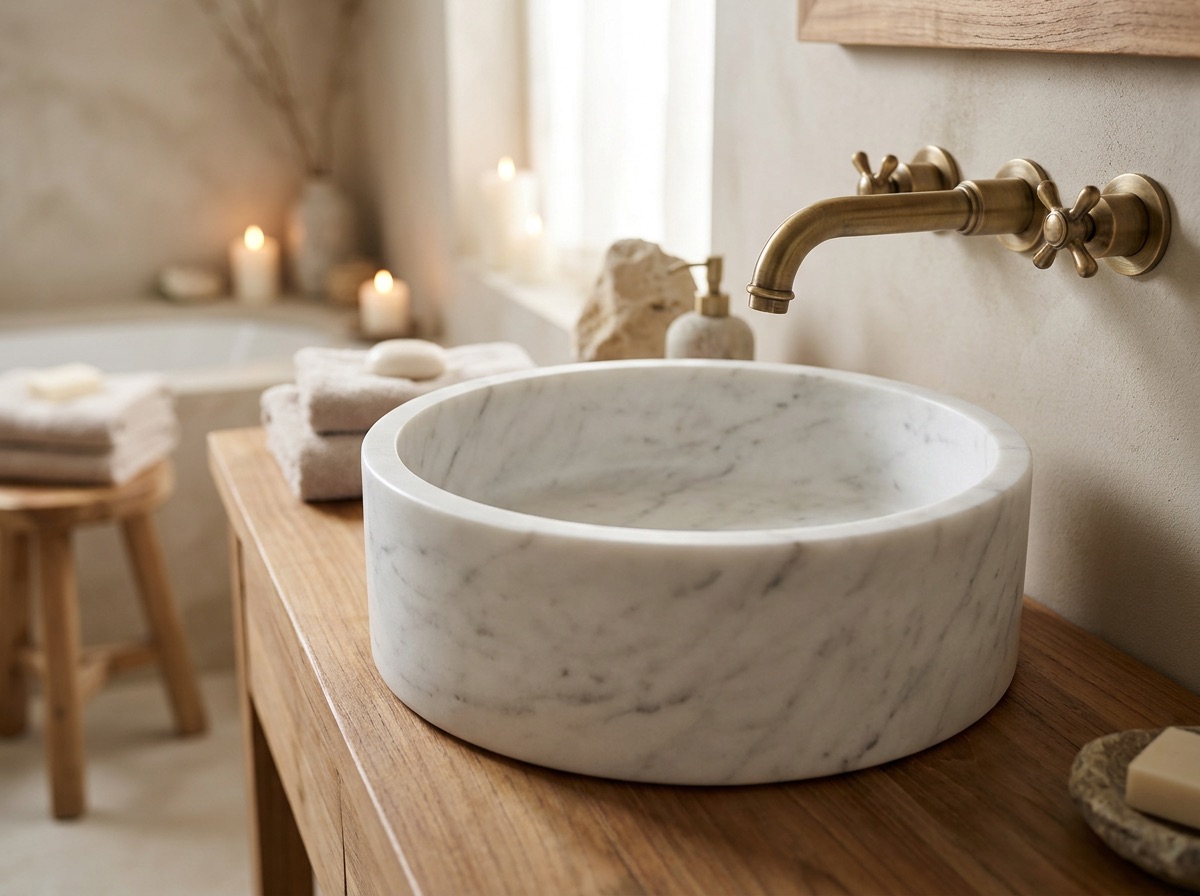
A marble sink is a solid block of stone hollowed on a lathe or CNC and finished by hand — no seams, no laminated edges, no composite. That construction is why the retail markup is so wide: as a market estimate for August 2026, factory-direct pricing runs $40 to $250 per piece, while the same vessel sinks retail in the US and Europe for $300 to $1,500.
This guide explains what drives the factory price of a stone sink — block quality, shape complexity, wall thickness and finish — which marbles and onyxes make sense for basins, how sizes and drain specs work, and what to inspect before shipment. With an MOQ of about 20 pieces and modest per-unit freight, sinks are one of the most practical marble categories for e-commerce brands, showrooms and hotel projects to buy direct. All figures are market estimates tied to our index data.
What you get in this category
The category splits into four product types. Vessel sinks — bowls that sit on the counter — are the volume leader: round, oval, cylindrical and organic freeform shapes, typically 380 to 450 mm across. Pedestal basins are full-height carved pieces, basin and column in one or two sections, the statement item in powder rooms. Integrated vanity tops combine basin and counter in a single carved block or a bonded assembly. Wall-hung and drop-in basins round out the range for compact bathrooms.
Everything is carved from solid blocks, which distinguishes the product from ceramic look-alikes and resin composites at similar retail price points. Each sink is slightly unique — veining runs through the full wall thickness. Factories produce to order in batches, so a buyer can mix shapes and stones within one crate to test what sells.
Price economics: what a sink actually costs
Within the $40 to $250 factory range (market estimate, August 2026), the ladder is predictable. Simple round vessel sinks in Guangxi White or a plain grey stone start at $40 to $70. Oval and cylinder shapes in Carrara-grade white, black or green marble run $70 to $130. Organic freeform shapes, thin-wall designs and river-stone looks land $100 to $180. Onyx basins and large pedestal pieces occupy the top of the range at $150 to $250, driven by material cost and breakage risk during carving.
Four factors set the number. Block consumption: a sink is carved from a block several times the finished volume, so material scales with external size. Shape: lathe-turned rounds are fast; asymmetric freeforms need CNC time plus hand finishing. Wall thickness: thin walls look expensive and are expensive — more breakage in production. Finish: polished interiors are standard; honed or split-face exteriors add steps. Retail prices, by contrast, are set by brand positioning — which is why identical basins sell at triple-digit differences under different labels.
Why solid-block carving matters
A solid-carved basin has no glue lines to fail, no veneer to delaminate around the drain, and no gelcoat to wear through — the three standard failure modes of composite and laminated stone sinks. Water sits against the same material all the way through, and a chipped rim can be ground and repolished because the stone underneath is identical. For a hotel buyer specifying hundreds of rooms, that repairability is a lifecycle cost argument, not an aesthetic one.
The honest caveats: solid stone is heavy — a 420 mm vessel sink weighs 15 to 25 kg, so counters and wall-hung brackets must be rated for it. Marble is also calcite, which means acid sensitivity; a stone sink in a busy family bathroom needs sealing discipline, covered later in this guide. Neither point is a defect, but a trader who does not mention them is not being straight with you.
Best stones for sinks and what they cost
White marble dominates demand. Guangxi White, at roughly $15 to $35 per square foot in slab terms (market estimate, August 2026), is the volume choice — a cool Carrara look at the lowest cost, ideal for e-commerce price points. Carrara itself ($40 to $90) carries the name buyers recognize and a softer grey veining that photographs well. Across the wider white spectrum ($20 to $120), warmer ivory stones suit spa and hotel palettes.
For contrast pieces, Nero Marquina ($40 to $90) gives the jet-black bowl with white lightning veins that anchors a designer bathroom, with broader black marbles ($30 to $80) close behind at lower cost. Green marble ($30 to $100) — Ming Green through Indian forest greens — is the current design-trend stone for basins and sells strongly in boutique channels. Onyx ($60 to $200) is the premium tier: translucent amber and honey bands that glow when a bowl is backlit or simply lit from above. Onyx is more brittle in carving and shipping, which is priced into the top of the sink range.
Specs, sizes and formats
Vessel sinks standardize around 380, 420 and 450 mm diameters with 130 to 160 mm height and walls of 15 to 40 mm. The drain is the spec that catches new buyers: confirm the hole diameter matches your market's standard — 45 mm for common 1.25 inch US pop-up drains, larger for European fittings — and decide whether you need an overflow, which most vessel designs omit. Vessels normally take no faucet holes; integrated tops are drilled to template.
Pedestal basins run 850 to 900 mm tall; integrated vanity tops follow counter logic with standard depths around 500 to 560 mm and lengths to your drawing. Every piece should arrive with a stated flatness tolerance on the rim (for vessels) or the underside (for drop-ins), because a rocking sink is an installation failure you cannot fix on site. Weight per vessel sink runs 15 to 25 kg; a 20-piece order crates at roughly 400 to 600 kg.
The custom and made-to-order process
Standard shapes ship from existing tooling: you pick shape, stone, size and finish from the factory's range and the order goes straight to production. Custom work — a signature bowl shape for a brand, a specific interior curve, a matching basin-and-tray set — starts from your drawing, photo or 3D file. The workshop returns a shop drawing and quote; for new shapes, insist on a pre-production sample piece before committing the batch, typically at sample cost plus courier.
Production for a 20 to 50 piece order runs 3 to 5 weeks: block selection, sawing to blanks, lathe or CNC hollowing, drain drilling, hand finishing and polishing, then QC and crating. Progress photos at the blank and polishing stages are reasonable to request. Payment is customarily 30 percent deposit, balance against QC photos before shipment.
Quality control checklist
Check every bowl, not a sample — a sink QC takes a minute per piece. The rim must be flat and even in thickness all the way around; place a straightedge across it in photos. The interior polish should be uniform with no dull machine marks at the bottom of the bowl. The drain hole must be clean-edged, correctly sized and centered, with no chipping around the bore.
On stone quality: wet photos expose cracks, filled pits and resin repairs — small fills are normal in some stones, but a fill inside the bowl where water sits daily is a rejection. Veining should run through the wall visibly at the rim, confirming solid stone. For onyx, hold each piece against light: internal fractures glow as bright lines. Finally, confirm sealing was applied if specified, and that each piece is labeled to the packing list.
MOQ, lead times, shipping and crating
The working MOQ is about 20 pieces — one manageable crate — and mixed-shape, mixed-stone orders within that quantity are normal, letting a new brand test several designs in one shipment. End-to-end timing runs 3 to 5 weeks of production plus 30 to 40 days of sea freight to North America or Europe.
Sinks crate efficiently: each bowl in a foam-lined carton, cartons racked in a timber crate with dividers, rims protected and nothing bearing weight on another piece. ISPM-15 timber is required for most destinations, and freight per sink at 20-plus pieces is a small fraction of unit value. Photograph the opened crate before unpacking, check each piece against the list, and claim damage within the insurance window — marine insurance at 1 to 2 percent of invoice is standard and worthwhile.
Care, sealing and daily use
A marble sink needs a penetrating sealer at installation and a refresh every 6 to 12 months in daily use — a two-minute wipe-on job that keeps water spots and cosmetics from staining. Daily care is pH-neutral soap and a soft cloth; nothing acidic touches marble, ever. Toothpaste and hard water leave film that wipes off; hair dye and undiluted cleaners are the realistic staining risks in a bathroom.
Etching — dull spots where something acidic sat — is the honest limitation of polished marble bowls. Honed interiors hide it almost completely, which is why many hotels specify honed basins. Light etching and scratches can be repolished in place by any stone-care service, and a solid basin can be refinished repeatedly over its life. Onyx asks a little more courtesy: it is softer, so no abrasive pads, and it rewards the care with a bowl no ceramic can imitate.
Frequently asked questions
How much does a marble sink cost?
Factory-direct, $40 to $250 per piece as a market estimate for August 2026: simple white vessel sinks from $40 to $70, shaped bowls in Carrara-grade, black or green marble $70 to $130, freeform and thin-wall designs $100 to $180, and onyx or pedestal pieces $150 to $250. The same basins retail for $300 to $1,500 in Western channels.
Are marble sinks carved from one piece of stone?
Proper ones are — a solid block is hollowed on a lathe or CNC and hand-finished, so the veining runs through the full wall thickness with no seams or veneers. You can verify it at the rim, where the vein pattern should continue through the wall. Solid construction is why a chipped or etched basin can be reground and repolished rather than replaced.
What is the minimum order for factory-direct marble sinks?
Around 20 pieces, which fills one crate at roughly 400 to 600 kg. Shapes and stones can be mixed within that quantity, so a new brand can test several designs in a single shipment. Single-piece purchases only make sense through retail channels, since freight and handling on one crated sink erase the factory saving.
Do marble sinks stain or etch?
Sealed marble resists staining well; the realistic risks are hair dye and harsh cleaners rather than water. Etching — dull marks from acids — is the real limitation of polished bowls, which is why hotels favor honed interiors. Reseal every 6 to 12 months and clean with pH-neutral soap only; a solid basin can be refinished for decades.
Which stone is best for a bathroom sink?
Guangxi White for volume and price, Carrara for the recognized name and soft veining, Nero Marquina or other black marbles for contrast pieces, green marble for the current design trend, and onyx for premium backlit or statement basins. All carve well as solid blocks; onyx is the most fragile and commands the highest price.
How heavy is a marble vessel sink?
Typically 15 to 25 kg for a 380 to 450 mm bowl, several times the weight of ceramic. Standard vanity counters take the load without issue, but wall-hung installations need rated brackets. Confirm counter cut-out and drain sizes against the factory spec sheet before installation day.
How long does a factory order of marble sinks take?
Production for a 20 to 50 piece order runs 3 to 5 weeks, plus roughly 30 to 40 days of sea freight and customs to North America or Europe — about 9 to 11 weeks door to door. Custom shapes add 2 to 3 weeks up front for a pre-production sample, which is worth doing before committing a batch.