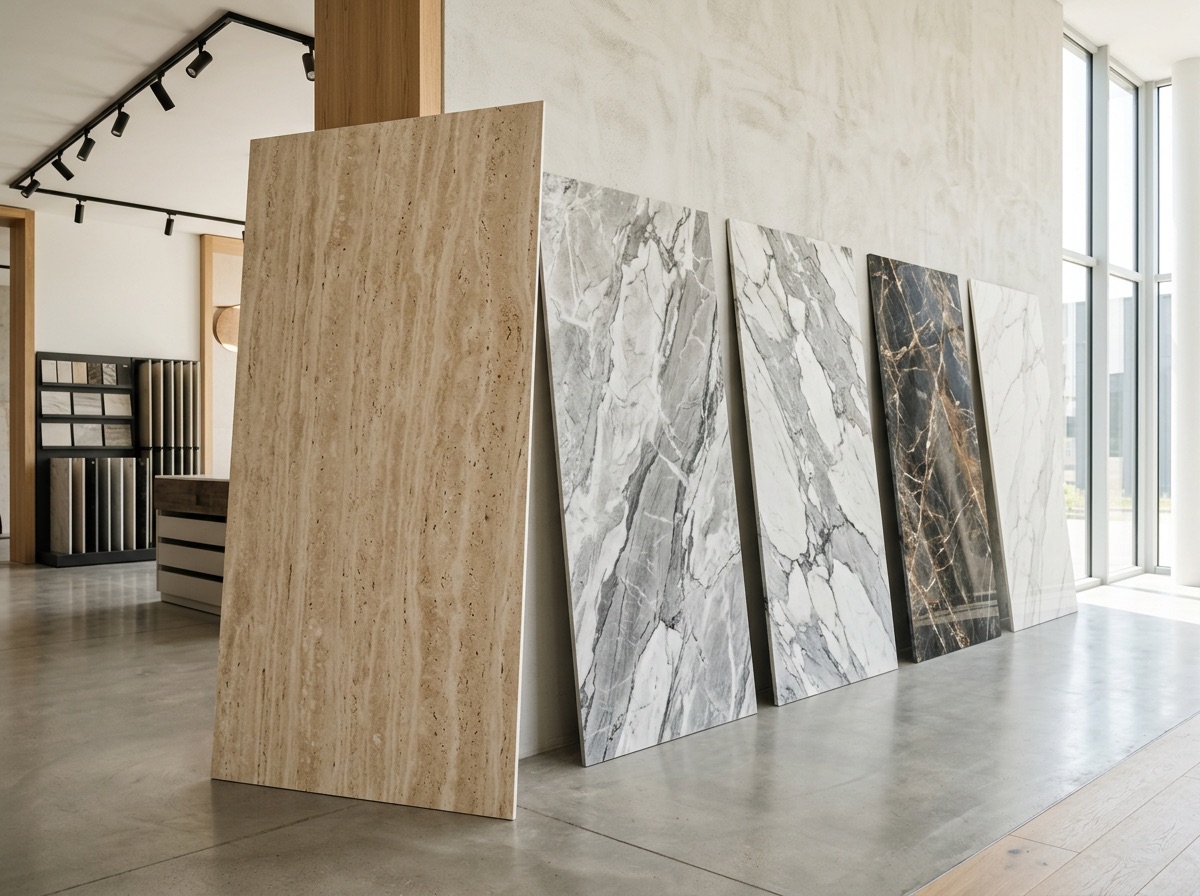
Sintered stone is the fastest-growing surface category in Europe and the Gulf, and it is arriving in North America a few years behind. As a market estimate for August 2026, factory-direct sintered stone and large-format porcelain slabs from China run $20 to $55 per square foot, in 12 mm and 20 mm thickness and formats up to 320 x 160 cm. That puts it in the same band as engineered quartz and cheaper than most natural quartzites, while offering something neither of them does: a surface that is genuinely heat-proof, UV-stable and near-zero porosity. It also carries drawbacks that showrooms tend to skip past, chiefly brittleness at the edges, fabrication difficulty and the fact that a chip cannot be polished out.
This page covers what sintered stone actually is and how it differs from porcelain and from quartz, where it beats natural marble and where marble still wins, why factory pricing sits where it does, what formats and finishes the mill produces, and how to order from drawing to crate. We compare against real stones from our index so you can see the alternatives at the same price point. All figures are market estimates as of August 2026; our partner mill quotes factory-direct on request.
What Sintered Stone Actually Is
Sintered stone is made from natural mineral powders, mainly clays, feldspars, silica and mineral oxides for colour, compacted under very high pressure and fired at around 1200 C. The heat fuses the particles into a single dense body without any resin or organic binder. It is, in effect, a fully vitrified ceramic slab produced at a size and thickness that ceramic technology could not manage until the last decade. Large-format porcelain slabs are made by an almost identical process; the trade uses the two names loosely, with sintered stone usually implying higher pressing force, thicker bodies and a product marketed against countertop materials rather than tiles.
Because there is no resin, the material does not scorch, does not yellow, does not absorb liquids and does not off-gas. Water absorption is typically below 0.1 percent, comparable to or lower than granite. The pattern is applied by digital printing before firing, sometimes with through-body colouring or vein technology that carries the design a few millimetres into the slab; on most lines the vein is on the surface only, which matters when you cut and edge it. That is the fundamental trade-off: an inert, extremely hard surface that behaves like fired glass in the ways that help and in the ways that hurt.
Sintered Stone vs Quartz, Marble and Quartzite: The Honest Comparison
Against engineered quartz, sintered stone wins on heat, UV, chemical resistance and outdoor use. You can put a hot pan on it, install it in an outdoor kitchen, clean it with bleach and it will not care. Against natural marble such as Carrara ($40-90/sqft slab, market estimate) or Calacatta ($80-250/sqft), it wins on maintenance: no sealing, no etching from acids, no staining from oil or wine. Against quartzite such as Taj Mahal ($70-140/sqft) or Patagonia ($100-250/sqft), it is cheaper and more consistent, and it is much lighter per square foot at 12 mm, which matters on wall cladding, façades and furniture.
Now the other side. Sintered stone is brittle. It is very hard on the face but has low tolerance for point impact on edges and corners, and a dropped cast-iron pan on an unsupported overhang can crack it. Chips on the edge expose the body colour under the printed surface, and unlike marble or quartzite the damage cannot be honed or polished away; you colour-fill it and live with it. Fabrication is difficult: it needs diamond tooling, slow feeds, water cooling and experienced hands, and cracked slabs during cutting are a real cost that fabricators price in. Mitred edges are near-mandatory on 12 mm because a square-cut edge shows the thin printed layer and the body beneath it. Not every local shop will take the work.
On appearance, sintered stone marble-looks are good in photographs and acceptable in most interiors, but a printed vein under a glassy surface does not have the depth of real stone. In flagship residential the difference is visible and buyers know it; a real Calacatta Viola ($90-250/sqft) or Nero Marquina ($40-90/sqft) island reads as what it is. Resale follows the same logic as quartz: neutral in the mid-market, a step below real stone at the top. Where sintered stone has no honest competitor is high-heat and outdoor applications: fireplace surrounds, barbecue counters, façades and pool surrounds where marble would etch and quartz would yellow.
Price Economics: Why $20-55 per Square Foot
Factory pricing is driven by thickness, format, finish and pattern technology. A 12 mm slab in a plain colour or basic marble-look at 320 x 160 cm sits near the bottom of the $20-55 range. A 20 mm slab with full-body colour or a multi-layer vein, a bookmatched pair and a polished finish sits near the top. Kiln time and pressing capacity are the constraints, not raw material, so pricing is stable and does not swing with quarry output the way Calacatta or Brazilian quartzite pricing does.
In Western markets, installed sintered stone countertops commonly run $80 to $150 per square foot, and branded lines sell above that. Slab pricing at Western distributors is typically two to three times the factory figure. The mark-up structure is similar to quartz: brand, distribution and a fabrication premium that reflects the difficulty of cutting the material and the scrap rate. Fabricators charge more per square foot to work sintered stone than to work granite, sometimes materially more, and that should be in your comparison.
For an importer, factory price plus roughly 25 to 40 percent for freight, crating and duty on a consolidated shipment lands a 12 mm slab well under $40 per square foot at a Western warehouse. Duty treatment differs from engineered quartz; sintered and porcelain slabs are generally classified as ceramic products, and the trade remedy orders that hit Chinese quartz do not automatically apply. Check the current HTS chapter 69 classification and any country-specific measures for your destination before ordering. Freight per square foot is lower than for stone because 12 mm slabs weigh roughly a third of a 3 cm marble slab.
Formats, Thickness and Finishes
Standard large formats are 320 x 160 cm and 260 x 120 cm; some lines run to 320 x 150 cm or 300 x 100 cm. Thicknesses: 6 mm for wall cladding and furniture skins, 12 mm as the general-purpose countertop and flooring gauge, and 20 mm for countertops that need a self-supporting overhang and for exterior paving. 3 mm ultra-thin panels exist for overlay on existing surfaces and for lightweight façade systems. For kitchen counters we recommend 12 mm with a mitred edge or 20 mm square-edged; 6 mm is a cladding product and should not be sold as a worktop.
Finishes: polished for the mirror marble-look, honed or matte for a natural-stone feel that hides fingerprints, silk or soft-touch as a middle ground, and textured or bush-hammered for exterior and wet-area slip resistance. Colours span white and grey marble-looks with printed veining, Calacatta and Statuario effects, dark marble and onyx effects, concrete, metal, oxidised steel and solid colours. Bookmatched pairs and continuous-vein sets across two or four slabs are available on premium lines and add to the price.
The mill supplies full slabs for local fabrication or cut-to-size pieces for countertops, vanity tops, table tops and cladding panels. Given how much skill sintered stone fabrication needs, we often recommend that a first-time buyer take cut-to-size from the factory rather than full slabs, because the mill's water-jet and CNC lines are set up for the material and the scrap risk stays with the producer.
Best Applications for Sintered Stone
Where it is the right answer: outdoor kitchens and barbecue counters, pool surrounds and terraces, ventilated façades and exterior cladding, fireplace surrounds and hearths, restaurant and hotel kitchen counters where heat and bleach are daily facts, large-format flooring in commercial lobbies and malls, and furniture such as dining and coffee table tops where low weight and a heat-proof surface both matter. Bathroom wall cladding in large panels with minimal grout lines is a growing use in hospitality.
Where we steer clients elsewhere: kitchens with heavy cast-iron cookware and unsupported overhangs, where edge chipping is likely; residential projects served by fabricators without sintered stone experience; and high-end residential where the client wants real stone and can afford it. In the last case a natural stone from the same price band, such as Guangxi White marble ($15-35/sqft), Han White ($25-70/sqft) or Ubatuba granite ($30-60/sqft), will often be more convincing and easier to fabricate.
MOQ, Lead Time and Ordering Process
Minimum order is one crate of 10 to 14 slabs, which at 320 x 160 cm is roughly 550 to 770 square feet. Cut-to-size pieces are quoted per project. Stock designs ship in 2 to 4 weeks; made-to-order patterns, bookmatched sets or non-standard thicknesses take 4 to 8 weeks from deposit. Ocean transit adds 4 to 6 weeks to Europe or North America.
The process: send a design reference or sample code, thickness, format, finish and quantity, and for cut-to-size, dimensioned drawings with cut-out positions and edge details. The mill returns an itemised quote with packing detail and lead time. On a 30 percent deposit production is scheduled. Before packing, the mill sends QC photos and, for larger orders, a third-party inspection report for approval. Balance is paid against shipping documents. Slabs travel on edge in reinforced A-frames or in flat wooden crates with foam interleaving; cut-to-size pieces are packed face-to-face with corner protection. Insist on physical samples before a first order, since the depth of a printed vein and the surface texture do not read on a screen.
Quality Control Checklist
Check thickness calibration, which should be within plus or minus 0.5 mm, and flatness with a straightedge across the diagonal; warped slabs are the number one fabrication problem with cheaper porcelain. Inspect for pinholes, glaze bubbles, colour banding and print misregistration on veined designs. Confirm the vein or pattern matches the approved sample and, on bookmatched sets, that the mirror actually mirrors. Look at the edges of the slab for micro-cracks, which propagate under cutting.
Ask for test data on water absorption, flexural strength, thermal shock, frost resistance for exterior use and slip resistance for flooring, and for the relevant certification for food contact if the slabs are going into kitchens. Ask specifically whether the design is surface-printed or through-body, because that determines how the edge will look after mitring. Finally, check the packing: sintered stone breaks in transit far more often from crate flex than from anything else, so the crate should be rigid, the slabs interleaved and the whole thing strapped.
Care and Maintenance
Sintered stone is the lowest-maintenance surface in this index. Clean with water and any household detergent; bleach, degreasers and most solvents do no harm. It does not need sealing and cannot absorb a sealer anyway. Hot pans are fine. What it does not tolerate is impact: do not drop heavy pans on edges and corners, do not stand on an overhang and do not use it as a chopping block, since a hard blow will chip it and the chip is permanent. Avoid hydrofluoric-acid-based products, which attack ceramic bodies. Polished finishes can show micro-scratches from grit dragged across the surface, so wipe rather than scrub.
Frequently asked questions
How much does sintered stone cost per square foot?
As a market estimate for August 2026, factory-direct sintered stone and large-format porcelain slabs from China run $20 to $55 per square foot in 12 mm and 20 mm, formats up to 320 x 160 cm. Installed in Western markets, sintered stone countertops commonly run $80 to $150 per square foot, with branded lines higher. Fabrication costs more than for granite because the material is harder to cut.
Does sintered stone chip?
Yes, at the edges and corners. The face is extremely hard, but the material is brittle under point impact, and a heavy pan dropped on an edge or an unsupported overhang can chip or crack it. Chips expose the body colour under the printed surface and cannot be polished out; they are colour-filled. Mitred edges on 12 mm and proper support under overhangs reduce the risk.
Is sintered stone better than quartz?
For heat, UV and outdoor use, yes: sintered stone has no resin, so it does not scorch or yellow, and it can go in an outdoor kitchen where quartz cannot. Quartz is easier and cheaper to fabricate, less brittle at the edges and more forgiving of an inexperienced installer. Prices overlap at the factory: quartz $18-45 per square foot, sintered stone $20-55.
Is sintered stone the same as porcelain?
Nearly. Both are mineral powders pressed and fired at around 1200 C into a vitrified body. Sintered stone usually means higher pressing force, thicker bodies of 12 to 20 mm and a product positioned against countertop materials; large-format porcelain slabs are the same technology often in 6 to 12 mm and marketed for cladding and flooring. Buy on the datasheet, not the label.
Can you put hot pans on sintered stone?
Yes. Sintered stone is fired at around 1200 C and contains no resin, so a hot pan will not scorch, discolour or soften it. Very sudden extreme thermal shock on a thin 6 mm panel is theoretically possible, but on 12 mm and 20 mm counters hot cookware is not a concern.
What is the minimum order for sintered stone slabs from China?
One crate of 10 to 14 slabs, roughly 550 to 770 square feet at 320 x 160 cm. Cut-to-size countertops and cladding panels are quoted per project. Stock designs ship in 2 to 4 weeks, made-to-order in 4 to 8 weeks, plus 4 to 6 weeks of ocean transit.