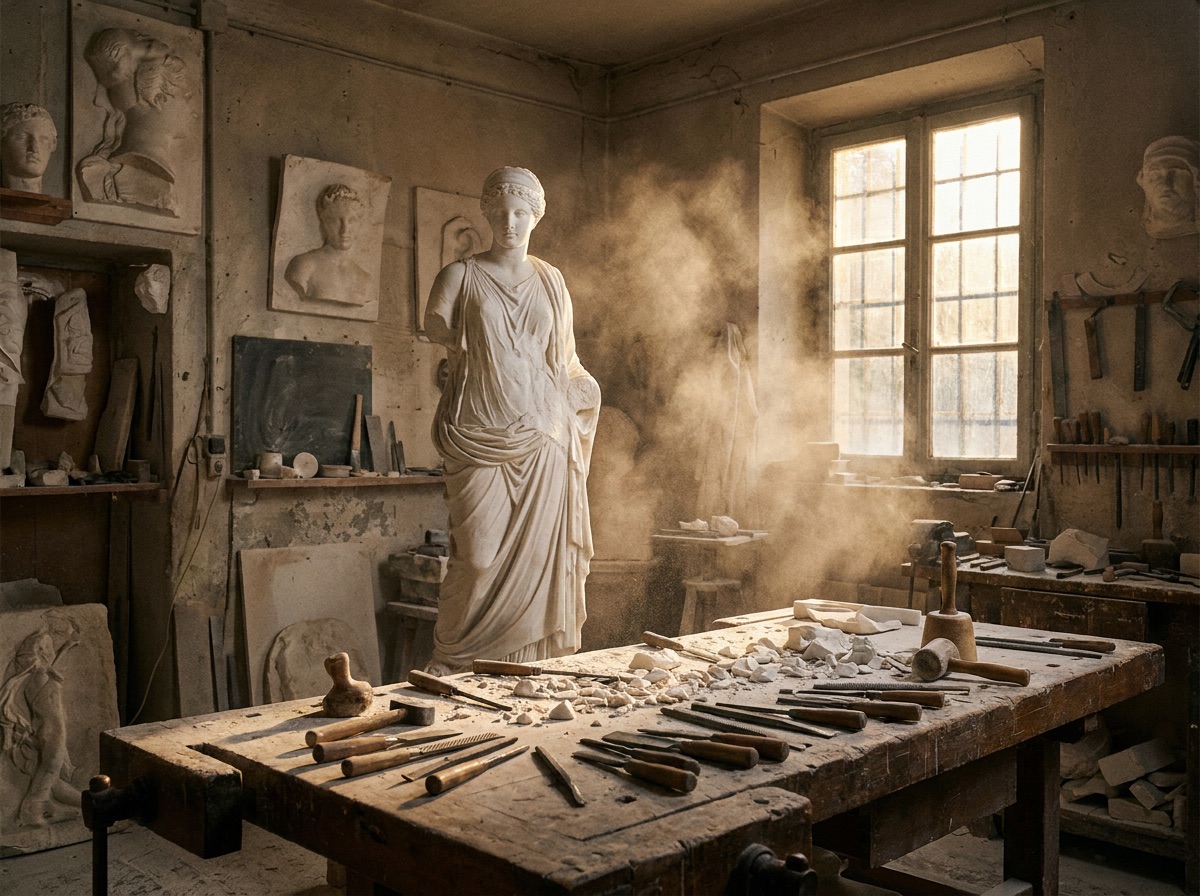
A marble statue is one of the few products where the price of the raw stone is almost irrelevant. A block of Han White big enough for a life-size figure costs a few hundred dollars; the finished statue can cost twenty thousand. Everything in between is labor, skill and time. As market estimates for August 2026, custom carved work runs from around $300 for small figures to $20,000 and beyond for monumental sculpture.
This guide breaks down what drives those numbers: hand versus CNC carving, which stones carve well and what they cost, how the made-to-order process works from a photo or 3D scan to a crated statue, and what to check before you wire a deposit. The figures track our index data as market estimates; treat the ranges as a sanity check against whatever offer is in front of you.
What you can order in this category
Custom marble sculpture covers three broad segments. The first is reproductions of well-known works — Venus de Milo, David, gods, Buddhas and religious figures — where the carver works from established models and pricing is predictable. The second is garden and architectural sculpture: fountains, lions, planters, columns with carved capitals, balustrades and finials, usually in weather-tolerant white marble.
The third is fully custom work: portrait busts and figures carved from photographs, memorial sculpture, abstract pieces, corporate and hotel commissions. This is where a carving workshop earns its keep — a sculptor translates photos into a clay or digital model, gets your approval, then executes it in stone. Our partner mill in China runs exactly this kind of workshop, quoting from photos, drawings or 3D scans. Because every statue is carved to order, single pieces are the norm — there is no real minimum order in this category.
Price economics: why quotes vary so widely
As a market estimate for August 2026, small carved figures start around $300 factory-direct. Garden statues in the 1 to 1.5 meter range typically run $800 to $3,000, life-size figures $2,500 to $8,000, and monumental work — over 2.5 meters, multi-figure groups, large fountains — starts around $8,000 and moves past $20,000. Western gallery prices run two to four times these numbers.
Four variables drive the quote. Carving hours: a smooth abstract form might take a week; a figure with flowing drapery and detailed hair can take two months. Stone: block price matters less than block size — a monolithic block for a 3-meter figure is far harder to source than four smaller ones. Detail risk: thin protruding elements can snap mid-carve, so workshops price in the chance of restarting. Finish: full polish takes far more hand time than a honed surface. In short, you are buying skilled labor at Chinese workshop rates versus Western rates — that arbitrage, not cheaper stone, is the factory-direct saving.
Hand carving vs CNC: the honest comparison
Almost every commercial statue made today involves a CNC machine at some stage, and buyers deserve a straight answer about it. A CNC mill working from a 3D model removes the bulk of the stone quickly — roughing out in days what would take a carver weeks. What CNC cannot do well is the last few millimeters: undercuts, deep folds, crisp edges, texture in hair and fabric. Fully machine-finished statues have a recognizable softness and visible tool paths in raking light.
The standard professional workflow is therefore hybrid: CNC roughing to about 90 percent, then hand finishing by carvers — 30 to 50 percent cheaper than fully hand-carved work with little visible difference on most subjects. Fully hand-carved pieces command a premium and suit portraits, fine art and provenance-minded buyers; fully CNC pieces are the budget tier, fine for garden ornaments viewed from distance but not a foyer bust. Ask which workflow a quote prices: a $1,200 life-size quote is almost certainly CNC-dominant — not a scam, but a different product from a $6,000 hybrid piece.
Best stones for sculpture and what they cost
Han White (Hanbaiyu) is the default carving stone at Chinese workshops and the one we recommend for most commissions. It is the imperial marble of China — the Forbidden City's balustrades are Hanbaiyu — with a fine, uniform grain that holds detail beautifully. As slab material it runs roughly $25 to $70 per square foot (market estimate, August 2026); as carving block it is the most economical serious sculpture stone, with large clean blocks readily sourced.
Carrara-grade white marble is the classical choice, at around $40 to $90 per square foot in slab form. Chinese mills process substantial volumes of Carrara blocks, so carving genuine Italian stone in a Chinese workshop is a real and common option — you pay more for the block but keep workshop rates low. At the top sits Statuario, the sculptor's marble of Michelangelo's David, at roughly $80 to $220 per square foot; flawless carving blocks cost more still and suit only museum-grade commissions. For garden and architectural work, Han White is hard to argue against; for interior fine art, Carrara-grade stone is the sweet spot. Avoid heavily veined marbles for figurative work — veins read as scars on a face.
Sizes, formats and specifications
Statues are specified by height including the integral base; sizes cluster around garden scale (80 to 150 cm), life-size (170 to 190 cm) and monumental (250 cm and up). Marble runs about 2.7 tonnes per cubic meter, so a life-size figure weighs 400 to 900 kg and a 3-meter figure can pass 3 tonnes. Confirm early that the destination can take the load and that a forklift or crane can reach the installation point.
Bases deserve their own line in the spec: a separate pedestal is quoted separately and adds weight and crate size. For outdoor pieces, specify base drainage and stainless-steel pinning between statue and pedestal. For fountains, the spec must include drilled water channels, pump housing dimensions and pipe diameters — retrofitting plumbing into carved stone is expensive and risky.
The custom order process, step by step
A made-to-order statue follows a predictable pipeline. It starts with reference material: photographs from multiple angles, drawings, or ideally a 3D scan or model file. The workshop returns a quote covering stone, workflow (CNC share versus hand hours), size, finish and crating, plus a lead-time estimate.
After deposit — typically 30 to 50 percent on custom carving — the workshop produces an approval model: a rendered 3D sculpt for CNC-led jobs or a clay maquette for high-end hand work. This is the cheap moment to change anything. Good workshops then send photos of the actual block before cutting and progress photos at roughing, detailing and finishing stages — insist on these milestones rather than a single reveal at the end.
Before crating, final QC photos and video are shared for sign-off, the balance is paid, and the piece is crated for export. From signed-off model to crated statue, expect 4 to 8 weeks for garden-scale pieces, 8 to 16 weeks for life-size figures, several months for monumental work — plus shipping.
Quality control checklist
Stone quality first: the block should be free of open cracks, iron staining and filler patches. Ask for photos of the block wet — water makes cracks and repairs visible. On the finished piece, check color consistency; a vein cutting through a face means the block was chosen badly.
On carving quality, inspect anatomy and proportions against the approved model from at least four angles — errors hide in three-quarter views. Look at the deepest recesses: eye corners, between fingers, inside drapery folds; unfinished tool marks there are the clearest tell of skipped hand-finishing. Surface finish should be even, with no polish swirls in raking light and no dull patches over repairs. Finally, verify that the base is flat and stable, pinning holes match the pedestal, and the piece matches quoted dimensions within a stated tolerance — 1 to 2 percent is normal for carved work.
MOQ, lead times and shipping fragile sculpture
Sculpture is the rare marble category with no meaningful MOQ: single pieces are carved to order for private buyers, designers and landscape architects alike. Lead times are dominated by carving; add 30 to 40 days for sea freight, plus a week or two for customs and delivery.
Crating is not an afterthought at these weights. A statue ships in a custom heavy-timber crate, braced so the piece cannot shift, with cushioning at contact points and protruding details individually wrapped; larger figures ride on an internal cradle. ISPM-15 fumigated timber is mandatory for most destinations, and marine cargo insurance at 1 to 2 percent of value is worth it on every shipment. Plan the last ten meters: a 600 kg crate needs a liftgate truck, monumental pieces a crane. Photograph everything on arrival before signing, and report damage within the policy window.
Care and maintenance
Indoors, marble sculpture needs only dusting and an occasional wipe with pH-neutral soap and water — never vinegar, citrus or bathroom cleaners, since marble is calcite and acids etch it instantly. Outdoors, expect the surface to soften and pick up biological growth over years; an annual gentle wash and a stone-specific biocide keep growth in check, while pressure washers destroy carved detail.
In freeze-thaw climates, trapped water is the main enemy: ensure the base drains, consider a breathable sealer on horizontal traps, and cover small pieces for the worst months. Chipped details can be repaired — workshops carve and pin replacement fragments — but prevention is far cheaper than restoration carving.
Frequently asked questions
How much does a custom marble statue cost?
As a market estimate for August 2026, factory-direct pricing starts around $300 for small figures, runs $800 to $3,000 for garden-scale statues, $2,500 to $8,000 for life-size figures, and $20,000 or more for monumental work. Western retail is typically two to four times higher.
Is a CNC-carved marble statue worse than a hand-carved one?
Not worse — different. CNC roughing followed by hand finishing is the standard professional workflow and delivers excellent results at 30 to 50 percent less than fully hand-carved work. Fully CNC pieces show softer detail and tool paths — fine for garden ornaments, not for close-viewed portraits. Always ask which workflow a quote is based on.
What is the best marble for statues?
Han White (Hanbaiyu) is the workhorse: fine uniform grain, pure white color and the lowest cost of any serious carving stone. Carrara-grade marble is the classical choice at a premium; Statuario is the museum-grade option. Avoid heavily veined marbles for figurative work — veins read as flaws on faces.
Can a workshop carve a statue from a photo?
Yes. Portrait busts and full figures are regularly carved from a set of photographs; a dozen clear photos from multiple angles is the practical minimum. The workshop first produces a 3D model or clay maquette for your approval, so you correct the likeness before carving begins. A 3D scan improves accuracy further for important commissions.
How long does a custom marble statue take?
From approved model to crated piece: roughly 4 to 8 weeks for garden-scale statues, 8 to 16 weeks for life-size figures, and several months for monumental work. Add about 30 to 40 days of sea freight plus customs and inland delivery, and 2 to 4 weeks for the modeling and approval stage up front.
How are marble statues shipped without breaking?
In custom heavy-timber crates with the statue braced against movement, contact points cushioned, and fragile protrusions individually wrapped; larger figures ride on an internal cradle. With ISPM-15 timber and marine cargo insurance at 1 to 2 percent of value, properly crated sculpture travels by sea with very low damage rates.
Do marble statues survive outdoors in cold climates?
White marble handles weather well but softens in detail over decades; freeze-thaw cycles are the main risk. Ensure the base drains so water cannot freeze in crevices, use a breathable sealer on water traps, and wash annually with pH-neutral cleaner rather than a pressure washer. In severe climates, covering pieces in winter preserves crisp detail.