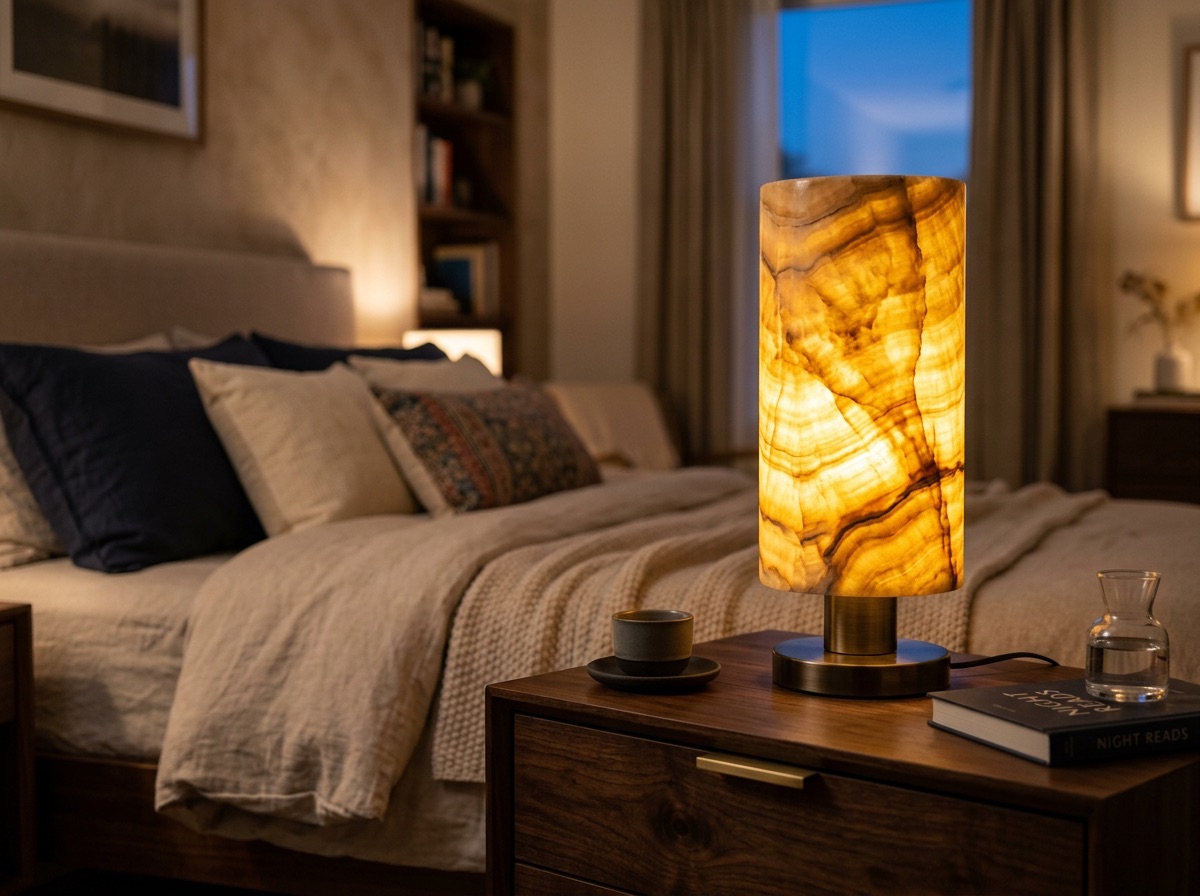
Marble table lamps are a margin product. As a market estimate for August 2026, factory-direct pricing runs $12 to $45 per base, while finished lamps retail at $60 to $250 in the US and Europe — a four- to six-times multiple that makes this one of the best-yielding marble categories for lighting brands, home retailers and e-commerce sellers. The stone content of a lamp base is small; what you are buying is turned and polished mass-production stonework plus, if you order complete lamps, factory wiring to US or EU specification.
This guide covers the price structure of the category, which stones work for lamp bases and what their slab prices imply, the backlit onyx line that anchors the premium end, electrical and compliance specs that decide whether your shipment is sellable, the ordering process at the 100-piece MOQ, and how lamps are QC'd, crated and cared for. All figures are market estimates tied to our August 2026 index data; exact quotes depend on stone, size and finish.
What you get in this category
The product range splits into three tiers. Bases only — turned cylinders, spheres, stacked geometric forms and sculptural shapes, drilled for cord and threaded rod — are the trade staple, sold to lighting manufacturers who add their own hardware, shades and branding. Complete lamps come wired at the factory with socket, cord, switch and optionally shade and packaging, ready for retail shelves. The third tier is the premium line: solid onyx lamps, either conventionally shaded or built as backlit pieces where the bulb glows through the translucent stone itself.
Forms follow furniture trends: short wide cylinders and spheres in green and white marble for the current organic-modern look, slim columns for classic table lamps, and chunky cubes for the minimalist segment. Mixed-stone bases — a white body on a black plinth, brass collars between stone sections — cost little extra at the factory and read as designer product at retail.
Price economics: from $12 base to $250 lamp
Within the $12 to $45 factory range (market estimate, August 2026), plain turned cylinders and spheres in white or grey marble sit at $12 to $20. Larger bases, shaped and multi-part forms, and green or black stone move the number to $20 to $32. Onyx bases and backlit designs occupy $30 to $45, driven by material cost and higher breakage in turning. Factory wiring to a complete lamp adds a few dollars per unit depending on the cord set and socket specified; a shade, if sourced alongside, adds its own line.
What drives cost inside the range: stone choice first, then size and weight (freight scales with kilograms), then shape complexity — a sphere wastes more block than a cylinder, and multi-part assemblies add labor. Finish matters least: polish is standard, honed is a small premium. The retail multiple, meanwhile, is set by your channel; the same $18 base retails at $60 in mass channels and $180 with a designer label and a linen shade.
Stone choices, with the onyx backlit line first
Onyx is the signature stone of this category and deserves its own paragraph. At roughly $60 to $200 per square foot in slab terms (market estimate, August 2026), it is expensive material — but a lamp base uses little of it, and no other stone does what onyx does: transmit light. A backlit onyx lamp glows amber, honey or green through its banding and sells as a statement object at $150 to $400 retail against a $30 to $45 factory cost. It is the highest-margin single item in the marble lighting trade and the natural hero product for a premium line.
For conventional bases, white marble in the $20 to $120 slab range covers everything from budget cool-whites to warm ivories; Guangxi White ($15 to $35) keeps mass-market price points honest, while Carrara ($40 to $90) adds the name buyers recognize. Green marble ($30 to $100) is the strongest trend stone in lighting right now, and black stones — Nero Marquina at $40 to $90, broader blacks at $30 to $80 — anchor the contrast end of a collection.
Specs, wiring and compliance
Typical bases run 120 to 200 mm in diameter or width and 150 to 350 mm tall, weighing 2 to 6 kg — heavy enough to feel expensive and to keep the lamp stable under a large shade. Standard machining includes a center bore for the threaded rod, a side or bottom cord exit with a protective grommet, and a felt or cork base pad. Specify all three explicitly; a missing grommet or an off-center bore is the kind of detail that turns a good shipment into a rework job.
For complete lamps, wiring is specified to destination: E26 sockets, 120 V cord sets and UL-listed components for North America; E27 and CE/UKCA-compliant sets for Europe and the UK. Factories wire to either spec routinely, but the buyer must state the requirement in the purchase order and confirm which certification documentation ships with the goods — customs and retail compliance both turn on paperwork, not solder. Rocker switches, inline dimmers and USB ports in the base are all available options at small per-unit cost.
The custom and private-label process
Most orders start from the factory's existing shape library: pick forms, stones, sizes and finishes, and production begins after deposit. Custom shapes start from a sketch, photo or CAD file; turning tooling for a new profile is cheap, so custom forms carry little premium at the 100-piece MOQ. For a brand launch, the sensible sequence is samples of three to five shapes (at sample cost plus courier), photography and market testing, then the production order.
Private-label extras are where factory-direct gets interesting: engraved or printed logos on the base pad, branded gift boxes, custom cord colors and bespoke shade pairings can all be arranged at the factory, turning a generic base into a finished retail SKU that never needs to pass through a domestic assembler. Production for a 100 to 500 piece order typically runs 3 to 5 weeks.
Quality control checklist
On the stone: color and veining consistency across the batch matters more for lamps than any other category, because retail customers buy pairs — ask for batch photos in daylight of every unit or at least every carton. Check for cracks and fills with wet photos, verify the polish is even with no flat spots on curved forms, and confirm bases sit flat without rocking. For onyx, backlight every piece: internal fractures show as bright lines, and banding should be attractive rather than muddy on the illuminated face.
On the hardware: bores centered and clean, grommets fitted, rods and sockets tight, cords the specified length and color, and switches working — a 100 percent power-on test is standard for wired lamps and worth stating in the PO. Verify the certification marks on cord sets match the paperwork. Finally, check packaging drop-readiness: a lamp that survives the crate but dies in last-mile courier shipping was packed wrong at the factory.
MOQ, lead times and shipping
The working MOQ is about 100 pieces, mixable across shapes and stones within reason — a practical first order for a lighting brand is 100 units across four designs. At 2 to 6 kg per base, a 100-piece order ships at 300 to 700 kg including packaging, comfortably within LCL sea freight economics; the freight cost per unit is typically a dollar or two, which is why factory-direct lamps undercut domestic wholesale so decisively.
Timing: 3 to 5 weeks of production plus 30 to 40 days of sea freight and customs, so roughly 9 to 11 weeks door to door. Packing is carton-based rather than crate-based: each lamp boxed in die-cut foam, cartons palletized or crated for the sea leg. ISPM-15 timber applies to any wooden pallet or crate. Marine insurance at 1 to 2 percent of invoice value is cheap; breakage rates on properly foam-packed lamps are low, and claims are simple when each unit has its own carton.
Care and retail aftercare
Marble lamp bases are close to maintenance-free: dust with a dry or slightly damp cloth, avoid acidic cleaners, and the polish lasts indefinitely indoors. The care card you pack with a retail lamp should say exactly that in two lines — plus a warning not to drag the base across furniture, since stone scratches wood faster than wood scratches stone. Felt pads, fitted at the factory, prevent the complaint before it happens.
Onyx asks slightly more: it is softer than marble, so no abrasive pads, and backlit designs run warm — specify LED bulbs in the documentation to keep heat away from the stone and the customer. For retailers, the practical aftercare point is spare parts: order 2 to 3 percent extra cord sets and grommets with the shipment, and a damaged-in-transit lamp becomes a five-minute fix instead of a return.
Frequently asked questions
How much do marble lamp bases cost from the factory?
As a market estimate for August 2026, $12 to $45 per base factory-direct: plain white cylinders and spheres at $12 to $20, larger or shaped bases in green and black stone at $20 to $32, and onyx or backlit designs at $30 to $45. Finished lamps retail at $60 to $250 in Western channels, a four- to six-times multiple.
What is a backlit onyx lamp?
A lamp where the bulb sits inside or behind translucent onyx, so the stone itself glows amber, honey or green through its natural banding. It is the premium item in the marble lighting range — around $30 to $45 factory-direct against $150 to $400 at retail — and should always be specified with LED bulbs to keep heat away from the stone.
Can the factory wire lamps for the US or EU market?
Yes — factories routinely wire to destination spec: E26 sockets, 120 V UL-listed cord sets for North America, or E27 with CE/UKCA-compliant components for Europe and the UK. State the requirement in the purchase order and confirm which certification paperwork ships with the goods, since retail compliance depends on the documentation as much as the components.
What is the minimum order for marble table lamps?
About 100 pieces, mixable across shapes and stones — a typical first order is 100 units spread over four designs. The order ships at roughly 300 to 700 kg by LCL sea freight, putting per-unit freight at only a dollar or two. Samples of individual designs are available first at sample cost plus courier.
How long does a marble lamp order take?
Production for 100 to 500 pieces runs 3 to 5 weeks, plus 30 to 40 days of sea freight and customs — roughly 9 to 11 weeks door to door. Custom shapes add little time since turning tooling is cheap, but allow 2 to 3 weeks up front for samples and approval on a new design.
Which stones are best for lamp bases?
Guangxi White for mass-market price points, Carrara for name recognition, green marble for the current trend segment, Nero Marquina and other blacks for contrast pieces, and onyx for the premium backlit line. Mixed-stone bases — white body on a black plinth with a brass collar — cost little extra and read as designer product.
Do marble lamps break in shipping?
Rarely, when packed correctly: each lamp in its own carton with die-cut foam, cartons palletized for the sea leg. The 2 to 6 kg mass of a base is robust; the risks are chipped edges from loose packing and cord damage, both preventable at the factory. Order a few percent spare cord sets and grommets so transit damage becomes a quick fix rather than a return.