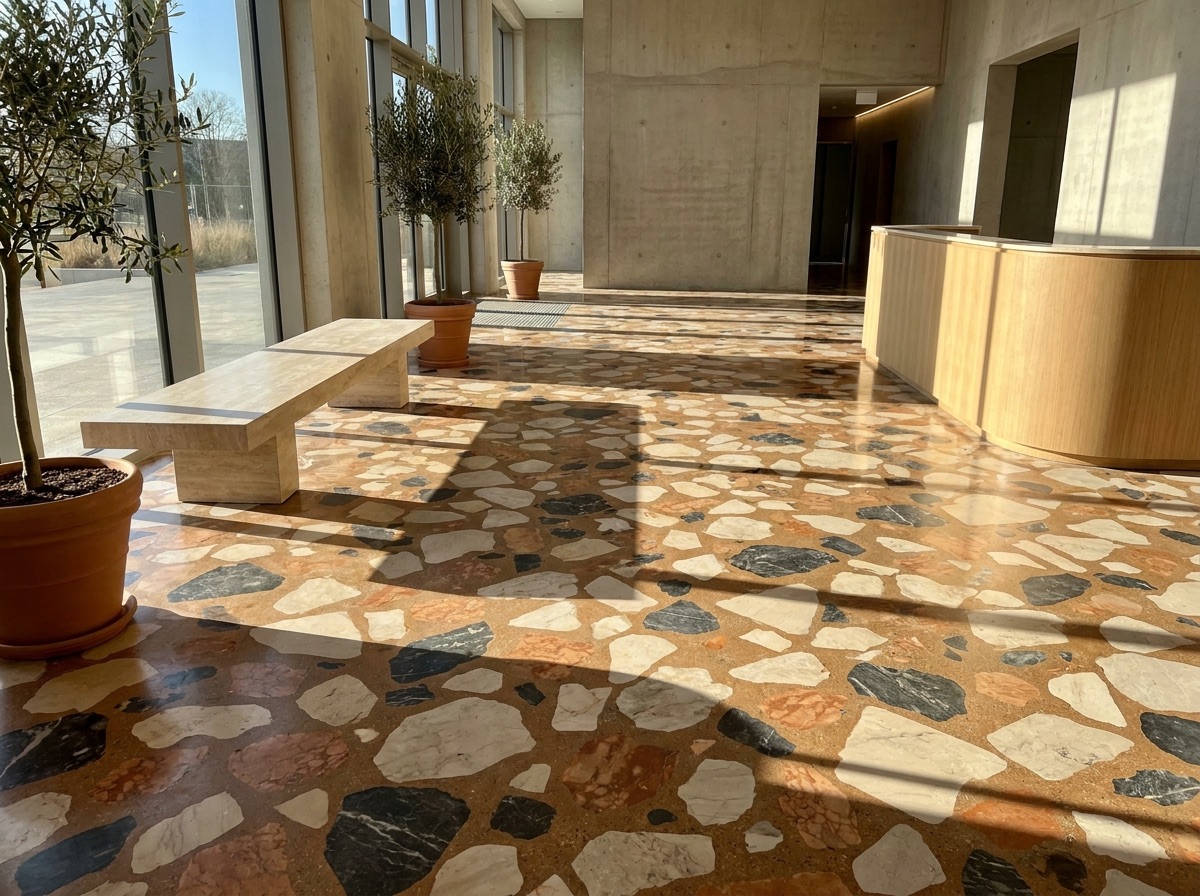
Terrazzo has come back into fashion hard over the last decade, and with it a lot of confusion about what it costs. As a market estimate for August 2026, precast terrazzo tiles and slabs from China run $12 to $40 per square foot factory-direct, in cement or epoxy base with marble, granite or glass chips, and the mill will cast a custom mix to your drawing. That is cheaper than most natural marble slabs and comparable to entry-level Chinese whites such as Guangxi White ($15-35/sqft), yet Western retail pricing for terrazzo tile and especially poured-in-place terrazzo can rival mid-range marble. The gap is a mixture of trend premium, freight on a heavy product and, for poured floors, the specialist labour that precast eliminates.
This page explains what terrazzo actually is and how cement and epoxy versions differ, where it beats natural stone and where it does not, why factory pricing sits at $12-40, what formats and finishes the mill produces, and how to specify and order a custom mix from drawing to crate. We compare against real stones from our index throughout. All figures are market estimates as of August 2026; our partner mill quotes factory-direct on your specification.
What Terrazzo Actually Is
Terrazzo is a composite: chips of marble, granite, quartz, glass or shell set in a binder, cured, then ground flat and polished so the chips are cut through and exposed in cross-section. The Venetian original used marble offcuts in lime mortar; today the binder is either Portland cement or an epoxy or polyester resin, and the chip is anything from 1 mm dust to 40 mm cobbles. Precast terrazzo, which is what a mill exports, is cast in moulds as tiles, slabs, stair treads and countertops, cured under controlled conditions and factory-polished. Poured-in-place terrazzo is mixed on the job site and ground down there; it is a flooring trade, not a stone product, and is not what this page prices.
The binder is what defines the two families. Cement-based terrazzo is heavier, thicker, porous unless sealed, tolerant of exterior and wet conditions, and reads as a mineral material with a slightly matte, honed character even when polished. Epoxy or resin-based terrazzo is thinner, lighter, denser, takes a higher gloss and brighter pigments, allows glass and mother-of-pearl chips and very fine or very large aggregates, but shares the resin weaknesses of engineered quartz: UV yellowing outdoors and sensitivity to heat. Neither is better in the abstract; the application decides.
Terrazzo vs Marble, Granite and Quartz: The Honest Comparison
Where terrazzo wins: cost per square foot against most natural stone, design control, and durability underfoot. A cement terrazzo floor with marble chip is essentially marble in a hard matrix; it takes decades of commercial foot traffic, can be re-ground and re-polished many times over its life, and can be colour-matched to a brand palette in a way no quarry can. Because it is cast, you can hit a repeatable colour across a 50-store retail rollout, which real Carrara ($40-90/sqft) or Emperador ($35-85/sqft) cannot promise across bundles. Slip resistance on honed cement terrazzo is good, and there is no book-matching or slab selection to argue about.
Where terrazzo loses: it is not a natural stone and does not carry a natural stone's status. On a statement wall or a boutique hotel lobby, a bookmatched Calacatta Viola ($90-250/sqft) or a black-and-white Nero Marquina ($40-90/sqft) floor commands a premium that terrazzo, however well specified, does not. Cement terrazzo is porous and stains if left unsealed; grout-like efflorescence can appear on exterior tiles; and thick cement tiles are heavy, so freight per square foot is higher than for 12 mm sintered stone or even 2 cm marble in some cases. Epoxy terrazzo has the quartz problem: fine indoors, yellows in sunlight, marks under a hot pan on a counter.
Repairability is a genuine terrazzo strength. Chips and scratches on cement terrazzo can be patched with matched mix and re-ground invisibly; even epoxy terrazzo can be spot-repaired more successfully than engineered quartz. Resale and perception are neutral to positive in commercial and design-led residential, where terrazzo currently signals a considered choice rather than a budget one, and neutral in mainstream housing. The honest summary: for floors, stairs and hard-wearing surfaces where colour control and longevity matter more than prestige, terrazzo is very hard to beat on value; for a surface that is meant to be admired as stone, buy stone.
Price Economics: Why $12-40 per Square Foot
Factory pricing is driven by binder, chip content, thickness, format and mould complexity. A standard 20 mm cement terrazzo tile in a stock mix with local marble chip sits at the bottom of the $12-40 range. A resin-based slab with imported marble or glass chips, custom pigment, a large 240 x 120 cm format and a high-gloss polish sits at the top. Custom mixes carry a set-up charge for trial castings and colour approval, which is why the MOQ is 500 square feet; below that the sampling cost swamps the order.
In Western markets, precast terrazzo tile retails at roughly $30 to $80 per square foot and poured-in-place terrazzo floors are commonly quoted at $50 to $150 per square foot installed, driven by specialist labour. Precast at $12-40 factory-direct plus freight lands far below poured-in-place and comfortably below Western precast retail. Freight is the caveat: cement terrazzo at 20 to 30 mm is heavy, and ocean freight, crating and duty typically add 30 to 50 percent to the factory price on a consolidated shipment, more than for lighter surfaces. Terrazzo tiles are usually classified as articles of artificial stone or agglomerated stone under HTS chapter 68; confirm the current rate for your destination before quoting a client.
For comparison at the landed level: a $20 cement terrazzo tile lands around $27-30 per square foot at a Western warehouse, against $40-90 for Carrara slab and $15-35 for Guangxi White. Terrazzo therefore competes on price with the cheapest Chinese marbles and undercuts European whites, while offering something they cannot: a specified colour, repeated exactly.
Formats, Thickness and Finishes
Tiles: 300 x 300, 400 x 400, 600 x 600 and 800 x 800 mm are the standard precast formats, in 20 to 30 mm for cement and 12 to 20 mm for resin base. Slabs: up to 240 x 120 cm or 300 x 120 cm depending on the binder, 20 to 30 mm thick, for countertops, table tops, wall panels and cut-to-size floor plans. Stair treads and risers, skirting, window sills, shower trays and precast benches are cast to drawing. Chip sizes run from 0 to 2 mm micro-terrazzo through the classic 8 to 15 mm to 30 to 40 mm and larger palladiana or Venetian slabs where large broken pieces of marble dominate.
Finishes: polished for interior floors and counters, honed for a softer look and better slip resistance, and brushed or bush-hammered for exterior paving and pool surrounds in cement terrazzo. Edges on slabs and treads follow stone practice: eased, bevel, bullnose. Colour is set by the binder pigment plus the chip palette; white cement with white and grey marble chip is the volume order, followed by warm greys, terracotta and blush pinks with mixed chips, and dark binders with pale chips. Glass, mirror and mother-of-pearl chips are resin-only.
The mill's competitive advantage is the custom mix. Send a reference image, a Pantone or NCS binder colour, and a chip brief, and it will cast sample tiles for approval before production. For a rollout, that sample becomes the control against which every crate is checked. Because chip is often marble offcut from the same mill, terrazzo is also one of the more resource-efficient stone products, which increasingly matters to architects specifying it.
Best Applications for Terrazzo
Floors first: retail, hospitality, offices, schools, transport buildings and residential lobbies, where terrazzo's wear resistance and re-polishability pay for themselves over decades. Stairs, where precast treads with an integral nosing are a clean, durable solution. Countertops and vanity tops in design-led residential and cafés, table and console tops in furniture, wall cladding and reception desks in commercial fit-outs. Cement terrazzo also works outdoors on terraces, courtyards and pool surrounds if specified in a brushed or honed finish and sealed.
Where we steer clients elsewhere: statement surfaces where the client wants stone to be read as stone; kitchen counters in heavy-use family kitchens if the binder is epoxy, because of heat marks; and very thin overlay applications where the tile weight is a structural problem. In those cases we point people to natural stone from the same price band, such as Guangxi White or Han White marble ($25-70/sqft), or to sintered stone for the heat-and-weight case.
MOQ, Lead Time and Ordering Process
Minimum order is 500 square feet, which for a stock mix is roughly one pallet of 600 x 600 tiles and for a custom mix is the smallest run that justifies trial castings. Stock mixes ship in 3 to 5 weeks; custom mixes take 6 to 10 weeks from deposit because of sample casting, approval and cure time. Cement terrazzo needs a proper cure before polishing, and rushing it shows up later as micro-cracking, so lead time on cement product is not something to negotiate down hard. Ocean transit adds 4 to 6 weeks.
The process: send a reference image or existing sample, binder type, chip brief, thickness, format, finish and quantity, plus dimensioned drawings for slabs, treads and cut-to-size floor plans. The mill casts one to three sample tiles and sends photos, or physical samples by courier, for approval; on a custom colour we strongly recommend physical samples, since binder tone shifts between screen and reality. On approval and a 30 percent deposit, production is scheduled. Before packing, QC photos of the batch against the approved sample are sent, and for larger orders a third-party inspection report. Balance is paid against shipping documents. Tiles ship on pallets, shrink-wrapped and strapped; slabs and treads in wooden crates with foam interleaving.
Quality Control Checklist
Colour consistency against the approved sample is the first check: compare a tile from each pallet under daylight, since binder tone drifts between batches if pigment dosing is careless. Check chip distribution for bare patches or clustering, and check that chip size and mix match the brief. Measure thickness and squareness on a sample of tiles; tolerance should be within plus or minus 1 mm on thickness and 0.5 mm on length for polished tiles that will be laid tight-jointed. Check flatness with a straightedge and look at the polished face under raking light for pinholes, unfilled voids and grinding swirl marks; good precast terrazzo is grouted and re-polished at the factory to close voids, cheap terrazzo is not.
For cement terrazzo ask about cure time before polishing and whether the tiles have been factory-sealed; for exterior use ask for frost-thaw and slip-resistance data. For resin terrazzo ask for the resin type and UV performance and check that any glass chip is fully bonded. Look at the edges for chips from handling and at the packing for pallet stability, since broken corners on tiles are the most common transit claim and are almost always a packing failure.
Care and Maintenance
Cement terrazzo should be sealed after installation with a penetrating sealer and re-sealed every one to three years depending on traffic; unsealed it will stain and hold dirt in the pores. Clean with pH-neutral cleaners; avoid acids, which etch the marble chip and the cement matrix, and avoid strong alkalis on polished floors. Over decades, a cement terrazzo floor can be re-ground and re-polished back to new, which is one of the strongest arguments for it. Resin terrazzo does not need sealing; clean it as you would engineered quartz, keep hot pans off it and keep it out of direct sun. Use trivets on any terrazzo countertop and cutting boards on all of them, since marble chip scratches.
Frequently asked questions
Is terrazzo expensive?
Precast terrazzo is not, at the factory. As a market estimate for August 2026, terrazzo tiles and slabs from China run $12 to $40 per square foot factory-direct, in line with entry-level Chinese marble and below European whites like Carrara at $40-90. Western retail for precast tile is roughly $30 to $80 per square foot, and poured-in-place terrazzo floors run $50 to $150 installed because of specialist labour. Freight is the main extra: cement terrazzo is heavy.
Is terrazzo cheaper than marble?
Usually. Terrazzo at $12-40 per square foot factory-direct undercuts most natural marble slabs, from Carrara ($40-90) to Calacatta ($80-250). It overlaps with the cheapest Chinese whites such as Guangxi White ($15-35), which is often the honest alternative if the client wants a real stone at terrazzo money. Landed, terrazzo carries a heavier freight bill per square foot than 2 cm marble tile.
What is the difference between cement and epoxy terrazzo?
Cement terrazzo uses a Portland cement binder: heavier, thicker, porous unless sealed, suitable outdoors and in wet areas, with a mineral, slightly matte look. Epoxy or resin terrazzo uses a resin binder: thinner, lighter, denser, brighter colours, glass and pearl chips possible, higher gloss, but it yellows in UV and marks under heat like engineered quartz. Cement for floors and exteriors, resin for interior counters, furniture and vivid colours.
Does terrazzo crack or chip?
Precast terrazzo tiles are robust in service. Cement terrazzo can develop hairline cracks if it was polished before curing fully or laid on a moving substrate; corners chip in transit if pallets are poorly packed. The good news is repairability: chips and scratches can be patched with matched mix and re-ground almost invisibly, which is not true of engineered quartz or sintered stone.
What is the minimum order for terrazzo tiles from China?
From 500 square feet. Stock mixes ship in 3 to 5 weeks; custom colour-matched mixes take 6 to 10 weeks because of sample casting, approval and cure time, plus 4 to 6 weeks of ocean transit. Custom mixes are approved on physical sample tiles before production.
Can terrazzo be used outdoors?
Cement-based terrazzo, yes, in a honed, brushed or bush-hammered finish and sealed; ask for frost-thaw and slip data. Resin-based terrazzo is for interiors only, because the binder yellows and degrades in sunlight.
Can terrazzo be used for kitchen countertops?
Yes, and it is a popular design choice, but treat it like marble: seal cement terrazzo, avoid acids, use trivets and cutting boards. Resin terrazzo counters must not take hot pans. For a hard-working family kitchen, granite such as Absolute Black ($30-75/sqft) or sintered stone is the more forgiving surface.