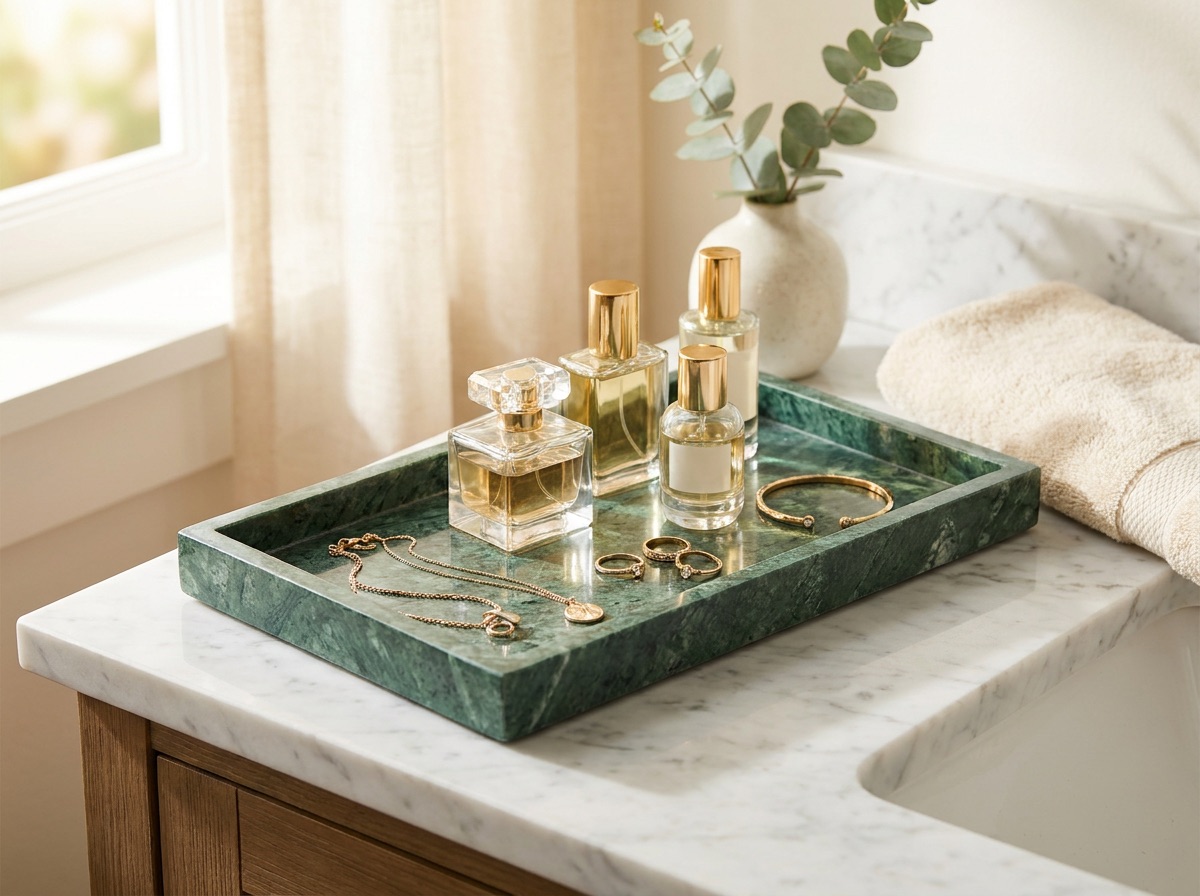
Marble trays are the highest-margin, lowest-risk entry point into the stone trade. As a market estimate for August 2026, factory prices run $4 to $15 per piece for vanity trays, serving trays and catchalls in white, green and black marble, while the same pieces retail for $25 to $90 in the US and EU. A five-to-eight-times multiple between factory gate and product page is routine, the pieces are small enough to ship by the carton, and a 100-piece minimum order fits inside almost any e-commerce test budget. This is the category where new importers should learn the trade before graduating to furniture.
This guide covers the product range and what each format sells for, the full economics from factory price to landed unit cost, which stones photograph and sell best, the specs and finishing details that separate a premium tray from a souvenir, QC at accessory scale, and the ordering mechanics including private-label options. Figures are market estimates; our partner mill in China quotes factory-direct against photos, drawings or a simple size list.
The Product Range: Vanity, Serving, Catchall
The category splits into three commercial families. Vanity trays - typically 15 to 25 cm, round, rectangular or scalloped - live in bathrooms and on dressers holding perfume and jewelry; they are the volume seller and the gift-market staple. Serving trays - 30 to 45 cm, usually rectangular or round, often with brass or leather handles - carry the higher price points and the food-adjacent photography that drives social commerce. Catchalls and small dishes - 8 to 15 cm - are the add-on unit that lifts average order value and fills carton corners nearly free of freight.
Construction is simple: a slab offcut or small-format stone piece, cut to shape, edges profiled, face polished or honed, base felted or foot-padded. Simplicity is the commercial point - trays convert the mill's offcut stream from premium slab production into finished goods, which is why a scalloped Carrara tray can leave the factory at single-digit dollars.
Price Economics: The Best Margin Structure in Marble
Walk the chain on a standard piece: a 20 cm round Guangxi White vanity tray at $5 ex-factory. A hundred pieces pack into a few cartons; consolidated sea freight, duty and inland delivery add $1 to $2.50 per piece depending on shipment size - call it $7 landed. It retails at $35 to $45 on a home-goods site and wholesales to boutiques at $15 to $18. Even after payment processing, advertising and returns, the unit economics outperform nearly every other home-accessory category.
The retail markup covers real costs - photography, advertising, fulfillment, breakage in parcel networks - but its size is set by perception: marble reads as luxury, and accessory pricing follows the read, not the input cost. Landed cost basics at accessory scale: trays ship boxed and cartoned rather than crated, LCL sea freight is the default at 100 to 1,000 pieces, air freight becomes rational for restocks of light pieces when a stockout costs more than the freight difference. Duty per the current tariff line for worked stone articles applies; on a $5 piece even a double-digit duty percentage is cents, not dollars.
One structural note: because trays cut largely from offcuts, factory pricing is less sensitive to slab-market moves than any other category on this index.
Best Stones for Trays
White sells first: Carrara ($40-90/sqft slab basis, market estimate) and Guangxi White ($15-35/sqft) cover the classic grey-veined look at two price points, and in a 20 cm tray the difference is nearly invisible to the end customer. Green is the trend engine: green marble ($30-100/sqft) trays in Ming Green and forest tones are the current social-commerce favorite and support premium pricing.
Black completes the core palette - Nero Marquina ($40-90/sqft) with white veining for drama, broader blacks ($30-80) for value. Beyond the core three: Panda White ($50-130/sqft) for high-contrast statement pieces, Emperador browns ($35-85) for masculine desk accessories, and onyx ($60-200/sqft) for translucent premium trays sold as objets rather than utility. A sensible opening assortment is 60 percent white, 25 percent green, 15 percent black, adjusted to what your channel's photography favors.
Specs and Formats: Sizes, Edges, Details
Standard sizes: rounds at 15, 20, 25 and 30 cm; rectangles at 20x10, 25x15, 30x20 and 40x25 cm; scalloped and irregular shapes as fashion dictates. Thickness runs 15 to 20 mm for flat trays; raised-lip designs are carved from thicker stock and price accordingly. Edges: eased, bullnose, or a shallow carved gallery lip; scalloped edges are CNC work that costs modestly more and photographs disproportionately well.
Finish and detail decisions that move perceived value: honed faces read spa-like and hide water marks on vanity trays; polished faces read glamorous and suit gifting. Bases must be felted or fitted with silicone feet - an unfelted tray scratches furniture and generates one-star reviews. Brass, gold-tone or leather handles on serving trays add $1 to $3 at the factory and $15 to $25 at retail, the single best value-add in the category. Gift boxes with foam inserts add well under a dollar at volume and double gifting conversion.
Quality Control Checklist
Per piece: dimensions within 1 to 2 mm; face polish or hone uniform without windows or wheel marks; edges smooth, continuous and chip-free - edges are where accessory QC lives or dies; no cracks or crumbling fills; veining within the approved range; base flat so the tray sits without rocking; felt or feet applied cleanly and aligned; handles, where fitted, tight and symmetrical with hardware that does not tarnish out of the box.
Per order: an approved sample set before production - because stone varies, approve a range across three or four pieces per stone, not one hero piece; in-production photos; and a random final inspection across cartons, not from the top layer. A $200 third-party inspection man-day is disproportionate on a $600 trial order but obviously right on a 1,000-piece run. For small orders, detailed photo and video QC from the mill - every SKU, multiple angles, edges close-up - is the standard substitute and any good factory provides it without friction.
Packaging: The Category's Real Engineering
Stone accessories fail in parcel networks, not in containers - so retail-ready packaging is where the engineering effort belongs. Minimum spec per piece: foam or EPE wrap, a snug inner box with the stone immobilized, and for gift-positioned SKUs a rigid gift box with die-cut foam. Master cartons of 10 to 20 pieces, double-wall board, weight capped near 20 kilograms for handling. The drop test that matters is the last-mile one: a single piece in its retail box, shipped through an actual parcel service to yourself, twice.
Private-label packaging is standard factory service at this MOQ: printed boxes, branded tissue, care cards, UPC labels and Amazon FNSKU compliance. A tray program that arrives shelf-ready from the mill skips a domestic co-packing step that otherwise costs $1 to $2 per unit.
MOQ, Lead Times and Ordering Process
Minimum order is from 100 pieces, mixable across sizes, shapes and stones within reason - a 100-piece order split across three stones and two sizes is normal. Custom shapes need tooling or programming and may carry their own per-design minimums. Lead times: 15 to 25 days production for standard designs, plus transit - 30 to 40 days by sea, 5 to 8 days by air for restocks that justify it. A first order lands in roughly 8 to 10 weeks by sea; repeat orders of running SKUs can compress the production leg.
Process: send reference photos or a size list; receive a per-SKU quote with packaging options; approve samples - physical samples by courier run one to two weeks and are worth it on a first order; 30 percent deposit; production with photo QC; balance against final photos or inspection; ship.
Selling the Category: Positioning Notes from the Trade
Trays are bought on photography and gifting occasions, not specifications. The listings that win show the tray in use - perfume bottles, jewelry, a candle - name the stone honestly, and lean into the fact that every piece's veining is unique. Bundles move the category: tray plus catchall, or tray in three sizes. Seasonal peaks are pronounced - fourth quarter gifting, Mother's Day, wedding season - and sea-freight lead times mean fourth-quarter inventory is ordered by July.
Honesty rules worth keeping even in accessories: name the stone correctly - Guangxi White is not Carrara, and 'Carrara-style' is the honest phrasing; disclose that veining varies; and never market resin-composite lookalikes as marble. The category is full of mislabeled product, which is why honest stone naming has become a differentiator.
Care and Maintenance
A marble tray needs less care than any other marble object because it holds objects, not food acids - but the same chemistry applies. Care card language that works: wipe with a damp cloth and mild soap, avoid vinegar and citrus cleaners, blot perfume and cosmetic spills promptly since alcohols and oils can mark unsealed stone, and keep the felt base dry. Serving trays used with food want food-safe sealing and prompt cleanup of wine and citrus, which etch polished surfaces.
Sellers should seal trays at the factory - it costs cents - and say so in the listing, because 'pre-sealed' converts. Small etches and scuffs on a honed tray blend into the surface with use; at tray prices replacement is the practical remedy for real damage.
Frequently asked questions
How much do marble trays cost wholesale?
Factory-direct prices run $4 to $15 per piece as a market estimate for August 2026 - small Guangxi White catchalls at the bottom, large serving trays with brass handles in premium stones at the top. Comparable pieces retail for $25 to $90 in the US and EU. Landed cost typically adds $1 to $2.50 per piece on consolidated sea shipments.
What is the minimum order for factory-direct marble trays?
From 100 pieces, mixable across sizes, shapes and stones. That fits a modest e-commerce test budget - a mixed 100-piece order often lands under $1,000 all-in. Custom shapes and printed private-label packaging can add per-design minimums, so specify packaging at the quote stage.
Which marble is best for vanity and serving trays?
White Carrara-look stones sell first - genuine Carrara or Guangxi White, nearly indistinguishable at tray scale. Green marble is the current trend leader on social commerce, and Nero Marquina covers the dramatic black slot. A 60/25/15 white/green/black opening assortment is a sensible default.
Why are marble trays so much cheaper from the factory than retail?
Trays cut largely from offcuts of slab production, so material cost is minimal, and fabrication is simple CNC and polishing work. Retail pricing follows marble's luxury perception rather than input cost, producing routine five-to-eight-times multiples. The gap funds the retailer's photography, advertising and parcel-damage costs - or your margin if you import directly.
How are marble trays shipped without breaking?
Container transit is gentle; parcel delivery is the danger zone. Each piece needs foam wrap and a snug inner box, master cartons capped around 20 kilograms, and gift SKUs need die-cut foam inserts. Run a real-world test: ship one boxed piece to yourself through a parcel network before approving mass production packaging.
Can I get trays with my own branding from the factory?
Yes - private label is standard at this MOQ: engraved or printed logos, branded gift boxes, care cards, UPC and Amazon FNSKU labeling, all applied at the mill. Retail-ready packaging from the factory saves the $1 to $2 per unit a domestic co-packer would charge. Print tooling minimums may shape the effective order size.
How long does a wholesale tray order take?
Standard designs take 15 to 25 days in production plus 30 to 40 days sea transit - roughly 8 to 10 weeks door to door, with air freight cutting transit to about a week for restocks that justify the cost. For fourth-quarter gifting inventory, orders should be placed by July.