Is Super White Quartzite Real Quartzite? The Dolomite Truth for 2026 Buyers
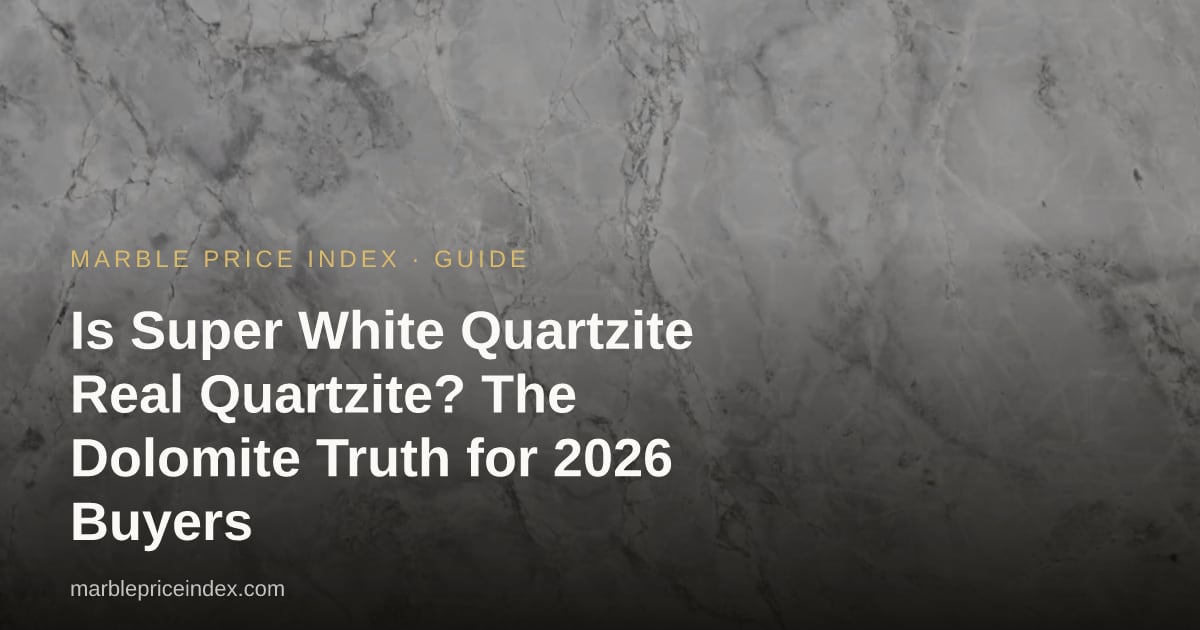
Every fabricator who has cut more than a hundred slabs has a Super White Quartzite story: a customer’s lemon juice left a dull ring on a “quartzite” island a week after installation, and nobody wants to be the one explaining that the stone they sold as bulletproof is, geologically, closer to marble. This isn’t a rumor. It’s the single most argued-about naming problem in the surface trade, and it’s worth understanding before you sign a purchase order — not after.
We sell stone, not geology lectures, but honesty about what’s in the crate is the whole point of running an open price index. So here’s the straight version: what “quartzite” actually means, why so much of what’s sold under that name is dolomitic marble, how to test a slab yourself in five minutes, and what it should cost you either way.
What “quartzite” actually means, geologically
True quartzite starts as quartz sandstone. Heat and pressure over geologic time fuse the sand grains into a dense, interlocking mass of nearly pure silica (SiO₂). The result is a stone that sits around 7 on the Mohs hardness scale — hard enough to scratch a knife blade or a piece of window glass — and is essentially inert to household acids. Lemon juice, wine, vinegar: none of it etches true quartzite, because there’s no calcium carbonate in the stone for the acid to react with. That’s the entire commercial case for quartzite over marble: the Calacatta look without the etching risk.
Marble, by contrast, is metamorphosed limestone or dolostone — calcium and/or magnesium carbonate. It sits around 3–4 on the Mohs scale (a steel knife or even a coin can mark it) and it etches on contact with acid, full stop. That dull, matte spot a lemon leaves on a polished marble counter is the surface reacting and losing its shine, not a stain that can be wiped off.
Where “Super White” and its cousins fall
Somewhere between those two categories sits a group of stones quarried in Brazil and sold worldwide as “quartzite” under trade names like Super White, White Macaubas, White Ice, Fantasy White and a rotating cast of similar labels. Independent geology testing — the kind fabricator associations and countertop inspectors have published for over a decade — has repeatedly found that a meaningful share of stone sold under these names is dolomitic marble or a marble-quartzite transitional rock, not the true metamorphic quartzite the name implies. Hardness on these slabs commonly tests in the 3–4 range, not 7, and they etch with lemon juice or vinegar just like Carrara does.
That doesn’t make the stone fake or the seller automatically a fraud — quarry veins vary block to block, trade names in this industry were never geological terms to begin with, and “quartzite” has functioned as a marketing category as much as a rock classification for as long as it’s been sold. But it does mean a buyer who chose the stone specifically to avoid marble’s etching problem can end up with exactly that problem, at a price closer to quartzite than to marble. On our own index, Super White Quartzite is priced and described precisely this way — a market estimate of $55–110/sqft for polished 2 cm slab, ex-warehouse, August 2026 data — sitting at the soft bottom of the quartzite price ladder rather than in line with harder stones like Bianco Superiore or Taj Mahal Quartzite.
Why the label gets blurry
There’s a simple economic reason this keeps happening. “Quartzite” is the hotter search term and the stronger sales pitch — buyers actively shop for it because they’ve heard it doesn’t etch. A slab that reads geologically as dolomitic marble but looks like a soft-grey Carrara sells faster and for more money labeled “quartzite” than labeled “marble,” even though the physical rock in the crate hasn’t changed at all. Quarries name their own material, distributors repeat the name down the chain, and by the time a slab reaches a US fabrication shop nobody along the way has run a lab test — they’ve just kept using the name on the paperwork.
None of that is unique to this one stone. It’s why we treat every unverified figure on this site as a market estimate rather than a fact, and it’s the same discipline that applies here: don’t take the trade name as a geology report.
Three tests you can run before you buy
You don’t need a lab. A fabricator or a reasonably careful buyer can screen a slab in the yard in under ten minutes.
1. The acid etch test
Put a drop of white vinegar or fresh lemon juice on an inconspicuous corner of the slab (an offcut, if you have one — never test on installed stone you can’t afford to mark). Wait 60 seconds, then wipe it off and look at the surface at an angle under bright light.
- True quartzite: no visible change. The polish stays uniform.
- Dolomitic marble sold as “quartzite”: a dull, slightly frosted spot appears where the acid sat. This is the single most reliable field test and it’s why we recommend it before every quartzite purchase, not just Super White.
2. The scratch/hardness test
Try to scratch the polished face with the edge of a steel knife blade or a piece of ordinary window glass, again on an offcut or an inconspicuous edge.
- True quartzite (~7 Mohs): the steel or glass won’t mark it — quartzite is harder than both.
- Dolomitic marble (~3–4 Mohs): a knife blade will leave a faint scratch.
This test is less forgiving of technique than the etch test (press too hard and you can scratch almost anything), so treat it as a secondary check, not the deciding one.
3. Ask for the mineral report
The only test that removes all doubt is an XRD (X-ray diffraction) or petrographic report from the quarry or importer, stating the calcite/dolomite content versus quartz content by percentage. Any supplier moving real volume of a stone should be able to produce one on request, or tell you plainly that they can’t. A supplier who gets cagey about a mineral report on a stone marketed as “quartzite” is telling you something.
| Test | True quartzite | Dolomitic marble (“fake” quartzite) | Time / cost |
|---|---|---|---|
| Lemon juice / vinegar etch | No mark after 60 sec | Dull, frosted spot | 2 minutes, free |
| Steel knife or glass scratch | No mark | Faint scratch | 1 minute, free |
| XRD / petrographic mineral report | >90% quartz (SiO₂) | High calcite/dolomite (CaCO₃/CaMg(CO₃)₂) | Days, supplier-dependent, sometimes a fee |
| Trade name alone | Not reliable — see above | Not reliable — see above | — |
What the price ladder tells you
Price isn’t proof of geology, but on a large enough sample it correlates with it, because harder, truly acid-resistant stone commands a premium over softer material that merely looks similar. Here’s where the Brazilian “quartzite” family sits in our August 2026 index, warehouse polished 2 cm, USD/sqft:
| Stone | Price range ($/sqft) | Position in the family |
|---|---|---|
| Patagonia Quartzite | $100–250 | Top — rare crystalline pockets, extreme variability |
| Bianco Superiore Quartzite | $80–170 | Upper — whitest, marketed against Statuario |
| Naica Quartzite | $80–170 | Upper — crystalline silver-grey |
| Perla Venata Quartzite | $80–160 | Upper |
| Taj Mahal Quartzite | $70–140 | Mid-upper — best-selling in North America |
| Mont Blanc Quartzite | $70–150 | Mid-upper |
| Calacatta Macaubas Quartzite | $60–130 | Mid |
| Sea Pearl Quartzite | $60–120 | Mid |
| Super White Quartzite | $55–110 | Bottom of the ladder |
Super White consistently prices at or near the floor of the category — not because it’s a lesser-looking stone (plenty of buyers prefer its soft grey veining to harder, brighter alternatives) but because the trade has priced in the uncertainty around what’s actually in the block. A buyer who wants genuine acid immunity and is comparing quotes should treat “priced well below the rest of the quartzite shelf” as a prompt to run the etch test, not as a bargain to grab blind. None of this is a claim about any single quarry or shipment — geology varies block to block even within one quarry name — it’s a pattern worth checking, not a verdict.
Case study: sourcing 45 sqft for a kitchen, factory-direct
A homeowner project needs 45 sqft of slab for an island and adjoining run — enough for one bundle cut plan. The buyer is deciding between staying with a local warehouse quote and going factory-direct through a mill, and wants the etch question settled before either purchase.
Local Western warehouse price: Super White Quartzite runs $55–110/sqft ex-warehouse (August 2026 market estimate). Midpoint $82.50/sqft.
- 45 sqft × $82.50 = $3,713 for slab material only, before fabrication and installation.
Factory-direct, FOB China: the index’s FOB estimate for this stone is $19–61/sqft — 35–55% of the warehouse price, since the warehouse figure already bakes in the importer’s freight, duty and margin. Midpoint $40/sqft.
- 45 sqft × $40 = $1,800 FOB at the origin port.
Landed at a US/EU port (CIF): add $4–8/sqft ocean freight and insurance for a full-container share (a 45 sqft order is far below a 20ft container’s ~2,500 sqft capacity, so in practice this would ship LCL by volume rather than as a container share — see the freight calculator at /tools/ for LCL rates). Using the container-share CIF estimate of $23–69/sqft as the reference ceiling, midpoint $46/sqft:
- 45 sqft × $46 = $2,070 landed, before duty and inland delivery, which the CIF figure explicitly excludes.
Material savings, factory-direct vs. warehouse: $3,713 − $2,070 = $1,643, or about 44% — squarely inside the index’s stated 30–60% factory-direct band. On a small 45 sqft order that gap narrows once duty, inland trucking and the higher per-unit cost of shipping less than a full container are added; it widens fast on multi-kitchen or spec-build volumes where a full container is justified.
The etch variable: none of that math changes what happens if the slab etches. If this buyer skips the vinegar test, installs the stone, and it turns out to be dolomitic marble, the cost isn’t in the original purchase — it’s in the callback. A polished-marble-style re-finish or replacement of a marked section runs into the same labor and material math as any marble repair job, on a stone the customer was told wouldn’t need it. The five-minute test at the yard is cheap risk management against a bill that isn’t.
If it does test as dolomitic marble — is that a dealbreaker?
Not automatically. A dolomitic “quartzite” is still a real, attractive natural stone, and plenty of buyers are happy with it once they know what they’re maintaining. The problem was never the rock — it’s being sold a marble-care stone under a quartzite promise. Three honest paths forward:
- Buy it anyway, at a marble-appropriate price, and seal and maintain it like marble — same sealing schedule, same acid-avoidance habits, same poultice approach to stains. See our guides on how to seal marble and marble stain removal — the techniques transfer directly.
- Switch to a stone that tests hard. Taj Mahal Quartzite and Mont Blanc Quartzite are the two most widely tested-and-confirmed true quartzites in this look family, at a real premium over Super White but with genuine acid resistance.
- Go engineered. If the priority is zero maintenance over natural veining, an engineered quartz slab (see our quartz vs. quartzite comparison) removes the etch question entirely — it’s resin-bound crushed quartz, uniform by design, not a natural-stone judgment call.
None of these is wrong. What’s wrong is paying quartzite money — or accepting a quartzite promise — for a stone that hasn’t earned it.
How to buy Super White (or any “quartzite”) with your eyes open
- Ask the supplier directly: “Is this true quartzite or dolomitic marble?” A straight answer is a good sign; deflection is not.
- Request the mineral report before finalizing a large order — it costs you nothing to ask.
- Run the vinegar test on an offcut from your actual bundle, not a showroom sample from a different block.
- Compare the quote against the full quartzite hub — if a “quartzite” quote sits well under the family’s normal range, ask why.
- Price both routes with the calculator in the PriceBuilder on the stone’s page or your own quote request so you’re comparing warehouse, FOB and landed cost on the same basis, not warehouse vs. a vague factory number.
- If your fabricator offers a leathered or honed finish, know that a matte finish hides minor etching far better than a high polish — see leathered vs. polished quartzite for the trade-offs either way.
FAQ
Is Super White Quartzite fake or a scam?
No — it’s a real, quarried natural stone, and the name reflects how the trade has marketed it for years rather than a deliberate fraud on any single sale. The issue is that a meaningful share of what’s sold under this and similar trade names tests as dolomitic marble rather than true metamorphic quartzite, so the acid-resistance promise attached to the word “quartzite” doesn’t always hold. Test before you buy rather than assume either way.
Does Super White Quartzite etch?
Slabs that test as dolomitic marble will etch with lemon juice, vinegar, wine and other household acids, the same way Carrara or any other marble does. Slabs that test as true quartzite won’t. Since both exist under this trade name, the only way to know for your specific bundle is the vinegar test on an offcut.
How can I tell if a “quartzite” slab is really marble before I buy it?
Run the vinegar or lemon-juice etch test on an inconspicuous corner or offcut: a dull spot after 60 seconds means dolomitic marble, no change means true quartzite. A steel-knife scratch test is a useful secondary check. For certainty on a large order, ask the supplier for an XRD or petrographic mineral report.
Is Super White Quartzite still a good buy if it’s dolomitic marble?
Yes, if you price and maintain it as marble rather than quartzite. It’s a real stone with genuine visual appeal at a market estimate of $55–110/sqft warehouse (August 2026 data) — competitive with mid-tier white marble — as long as you seal it, avoid acids in daily use, and accept that a polished finish will need periodic re-honing. The problem is only a mismatch between price/promise and the stone’s real properties, not the stone itself.
What’s a true quartzite alternative with a similar look?
Taj Mahal Quartzite and Mont Blanc Quartzite both deliver a comparable warm-to-cool white, veined look and are more consistently confirmed as true quartzite in independent hardness and etch testing across the trade, at a price premium of roughly $15–40/sqft over Super White in our index.
Does factory-direct sourcing change the etch risk?
No — geology is set at the quarry, not by the supply chain. Factory-direct sourcing through a mill changes the price you pay (typically 30–60% below Western warehouse, per our factory-direct sourcing model), not what’s in the block. Test the actual bundle you’re buying regardless of which route you take.