Green Marble Guide 2026: Verde Alpi vs Rainforest Green vs Ming Green
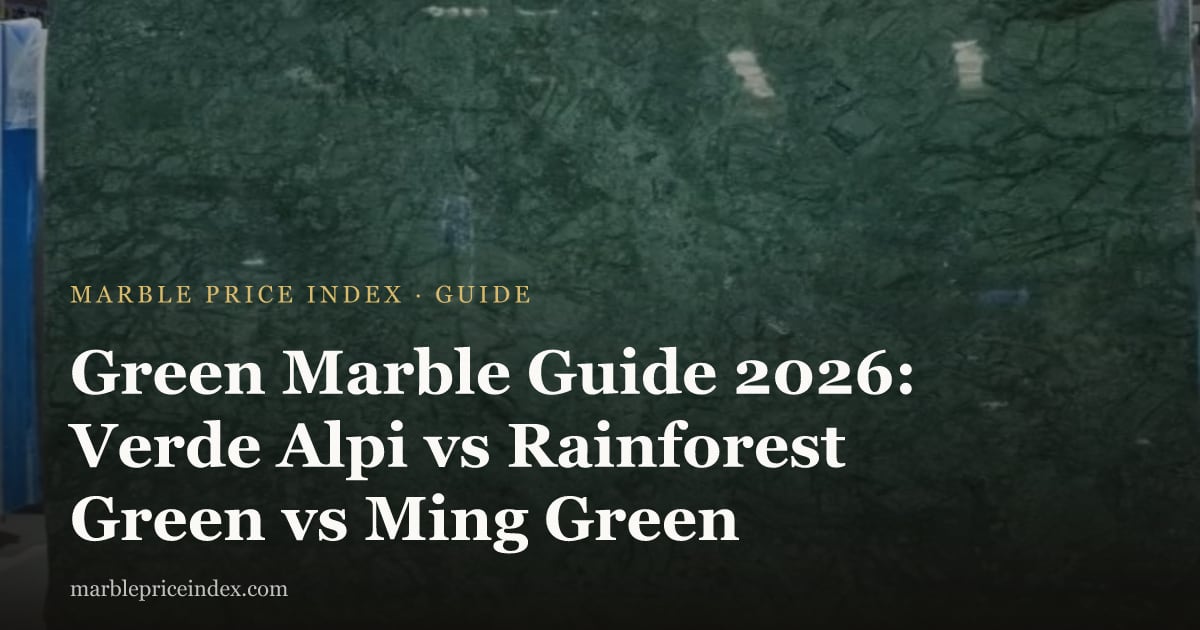
Green marble is not one stone. It is a colour family that spans a fine, almost solid dark forest green from the Italian Alps, a chaotic multi-tone brown-and-green “rainforest” pattern from India, and a soft, pale celadon from China — three completely different looking stones that all show up in a search for “green marble” and all get priced against each other by buyers who haven’t seen a slab in person. We source across this family through our partner mill, so this is the breakdown we give clients who send us a green marble reference photo and ask “which one is this, and what does it actually cost.”
This guide covers where each of the three main green marbles comes from, how to tell them apart from a photo, what drives the price spread within the family, where green marble shows up in furniture and feature applications, and a worked case study pricing a bathroom vanity two ways. All prices are US market estimates for August 2026, sourced from our green marble price data and the related green quartzite family, labelled as such throughout — the index tracks green marble as a combined family range rather than three separate named-quarry prices, because that is the level of verified data we have today.
Why “green marble” covers three unrelated stones
Geologically, these three greens are not close relatives. Verde Alpi is a true serpentine-marble breccia from the Italian Alps; Indian “Rainforest” green marble is a forsterite marble prized for its wild, non-repeating pattern; Ming Green is a soft-toned Chinese serpentine marble, technically closer to a serpentinite than calcite marble in the strict sense, sold under the marble name because that’s how the trade lists it. What actually separates them for a buyer:
- Pattern density — Verde Alpi is busy and fine-grained across the whole slab; Rainforest Green is wildly irregular, no two slabs alike; Ming Green is the quietest of the three, close to a solid tone with soft white veining.
- Colour saturation — Verde Alpi and Rainforest run deep forest to near-black green; Ming Green sits pale, closer to celadon or sage.
- Origin and freight distance — Italy, India and China respectively, which affects lead time and FOB cost more than it affects the finished look.
- Price tier within the family — driven mostly by block yield and how much waste a quarry loses to fissures, which is higher in the more dramatically patterned stones.
The green marble family at a glance
| Stone | Origin | Look | Slab price (2cm, polished, ex-warehouse) | Best for |
|---|---|---|---|---|
| Verde Alpi | Aosta Valley, Italy | Fine, dense dark-green pattern with white veining, near-solid at a distance | Toward the upper half of the $30–100/sqft green marble range | Bar tops, vanities, accent walls where a rich uniform green reads best |
| Rainforest Green (Indian) | Rajasthan, India | Wild, wood-grain-like brown-green pattern, highly directional — usually book-matched or vein-cut to show the pattern | Mid-to-upper range within the same family band | Statement islands, feature walls, bookmatched pairs |
| Ming Green | Guangdong, China | Pale soft celadon-sage with fine white webbing, closest to a solid colour | Lower-to-mid range; our partner mill’s core green stone | Trays, tabletops, bathroom accessories, volume tile runs |
| Green Quartzite (Sea Pearl, Emerald Green) | Brazil, India | Sage to deep emerald, crystalline, more durable than any of the above | $60–140/sqft — a step up in both price and hardness | Kitchen counters where acid resistance matters more than the softest green tone |
The index carries green marble as one $30–100/sqft family range because Verde Alpi, Rainforest and Ming Green currently trade within overlapping bands and we don’t yet have enough verified per-quarry factory invoices to split the range with confidence — that split is on our roadmap as verified pricing comes in from the mill. Until then, treat a specific quote against the pattern and finish you’re actually buying, not against the stone’s name alone.
Verde Alpi — the reference dark green
Quarried in the Aosta Valley in the Italian Alps, Verde Alpi is what most designers picture first when someone says “green marble”: a dense, dark forest-green ground threaded with fine white calcite veining, uniform enough at a distance to read as a solid colour but with real depth up close under raking light. It has been quarried since the early 20th century and is the best-documented of the three greens covered here, which — as with Nero Marquina in the black-marble family — is most of why it sits toward the upper half of the family’s price range rather than the strength of the stone itself.
Verde Alpi is a serpentine-rich marble, which means it takes an unusually deep, glassy polish but is also slightly softer and more prone to pitting than a pure calcite marble — sealing on a schedule matters more with this stone than with, say, Carrara. See our how to seal marble guide for the maintenance routine; green marbles generally need resealing every 6–12 months in wet applications, more often than white marble.
Rainforest Green — the pattern stone
Indian Rainforest Green (also sold as Forest Brown or Rainforest Brown, depending on which tones dominate the block) is a forsterite marble with an irregular, almost wood-grain pattern of brown, tan and green bands running through it. No two slabs look alike, which makes it a poor choice for volume tile runs but a strong one for a single statement piece — a bookmatched island, a feature wall, a dining table top — where the point is that the pattern is unrepeatable. Buyers sourcing this stone should always ask for photos of the exact slab or bundle, not a reference image; “Rainforest Green” as a name tells you almost nothing about how saturated or how brown-versus-green a specific block will read.
Because the pattern varies so much block to block, waste rates during fabrication run higher than on a uniform stone like Ming Green — expect to budget 20-25% waste on a bookmatch job rather than the 10-15% typical of a quieter marble, which shows up directly in the installed price even when the raw slab cost is similar.
Ming Green — the quiet, affordable green
Ming Green comes out of Guangdong province in southern China and is the palest, quietest member of the family: a soft sage-celadon ground with fine, gentle white webbing rather than bold veining. It reads as “green” without dominating a room, which is why it shows up so often in marble trays, tabletops and bathroom vanity tops rather than large architectural pours — the scale suits a softer stone. It’s also our partner mill’s core green product, processed at volume alongside Guangxi White, which keeps it toward the lower end of the family’s price band and gives it the shortest factory-direct lead time of the three.
For buyers comparing green marble to green quartzite for a kitchen application, Ming Green’s softness is the trade-off to weigh: it etches and scratches like any calcite marble, where green quartzite holds up to lemon juice and knife drags at a real cost premium. If the piece sees daily acid contact — a kitchen island, not a powder-room vanity — quartzite is usually the better-performing choice even though the marble looks softer and more saturated out of the box.
Green marble vs green quartzite: when durability matters more than tone
| Property | Green marble (Verde Alpi, Rainforest, Ming Green) | Green quartzite (Sea Pearl, Emerald Green) |
|---|---|---|
| Hardness (Mohs) | 3–4 (serpentine/forsterite marble) | 6.5–7 |
| Acid etching | Yes, all three | No |
| Colour range | Deep forest to pale celadon | Grey-green to deep emerald, more crystalline sparkle |
| Slab price, market estimate | $30–100/sqft | $60–140/sqft |
| Best use | Vanities, trays, tables, feature walls, low-acid surfaces | Kitchen islands, countertops, high-traffic surfaces |
If the application is decorative or low-contact — a vanity top, a coffee table, a backlit accent — the marble family wins on colour range and price. If it’s a kitchen counter that will meet citrus, wine and a knife edge daily, green quartzite costs more up front but avoids the etching that shows up on any green marble within the first year of hard kitchen use. This is the same trade-off we lay out generally in Marble vs Granite vs Quartz, just applied to the green end of the palette.
Where green marble actually gets used
Beyond countertops and vanities, green marble is currently having a design moment in a few specific categories:
- Coffee and dining tables — a solid green top on a metal or fluted-stone base is one of the fastest-growing searches in our coffee tables and dining tables categories; Ming Green and Verde Alpi both suit this scale well.
- Backlit and feature walls — translucent-cut green stone laminated over an LED panel is a signature look; we walked through a real build in our backlit green feature wall case study.
- Bathroom vanities and trays — smaller-format pieces where Ming Green’s soft tone and lower price make it the volume choice; see our marble bathroom ideas piece for pairing green stone with cabinetry and fixtures.
- Accent walls and fireplace surrounds — Verde Alpi and Rainforest Green both bookmatch dramatically at a scale a single vanity can’t show off.
Case study: a bathroom vanity top, costed two ways
A primary bathroom double vanity, 8 ft long by 22 in deep with an integrated backsplash and two undermount sink cutouts, finished area roughly 15 sqft plus 4 sqft of backsplash — 19 sqft total, bought at 15% waste for cutouts and edge work, so 22 sqft of slab. Market estimates, August 2026, mid-range US metro.
Route A — US warehouse Verde Alpi slab + local fabricator, mid-band at $65/sqft (middle of the upper half of the $30–100 family range):
| Line item | Math | Cost |
|---|---|---|
| Slab material | 22 sqft × $65 | $1,430 |
| Fabrication (edge polish, 2 sink cutouts, backsplash) | 19 sqft × $45 | $855 |
| Templating and installation | flat | $480 |
| Sealing | flat | $90 |
| Stone total, installed | $2,855 (~$150/sqft) |
Route B — factory-direct Ming Green, cut-to-size from our partner mill, panels and cut-outs finished in Guangdong, priced at an estimated $28/sqft — toward the lower end of the family band and roughly 55% below the Verde Alpi warehouse price:
| Line item | Math | Cost |
|---|---|---|
| Cut-to-size vanity top + backsplash, cutouts pre-cut | 19 sqft × $28 | $532 |
| Crating + ocean freight (share of crate, LCL for a single vanity) | flat | $260 |
| Duty + port fees | flat | $110 |
| Local templating and installation | flat | $380 |
| Sealing | flat | $90 |
| Stone total, installed |
Route B costs about 52% less, but again it is a different stone, not just a cheaper version of the same one — Ming Green’s pale, quiet pattern instead of Verde Alpi’s dense dark-green veining. A single vanity is also below the volume where a full container typically pencils out on its own; LCL freight (priced by volume, not by container share) is what makes a small factory-direct order like this workable at all — see our container shipping notes for how that math works at larger scale. Route A suits a buyer who has already chosen Verde Alpi specifically and wants it in days rather than weeks; Route B suits a builder speccing multiple bathrooms, or anyone open to the paler green look, chasing the bigger discount. Either way, run your own dimensions through our cost tools or request a quote for current numbers before committing.
Buying notes specific to each stone
- Verde Alpi: ask for a raking-light photo, not just a straight-on shot — the depth of the pattern only shows under angled light, and flat photos make every slab look more uniform than it is.
- Rainforest Green: always buy against the specific bundle or block, never the name alone; if you need matched pieces (a two-slab island, a bookmatched wall), confirm they’re cut from the same block before ordering.
- Ming Green: the best factory-direct value in the family and our partner mill’s core green stone, so lead times are typically the shortest of the three — see Importing Marble From China for how the ordering process works end to end.
- All three: reseal more often than white marble — the serpentine content in these greens makes them more porous and prone to pitting than a pure calcite stone.
FAQ
What is the most expensive type of green marble?
Within the family, Verde Alpi and heavily patterned Rainforest Green typically sit toward the top of the $30–100/sqft range (market estimate, August 2026) because of established quarry documentation and higher fabrication waste on the pattern stone. Ming Green is generally the most affordable of the three.
Is green marble the same as green quartzite?
No. Green marble (Verde Alpi, Rainforest Green, Ming Green) is a soft, calcite- or serpentine-based stone that etches with acid; green quartzite is a much harder, acid-resistant stone at a higher price point ($60–140/sqft vs $30–100/sqft). They can look similar in a photo but perform very differently on a kitchen counter.
Does green marble stain or etch easily?
Yes — all three greens covered here are calcite- or serpentine-based and etch with lemon juice, wine and vinegar, and can stain from oil if left unsealed. They also tend to need resealing more often than white marbles like Carrara because the serpentine content is slightly more porous. For a kitchen surface with daily acid exposure, green quartzite or a sealed granite alternative holds up better long-term.
Can Ming Green and Verde Alpi be mixed in the same project?
They can, but they read as clearly different stones side by side — Ming Green’s pale celadon versus Verde Alpi’s dense dark green — so it works best as an intentional contrast (a pale vanity top with a dark green tile border, for example) rather than an attempt to match them as the same colour.
Where does green marble come from?
The three main sources are the Aosta Valley in Italy (Verde Alpi), Rajasthan in India (Rainforest Green), and Guangdong province in China (Ming Green). Our partner mill processes Ming Green domestically and imports blocks of the other two for cutting, which is why lead times and factory-direct pricing vary by stone even within the same family.
How do I get an accurate current price for green marble?
Prices move with block availability and freight rates, so treat the ranges here as a starting point rather than a quote. Request a quote with your square footage, stone preference and destination port, or use our pricing tools to model warehouse versus factory-direct costs yourself.