Onyx vs Marble: Price, Translucency and the Backlit Wall Math (2026)
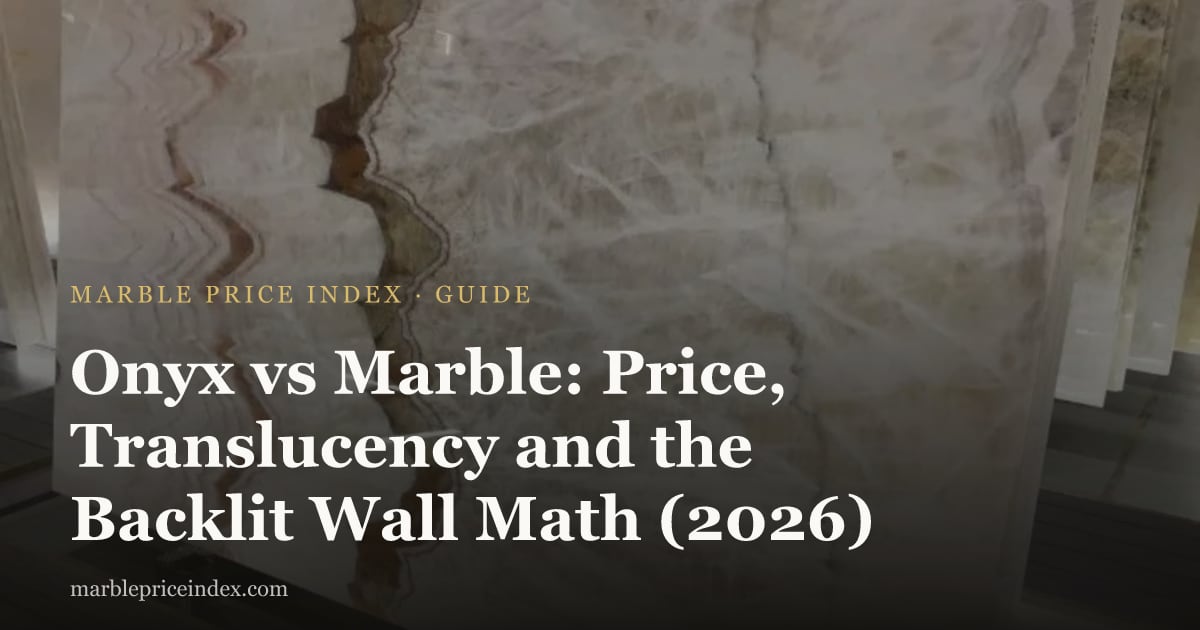
Buyers ask us “onyx or marble” more often than any other stone-vs-stone question except granite vs quartz, and it is almost always the wrong question — the two stones rarely compete for the same job. Marble is the workhorse: countertops, floors, vanities, the surfaces a household touches every day. Onyx is the specialist: a banded, light-transmitting calcite bought almost exclusively to be lit from behind. We index both — onyx at $60–200/sqft and marble from $15–300/sqft depending on the stone — as market estimates for August 2026, and this guide lays out where each one actually wins, what a backlit wall costs built two different ways, and why the “onyx vs marble” framing usually resolves into “onyx for the glow, marble for everything else” within the first five minutes of a real project brief.
Onyx and marble are not competing for the same job
Both are calcite-based stones that take a high polish, and both show up in the same design mood boards, which is why they get compared. But the comparison mostly ends at “both are elegant, veined, calcium-carbonate rock.” Marble is a metamorphosed limestone with a relatively opaque, fine-to-coarse crystalline structure — light stops at the surface, which is exactly what makes it read as a solid, grounded material for a kitchen island or a floor. Onyx is banded calcite deposited in thin mineral-spring layers, with an aligned crystal structure that lets light scatter through the slab rather than stopping at it. That structural difference is the entire reason onyx costs what it does and is used how it’s used — full details on the geology are in our onyx stone guide.
The practical result: nobody puts onyx on a kitchen island that will see cutting boards and hot pans (Mohs 3, softer and more fracture-prone than most marble), and very few buyers backlight a marble wall, because most marble simply doesn’t transmit enough light to justify the lamination and LED cost. There are exceptions on both sides, covered below, but the 80% case is clean: marble for surfaces, onyx for glow.
Price comparison: onyx, marble, and the translucent quartzites
All figures are market estimates, August 2026, for polished 2 cm slabs, ex-warehouse (Western pricing before any factory-direct discount).
| Stone | Type | Slab price ($/sqft) | Translucency | Typical use |
|---|---|---|---|---|
| Onyx | Banded calcite | $60–200 | High — the reason it’s bought | Backlit walls, bars, lamps, bathroom panels |
| Cristallo Quartzite | True quartzite | $90–200 | High | Backlit islands, feature walls — harder than onyx |
| Patagonia Quartzite | True quartzite | $100–250 | Moderate–high, variable by slab | Statement backlit walls and islands |
| Statuario | Marble | $80–220 | Low–moderate in thin cut only | Countertops, flooring; rarely backlit |
| Carrara | Marble | $40–90 | Low | Countertops, flooring, walls (not lit) |
| Calacatta | Marble | $80–250 | Low | Countertops, flooring, feature walls (not lit) |
| Black Marble / Nero Marquina | Marble | $30–90 | None | Feature walls, bathrooms, fireplaces |
Two things jump out. First, onyx is not even the most expensive translucent option — Patagonia quartzite tops the whole table, because it’s a true quartzite (Mohs 7, no resin-fill dependency) that also happens to transmit light in the right cuts, and buyers pay for that rare combination of hardness and glow. Second, ordinary marble — Carrara, Calacatta, Statuario — sits in the same dollar range as onyx and the translucent quartzites without offering the light-transmission property at all. If a buyer is choosing marble specifically to backlight it, they are usually paying marble prices for a granite-grade opacity result; that’s the mismatch this guide exists to head off.
Why onyx glows and marble mostly doesn’t
The difference is crystal structure, not “quality.” Onyx’s layered calcite deposition produces long, aligned crystals with few internal grain boundaries — light passes through with limited scattering. Ordinary marble is a jumble of interlocking calcite (or dolomite) crystals at every angle, so light entering the slab bounces around at each grain boundary and is mostly absorbed or reflected back out within a few millimetres. Cut a marble slab thin enough — under 10mm, sometimes under 6mm — and some whites (Thassos, Statuario, ultra-fine-grained Carrara lots) will pass a usable amount of light, which is why “backlit marble” projects do exist. But they are the exception that requires hand-selecting unusually fine-grained blocks, thin-cutting them (which multiplies breakage risk), and accepting a duller, more diffuse glow than onyx delivers as a baseline. Cristallo and Patagonia quartzite split the difference: true quartzite hardness with translucency that rivals onyx, which is why they show up in the same backlit-wall category as onyx rather than alongside ordinary countertop marble — see our backlit stone feature walls product page for how the category is built.
Durability and maintenance: onyx vs marble
| Property | Onyx | Marble (typical, e.g. Carrara/Calacatta) |
|---|---|---|
| Hardness (Mohs) | 3 | 3–4 |
| Fracture risk | High — banding creates natural cleavage planes | Moderate |
| Acid etching (lemon, wine, vinegar) | Yes, and shows badly on polished onyx | Yes |
| Typical fabrication | Nearly always resin-backed / mesh-reinforced, 2–3 cm minimum for structural pieces, thinner for backlit panels | Usually unbacked at 2–3 cm; resin fill for fissures only |
| Outdoor / high-traffic use | Not recommended — too fragile and too soft | Possible in covered, low-abrasion applications; not exposed flooring in freeze-thaw climates |
| Best surfaces | Backlit walls, bar fronts, lamps, powder-room panels | Countertops, flooring, vanities, fireplaces, feature walls |
Onyx is, in blunt terms, the more fragile and more expensive of the two, and it earns that position entirely on the light-transmission property. Strip the backlighting out of the brief and marble wins on every durability line — which is exactly why so few kitchen islands are onyx and so few backlit bars are marble.
Where each one actually wins
Onyx wins: backlit bars and reception walls, bathroom shower panels lit from a niche, table lamp bases, small vanity accents where the glow is the point and the surface won’t take daily abrasion. Our backlit green feature wall case study walks through a real project built on exactly this brief, using a translucent quartzite rather than onyx — the engineering (thin-cut, laminate to glass, even-emission LED panel) is nearly identical regardless of which translucent stone sits on top.
Marble wins: kitchen and bathroom countertops, flooring, dining tables, fireplace surrounds — any surface job where day-to-day durability, slab availability and fabrication cost matter more than light transmission. If the actual goal is a dramatic white kitchen rather than a glowing one, Carrara or Calacatta does the job at a fraction of onyx’s fabrication complexity, and our broader marble vs granite vs quartz guide covers the surface-durability trade-offs in more depth.
Translucent quartzite splits the difference: when a buyer wants the glow of onyx but the hardness of a countertop stone — a backlit kitchen island rather than just a wall — Cristallo or Patagonia quartzite is usually the better spec, at a similar or higher price than onyx.
Case study: pricing a backlit feature wall two ways
A lounge/bar project specs a book-matched onyx backlit wall, 2.5m wide by 2.2m tall finished (5.5 m² / 59 sqft). Market estimates, August 2026.
Route A — source raw onyx slabs from a Western warehouse, assemble with independent trades (fabricator for thin-cutting, a separate lamination shop, an electrician for the LED system):
| Line item | Math | Cost |
|---|---|---|
| Onyx slab material, mid-market ($130/sqft) | 80 sqft bought (35% waste: bookmatch seam + thin-cut engineering) × $130 | $10,400 |
| Thin-cut to 6mm + resin/mesh backing (specialist service) | 59 sqft × $45 | $2,655 |
| Lamination to low-iron glass, edge encapsulation | 59 sqft × $35 | $2,065 |
| Even-emission LED panel, dim-to-warm driver, electrical | flat | $2,800 |
| Custom frame + installation | flat | $1,900 |
| Total, installed | $19,820 (~$336/sqft) |
Route B — factory-direct engineered backlit wall kit from our partner mill, same footprint and comparable onyx grade, slab selection + thin-cut + lamination + LED panel + framing bundled into one production run:
| Line item | Math | Cost |
|---|---|---|
| Factory-direct engineered onyx wall kit (slab through LED panel, framed) | quoted for this size/grade, inside the $1,800–12,000 backlit-wall factory band | $7,200 |
| Crating + ocean freight (share of crate) | flat | $650 |
| Duty + port fees | flat | $380 |
| Local installation | flat | $1,200 |
| Total, installed | $9,430 (~$160/sqft) |
Route B runs about 52% cheaper than Route A for a comparable finished wall — not because the raw onyx is priced differently (both routes assume the same $60–200/sqft market band), but because Route A stacks three separate trade margins (fabricator, lamination shop, electrician) on top of a Western warehouse slab price, while Route B is one production run at a mill that does thin-cutting, lamination and LED integration in-house at China-scale labour cost. The trade-off is lead time: Route A can start as soon as a local fabricator has an opening; Route B typically runs 8–12 weeks from confirmed order to crated wall, because it’s a made-to-order engineered product, not a stocked item. For a bar opening on a fixed date, that lead time has to be planned around; for a renovation with a normal design-to-install timeline, it rarely matters. Run your own dimensions through our cost tools or request a quote for current numbers — onyx and quartzite block availability shifts the exact figures month to month.
Sourcing onyx and marble factory-direct from China
Iran, Turkey, Mexico and Pakistan are the volume onyx quarries, but a large share of that rough block — especially Iranian and Pakistani material — flows to Chinese mills for processing, because vacuum-resining, mesh-backing and precision thin-cutting are exactly the capabilities Chinese processors have scaled hardest. Marble sourcing is more geographically split: Italian Carrara-basin marble stays largely European for the top grades, while Chinese quarries (Guangxi White, Han White, Panda White, and volume processing of imported blocks) supply the mid-market bulk of global marble demand. For both stones, buying factory-direct rather than through a Western warehouse typically saves 30–60% on the material line, before freight and duty — the saving comes from cutting out the importer’s stocking margin, not from a lower-grade stone. The trade-off is the same one it always is with import sourcing: longer lead time, container-scale minimums that favour combining an onyx feature wall with a marble countertop or flooring order in the same shipment, and the need to inspect onyx specifically under backlighting before committing, since a slab that looks clean face-on can hide dead opaque zones that only show up with a light behind it. Our guide to importing marble from China covers the logistics end to end and applies equally to an onyx order riding in the same container.
FAQ
Is onyx more expensive than marble?
On average, yes — onyx runs $60–200/sqft against marble’s much wider $15–300/sqft band, market estimates for August 2026. But mid-to-premium marbles like Calacatta ($80–250/sqft) and Statuario ($80–220/sqft) overlap or exceed onyx pricing, so “onyx is pricier” only holds when comparing it to entry and mid-range marble, not the top of the marble market.
Can marble be backlit like onyx?
Rarely, and never as effectively. A small set of very fine-grained white marbles (Thassos, Statuario, select Carrara lots) will pass some light if cut under 10mm, but the result is dimmer and more diffuse than onyx or a translucent quartzite, and thin-cutting marble that thin sharply increases breakage risk during fabrication and shipping. If backlighting is the actual goal, onyx or a translucent quartzite like Cristallo is the more reliable spec.
Is onyx durable enough for a kitchen countertop?
Not recommended. Onyx is Mohs 3 with natural cleavage planes along its bands, softer and more fracture-prone than most marble, and etches visibly under acid. It’s built for low-abrasion, low-impact surfaces — backlit walls, bar fronts, vanity panels — not daily cutting-board-and-hot-pan use.
What’s the price difference between onyx and translucent quartzite?
They overlap. Cristallo quartzite runs $90–200/sqft and Patagonia quartzite $100–250/sqft, both market estimates, against onyx’s $60–200/sqft. Quartzite is the harder, more durable choice at a similar or higher price; onyx is more fragile but often shows a more even, saturated glow. Neither is a strict upgrade over the other — pick based on hardness needs and the specific slab’s light transmission.
How much does a backlit onyx wall cost installed?
Factory-direct engineered kits from our partner mill run $1,800–12,000 per wall depending on size and grade, before freight, duty and local installation; fully installed US projects sourced piecemeal (raw slab plus separate fabrication, lamination and electrical trades) typically land at $8,000–40,000+. The case study above breaks down both routes line by line for a 5.5 m² wall.
Where does commercial onyx come from?
Iran is the volume leader for white, green and honey onyx with the deepest color range; Turkey, Mexico and Pakistan follow. Most Iranian and Pakistani block flows to Chinese mills for the resin-fill and precision thin-cutting the stone requires, which is also why China is the practical sourcing hub for factory-direct onyx orders. Full detail in the onyx stone guide.