Onyx Vanity Top Cost Guide (2026): What a Backlit Bathroom Vanity Really Costs
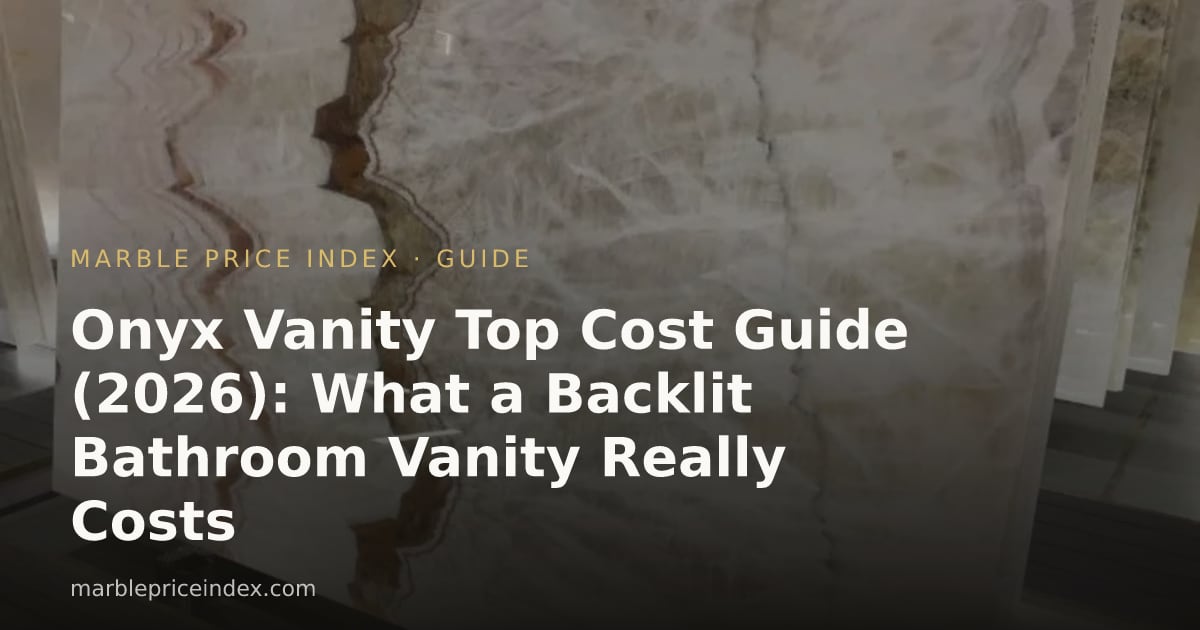
A vanity top is the smallest piece of stone in a bathroom and the one people look at hardest. That makes it the most common place for onyx to enter a house: one slab, one glowing surface, one very deliberate statement. It is also where buyers get burned, because a vanity top is priced nothing like a feature wall or a bar front. The slab is small, the waste is large, the sink cutout is the riskiest cut in the whole job, and fixed costs (freight, electrician, plumber) swamp the stone price.
This guide prices an onyx vanity top per project, not just per square foot, with a worked 48-inch case study and a plain account of when factory-direct helps and when it barely does. If you have already read our backlit onyx bar cost guide, the stone and LED logic is the same family. The structural and moisture questions are different, and so is the math.
We index onyx at $60–200/sqft as a market estimate for August 2026. Every number below stays inside that band and the other ranges in our price index.
Why a vanity top is not a small countertop
Kitchen countertops are priced on volume: 40 to 60 sqft of stone, fabrication amortised across long runs, one template visit. A vanity top is 6 to 12 sqft. Three things follow.
- Waste dominates. Onyx slabs are cut around veining and cloudy patches. On a small piece you choose the section of the slab that glows best, and the rest is offcut. Budget to buy 35–50% more stone than the finished top’s area.
- Fabrication is a flat-rate world. A sink cutout, faucet holes and a polished edge cost roughly the same on 7 sqft as on 20. Per square foot, a vanity looks expensive because the fixed work is divided by very little stone.
- The risk concentrates in one cut. Onyx is a Mohs 3 banded calcite, brittle and often veined with natural fissures. The undermount sink opening removes the middle of the slab and leaves thin, unsupported corners. Fabricators lose slabs there.
This is why two quotes for “an onyx vanity top” can differ by 3x and both be honest. One priced a 30-inch single with a vessel sink and no lighting. The other priced a 72-inch double with undermount cutouts, a backsplash and an LED panel underneath.
Onyx vs the usual vanity-top alternatives
Most vanity tops in the world are not onyx. Buyers choose it for one reason: light. If you do not need the glow, a cheaper stone does the job with far less fuss.
| Material | Slab price (sqft, market estimate) | Hardness (Mohs) | Vanity verdict |
|---|---|---|---|
| Onyx | $60–200 | 3 | Glow and drama; needs backing, low-traffic use only |
| Cristallo Quartzite | $90–200 | 7 | Translucent look with real hardness; the durable “glow” option |
| Carrara Marble | $40–90 | 3–4 | Classic white, etches but forgiving in a bathroom |
| Taj Mahal Quartzite | $70–140 | 7 | Warm cream, hard, no backlighting |
| Black Galaxy Granite | $35–70 | 6–7 | Bomb-proof and the cheapest per project |
| Travertine | $8–40 | 3–4 | Budget warm tone; fill and seal the pores |
Market estimates, August 2026, from our quartzite, granite and travertine hubs and the stone pages linked above. Onyx is the only row that glows evenly at 15–20 mm. Cristallo comes closest, at the same price ceiling and with far better scratch resistance. For the marble-versus-travertine decision in wet rooms specifically, see marble vs travertine for bathrooms.
What a vanity top project actually contains
An onyx vanity quote has up to seven components. Ask any supplier to break the number out along these lines.
- Slab priced per sqft of stone you buy, not of stone you install. Waste belongs here.
- Reinforcement. Onyx is normally bonded to a fibreglass mesh or a thin aluminium honeycomb backing. Thick 30 mm slabs are rarely used on vanities because they block light and weigh a lot.
- Fabrication. Templating, cutting, edge polish, faucet holes and the sink opening.
- Backlighting. An even-emission LED panel or diffused strip set below the top, with a driver rated for a damp zone. Our LED panel guide for translucent onyx explains colour temperature and spacing.
- Electrical. A dedicated low-voltage feed and switch or dimmer, done to the local code for wet rooms.
- Plumbing. Disconnect and reconnect of the old vanity, sink set and trap.
- Sealing. Onyx takes an impregnating sealer, and it needs re-treating every year or two.
Thickness and weight
Onyx vanity tops come in three practical builds:
| Build | Finished thickness | Typical use | Glow quality |
|---|---|---|---|
| 20 mm slab, mesh-backed | ~2 cm | Unlit vanity top, standard edge | Not translucent enough at this depth |
| 10–12 mm laminated to glass | ~2.0–2.5 cm total | Backlit floating top | Even glow when light is diffused |
| 5–8 mm laminated to low-iron glass | ~1.5–2.0 cm total | Backlit panel or thin top | Strongest glow, most fragile edge |
A finished 48-inch backlit top weighs roughly 35–55 lb depending on the glass layer. A wall-hung cabinet must be rated for that plus the sink and water. A cheap floating vanity carcass is the most common installation failure we see in RFQ questions.
The sink cutout is where projects go wrong
Everything else on the list is routine. The sink opening is where the risk sits, so choose the sink type before you choose the slab.
Vessel sink. No cutout except a faucet hole. Lowest fabrication cost, lowest breakage risk, and the sink hides part of the glowing surface. This is the safest way to own an onyx vanity.
Drop-in sink. A cutout, but the rim covers the raw edge and hides small chips. Moderate risk.
Undermount sink. The most beautiful and the riskiest. The cutout needs a polished, sealed edge, and backlighting under it can light up the cutout wall. Expect fabricators to add a 10–25% contingency or to quote the job on a “slab breakage is yours” basis. Ask who owns the loss before signing.
Integrated onyx basin. Carved from a block. Spectacular and expensive; it is a product category of its own. Check the sinks page for the factory-direct piece prices.
If a supplier promises no breakage risk on an undermount onyx cutout, they are either quoting a padded price or they have not done many.
Price per project: what to expect by size
Blended numbers from typical quotes, framed as market estimates for August 2026, not index figures. They assume mid-grade onyx inside the $60–200/sqft band and a standard polished edge.
| Vanity size | Finished area (incl. 4 in backsplash) | Stone purchased (incl. waste) | Typical local project range (stone + fab + light, before plumber) |
|---|---|---|---|
| 30 in single, vessel sink | ~4.5 sqft | ~7 sqft | $1,300–2,600 |
| 48 in single, undermount | ~8.7 sqft | ~12 sqft | $2,400–4,800 |
| 60 in double | ~11 sqft | ~15 sqft | $3,400–6,800 |
| 72 in double, backsplash + side splashes | ~14 sqft | ~19 sqft | $4,500–9,000 |
Compare with the factory-direct vanities category: $30–120 per piece for cut-to-size standard marble vanity tops. Those are not onyx and not backlit, but they show how much of a local quote is stone versus service. Onyx and backlighting are on a different curve entirely.
Worked case: a 48-inch backlit onyx vanity top
Representative example, market estimates, August 2026. A 48 × 22 in top with a 4 in backsplash: 7.33 sqft top plus 1.33 sqft backsplash, about 8.7 sqft finished. One undermount sink, single faucet hole, polished eased edge, warm-white LED panel underneath. To get a section of slab without cloudy patches we buy 12 sqft of stone.
Route A: local stone yard, local fabricator, separate trades.
| Line item | Basis | Cost |
|---|---|---|
| Onyx slab section, mid-grade, Western warehouse | $130/sqft × 12 sqft | $1,560 |
| Reinforcement, cutout, edge polish, backsplash | $95/sqft × 8.7 sqft | $827 |
| LED panel + damp-zone driver | one 48 in panel | $260 |
| Electrician (dedicated feed, dimmer) | flat | $350 |
| Impregnating sealer, two coats | flat | $60 |
| Plumber and fabricator install | flat | $450 |
| Total, Route A | $3,507 |
Route B: factory-direct finished top, shipped as a small LCL parcel.
| Line item | Basis | Cost |
|---|---|---|
| Onyx material at factory | $70/sqft × 12 sqft | $840 |
| Factory reinforcement, cutout, edge polish, backsplash | $40/sqft × 8.7 sqft | $348 |
| LED panel + damp-zone driver, packed with the top | one 48 in panel | $180 |
| Crating, LCL freight and duty allocated to one piece | flat | $520 |
| Electrician | flat | $350 |
| Plumber and install | flat | $450 |
| Total, Route B | $2,688 |
Route B is $819 cheaper on a $3,507 base, about 23%. That is well below the 30–60% saving you see on full containers or larger projects, and the reason is not subtle: freight, duty and crating are near-fixed costs, so a single 9 sqft piece carries $520 of logistics against $1,188 of stone and work. A full-bathroom set of a top, a wall panel and a shelf shares that logistics cost and pushes the saving toward 35–40%. You can test your own numbers in the cost tools, or check the freight and duty logic in the PriceBuilder on the onyx page.
The trade-offs in Route B are also plain. Lead time is 8–12 weeks from confirmed order to a crate at your door. A cracked corner in transit cannot be re-cut across town in three days; it is a claim and a remake. Buy insurance and specify edge protectors. If the vanity install date is fixed and the builder is waiting, local wins.
Care and moisture in a real bathroom
Onyx is calcite. It dissolves in acid and drinks water through its pores. A vanity top will meet toothpaste, mouthwash, perfume, cleaning spray and hair products. In practice:
- Seal on installation and re-seal every 12–24 months. Water-based impregnators are enough.
- Use a tray for products. Perfume and vitamin C serums etch the surface within minutes and leave dull rings.
- Wipe splashes rather than letting them dry.
- Keep the backlight on a dimmer. Heat from a poorly ventilated LED panel discolours amber onyx over a few years.
- Do not use vinegar, bathroom limescale removers or any “kitchen and bath” cleaner without checking the label for acid. The general etching rules in our onyx vs marble guide apply here.
In a guest powder room, onyx is a reasonable choice: low traffic, low splash. In a family bathroom where children brush their teeth twice a day, it is a maintenance commitment. That is the case for Cristallo quartzite, the harder, translucent alternative, or for an unlit marble top from the same marble bathroom ideas palette.
Choosing between a vanity top and a bigger onyx moment
Because logistics are so lopsided against small orders, the best-value onyx purchases are seldom a lone vanity top. The pattern we see in inquiries is:
- Vanity + mirror surround or wall panel, cut from adjacent slab sections so the veining continues. Shares crating and freight.
- Vanity + shower niche in the same stone, sealed carefully. Shower use is possible but only outside the direct spray zone.
- Vanity + a backlit wall sized from our feature wall case study, where the wall sets the freight and the vanity comes almost free on the same pallet.
A vanity top alone is a product for a designer who wants the glow and does not mind paying for the privilege locally. A vanity as part of a set is where factory-direct starts to matter.
How to request a proper quote
Whether you send it to a local yard or to us, put these in the request so the numbers are comparable:
- Finished dimensions, backsplash height and side splashes.
- Sink type and model (attach the cut sheet for undermounts).
- Faucet hole count and spread.
- Edge profile (see our edge profile cost guide for how profiles change fabrication price).
- Backlit or unlit, and if backlit, panel size and power.
- Who owns breakage during cutting.
- Delivery address, for freight and duty on imports.
You can send the same spec through our quote form and we will answer with a factory price, freight estimate and lead time, and say plainly when a local fabricator is the better call.
FAQ
How much does an onyx vanity top cost?
For a 48-inch single vanity with an undermount sink, expect roughly $2,400–4,800 locally before the plumber, inside the $60–200/sqft onyx slab band (market estimate, August 2026). Backlighting, thickness and breakage contingency move it more than the stone grade does. A 30-inch vessel-sink top can come in near $1,300, while a 72-inch double with side splashes can reach $9,000.
Can onyx be used in a bathroom?
Yes, on a vanity top and on dry wall areas, if it is sealed and you accept the etching risk. It is not a good match for shower floors, tub decks or any surface that takes daily acid contact. In a powder room it works well. In a busy family bath, consider Cristallo quartzite or an unlit marble.
Do I have to backlight an onyx vanity?
No. Unlit onyx still shows its banding and colour depth, and a 20 mm mesh-backed top is cheaper and sturdier. Backlighting adds roughly $180–350 for the panel and driver plus an electrician, and it needs a thin laminated build, which is the more fragile version.
Is a factory-direct onyx vanity top worth it?
For a single piece, the saving is modest: in our worked example about 23%, because freight, duty and crating are nearly fixed. For a bathroom set or a full container of mixed pieces, the saving moves toward the 30–60% range we see for factory-direct pricing in general, at the cost of an 8–12 week lead time and a remake claim if the piece breaks in transit.
Which sink is safest with an onyx top?
A vessel sink. There is no large cutout, so breakage risk and fabrication cost both drop. A drop-in is the next safest choice. An undermount is the most attractive and the riskiest, and you should agree in writing who pays if the slab cracks during cutting.
How thick should a backlit onyx vanity top be?
Aim for 10–12 mm of stone laminated to glass, or 5–8 mm for the strongest glow, giving a finished thickness of about 1.5–2.5 cm. Thick 20–30 mm onyx does not transmit light evenly and adds weight your cabinet may not be rated for.