Taj Mahal Quartzite vs Calacatta Marble: Price and Durability Compared (2026)
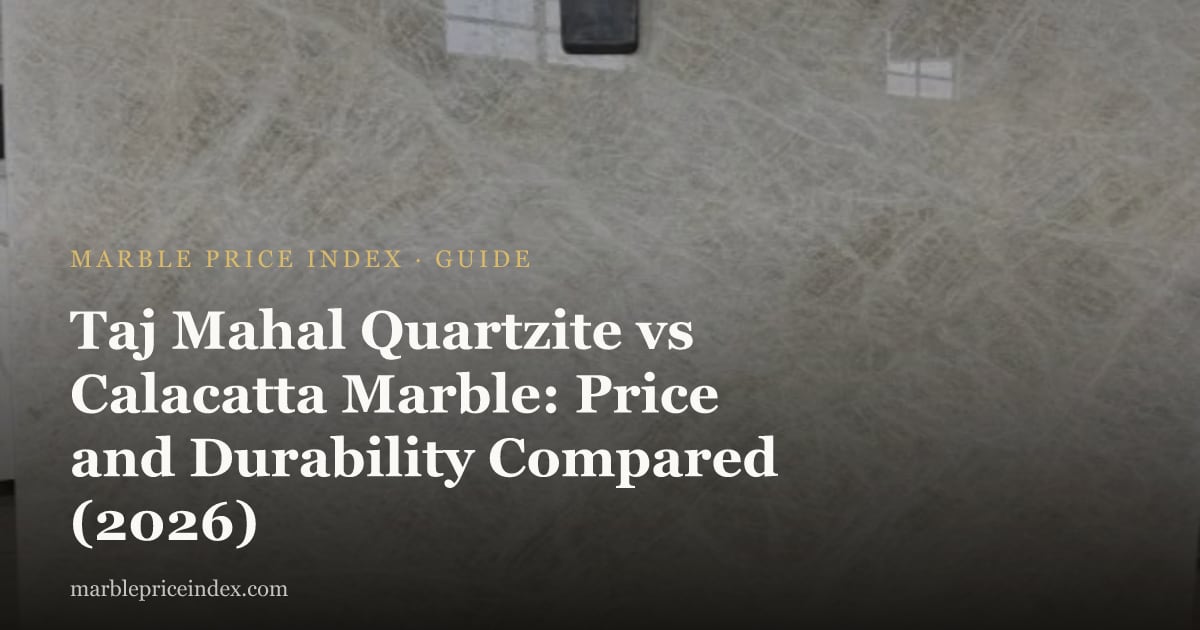
Every luxury-kitchen designer has had this conversation: the client wants Calacatta’s white ground and bold gold-grey veining, then flinches at the maintenance lecture — no lemon on the counter, reseal every year, watch the wine glass. Taj Mahal quartzite exists because of that flinch. It reads like a softer Calacatta and behaves like granite. This guide puts real numbers next to the two stones — warehouse, factory-direct FOB, and landed CIF — plus the geology that explains why one etches and the other doesn’t.
Two different rocks that look related
They are not cousins. Calacatta is a metamorphosed limestone — calcium carbonate, formed from ancient seabed sediment, recrystallized under heat and pressure in the Apuan Alps. Its mineral is calcite, which reacts with any acid stronger than pH 7 and dissolves the polish on contact.
Taj Mahal, like all true quartzite, started as sandstone — silica sand fused under enough heat and pressure to weld the quartz grains into a single interlocking mass. Quartz doesn’t react to household acids. That single mineralogical fact is the entire reason this comparison exists: Taj Mahal was selected and marketed specifically because its color story overlaps with Calacatta while its chemistry overlaps with granite.
The practical shorthand: Calacatta is roughly 3–4 on the Mohs hardness scale, easy to scratch with a knife dragged wrong and easy to etch with citrus. Quartzite sits around 7 Mohs, close to the quartz in a kitchen knife blade — it won’t etch from wine or lemon and shrugs off scratches that would mark marble or even most granite.
Price: warehouse, factory-direct FOB, and landed CIF
Slab prices below are Western-warehouse polished 2 cm, ex-warehouse — market estimates for August 2026. FOB is the factory-direct quote at origin (Marina di Carrara for Calacatta, Vitória for Taj Mahal); CIF adds ocean freight and insurance to a US or EU port. Duty and inland delivery aren’t included in either factory figure.
| Stone | Origin | Warehouse $/sqft | Factory FOB $/sqft | Landed CIF $/sqft |
|---|---|---|---|---|
| Calacatta Marble | Carrara, Italy | $80–250 | $28–138 | $32–146 |
| Taj Mahal Quartzite | Brazil (processed via partner mill) | $70–140 | $24–77 | $28–85 |
The gap starts at the quarry. Raw Calacatta block runs a market-estimate $4,750–12,100 per tonne, against $3,750–6,050 per tonne for Taj Mahal block — roughly double at the low end and double again at the high end. That’s not processing cost or brand markup; it’s geology. Calacatta forms in narrow, unpredictable veins within the Carrara basin, so a block that yields large, well-matched, heavily-veined slabs is genuinely scarce and priced like it. Quartzite blocks form in broader, more consistent deposits, so yield per tonne is more predictable and the price curve is flatter.
Two things jump out from the finished-slab numbers. First, Calacatta’s range is wider at every stage — book-matched, high-vein blocks command a real premium that plain-ground blocks don’t, so the number depends heavily on which specific slab you’re buying, not just the stone name. Taj Mahal’s range is tighter because quartzite blocks vary less dramatically by veining grade. Second, at the top end the two stones’ factory-direct prices nearly meet — a rare, heavily-veined Calacatta block and a premium Taj Mahal block can land at similar CIF numbers, which is the scenario where the decision comes down entirely to durability and look, not budget.
The “Calacatta look” quartzite family
Taj Mahal isn’t the only quartzite selling on Calacatta’s coattails. If the goal is specifically “Calacatta look, quartzite chemistry,” it’s worth comparing the whole family before picking one:
| Stone | Veining character | Warehouse $/sqft | Closest marble match |
|---|---|---|---|
| Taj Mahal Quartzite | Soft taupe-gold movement, warm ivory ground | $70–140 | Calacatta Gold |
| Perla Venata Quartzite | Bolder, more dramatic flowing veins | $80–160 | Calacatta (classic) |
| Mont Blanc Quartzite | Cooler grey-brown veining | $70–150 | Carrara / Calacatta |
| Bianco Superiore Quartzite | Brightest white ground, soft grey veins | $80–170 | Statuario |
| Calacatta Macaubas Quartzite | Quiet, linear grey veins | $60–130 | Calacatta (subtle grade) |
If Calacatta’s soft grey-gold veining on warm white is the target, Taj Mahal is the closer match. If it’s Calacatta’s bolder, more contrasty veins on a brighter white, Perla Venata or Bianco Superiore sit closer. Worth noting: Taj Mahal alone carries roughly 32,000 monthly US searches by our demand data — more than four times Calacatta’s own search volume — which tells you how much of the market has already migrated toward the durable alternative.
Durability and daily care, side by side
| Factor | Calacatta Marble | Taj Mahal Quartzite |
|---|---|---|
| Mohs hardness | ~3–4 | ~7 |
| Acid / etch resistance | None — citrus, wine, vinegar etch on contact | High — quartz doesn’t react to household acids |
| Scratch resistance | Moderate — knife blades and grit can mark it | High — close to knife-blade hardness |
| Sealing schedule | Every 6–12 months (kitchen use) | Every 1–2 years, some slabs less |
| Heat tolerance | Good, but thermal shock can crack thin slabs | Very good — quartzite handles direct heat well |
| UV stability | Good indoors | Excellent — stable for outdoor kitchens too |
| Polish/gloss retention | High-gloss but shows every etch mark starkly | Holds polish without etch-dulling |
| Resale / prestige signal | The historic benchmark — “real Calacatta” still reads as the top tier to some buyers | Increasingly recognized as premium; still occasionally mistaken for “not real marble” by uninformed buyers |
Sealing frequency for Taj Mahal is lower but not zero — quartzite still has some porosity depending on the block, and treating it as maintenance-free is how oil stains sneak in. The real gap is etch resistance, not sealing schedule. For a deeper walkthrough of the marble side of that table, see the marble stain and etch care guide; the quartzite cleaning routine covers the lighter-touch quartzite equivalent.
Case study: a 50 sqft kitchen, material cost only
Here’s a representative example — a 50 sqft island-plus-perimeter kitchen (12 sqft island, 38 sqft perimeter and backsplash returns), 2 cm polished slab, cut-to-size with sink and cooktop cutouts. Numbers are market estimates for a mid-grade block of each stone, not the cheapest or the rarest.
Calacatta Marble
- Western warehouse slab: $150/sqft × 50 sqft = $7,500
- Factory-direct FOB (Marina di Carrara): $65/sqft × 50 sqft = $3,250
-
- Ocean freight and insurance (~$6/sqft): +$300
- Landed CIF at destination port: $71/sqft × 50 sqft = $3,550
- Material-stage saving vs warehouse: $7,500 − $3,550 = $3,950 (53%)
Taj Mahal Quartzite
- Western warehouse slab: $95/sqft × 50 sqft = $4,750
- Factory-direct FOB (Vitória): $40/sqft × 50 sqft = $2,000
-
- Ocean freight and insurance (~$5/sqft): +$250
- Landed CIF at destination port: $45/sqft × 50 sqft = $2,250
- Material-stage saving vs warehouse: $4,750 − $2,250 = $2,500 (53%)
The savings percentage lands in the same 50%+ band for both stones — sourcing factory-direct compresses the price gap between them at the material stage: Calacatta’s landed cost ($3,550) is only about $1,300 more than Taj Mahal’s ($2,250) on this order, versus a $2,750 gap at Western warehouse pricing. Fabrication and installation — templating, edge profiles, cutouts, labor — sit on top of either number and don’t change much with the country of origin; as a category, countertops run $40–250/sqft installed in the US, which is the number that narrows the two stones’ total project cost even further once labor is added. Duty and inland freight aren’t included above and vary by port and HS classification — run your own numbers on the price builder before committing to a quantity.
When Calacatta still wins
Durability isn’t the only variable a kitchen designer is optimizing for. Calacatta wins when:
- Provenance matters to the buyer. “Quarried in Carrara” carries weight in some markets — galleries, heritage renovations, ultra-high-end resale — that no quartzite marketing overcomes.
- The vein pattern is the point. Calacatta and its relatives (Calacatta Gold, Statuario) offer bolder, more painterly veining than most quartzite blocks achieve. If a client has seen a specific slab photo and wants that exact vein, marble’s broader selection wins.
- Low-splash applications. A fireplace surround, a powder-room vanity, or a feature wall rarely sees citrus or wine. Marble’s fragility matters far less where acid exposure is low — see the full breakdown of Carrara vs Calacatta vs Statuario for picking within the white-marble family itself.
When Taj Mahal wins
- Working kitchens with kids, wine, and citrus. This is the scenario Taj Mahal was built to solve. No etch rings, no panic when a lime rolls across the counter.
- Lower long-term maintenance cost. Fewer resealing cycles and zero acid-driven re-polishing bills over a 10-year ownership horizon.
- Outdoor or high-UV kitchens. Quartzite’s stability under sun and heat makes it a safer choice for an outdoor island than marble, which can discolor and etch faster outdoors.
- Buyers who want the Calacatta look without the maintenance conversation. For cabinet pairings that work with Taj Mahal specifically, see what color cabinets go with Taj Mahal quartzite.
Sourcing notes: ports, lead time, and MOQ
Calacatta ships from Marina di Carrara, Italy — established export infrastructure, but Italian block and slab costs sit at the top of the market, which is why the FOB and CIF ranges above stay wide. Taj Mahal ships from Vitória, Brazil, then is commonly cut-to-size at partner mills in China before final shipment — the same factory-direct model that applies across this index’s quartzite hub. Both routes support full 20ft container orders (~2,500 sqft of 2 cm slab) or LCL for smaller jobs; a single 50 sqft kitchen like the case study above ships LCL, at a per-cubic-meter rate rather than a full container share. For slab orders under container volume, get a landed quote through /quote/ rather than assuming the container-rate CIF numbers above apply pro-rata — LCL pricing runs differently.
FAQ
Is Taj Mahal quartzite cheaper than Calacatta marble?
At Western warehouse pricing, yes — $70–140/sqft versus $80–250/sqft, and Calacatta’s ceiling is far higher because rare book-matched blocks command a real premium. Factory-direct, the gap narrows: landed CIF quotes can run $28–85/sqft for Taj Mahal versus $32–146/sqft for Calacatta, and at the top end the two nearly meet.
Does Taj Mahal quartzite etch like marble?
No. Quartzite is quartz-based (Mohs ~7) and doesn’t react to the citric and acetic acids that etch calcite-based marble on contact. This is the core reason it’s marketed as a Calacatta alternative — the color story is similar, the chemistry is not.
Is Taj Mahal actually real quartzite, or is it dolomite marble sold as quartzite?
Genuine Taj Mahal from established Brazilian quarries is true quartzite. The mislabeling problem in the market is real but concentrated in a handful of other “quartzite” trade names that are actually dolomitic marble with a quartzite-adjacent look — always ask for a scratch/acid test result or lab hardness data on the specific block, not just the trade name.
Which looks more like Calacatta — Taj Mahal or another quartzite?
Taj Mahal’s soft, warm gold-taupe veining is the closest match to Calacatta Gold’s warmth. For a cooler, bolder vein closer to classic Calacatta, look at Perla Venata quartzite instead.
Do I still need to seal Taj Mahal quartzite?
Yes, but less often — typically every 1–2 years versus 6–12 months for a heavily used marble kitchen counter. Quartzite still has some porosity depending on the block; skipping sealing entirely risks oil staining even though acid etching isn’t a concern.
Can Taj Mahal quartzite go outdoors?
Yes — its UV stability and heat tolerance make it a safer outdoor-kitchen material than Calacatta marble, which can discolor and etch faster under sun and weather exposure. For a wider outdoor-material comparison including granite, see the granite vs quartz breakdown for durability logic that carries over to outdoor quartzite too.