Marble Kitchen Ideas: 10 Stone-and-Cabinet Combinations with Real Prices (2026)
Most “marble kitchen ideas” articles are a scroll of photographs with no stone names and no prices. That is not much use if you actually have to buy the slab. This guide is written from the trade side: ten complete combinations — stone, cabinet colour, hardware, backsplash, floor — each with the stone’s current slab price band, a line on why the palette works, and a budget alternative that gets you 80% of the look for a fraction of the cost. It ends with a lighting and finish section (the part most people skip and then regret) and an honest paragraph on etching, because a marble kitchen is a maintenance commitment and we would rather you knew that before the slab is templated.
All prices are US market estimates for August 2026, ex-warehouse for polished 2 cm slabs unless stated. Factory-direct pricing from our partner mill in China is typically 30–60% below those numbers; where that changes the choice, we say so.
How to read the price bands
Every stone below carries a slab price band per square foot. That is the material cost only. To get to an installed countertop in the US, add roughly $40–60/sqft for fabrication and installation, and buy about 30% more slab than finished area to allow for veining layout and waste. A $55/sqft Carrara slab therefore lands around $110–130/sqft installed; the full breakdown is in our marble countertops cost guide. Where a combination uses quartzite or granite instead of marble, the same rule applies.
The ten combinations
1. Calacatta, warm white shaker, unlacquered brass, full-height slab splash, wide oak boards
- Stone: Calacatta marble — $80–250/sqft slab, market estimate August 2026. Bright white ground, bold grey-gold veins.
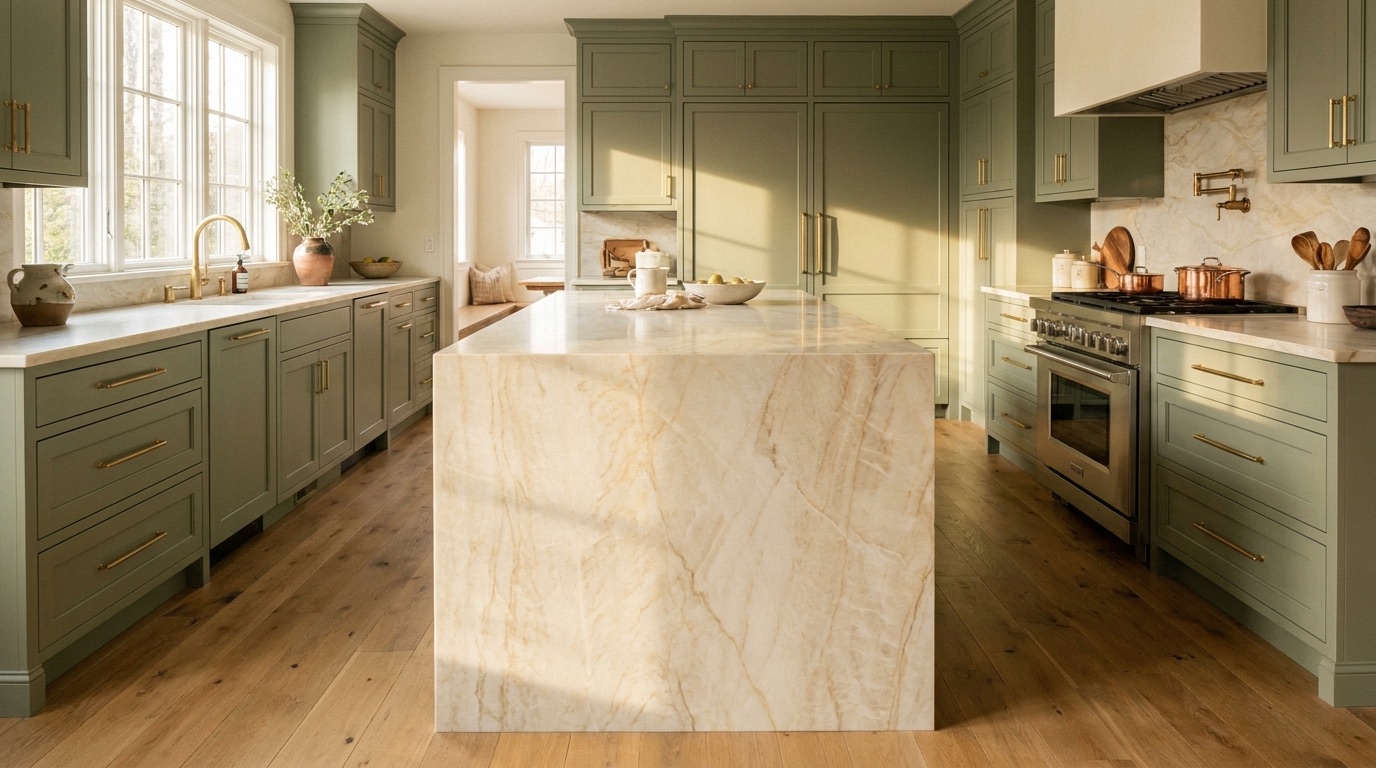
- Cabinets: warm white (Swiss Coffee, White Dove), shaker or slab front.
- Hardware: unlacquered brass that will patina.
- Backsplash: the same Calacatta slab run to the underside of the uppers or to the ceiling behind the range.
- Floor: wide-plank white oak, matte.
- Why it works: this is the reference “marble kitchen” of the 2020s. The warm white cabinet agrees with the stone’s white ground, the brass picks up the gold in the veins, and the oak floor stops the room from reading clinical. Calacatta is the flagship stone precisely because the veins are wide enough to read across a room — which is also why the price band is so wide. Book-match the island and the splash and it becomes a listing headline.
2. Carrara, mid-grey painted cabinets, black hardware, white subway tile, honed grey porcelain floor
- Stone: Carrara marble — $40–90/sqft slab. Cool white to light grey with soft feathery veining.
- Cabinets: warm mid-grey (Chelsea Grey, Coventry Grey).
- Hardware: matte black bar pulls.
- Backsplash: classic 3×6 white subway, thin grey grout.
- Floor: honed grey porcelain, large format.
- Why it works: Carrara is softer and greyer than Calacatta, so it sits comfortably with grey cabinets rather than fighting them. Black hardware gives the scheme an edge; the subway tile keeps the budget in check where the slab does not need to be. Carrara is the workhorse of the Italian whites and the most forgiving to buy — the sheer volume of blocks processed means slab-to-slab consistency is good and the price band is tight. See Carrara vs Calacatta vs Statuario if you are choosing between the whites.
3. Statuario island, charcoal perimeter, brass, plaster walls, terrazzo floor
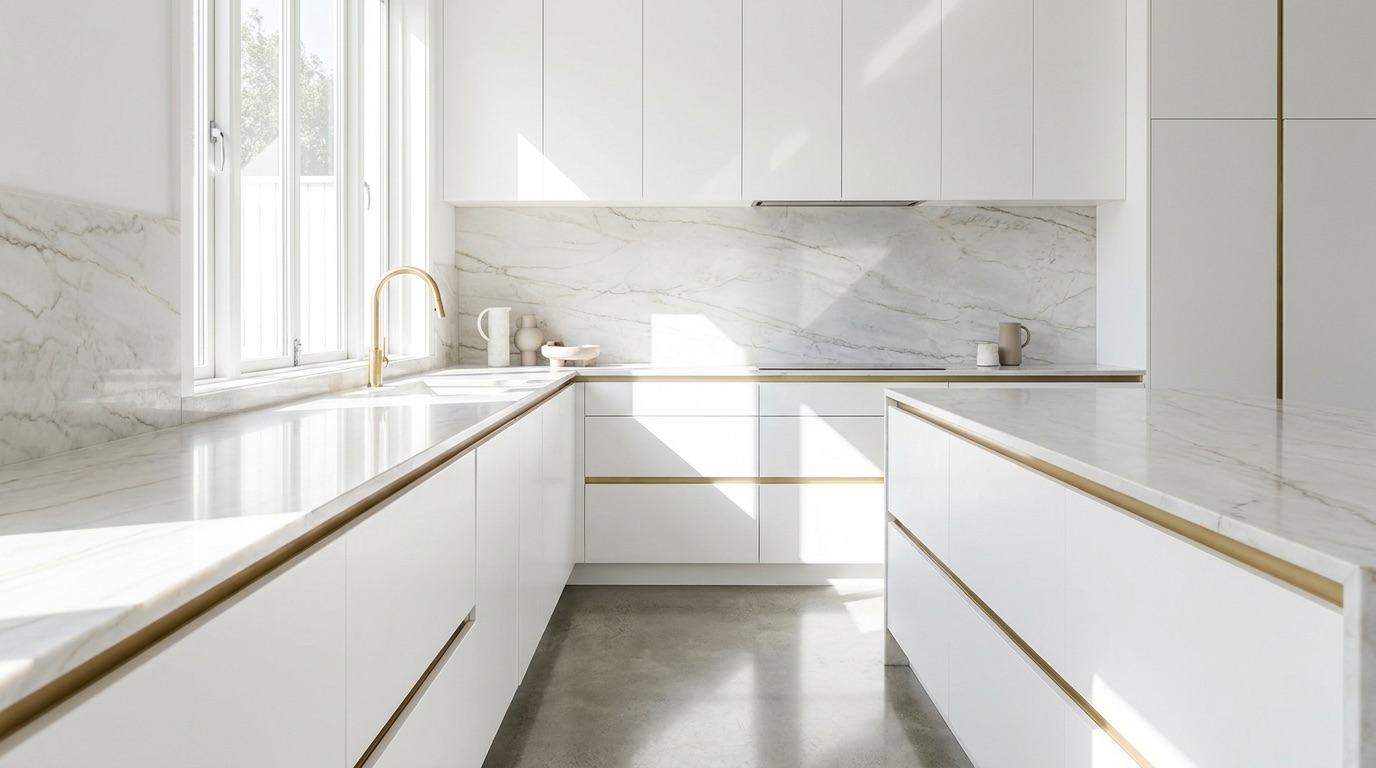
- Stone: Statuario marble — $80–220/sqft slab. Luminous white ground, bold grey veins.
- Cabinets: charcoal (Iron Ore, Kendall Charcoal) perimeter, waterfall Statuario island.
- Hardware: aged brass.
- Backsplash: limewash plaster, no tile.
- Floor: cement-based terrazzo with white and grey chips.
- Why it works: Statuario is the whitest of the classic Italian whites, so it looks brightest against something dark. Putting the expensive stone on the island only — 20–30 sqft — and running a cheaper surface on the perimeter is the single most effective way to have a statement marble kitchen on a controlled budget. The terrazzo floor echoes the marble chips without competing with the veining.
4. Calacatta Viola island, cream cabinets, antique brass, cream zellige, honed limestone floor
- Stone: Calacatta Viola — $90–250/sqft slab. White field, violet-burgundy veins.
- Cabinets: cream (Bone, Navajo White) with a slab front.
- Hardware: antique brass or burnished bronze.
- Backsplash: cream zellige, laid tight.
- Floor: honed limestone or a warm travertine — see travertine at $8–40/sqft for the budget route.
- Why it works: Viola is the designer stone of the decade and it does not want competition. Cream cabinets let the wine-coloured veins carry the room; brass warms the purple; the zellige adds hand-made texture without pattern. Supply of well-matched Viola slabs is tight, so buy from photographs of the actual bundle and expect a premium for a book-matched pair.
5. Nero Marquina, white oak flat-front, black hardware, white slab splash, pale oak floor
- Stone: Nero Marquina — $40–90/sqft slab. Jet black with lightning-white veins.
- Cabinets: rift-cut white oak, integrated pulls.
- Hardware: minimal black or none.
- Backsplash: a contrasting white slab (Carrara or Guangxi White) behind the range.
- Floor: pale oak, matte lacquer.
- Why it works: black marble on light wood is a Scandinavian-modern classic. Nero Marquina’s white veins are the link to the white splash; the oak stops the black from being heavy. Nero Marquina etches visibly on a polished finish — a honed finish is the working recommendation for a black marble counter (see the finish section below).
6. Panda White book-matched island, deep green perimeter, brass, same-stone splash, black granite floor
- Stone: Panda White — $50–130/sqft slab. White ground, bold black brush-stroke veins.
- Cabinets: deep green (Rookwood Dark Green, Cascades) perimeter, book-matched Panda White island.
- Hardware: brass.
- Backsplash: the same Panda White, book-matched behind the range.
- Floor: honed black granite tiles, $30–80/sqft slab, less as tile.
- Why it works: Panda White is one of China’s signature stones and one of the few marbles whose veining is dramatic enough to book-match into a real pattern. Green is complementary to the black-and-white without competing; brass warms it. This is a gallery-wall kitchen — the island is the picture.
7. Emperador, cream shaker, oil-rubbed bronze, cream tile, dark walnut floor
- Stone: Emperador marble — $35–85/sqft slab. Chocolate brown with fine cream webbing.
- Cabinets: cream shaker with a light glaze.
- Hardware: oil-rubbed bronze cup pulls.
- Backsplash: hand-made cream tile, 4×4.
- Floor: dark walnut or a walnut-tone travertine.
- Why it works: the classic warm traditional kitchen — English country house, Tuscan, hotel bar. Emperador is the reference brown marble, widely processed in China with consistent block supply, so pricing is stable and matching is easy. It also hides etching and daily wear better than any white marble because the ground is dark and busy.
8. Green marble island, warm white perimeter, brass, white slab splash, oak floor
- Stone: green marble — $30–100/sqft slab. Verde Alpi, Rainforest Green, Ming Green.
- Cabinets: warm white perimeter, green marble island — or the reverse, green cabinets with white stone.
- Hardware: brass.
- Backsplash: white slab or plaster.
- Floor: oak.
- Why it works: green marble is having its moment in tables and vanities and it translates well to an island. Kept to one surface, it reads as jewellery rather than wallpaper. Ming Green is the softer celadon; Verde Alpi and Rainforest are the saturated forest greens with white webbing. Price varies a lot within the family — sample the specific quarry.
9. Guangxi White throughout, warm white slab-front, brushed nickel, same-stone splash, large-format porcelain floor
- Stone: Guangxi White — $15–35/sqft slab. Cool white with light grey veining — China’s Carrara.
- Cabinets: warm white, flat front.
- Hardware: brushed nickel or integrated.
- Backsplash: same stone, full height.
- Floor: 24×48 white porcelain.
- Why it works: this is the volume-project marble kitchen — developer housing, serviced apartments, hotels — and it looks far more expensive than it costs. Guangxi White gives the Carrara aesthetic at a third of the Carrara price, and because it is the core factory stone for our partner mill, factory-direct cut-to-size countertops start from $18/sqft finished. Run the same stone as slab splash and even as floor tile ($6–40/sqft factory) and the whole kitchen reads as one material.
10. Onyx backlit bar, black cabinets, brass, dark plaster, black floor
- Stone: onyx — $60–200/sqft slab. Translucent amber, honey, green and white bands.
- Cabinets: near-black.
- Hardware: brass.
- Backsplash: dark plaster; the onyx bar front or splash is backlit.
- Floor: black granite or dark porcelain.
- Why it works: onyx is not a working countertop — it is fragile and it etches — but as a backlit bar front, splash panel or breakfast-bar top it is the single most dramatic thing you can put in a kitchen. Keep it away from the sink and hob. Our partner mill ships onyx as engineered backlit wall kits with the LED panel pre-fitted, from $1,800; the backlit feature wall case study shows the build.
Look → stone → budget alternative
The table below maps each look to the reference stone and to the alternatives we would actually recommend if the reference stone is out of budget or the maintenance is a concern. Prices are slab, market estimates August 2026.
| The look | Reference stone | Slab $/sqft | Budget / low-maintenance alternative | Slab $/sqft | What you give up |
|---|---|---|---|---|---|
| Bold white-and-gold veining | Calacatta | $80–250 | Guangxi White (marble); Perla Venata quartzite; Calacatta-look quartz ($18–45 factory) | $15–35 / $80–160 / $18–45 | Vein scale (Guangxi); nothing much (Perla Venata, but it costs the same); uniqueness and heat tolerance (quartz) |
| Soft grey feathered white | Carrara | $40–90 | Guangxi White; Mont Blanc quartzite | $15–35 / $70–150 | Slight warmth and vein character (Guangxi); budget (Mont Blanc) |
| Bright pure white with grey | Statuario | $80–220 | Bianco Superiore quartzite; Han White | $80–170 / $25–70 | Etch resistance is a gain, not a loss (Bianco Superiore); veining (Han White is nearly plain) |
| Warm cream with gold | Calacatta Gold | $100–300 | Taj Mahal quartzite | $70–140 | Nothing in looks; you gain hardness — Taj Mahal is the best-selling stone in the US for a reason |
| Purple-wine veining | Calacatta Viola | $90–250 | No honest equivalent; keep Viola to the island | — | — |
| Black with white veins | Nero Marquina | $40–90 | China Black / Mongolia Black (black marble); Absolute Black granite | $30–80 / $30–75 | Vein sharpness (Chinese blacks); veining entirely (Absolute Black — but zero etching) |
| Black-on-white brush strokes | Panda White | $50–130 | Patagonia quartzite for drama at a higher price; large-format porcelain slab for the look at a lower one | $100–250 / $20–55 | Repeat pattern (porcelain) |
| Warm brown | Emperador | $35–85 | Walnut travertine, vein-cut and filled | $8–40 | Polish depth |
| Green | Green marble | $30–100 | Sea Pearl or green quartzite; Ubatuba granite | $60–120 / $30–60 | Webbing pattern (quartzite is wavier); polish (Ubatuba is flecked) |
| Translucent glow | Onyx | $60–200 | Cristallo quartzite — backlights, and it is a working surface | $90–200 | Colour banding |
Two patterns in that table are worth spelling out. First, for every white marble look there is a quartzite that delivers the same aesthetic without etching — at a similar or higher slab price. You are not saving money by going quartzite; you are buying durability. Second, for every classic marble there is a Chinese-quarried stone at a third to a half of the price that gives the look at volume — Guangxi White for Carrara, China Black for Nero Marquina, Han White for plain white. That is the lever that makes a marble kitchen affordable in a development, and it is why the types of marble guide spends as much time on Chinese stones as Italian ones.
Lighting and finish: the two decisions that make or break it
Colour temperature
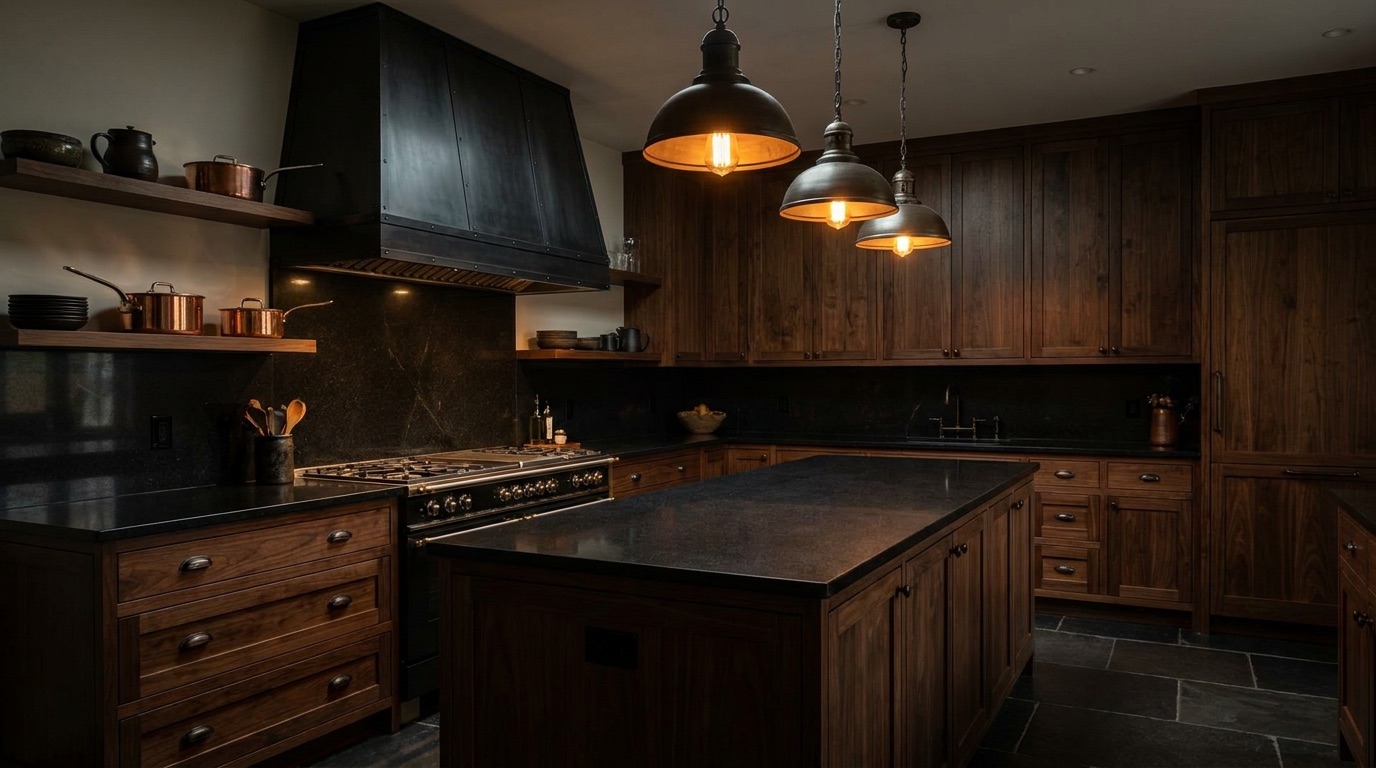
Marble is white, and white takes the colour of the light on it. Under 2700 K warm LEDs a Carrara slab reads cream and its grey veins go soft; under 4000 K it reads blue-white and the veins sharpen. Neither is wrong, but the cabinet colour has to be chosen under the same light. Take the slab sample and the cabinet door sample home and look at them under the actual pendants at night — that is when the kitchen is used. Our working rule: 3000 K for warm whites and creams with brass; 3500 K for greys and blacks with nickel or black hardware. Under-cabinet lighting is where etching shows first, because raking light catches every dull spot; put the strips at the front edge of the upper cabinet, not the back, so the light hits the counter head-on.
Polished vs honed vs leathered
- Polished is the showroom finish. It gives the deepest colour and the most reflection, and it shows every etch mark as a dull spot on a shiny surface. Best for islands that are looked at more than cooked on, splashes, and any stone kept away from acid.
- Honed (matte) is the working-kitchen finish. Colour is slightly lighter, veins slightly softer, and etching becomes almost invisible because there is no polish to dull. Every white marble kitchen we would specify for a family goes honed. It costs nothing extra from the factory; some warehouses charge $5–10/sqft to hone a polished slab.
- Leathered (textured matte) hides everything, but it is more common on granite and quartzite than marble; on soft marbles it can trap dirt in the texture. Excellent on Sea Pearl and the black granites.
Edge profile
Eased or pencil edge, 2 cm or 3 cm mitred to look thick — that is the modern default and the cheapest to fabricate. Ogee and bullnose belong with combination 7 (Emperador, traditional). A mitred waterfall edge on the island roughly doubles the fabrication cost of that piece; budget for it. Slab thickness options are covered in marble slab sizes and thickness.
An honest note on etching
Marble is calcite. Acid — lemon, vinegar, wine, tomato, most soft drinks — dissolves the surface on contact and leaves a dull mark. Sealing does not stop this: sealers stop staining (pigment soaking in), not etching (polish being chemically removed). Anyone who tells you a sealer makes marble “etch-proof” is selling the sealer.
What actually manages etching in a marble kitchen:
- A honed finish — the mark is there, but you cannot see it.
- Behaviour — wipe acids up promptly; use boards; keep the lemon-squeezing over the sink.
- Acceptance — a Carrara counter after five years has a patina, like a copper pan. In Europe this is normal. In the US it is a mindset shift.
- Repair — unlike engineered surfaces, marble can be re-honed or re-polished in place, typically $200–500 per visit. Details in how to seal marble and how to clean marble countertops.
If none of that is acceptable, choose the quartzite from the alternatives table for the same look. If heat, seams and resale are not concerns, engineered quartz is the zero-maintenance answer — see quartz vs marble for the full comparison.
Case study: combination 3 (Statuario island, cheaper perimeter), costed
A representative US kitchen: a 24 sqft waterfall island in Statuario, 30 sqft of perimeter run in Guangxi White, honed, plus a 12 sqft Statuario slab splash behind the range. Market estimates, August 2026, mid-range metro fabrication.
Route A — US warehouse slabs, local fabrication:
| Line item | Math | Cost |
|---|---|---|
| Statuario slab for island + splash (36 sqft finished, ~40% waste for a waterfall book-match) | 50 sqft × $140 | $7,000 |
| Guangxi White slab for perimeter (30 sqft finished, 30% waste) | 39 sqft × $30 | $1,170 |
| Fabrication — island incl. two mitred waterfall ends | 24 sqft × $60 | $1,440 |
| Fabrication — perimeter, eased edge | 30 sqft × $35 | $1,050 |
| Fabrication — splash panel | 12 sqft × $30 | $360 |
| Sink + cooktop cutouts | $200 + $150 | $350 |
| Installation | 66 sqft × $12 | $792 |
| Sealing | flat | $120 |
| Total | $12,282 (~$186/sqft finished) |
Route B — factory-direct cut-to-size from the partner mill (Statuario island and splash cut to template from a Chinese-processed block; Guangxi White perimeter cut to size; all polished/honed, edges and cutouts done at the factory):
| Line item | Math | Cost |
|---|---|---|
| Statuario island top + waterfall legs + splash, cut to size | 36 sqft × $85 | $3,060 |
| Guangxi White perimeter, cut to size, cutouts included | 30 sqft × $25 | $750 |
| Crating + ocean freight (share of a crate) | flat | $700 |
| Duty + port + broker | flat | $350 |
| Local templating + installation | flat | $1,100 |
| Sealing | flat | $120 |
| Total | $6,080 (~$92/sqft finished) |
The saving is a little over $6,000 on one kitchen — but the honest caveat is that a single kitchen does not fill a crate. Factory cut-to-size works from about 10 countertops, so Route B is the developer’s, builder’s and multi-unit route, or a single homeowner riding on a fabricator’s container. If your project is at that scale, request a factory quote with your drawings and let the mill price it against the warehouse. For a single kitchen, use the tools page to sanity-check the warehouse quote against the index.
Quick rules to take to the showroom
- Decide the finish before the stone: honed for working surfaces, polished for islands and splashes.
- Put the expensive marble where it is seen (island, splash), the cheap marble where it works (perimeter).
- Match the cabinet white to the stone’s white — warm to warm, cool to cool — under the kitchen’s actual light.
- Buy from photos of the actual slabs, not the sample. Calacatta, Viola and Panda White vary enormously bundle to bundle.
- Every white marble look has a quartzite twin at similar money and a Chinese marble twin at a third of the money. Know which trade you are making.
FAQ
What is the best marble for a kitchen?
For a working family kitchen: honed Carrara ($40–90/sqft slab) or, on a volume budget, honed Guangxi White ($15–35). For a statement island: Calacatta or Statuario. Market estimates, August 2026.
Is a marble kitchen a bad idea?
No — it is a maintenance decision. Marble etches from acid and needs sealing once or twice a year, but it is repairable indefinitely and it is the only countertop material that reads as luxury at resale. Choose honed, use boards, and it will outlast the cabinets.
How much does a marble kitchen cost?
At US installed prices, $90–130/sqft for a mid-range Carrara kitchen and $150–300+/sqft for Calacatta; a 45 sqft kitchen therefore runs roughly $5,500–14,000 in the stone alone. Factory-direct cut-to-size starts from $18/sqft finished for entry stones. Full breakdown in marble countertops cost.
What cabinet colour goes best with marble?
Match undertones. Cool whites like Carrara and Statuario suit warm-white, grey and charcoal cabinets; warm whites like Calacatta Gold suit cream, greige, sage and navy. Detailed pairings for the most common stone are in what colour cabinets go with Carrara marble.
Marble or quartzite for a kitchen?
Same look, different behaviour: quartzite does not etch and is harder, at a similar slab price ($70–170/sqft for the white quartzites). Marble is softer, cheaper at the entry level, repairable and carries the resale story. See quartz vs quartzite and quartzite countertops cost.
Can I use marble for the backsplash only?
Yes, and it is the best-value place for it: a splash takes no acid, no knives and no hot pans, so even polished Calacatta stays perfect. A 12–20 sqft slab splash is also the smallest sensible piece to buy from a warehouse remnant.